

Album Review: $TARFACE by $TARFACE
Working from a character he built for a film he’s developing, Tyga sings the story of a coke runner who loses everything he counted, and the results are uglier than Laura Loomer.
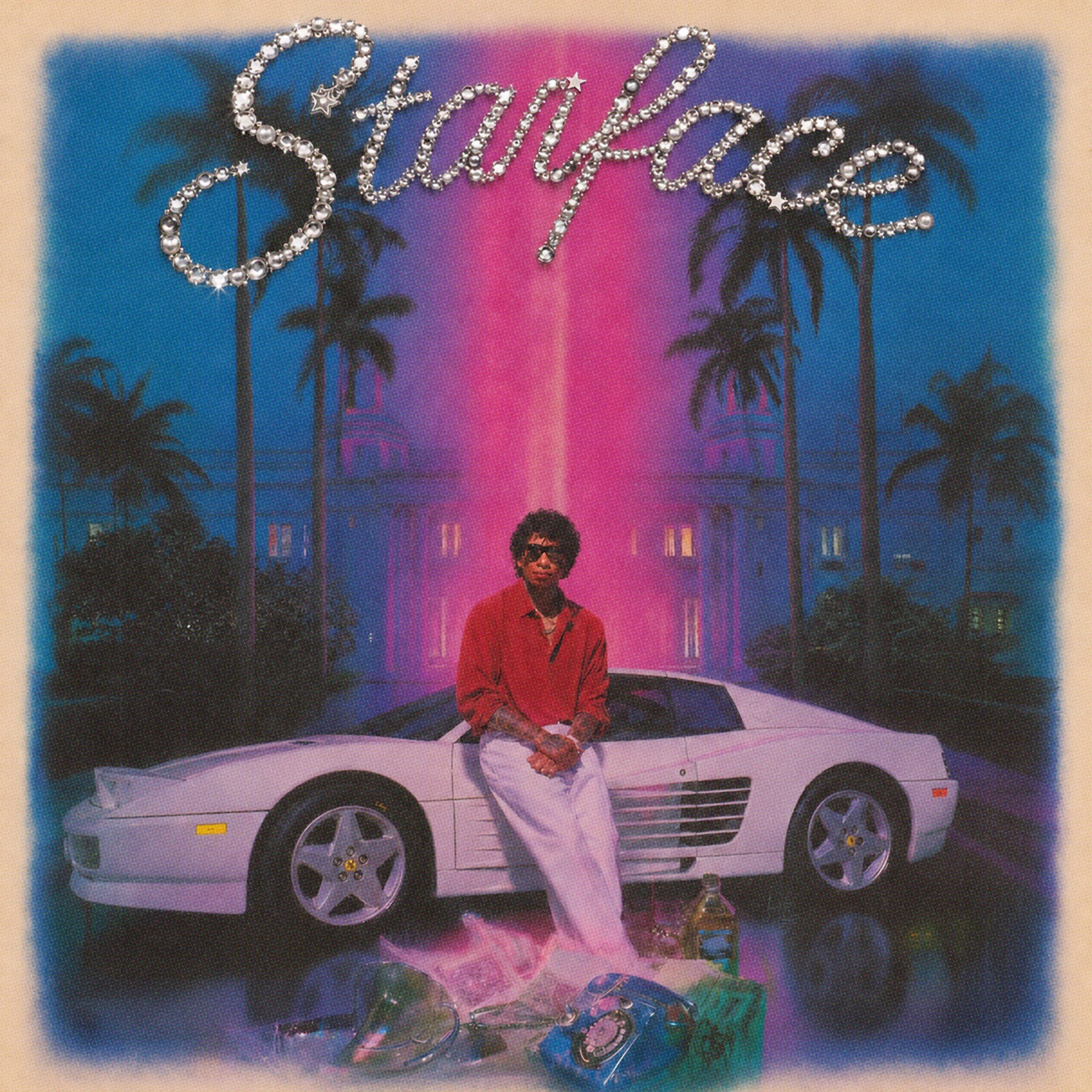
Remember when Tyga used to be one of the prominent rappers in the early 2010s? He spent the bulk of his career inside other people’s songs, popping up on “Deuces” and later “Loyal,” landing high on the charts twice as the featured artist in the second act. For Michael Ray Nguyen-Stevenson, born in Compton, Billboard lists 41 appearances on the Hot 100, including six top 10s; after so long at large, he’s been difficult to pin down in the group. So, almost 20 years into the game, he did something distinctly his own. Stepping away from the label that’s his name, he explained to Billboard that he wanted the persona “to stand on its own.” Requesting Count Bassy and Nic Nac remove all contemporary beats and post-production from the album (relying on generic ‘80s synth-pop), which he says is based on a movie he’s working on called Baby, You’re a Star.
His subject is someone who clocks in at night. Now cosplaying as $TARFACE (inspired by the movie Scarface), who has rarely been concerned with the physical toll of life, kind of seems precise about this particular detail. He steers with his hands at the top of the wheel, adrenaline fully engaged, sharp corners gnawing at his hands. On “White Grains,” his face hangs slack at the place when it’s no longer exciting, looking back at the rearview to see if there’s a blue light, with only the motor for company inside his head. “Every road looks like the end of the race tonight,” he awfully croons, describing what 48 hours of no rest can do to a freeway, and by far the most basic lyric any artist can write. He impersonates someone who hasn’t slept enough. Fastening a double door behind him on “Spinnin in Circles” before doing any kind of analysis. He’s shielding himself from the midday rays, cruising in a loaner with shards of safety glass dividing the lanes and a plastic bag sitting on the dash, until the entire workday starts crumbling around him. He then confesses that all he can see is purple.
Cash comes in, talent walks out, and he observes mirrors reflecting pools, where the hidden things go, invoices getting filed and profits tucked away, and a city and the beach described as his property. A dude reciting his net worth above rippling leaves. He does the same thing on “Powdered Dreams.” But “Just Us Tonight” eschews a club, a crowd, and a slow tempo, leaving only a pair of lines about seeing shadows moving and hearing someone say yes, which he shoos out of his mind, shoving it in a ballad and tossing. With “Affection,” he makes the leap and suffers for it. Subject-matter-wise and writing-wise. But it’s in terms of quarters and cards and revolving doors and someone else to blame, delivering the song with a resigned sort of weariness, the sort of song you’d write about a friend’s misfortune. In “Last Forever,” he grabs a minute or so of late-night action, laying it down over a smooth groove (while slathered in autotune like barbecue on Jerk chicken), before settling for the passage of time stealing his attention.
He’s been with her long enough to notice the jewels at her child’s throat. The hint that helps us know the nature of this relationship before he even mentions the split; the warmth in July feels like frostbite. For “Freezing,” he spots her reflected in the glass and laments her fame, the most petty and honest statement he makes on the record. “Ice on my heart/Only goes so far,” he sings, and the jewelry he displayed three songs earlier becomes a degree of coldness he can’t influence. She drains his bank accounts and bolts, and he lays it on the Great Value Prince record “Gave U Racks” the way everyone really discusses such things, clumsily and without reservation. Acknowledging the purchases and damages, then moving on with words that seem favorable: “Left me for the better life, I hope you enjoy that bitter life.” Petty is the theme. Where is Fenix Flexin when you need him?
Later, she leaves him in the field where he toiled. His finances are ruined, his pockets are clean, and he scans his correspondence daily, seeking mercy, a notion appropriate to “Time Is Currency,” he writes using just a few sentences and then echoes. Tyga tries to do something different that can’t quite freshen the formula. However, he achieves it surprisingly in “Died 4U.” And he does this by recounting hundreds of mistakes, hurting his hands, sorting through each one of her errors. The coolness that he promises more bark than bite throughout the album comes to him in the form of a turning away and paleness. He claims to have made the money cry, and it begins to rain. Money is thrown on the pavement, and paper cuts appear in his chest. The kind of money that cuts is the only type of money he doesn’t waste, and he had to rebuild himself to find it. One song out of ten doesn’t do the lifeless Miami Vice-inspired record justice.
Poor (★½☆☆☆)
Favorite Track(s): “Died 4U”
This is awful, but I listened to the whole thing. I'm okay. I'm going to be okay.