

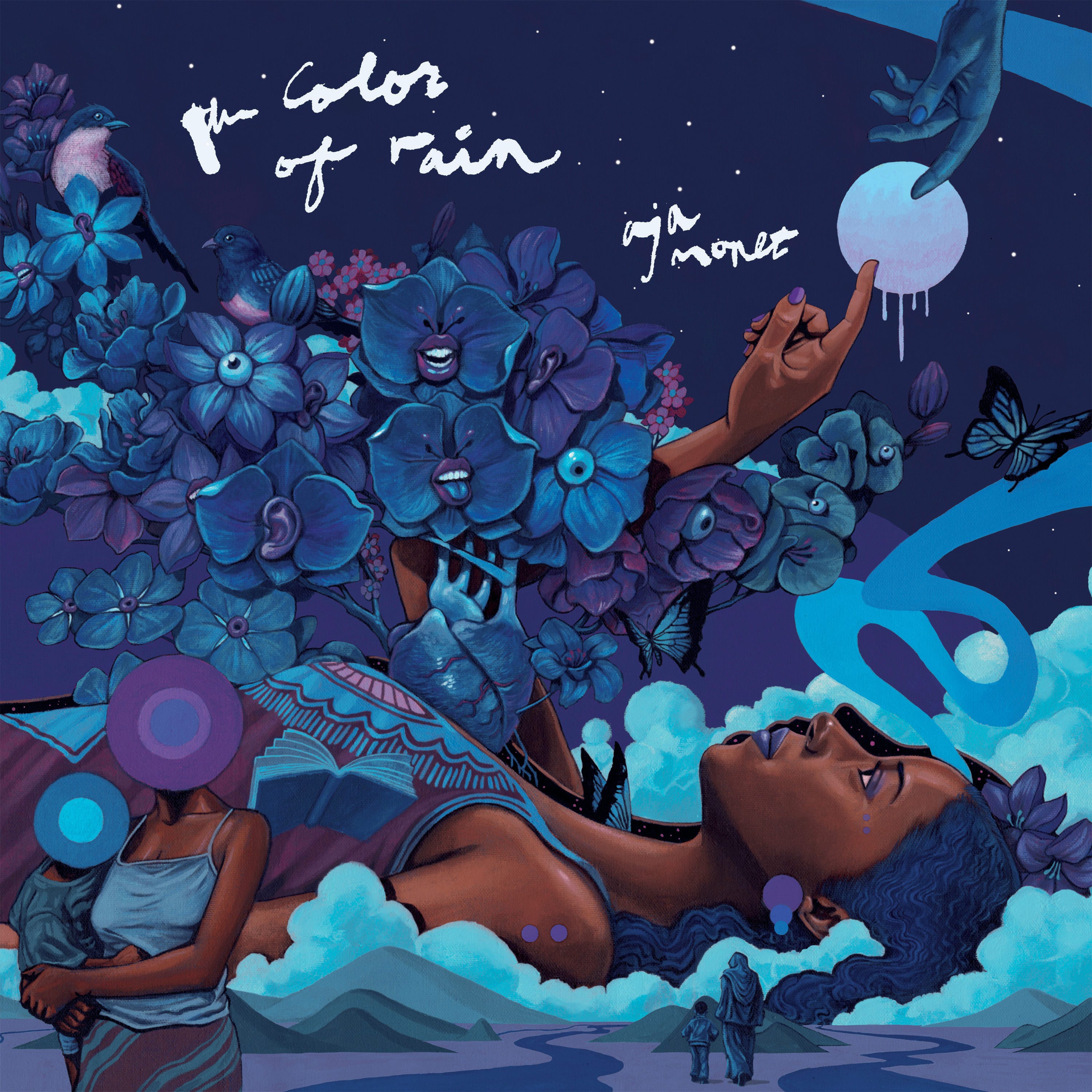
Three miles from where the Eaton fire burned is Altadena, with Octavia Butler’s headstone. And in “hollyweird,” the late novelist newscasts from her gravesite. A marching band has been cut down to four members, but the bass refuses to settle on any image. An arsonist’s wet dream rolling down Runyon Canyon. A neon cotton candy cloud over Koreatown at midnight. A mayor in Ghana for Detty December. aja monet dominates the “doom-scroll” at high speed and won’t moderate her own frustration. “It is not rain,” she admits. A trans woman in a burgundy crop top and yellow geometric sunglasses sips iced tea on the sidewalk while the downtown protest rolls by, and a list has become a city.
“withness” features a bass playing something repetitive that sounds like an elongated inhale with just a four-note shape stretched. Justin Brown pushes the limits of light drumming; the room decolorizes from reality and turns into Monet’s. “elsewhere” changes the band’s focus into a club, with a dedicated syncopation to Sly Stone for the day of his passing, who looks at himself through an electric line mirror. Georgia Anne Muldrow’s voice is on that line. Brandee Younger’s harp washes through glissandi, making her and the Black-skin song a glottal buffer in the interplay “indigo.” This album is already longer and more relaxed than the last, and the previous band focused on more tense sounds.
The percussion on “for the Congo” locks in a relentless hand-drum pattern, and the song sounds hostile in less than two bars. Against the words, “Tell them/Tell them/Tell them to talk about the blood,” monet fires the World Bank and IMF, cites Paul Kagame, Rwanda and foreign extraction companies and military regimes. But she turns in also analogously. “This is the war my favorite poet warned me about/The one between me and me.” The war against herself becomes the war the song names. “The death machines in our palms,” she says. This song is asking you to look at the death machine you are holding in your hand.
The opening poem names so many specific things, from Edison power lines to smart meters to the Rafah border, that the cumulative effect could collapse into grievances in a poet’s voice. Yet “to sister” pulls the record back to a body. monet sings, “un-punish yourself/Un-self yourself/You deserve to be well-kept, held close to the chest,” and a stretch mark holds the frame, a head wrap, a thigh thinking of cocoa beans.
Side A’s tender center is “skinfolk,” a song that turns a body catalogue into a hymn. monet sings the skin into the color of prayer hands, of hard work and sacrifice, of dreadlocked Jesus. “Skin double dutching the darkness,” she chants. Two ropes turn, feet hit concrete, and a line of jump-rope rhythm carries more political weight than half the protest poetry written this year. Mereba’s voice carries the line “I was dancing/I was dancing with the sound of light/Good grief/We escaped a world of black and white.” Younger’s harp cascades through the verses, the bass holds a deep funk groove, and monet closes by saying she has loved this skin “longer than loving.”
Mick Jenkins and Vic Mensa appear on “melting clocks.” The song is the album’s most uneven feature track. Mensa raps, “If I could turn back the hands of time/No CIA for Frantz Fanon/I reverse the bullet to kill them at the marathon,” yet his verse hurtles through historical reversals at top velocity and ends up name-checking too fast for any one to land. Mick Jenkins goes interior; he raps, “The moment you start keeping is the moment you lost me.” monet’s own verse is slower than either. “How wrist watches keep selling us the pipe dream of being able to own time,” she says, and the rappers sound urgent against her patience.
With “every media minute” running through the news cycle at the same panoramic speed as the opener, then drifts into a long passage about wanting a God no American can worship, a God who smuggles souls past patrol officers and returns prayers to sender. Sharp opening, but the section thins. monet’s God-list goes one beat too long, and a climactic line, “There’s a whole lot of religion and not enough God,” reads like a finishing move from a slam set. By contrast, “working class musicians” stays dirty with “trumpet trigger fingers grappling brass valves,” “trolley a kit on the subway in the snow,” and the rent’s too damn high in a chant that gets you laughing before you cry.
aja monet’s 2023 debut leaned on Adjuah’s trumpet. Here Brown’s drums do what the trumpet used to do, marking time and breaking it open under “elsewhere” and the Congo song. Younger’s harp answers monet on the love song, cascading where the horn used to lift, and the bass on “withness” holds the floor where the trumpet once held the ceiling. “The rent’s too damn high,” chants at the close of “working class musicians,” over a funk groove too tight to argue with. Living from gig to gig. Playing to live.
Great (★★★★☆)
Favorite Track(s): “hollyweird,” “for the Congo,” “skinfolk”