

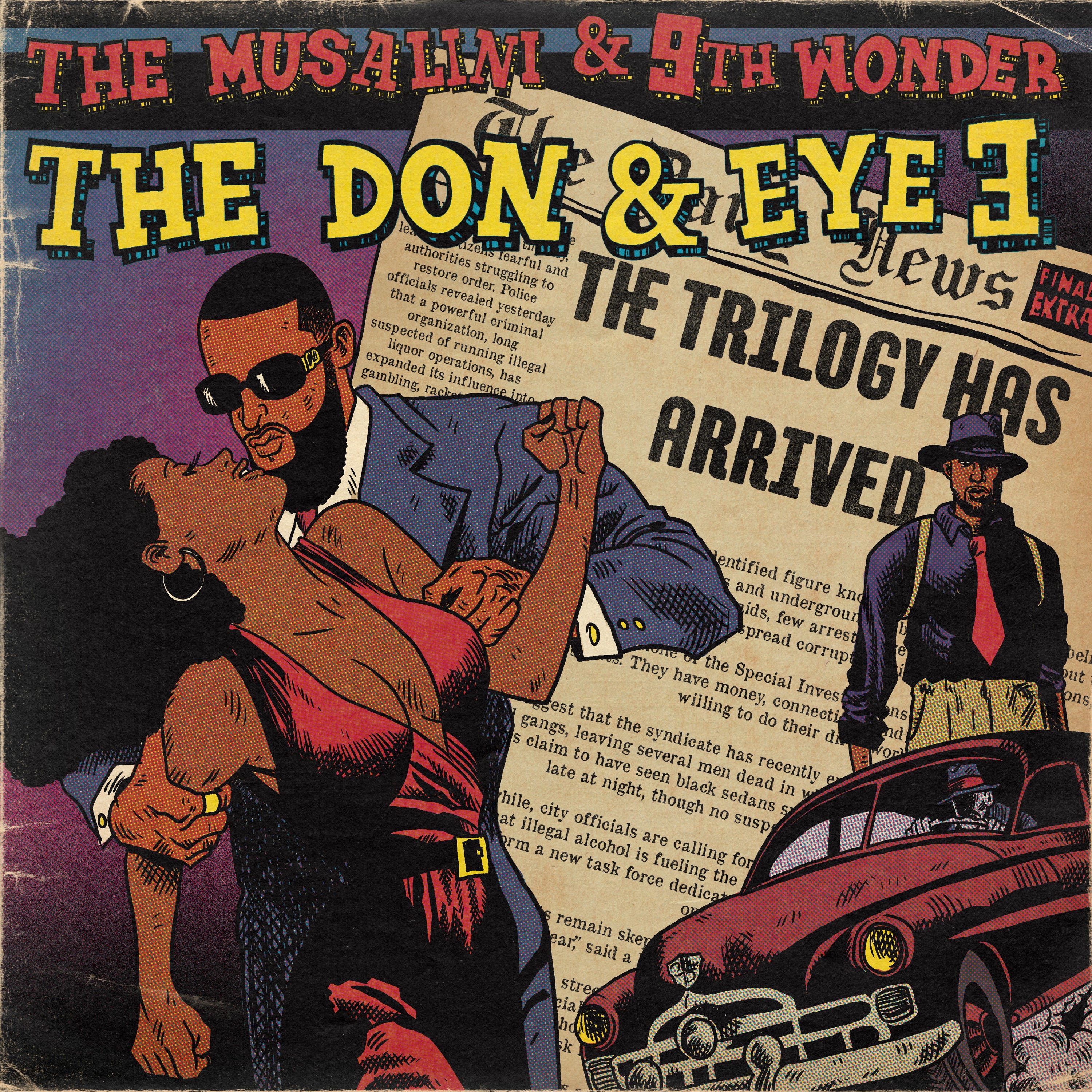
Album Review: The Don & Eye 3: The Trilogy by The Musalini & 9th Wonder
With 9th Wonder on board for the trilogy, The Musalini answers with grilled calamari, teal dresses, and Bronx Zoo alligators, writing that stays funny and particular across fifty-one minutes.
As for The Musalini, the question of what makes for a good night out is one he is equally prepared to contend for, just like other men might argue a dissertation. Three albums deep with 9th Wonder, who‘d produced every second of them, and how constant when part three is announced here, in intros, in hooks, in asides, like a waiter firming up something they never doubted would come to pass. And he can be comically serious about it too, as on “Two Letters,” where he dubs himself a walking billboard and then proceeds to assign a value to his figures of speech, a quarter million for all these fly metaphors, before he cuts the chorus short so he can establish the parameters: “This ain‘t a love song.”
The bragging on “Shrimp Lo Mein” for the last two minutes, harping on grueling markets and long nights and a crew full of wolves who got eaten too, before the whole 16 settle down as though it’s a plate of house fried rice, with all the best in the world in it. Suddenly, the flexing takes the voice of a guy on the cell last night telling a friend who missed it all about the shrimp in disbelief. He does it again at the Bronx Zoo on “Salt Box,” hustling with the alligators over grilled calamari and catfish, back into a role to tell a swindler he‘s fronting like a Gotti but he‘s really just a Sammy, back into a role to say the hood loves him like some fried chicken, again 150 miles out from the capital at the top of the hill at the Capital Grille, moonlight and candlelight and reservations for nine, honey apple wings, beefsteak with his queen, ice on chill, before Eli Tha Don pulls up in the second verse with a short teal dress and Key & Peele back at the crib. No one ever says a number.
Under “Off the Books,” he asserts, “I got a safe full of these rhymes,” and says he‘ll “Treat it like art, it‘s increasing in value,” the only way he admits that the rap is work, and then states a simple credo: money over fame, tells us other men are out here trying to buy planes. Le$ does the same thing on“Lay Low,” claiming victory before he gets it, “In my head it‘s already mine, I just ain‘t got it yet,” and then noting that he speaks only when he has something to say, which, in a record like this, gives him something of a joke at his host‘s expense.
The line underneath the summer forbear on “Pocket Full” floats around a beach house in the Outer Banks, bricks in the vault and the heat of summer in the Porsche without ever catching hold, which is inevitable when the furniture becomes nothing special. A quick break at Shake Shack is the final tangible thing in “Fast Life.” Quiet Snipers pass in cappuccino mornings and toast butter to char perfectly and breakfast on the balcony with skyline views for “Picture Me Rollin’,” something any hotel would have sold for.
Swank makes it to “Can You Stand the Rain” already carrying along by writing raps, mama’s voice in his ear telling him, “The streets ain’t for you, be damned if you die here,” soon joined in the same verse by a line about bullet holes that “redecorate your home like Ikea,” and he carries it that heaviness both times he pulls up: on “Pretty Lady,” where a house with a hole in the roof has rain caught in pans and a cup, with a run of funerals for people he loved, and then on a line that sees him in SoHo four hundred dollars in on a pair of jeans, remembering when twenty was everything. King Draft steals the show on “Car Keys” so effortlessly. He raps that a classmate from kindergarten brings a knife to show and tell; half the people he knows have seen hell or a jail; the government is the terrorist and the block is an oval they‘ve been spinning for a hundred years. Then, in the middle of a song about crab cakes and canyon cribs, he says that he doesn’t have a house either, “I don’t even got a home, I want a Louis my belt.”
Heather Victoria sings he can‘t keep that to himself still thinks about him on “Memories,” the one song where anything of this costs the girl anythng, and when he responds that she has to get over it, that she‘s a memory now, he is doing what the format exists to avoid: “Nothing wrong with you, girl, it‘s more about me.” Musalini is cruising past the Bronx with Big Pun on when it‘s time to arrive. She still gets the last word on the chorus, which is as gracious as he is for the rest of the night.
On “Live from Tokyo,” he admits that the quite independent life is nice—and then at the same time notes, “but soon enough the majors want a piece, tryin’ to profit off a P,” the only topic on here he‘s ever willing to debate, and for a moment he sounds like someone not having a good time. Smoke DZA outsources that chat to himself far better, turning his hundred M pursuit into a meeting with the suits on “Premium Plush” and calling himself the stalking horse at the auction. On “Owe It All,” Musalini is back on the far side of the deal, part three with the big-guy budget, out of the hole and now out here teeing off, new tapes every other month for the streets to bump. Somewhere deep down, you can find the guy who decided long ago that a nice night is a professional grown-up worth thirty-five minutes defending, who’s just taken that argument three times, and is conspicuously going to take the round four.
Solid (★★★½☆)
Favorite Track(s): “Shrimp Lo Mein,” “Salt Box,” “Capital Grille”