

Album Review: The Insanity Project by Dice Raw
On his latest full-length LP, Dice Raw writes about grief, faith across religions, and gun violence piled into the same dense verses.
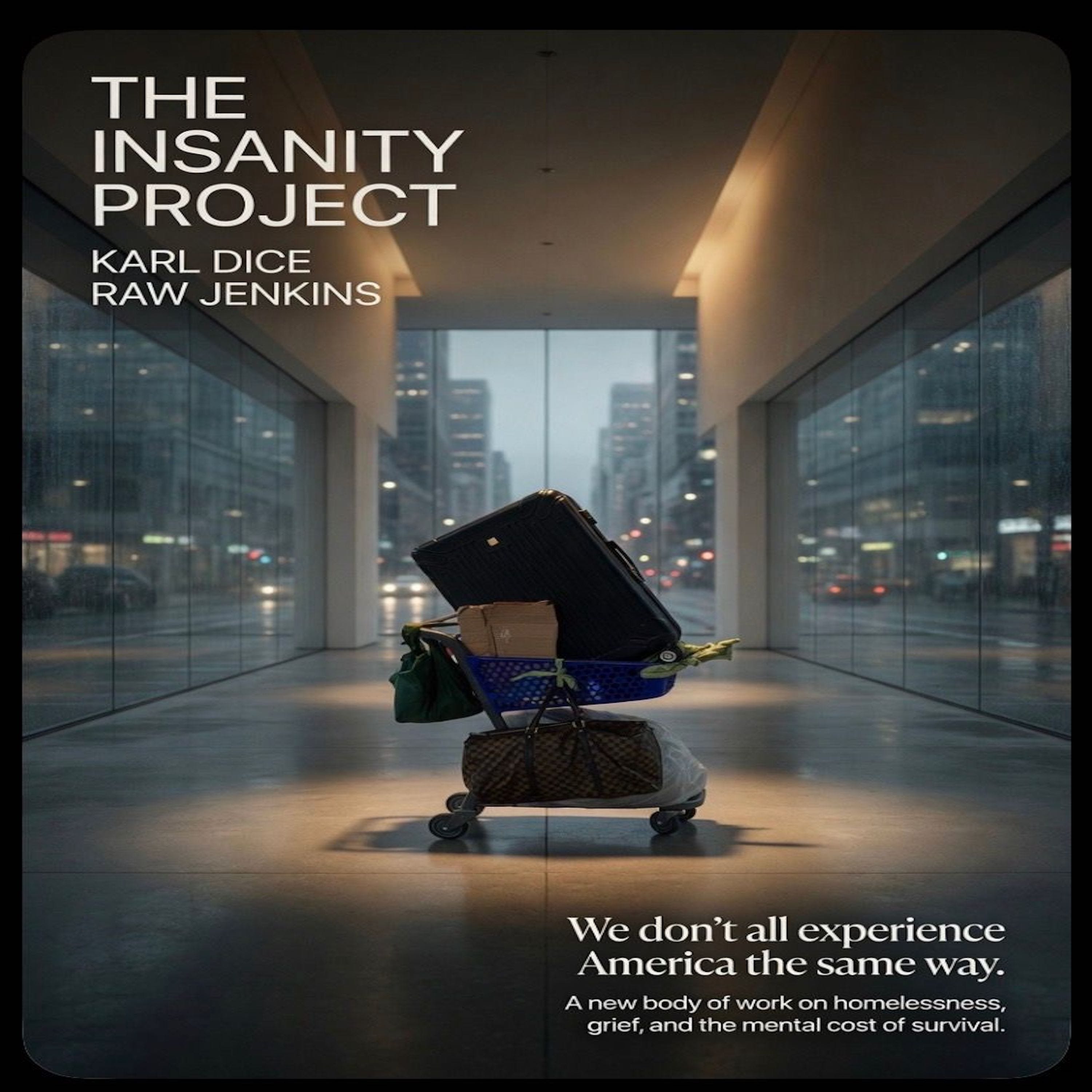
For the last three decades, his writing has worked outward, toward characters, city, and audience—words he knew somebody else would be performing on stage or recording. The artist, and there are many names for him, is Karl Jenkins, a hip-hop theater practitioner and MC from Philadelphia, known as one of the illest and underrated MCs, Dice Raw. Beyond as The Roots’ affiliate, The Insanity Project inverts the instrument. The language goes inward, at his family, at his head, at the neighborhood that raised him, at a violence that’s never entirely a metaphor. The rich material here, like the frightening material, is true, and he’s giving it equal weight.
A mother living in a third-floor walk-up apartment who could, with a frozen pizza and a film, render the anxieties of an entire street irrelevant. She’s the warm centerpiece to “Been a Minute.” The verse expands to include a Nanny, a grandmother, and a Miss Nancy, with the door to her house so welcoming that the entire street became a single living room back when, he says, Black folks got fancy and their monograms arrived. The verse closes on grandparents “who put in work for freedom, not for the bag.” “Honor Thy Parents” takes us even deeper. When he hears from a doctor that his mother has cancer, he replies without fuss or hyperbole: “I cried that day and cried every day since.” The verse says her name: Pamela. He returns, too, to a father who died on New Year’s Eve, a stranger whose family’s tales described him as a philandering, cheating sack of. A prayer follows that God might “smack him right in the back of the head” when he sees him: “I swear on everything you can see/I could still spit at his ghost and make him do my taxes for me.” Both of the verses—hatred, grief—work best when they live in the same rhyme, and in this one, he is least inclined to put on a show.
“My brain switched/And now the switch broke and I can’t switch back,” he states plainly on “Circles,” between a mention of Emmett Till and a claim that American violence is some long-forgotten Con.” He’ll claim he is simply stating the facts, and that’s where the unease lies: the sheer flatness of how he discusses such awful things. The “dismay is just an observation of the weather,” as he’ll say.
When asked whether two million Black men’s disappearance is some dope-boy magic or some kind of horror movie, the “Heather” verse begins with a steady hand hovering over an automatic while cataloging film-taught terror, the language of the ‘super-predator’ and the crack cocaine which he asserts has been speeding the dissolution of black male being. The language of the verse has reached such density that he offers no real pause between images. On “Keep Dancing,” more brutal still, he starts with a rapid montage of video news: a husband shoots his wife at a community pool; live action within the Robb Elementary school; five hundred days of invasion, marked by Zelenskyy’s somber tone; an announcer begging, please, stop dying. But after this barrage comes his hook, a pair of words pitched against this barrage: “Keep dancing.” The second verse finds these dancers dancing next to the dead body of a wife and a pile of bloody children. Amidst the bloodshed, a recitation of Sonia Sanchez’s “Catch the Fire” rolls across the verses of Nzinga, Nat Turner, Mandela and, in the final chant.
In an explicit nod to his government name and multi-faith understanding with his prayer to Adonai, Allah, and Christ, “Mansa Musa” is the most thorough, extended meditation on stacking wealth; a private jet to an endless stretch of satin PJs with room for rats to feed a piranha, to breathe, to feel it all as a show of potency. “Yeat” echoes that gesture toward the White House, praying he wouldn’t hardly say something crazy in front of Biden. Then he escalates that ambition to the cosmological, stating in “Black Gold” that he’d rather be water than a star, a tsunami smashing little cities to bits.
As we reach a rapper in his 40s on “Share With You” who, at an audience no one will remember, hollers he missed it all and if he should be the brawler or just the bowling pin. “Philadelphia,” using many familiar urban references from the ‘80s—stagflation, coke money, bargain basement dollar parties, that Sergio Tacchini fit that was your whole identity—offers a backward glance at the city and a chorus about how as kids we dreamed of being a team against its destructive power; he portrays a young woman as a stolen queen from an economic kingdom, and he compares the gesture of a thousand-dollar handshake to a Nazi salute and can recollect his meeting with both Larry Hoover and Pappy Mason, before watching the tip of a nose covered in snow melt away. And although the exotic boasts will eventually disappear, as will the cumulative death tally for listeners, the story of the mother making the world right with frozen pizza will remain.
Great (★★★★☆)
Favorite Track(s): “Been a Minute,” “Honor Thy Parents,” “Philadelphia”