

Album Review: Goyard & The Kayfabe Reveal by Ghais Guevara
Ghais Guevara’s fictional revolutionary keeps talking, and Robinson’s autobiography keeps bleeding through. The specifics devastate; the panoramas dilute.
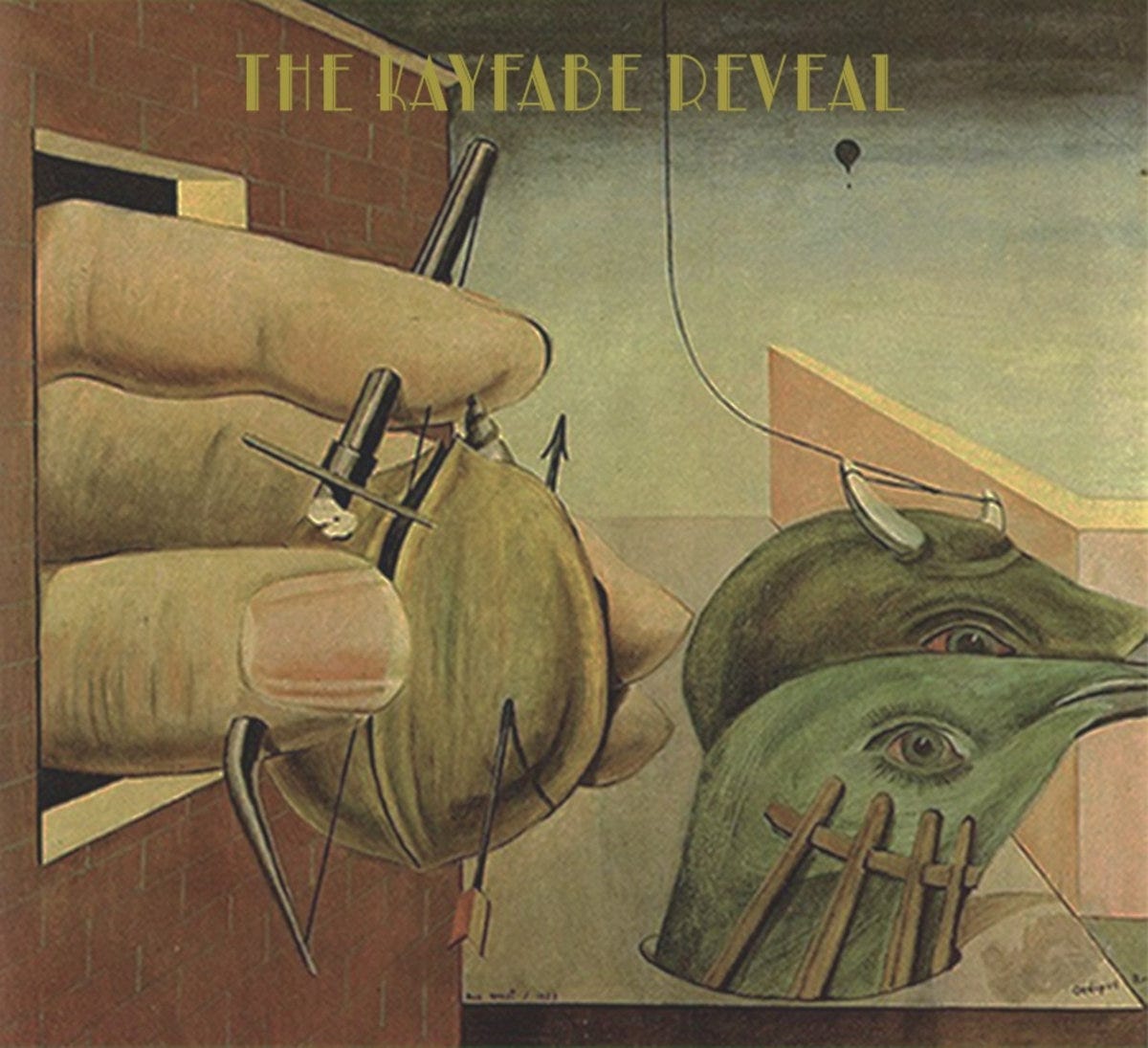
In professional wrestling, kayfabe is the agreement between performer and audience to entertain the scripted as real. When it breaks, when the performer steps out of character in front of the crowd, what remains is just a person standing there without the fiction between them and the room. Ghais Guevara named his second album after that collapse, but the title is doing double work. The Kayfabe Reveal is both a concept (the fiction falling apart) and a plot point within the fiction that his debut, Goyard Ibn Said, established last year on Fat Possum. Goyard, the fictional North Philly rapper whose rise and disintegration powered that first record, is still talking. He hasn’t disappeared. He’s narrating a revolution triggered by the exposure of a tyrant called Jouissance, and the album follows him from the buildup through the war through the wreckage. Robinson, the 25-year-old born Jaja Gha’is Robinson, who grew up in North Philly and now lives in London, feeds his own biography into the character’s backstory until you can’t separate the two. That blurring is the record’s greatest gamble and, most of the time, its biggest payoff.
The prologue picks up where Goyard Ibn Said left off, after the manic breakdown of “Shaitan’s Spiderweb,” and loads the album with sourced philosophy. A reading of Nietzsche on ressentiment. The sheep who cannot strike the falcon and calls that inability a moral choice. “I would never do such a thing,” the sample repeats, the sheep’s self-congratulation curdling with each loop. Bruce Fink on Lacan’s jouissance, desire packed into language independent of the speaker. Then Goyard’s own voice, warning that the memories to follow come from someone who can’t be trusted. If you want truth, go elsewhere. If you want an example of forgiving yourself, stay. It’s a lot of intellectual furniture for an album’s first minutes, and whether the Deleuze and Guattari citations (from Anti-Oedipus, peppered between tracks as interstitial narration) earn their place depends on how much you need the scaffolding to feel the songs. Most of the time, you don’t. The songs do the work on their own.
The fifth high-energy aggressive track, “History of Violence,” is where Robinson’s writing gets closest to its own nerve. He takes a woman to a steakhouse he can’t really afford. She had a plan, knew what to do past high school. He didn’t. He’s bragging about urban wear and earned rights, and then mid-date, without warning, the song turns into a catalog of what he grew up inside. His father stopped the car, let his mother out, took the long way to her crib because Lord knows how it was about to get when he started acting ignorant. A kid got shoved, hit a door, ripped through a window, fame gone. A woman has been in a coma since a TKO in the warzone: “I ain’t even get to high school, we was set tripping six years, ho.” The second half puts him on another outing. He’s off her, she says that’s not normal, he says what’s normal, none of this is normal. He put confidence in Gucci and took a walk. He subscribes to broken figures. The song earns its title because the violence isn’t announced or moralized. It’s listed, mid-dinner, by someone who carries it like weather.
On “ANTI-HERO,” each verse wears an instruction as its label: get angry, get livid, get healed. The screenplay marks this track and the two around it as protagonist development, Goyard’s backstory before the war, and Robinson fills it with detail too granular to belong to anybody fictional. The livid verse drops to something particular. Boiling water carried upstairs without spilling. Learning to mask feelings well enough to attract someone in True Religion jeans. The healed verse hits harder. Mass incarceration is called real, his people went minus forty years, and everything he did for signs of escapism only made his hate bigger:
“Every line we did reminded us that we was hate victims
Trapped inside a room with no expression ‘til it turned inward.”
The post-chorus repeats its simulations where he’s no longer the target. He loves being an artist, but he’s pondering his performance, and the phrasing, “it gets me till tomorrow,” admits the relief is borrowed, a day’s worth at most.
“Performative” bites at something adjacent and more personal. Nothing is open past eleven but the hospital. Existence as a Black man is called nonsense. He daps up abusers. He got emasculated for linking with someone who made him feel okay. He put Andrew Tate on a shirt. The featured verses from FARO and Teller Bank$ switch registers, tagging industry figures as ornaments:
“These niggas performative, industry ornaments
Dumb and subordinate, conscious distortion.”
The accusation gains weight, as it comes from inside the same masculine posturing it’s naming. Nobody on this song is exempt, and Robinson is smart enough not to pretend he is. Nobody on this song is claiming exemption. “Your Getaway (Ad Break),” structured as a sponsored interlude advertising a place called The Temple, splits a travel ban monologue against a private fantasy of escape. “If you from Afghanistan, Somalia, or Libyan, that travel ban mean you gon’ need another place to chill in.” He says he doesn’t make the rules, but enforces them, and that ain’t no endorsement. The enforcer and the dreamer share the same mouth, and Robinson doesn’t blink.
Where the album spreads widest is in its colonial and political material, and the results split. The soulful atmosphere of “Jouissance, The Wealthy” introduces the ruler behind the kayfabe, a military figure with a fetish for crumbling empires. He kisses the cross and gives his final breath. His soldiers get chopped down and he feels blessed. Corpses illuminate the afterparty. The outro, narrated through Goyard and citing Deleuze and Guattari, drags the lens to the present. Fortune 500 transplants attend universities that steamroll locals, feigning understanding of the nature of things here. The colonial mercenary and the gentrifier occupy the same argument because Robinson sees them at different altitudes doing the same thing. “Battle of Ressentiment” pushes further into wartime imagery. Chemical weaponry encroaching, civilian clothes pleading in another language, orders to burn anything Iliad. One verse line sticks: “I’m gon’ live through my body/I am just a spirit that’s in need of a vessel after the aftershocks.”
The aftermath belongs to the somber “Manufacturing Lack,” and it carries the album's most plainspoken political writing. Robinson puts Goyard in front of the wreckage. He stood with the earth at his disposal and didn't know what to make of it. His comrades are faceless or in detention centers, shoelaces confiscated. He's a consequence of testing the regime, and the state promised a right to speak and left people undeveloped and incomplete with the ability to pass that damage into their seeds, rapping, “The fetus grew old as the trees/Wisdom of a fiend, how it all repeats.” The outro, sourcing Deleuze once more, folds psychoanalysis into political collapse and closes on a passage attributed to Cormac McCarthy. Bodies and trees rendered as ornaments by chemical waste. They made the place gray again. But the protagonists remain light. They dance in war and peace, and they never die. “Ancestral Ties,” with Wahid, readies the citizens for that fight. Wahid’s verse reports from the body itself, blood quartered by genes, told to bare ass in the field anytime his legs hurt. The real hides on the wrist.
Those songs carry the album’s heaviest arguments, but they also house its loosest writing. When Robinson reports from a specific body, carrying boiling water upstairs, sitting across from a woman whose life makes sense, the lyrics land because they’re tethered to a physical situation. When he widens to the panoramic, invoking centuries and Nietzsche and empires, the phrasing sometimes settles for the grand claim when the record needs another concrete particular. The problem is frequency. When every third song reaches for the civilizational, the ones that stay close to a single memory or a single person end up doing the album’s real persuading.
Robinson talks to someone specific on the title track, without an audience: “Now that it’s just us and the best of you/Think it’s best you knew half nightmares no longer true.” He says the best of him was drained, and it’s going to project onto that person. By the latter verse, impulse takes over. He got high in the studio, dissed the whole city, said he can get away with anything, walk an opp down with a Glock nine milli. That verse is the actual kayfabe reveal—the voice that shows up when the room clears out, the one the character was built to contain. Goyard & The Kayfabe Reveal ends in a club. People want to celebrate. A woman needed three years to realize his hell was her solace. An East Coast killer writes rap operas because orphans keep him honest. Robinson wants different terrain, more content, but if you ask him, he’s looking for God’s offering. The gang back home will disavow him for what he wants. The planning goes on, as he doesn’t know what to do with his time. He’s lonely.
Great (★★★★☆)
Favorite Track(s): “History of Violence,” “ANTI-HERO,” “The Kayfabe Reveal”
This is really beautifully written. Great stuff!! Thank you for your work - enjoyed every word 🙌