

Album Review: The Mountain by Gorillaz
Gorillaz finally stop curating and start mourning, producing their least polished and most necessary album since Plastic Beach.
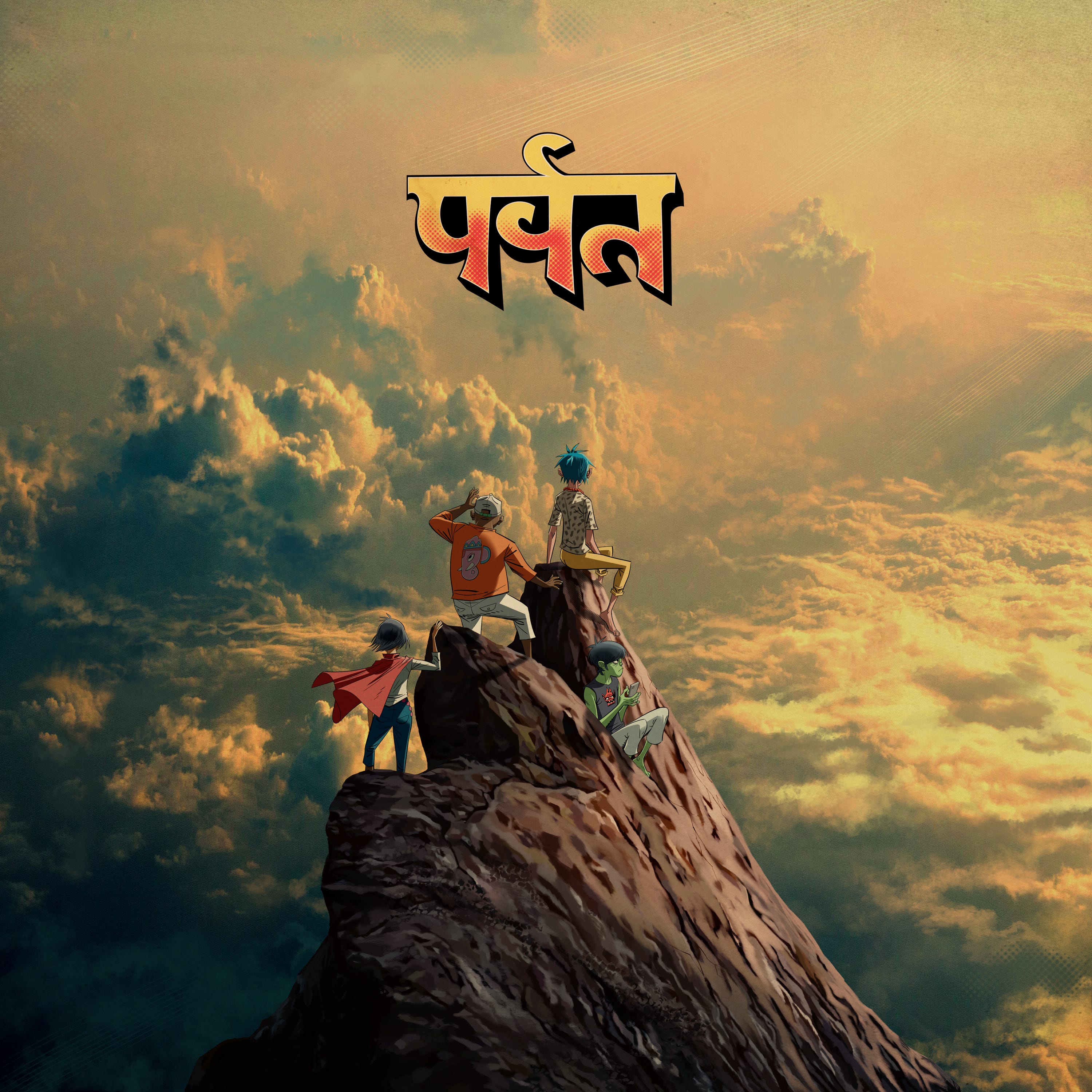
Both Damon Albarn and Jamie Hewlett lost their fathers within days of each other in late 2023. Albarn’s mother-in-law died around the same time. They could have postponed the trip they’d been planning. They went to India anyway. New Delhi, Rajasthan, Varanasi, Mumbai. They scattered ashes in the Ganges. Whatever Gorillaz album was supposed to come next got swallowed by that trip. The Mountain is what grew in its place, and it carries the specific weight of people who went looking for answers in Hindu and Buddhist death rituals because their own culture didn’t have any that worked. It’s also the band’s first release on KONG, their own label, independent of Parlophone and Warner for the first time in twenty-six years.
Three years passed since Cracker Island, the Greg Kurstin-produced synth-pop album that did it well immediately overseas, and evaporated from conversation almost immediately. Before that, Song Machine and Humanz both suffered the same affliction. Too many guests, not enough reason to put them in the same room. The last Gorillaz record that felt like it had something real to say was Plastic Beach in 2010. Sixteen years ago. Six of the people on The Mountain are dead. Dennis Hopper, Bobby Womack, Dave Jolicoeur of De La Soul, Tony Allen, Proof from D12, and Mark E. Smith of The Fall. Their voices appear through unreleased recordings, and none of them are used as tributes. Listen to what they’re actually saying.
Hopper opens the album by murmuring “all good souls come to rest,” “serenity,” and “darkness” over sitar and bansuri flute. He’s setting terms. Tony Allen’s drums still thump underneath “The Hardest Thing” while Albarn repeats the only sentence the song needs: “The hardest thing is to say goodbye to someone you love.” Then he asks, “Do you love? Do you pray? Down inside/Wondering how/How you got to the afterlife?” Allen died in April 2020. The question just hangs in the room with his drums still going. Proof, Eminem’s closest friend, shot dead in a Detroit club in 2006, turns up on “The Manifesto” and he rapped his ass off: “A recovering heroin addict, looking down the barrel of my parent’s attic/Got this shotgun just swerving at it.” Twenty years dead and still the most aggressive voice on a Gorillaz record. Mark E. Smith barges into “Delirium” shouting “Shrunken China Heads/Peg-legged slave trader” in that unmistakable bark. His voice doesn’t nestle into the song. It shouldn’t. Trugoy the Dove, who died in February 2023, contributed to “The Moon Cave.”
“Orange County” is where the album’s personal reckoning gets hardest to dodge. Kara Jackson sings, “Every face you forgot/Father’s jaw, they suspend the clock/Another start/Get another chance to love.” She’s talking about the physical remnants of gone parents. The jaw, the brow, the way your own face becomes a museum of someone who’s gone. Albarn answers:
“I hear you now
I understand, you lost today to get tomorrow back
But what are the tolls?”
Jackson comes back sharper: “Your legacy frightens me, will I keep it gold?/Or will it spoil/Before I get the chance to grow old?” That’s a child, or someone playing the part, asking a parent who isn’t coming back whether their inheritance is a gift or a curse. And then the bridge strips everything away: “I don’t know if I can take this anymore/So why you tryna break me?” Albarn’s father died before the India trip. The grief on this album hits hardest when it takes the shape of a conversation between the living and the dead that can never actually be finished. “The Sweet Prince” tries to finish it. Albarn sings from someone’s bedside: “I was trying to say I love you/But you just looked the other way.” The chorus tells the dying person this statement.
“Sweet prince, don’t be sad
You were never meant to be here
And the sword you hold in your hand
Well, its mighty blow will set you on
Your patterned path into the next life.”
That’s consolation that admits it doesn’t fully believe itself. You were never meant to be here, which is a strange thing to tell someone you love.
The album is skeptical about comfort in general. “The Happy Dictator” puts Sparks’ Russell Mael in the role of a despot who speaks entirely in reassurances:
“No more bad news
So you can sleep well at night
And the palace of your mind will be bright.”
Then the questions tighten like a vise: “Are you not better off than ever?/Are you not better off right now?/When have you felt this way?” eople surrender their freedom because someone promised the nightmares would stop. “The God of Lying” takes that further into the personal. Joe Talbot from IDLES fires off questions: “Are you happy with your housing? Are you climbing up the walls?/Are you deafened by the headlines, or does your head not hear at all?” And then the admission that guts the song: “But there’s a terrific chance there’s nothing, beyond what you believe.” 2D answers by running toward the exit with a grin on his face, screaming that hope is behind him, and then the bridge collapses into the bleakest four lines on the album:
“I went to the liquor store
And they took all my money
I stared into the mirror there
And begged a man to love me.”
“The Plastic Guru” barely needs two minutes to make its point. “We believe what we choose/Is that not the truth?” False prophets, self-deception. Done.
Black Thought appears on three tracks and does the most concentrated intellectual labor on the record. On “The Moon Cave,” his verse runs telescopic:
“Is it hip-hop? Is it Gothic?
Can it fit into the corner pocket?
Is it hovering above the surface?
Is the pain where the megahertz is?
Where the masjid, where the church is?
Are the last days where the earth is?”
He’s asking a real question about whether music and faith and extinction occupy the same frequency. On “The Empty Dream Machine,” he ties Indian musical heritage directly to his own Philadelphia survival: “Listenin’ to Asha sing, Dum Maro Dum/My chalice wasn’t masala, it’s something harder, son/My brainchild went from little one to martyrdom.” Then the lines that nail his thematic contribution to the whole album: “On the mountain top, it’s a wonderland like it was Alice/Part of the pendulum and do me like I’m a Black man/That’s Black-like spirits, Black-like Krishna.” He’s connecting Blackness to divinity without a safety net, placing himself inside Hindu iconography with the same matter-of-factness he’d claim a Philly street corner. On “The Sad God,” the album’s final track, he closes everything out:
“You do well when you think well
And people more likely to try to give you hell when you bring hell
It ain’t got to begin well, but it’s all well if it end well
A man still gotta mean well and intend well, even in hell.”
That’s the album’s last word. Not God’s. Not Albarn’s. Black Thought’s.
The album’s multilingual dimension is not ornamental. Trueno raps in Spanish on “The Manifesto” about climbing the mountain without breath, leaving his legacy before departure. “Al final lo que importa es el intento.” In the end, the attempt is what counts. Then his second verse breaks the door down in Argentine slang. Yasiin Bey on “Damascus” draws a clean line between authentic culture and its commodification: “Turkish coffee, Starbucks, get off me.” He and Omar Souleyman, who sings in Arabic alongside him, keep returning to “New arrivals, fresh survival,” a refrain about displacement and the stubborn act of staying intact while moving. Asha Bhosle, ninety-one years old, sings in Hindi on “The Shadowy Light” next to Gruff Rhys, and the song around them asks:
“If it’s God you trust
What will they promise you
When your voice is lost?
And replaced by the cold machines
The madmen and fever dreams.”
The bridge answers its own question: “I shed, I shed my skin/The end of the beginning/Smile, smile, and smile/Accepting and forgiving/Living is the ending.” Five languages, six countries’ worth of recording locations. Albarn and Hewlett told Rolling Stone UK that listeners were “supposed to listen to it from beginning to end,” and that they were “trying to bring back that idea of taking time to invest in something, instead of this culture of scrolling.” They earned the right to say that. An hour and six minutes is a lot to ask, and a handful of moments test patience. “The Plastic Guru” says its piece in two minutes and then lingers past its welcome in an instrumental outro, and a few stretches where the sitar recurs without new purpose drag. The album’s midsection could lose five minutes and get tighter without sacrificing a single idea.
But that’s a minor complaint against a record that does something Gorillaz haven’t attempted in over a decade. It commits to meaning something specific. Cracker Island wanted to be fun. Song Machine wanted to be a playlist. Humanz wanted to be a party at the end of the world. The Mountain wants to talk about death, and it does, with the departed in the room, across continents, in five languages, with Albarn’s own father’s ashes in the river that runs through the recording sessions. The ambition is moral before it is anything else. And the album earns most of it. Not all. The sheer density of collaborators still creates a few moments where the guest overpowers the song’s own gravity, and this is the first time since Plastic Beach that a Gorillaz album feels like it was made because it needed to be.