

Album Review: The Romantic by Bruno Mars
A Chicano soul valentine from a pop star who’s never sounded less interested in proving he’s a pop star. Mars and D’Mile bet everything on sweetness and spent the whole time slow-dancing.
Ten years between solo albums used to mean something had gone wrong. For the artist behind 24K Magic, that gap filled itself with a Silk Sonic project alongside Anderson .Paak, two of the biggest global singles of 2024 and 2025 (“Die with a Smile” with Lady Gaga, “APT.” with ROSÉ), a record-shattering 150 million monthly Spotify listeners, and a 40th birthday. Bruno Mars didn’t disappear, but he hovered, picking off massive collaborative wins while the solo album kept not arriving. In that stretch, the most consequential thing that happened to his music wasn’t any hit single.
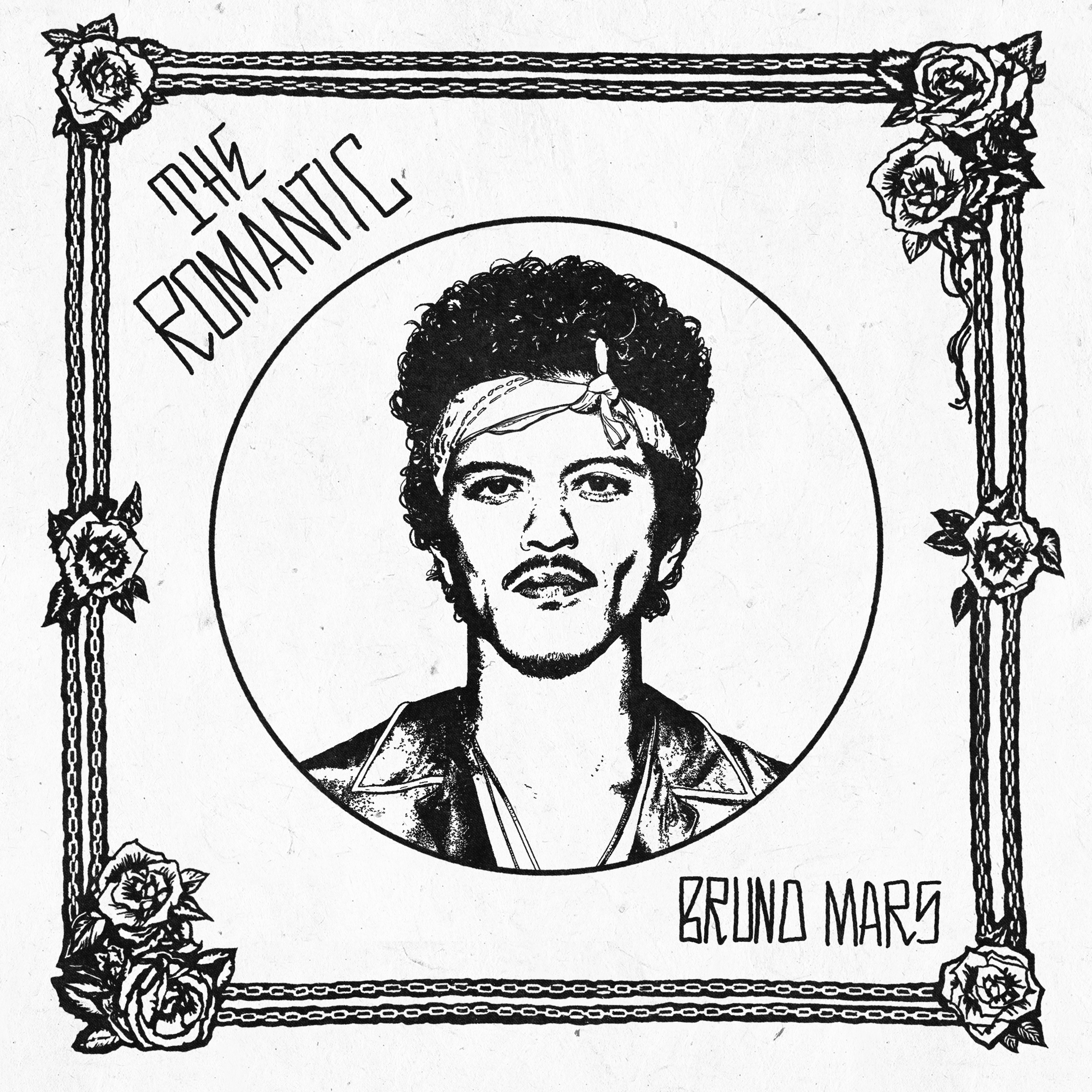
It was D’Mile. Dernst Emile II, the Brooklyn-born producer who’d nearly quit the industry before making Lucky Daye’s Painted in 2016 and 2017, connected with Mars through their mutual collaborator James Fauntleroy around 2019. By the time they cut “Leave the Door Open” for Silk Sonic, D’Mile had already reshaped what a Mars record could sound like, pulling away from neon toward amber, the brass and strings drawing from a pre-disco sweetness that Motown perfected and Chicano soul communities kept alive for decades. The cover of The Romantic makes that debt visible. A monochrome portrait framed by roses and chains, lowrider-culture lettering, the word “romantic” embedded in an aesthetic that Thee Sacred Souls and Thee Sinseers have been reviving on the Daptone-adjacent circuit. Mars isn’t Mexican, but his Puerto Rican roots and his years in LA put him close enough to this tradition that borrowing its visual grammar doesn’t scan as tourism.
D’Mile’s fingerprints are everywhere and they’re warm. He and Mars produced all nine tracks, with Philip Lawrence and Brody Brown writing alongside them, and the sound coheres around a particular temperature. Horns that glow rather than punch, guitars that curl instead of chop, drums that breathe beneath Mars’s voice rather than competing with it. Gabriel Roth, the Daptone Records founder who engineered brass for Sharon Jones and Charles Bradley, handled the horn sessions here, and you can hear that lineage in the way the arrangements sit back, patient, never overcrowded. After 24K Magic leaned on New Jack Swing and Silk Sonic aimed for ‘70s Philly soul, The Romantic reaches further back, to the doo-wop ballads and sweet soul sides that Chicano communities in East LA and the Southwest have played at quinceañeras and car shows for half a century. D’Mile, who once apprenticed under Rodney “Darkchild” Jerkins chasing mainstream pop placements, abandoned that instinct years ago. His best work since Painted has been about giving a singer room to mean it without burying them in tricks. He does the same for Mars, and Mars sounds grateful.
The album opens with three songs about wanting someone and not quite having them, and each one pitches the desire at a different altitude. “Risk It All” is Mars at his most sweeping and his most generic. As a Latin-tinged introduction that sets the tone for the record, he’ll swim across the sea, sacrifice his life, climb any mountain. Every line is a grand gesture with no address attached, no actual woman in the room, just the promise that he’d do anything for her. “Cha Cha Cha” drops thirty thousand feet from that altitude into a club where Mars is singing his behind off of his lemon pepper steppers on, and there’s a party at the Pinky Ring (a lounge in Las Vegas), and the hooligans are outside. It’s ridiculous, and it knows it, and when the song floats up toward “Let’s go to the moon a little later/Hope your wings get to fly,” it’s the only moment where Mars lets the track peek past the dancefloor.
Then “I Just Might,” the lead single, the Hot 100 number-one debut, the Leo Sayer comparison that stuck. It’s disco-pop, funk-bright, and it runs on a conditional. If she dances as good as she looks, he just might make her his baby. “But what good is beauty if your booty can’t find the beat?” is the kind of line Mars has built a career on, funny, blunt, a little shallow, entirely charming. Later he turns the club into a tryout:
“Put some spirit in it, put your heart into it
That’s all I need
And if I like what I see, you’re comin’ home with me.”
Seduction as casting call. Mars has always been comfortable being the guy who says the fun thing instead of the true thing, and these three songs are him at full wattage in that mode.
As “God Was Showing Off” comes on, it takes the album from pursuit into something stranger. Mars tells a woman she’s so beautiful that God flexed while making her, calls her an “earth angel,” instructs her not to hide her wings. It’s flattery pitched at biblical scale, and the second half presses further.
“Whoever said God don’t have favorites
Never seen you before
Now everybody got something special
But it’s obvious you’ve been blessed
With just a little more.”
Then, in the outro, Mars betting she can walk on water and turn that water into wine. He’s giving this woman miracles and assigning her divinity, and the production plays it completely straight, but it can harken back to Silk Sonic’s “Smokin’ Out the Window.” It’s a gorgeous and slightly unnerving song, because Mars is so committed to the bit that you can’t tell whether the worship is about the woman or about his own capacity for worship. Either way, it’s the most inventive lyric on the album, and D’Mile wraps the whole thing in the warmth of an old soul 45 played at a candlelight vigil.
Where Mars starts losing his composure, the songs hit next level. The baby-making “Why You Wanna Fight?” is the first track where he isn’t performing certainty. He admits he was wrong, says he’ll call her momma and plead with all her friends, pleads:
“You might hate me now, but I never stopped loving you
That’s what we not gon’ do.”
From there, “On My Soul” pulls him back into pledges. The spirit of Curtis Mayfield runs through two minutes and fifty-four seconds here. He wants to give her his name, he’s traveled all around the world and she’s right here, “Turns out you don’t need a rocket ship, no/To find your own shooting star.” And the simplest sentence Mars sings on the entire album, “I’m tryna live the dream/But I need you on my team,” might also be the most revealing, admitting that the dream doesn’t work alone. “Something Serious” follows with even less drama. Don’t you want real love? Don’t you want pretty babies? These songs trace the path from desperation through commitment to domesticity, and even at his most unguarded, though, his lyrics stay in the territory of postcard sentiments, lovely, brief, unsigned. Does he ever says what the fight was about? Nope. Does he ever tells you what he did wrong? Nope. Instead, he promises to love her like she’s never been loved before, but he never names what that love would actually look like on a Tuesday morning. The songwriting stays beautiful and stays safe, which is the record’s signature and its detriment.
“Nothing Left” cracks the whole thing open. Mars used to light up when he called to say “I love you,” but those words don’t hit the same now. He’s alone in a home they built, the fire doesn’t burn like it used to, and he can’t find the magic in her eyes. After eight songs of Mars telling women how incredible they are and how much he’d give for them, this is the first time he asks for something back and doesn’t know if he’ll get it. The closer, “Dance with Me,” picks up from that uncertainty. Mars asks someone to dance with him one more time, hoping that when the music ends they’ll fall in love all over again.
“Put your pride aside, right here next to mine.”
If the first seven songs are a man performing love at various speeds and volumes, these last two are a man standing in the kitchen realizing the performance didn’t work.
As his fourth outing, The Romantic is a short, sleek album made by people who know exactly how to build records like this, and that know-how pays off more often than it doesn’t. Mars and D’Mile execute flawlessly across nine songs, their refined blend of warm analog brass, close-mic’d vocals, and clean rhythm sections never stumbling. Mars’s voice remains one of the most reliable instruments in pop music, but sonically it’s Chicano soul at its finest. He can sell a hallelujah or a “lemon pepper steppers” line with equal conviction, and D’Mile wraps him in arrangements that feel expensive without sounding cluttered. The earlier songs don’t have the lyrical specificity of the closing stretch, but they don’t need to carry the same weight, and the production gives every one of them a reason to exist beyond the words.
Mars turned 40 making this album. He’s still the most gifted pop chameleon of his generation, and The Romantic proves he can inhabit the oldies-soul tradition with as much ease as he did funk, reggae, or New Jack Swing. This is the most cohesive thing he’s made, and the Chicano soul commitment, from Gabriel Roth’s horn engineering to the cover art’s lowrider chassis, gives it a gravity his earlier records chased through flash. The album ends with Mars asking someone to stay in the room, “Dance with me, darling, just one more time,” the backing vocals folding over each other while he insists he doesn’t want to dance with nobody else, and you believe him, and you also know he’s been saying versions of this his whole career, and the song keeps going, and she hasn’t answered yet.
Editor’s Note: The lyric on “Cha Cha Cha” is not ‘party at the bakery,’ but ‘party at The Pinky Ring,’ which is Bruno Mars’ lounge in Las Vegas.
Great (★★★★☆)
Favorite Track(s): “Why You Wanna Fight?,” “Nothing Left,” “Dance with Me”
This review has got me excited to check it out. Well done!