

Album Review: The Way the Light Looks by Eligh & FAZE.ONE
Forty-six and content with no repeats, Eligh writes fatherhood and recovery plainer than the nanobot and matrix conceits he hangs beside them.
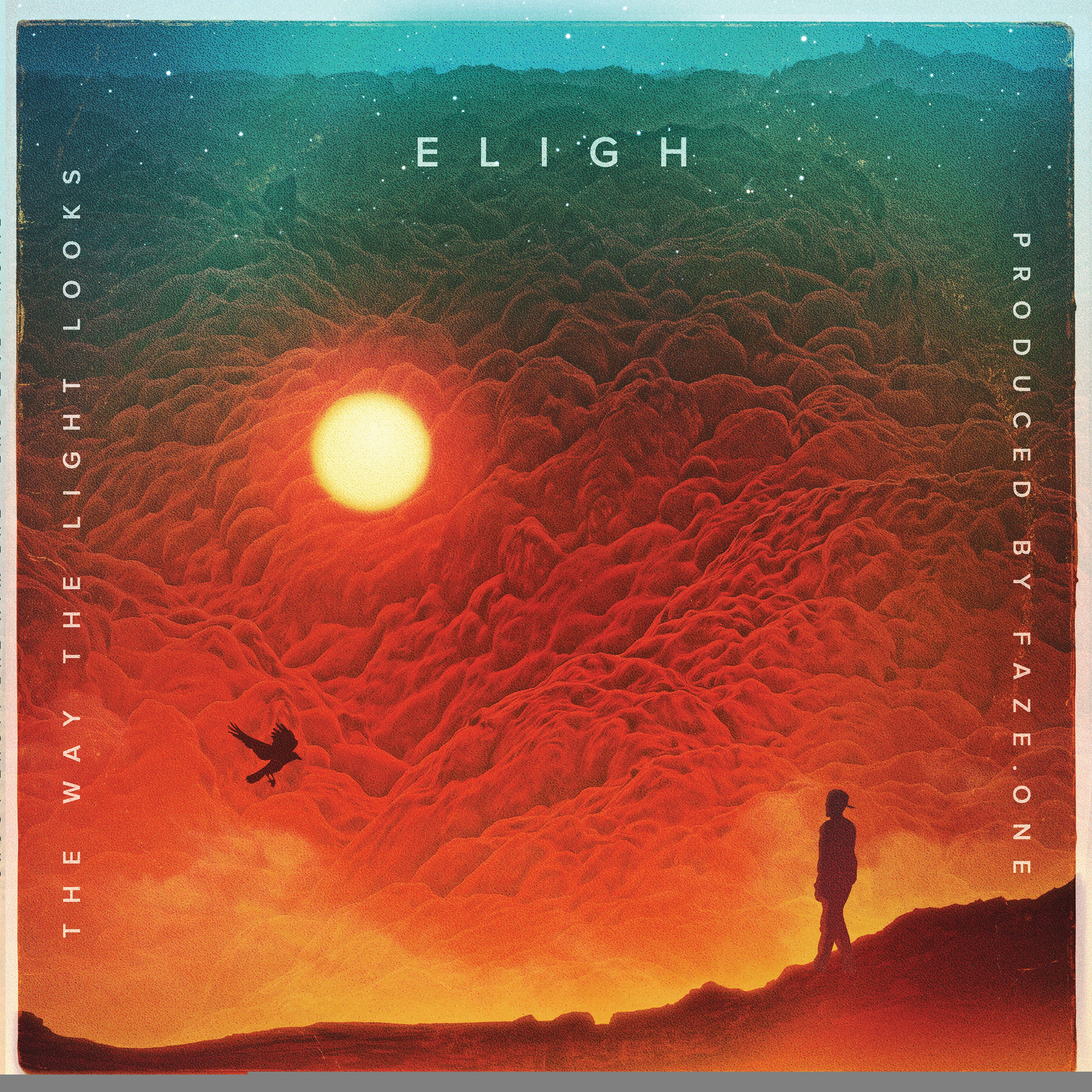
A rapper of over forty who has been in recovery for more than a decade can’t really be up to much to put in his work. He can cheer for himself. He can teach about it. Eligh, founder of Living Legends and the better half of G&E with The Grouch, does largely neither across this joint venture with FAZE.ONE. He raps from within the smallest corners of it, the tour bus and the teething child and the game of chess played against himself, and he stays strongest down there, before any outside entity arrives to explain the method of getting out.
The heaviest writing is toward two-thirds of the way through. “Anger” comes to its slowest, most cumbersome tempo of all the Eligh verses on here, and uses its space to map out his temper to his youth: “It all began early back in my home/Childhood repression mixed with obsession.” It continues, but goes where very few rap songs about fatherhood dare go. He records himself losing it at his infant child: “Hit the bottom when I can’t control my anger/At my son when he is teething in the night and needs the comfort of a father.” The self-portrait doesn’t get any prettier from there (“A piece of shit inside the terradome”), until he names the thing he despises (“A man who’s getting angry at a baby ‘cause he’s in pain”). There isn’t a concept placed over it, just these rhino and killer whale shapes he can’t seem to pull himself away from. “They Don’t See” is of the same sort, but cold, and makes you compare touring life and the child back home, finishing with what he says flat: “Music lover losing love for tour.”
FAZE.ONE creates an unchanging, bass-heavy groove with changing speeds playing the most important role, more so than the textures involved. Most of the rapping tracks (the few with the same pace—“No Ploy,” “New Man,” “Inside Out”) are head-nod slow enough that Eligh still manages to cram a ton of syllables without his delivery sounding strained. But speed on the record plays the opposing role: “Glory Dayz” picks up the pace and the speed keeps the looking-back track from slipping into simply looking back, while “They Don’t See” uses its faster speed to amp up its touring rant at the same rate as its own agitation. The voice rests up front in the mix in the flat tracks so that even when Eligh clips a word short, the enunciation is legible through the drums.
Concepts are handed the steering wheel by two tracks, both of which fall slack to them. “New Man” puts “The pitch, asking for the opportunity to pump your veins with nanobots, or, how to de-trigger your triggers and make you the best man,” at the song’s core. It’s hilarious, yet it repeats its argument beyond where the emotion under it has anything left. “Motherboard” takes the same dive, from a spiritual angle: “The matrix is technology sustained through time,” followed by the rush for the exit, “Small cracks of light brought together that allows me/the time required to stoke the fire.” The thought has a head start on what Eligh does with it. The only idea that sticks is the simplest; the afternoon sun quality on the title track, which drops Eligh into 1988, and the plea to take our eyes off the screen: “Why so serious?/Go fly a kite.” Compare this proposal to the nanobot one, or to the verse about a teething baby, and see how one theorizes about a means to an end, while the other just landed on one.
Slug makes “On Fire” doubt more than anywhere else on the album; “Tell me why sometimes the loneliness overwhelms me/Got me wondering if I could learn to love what I’m becoming,” which makes the narrator’s simple hook “got to get home” seem a bit easy by comparison. Ceschi ramps up the political heat on “That’s My Shining” while Eligh keeps it cool, with lines like “human beings are the cancer/I break the knees of a fraud, make him pray to God,” and Myka 9 wraps it all up in elastic, freestyle phrasing he’s been refining for decades. The pit stop here is “Everest,” which puts Buddy Rockwell at the helm for three of the four verses. These are straight-up motivational speeches, “don’t stress the numbers, don’t trip on the views,” and the one verse by Eligh that has nervous systems and daughterly kisses in it gets lost under the coaching.
The plainest of Eligh’s love songs are his strongest. On “Nothing Like You,” the husband and wife get the warmest verse on the album: “married you out on a beach with our loved ones/we got a son and a daughter.” The feeling gets a bit clinical at “my eternal metabolic anatomical connection.” “Glory Dayz” improves on this backward glance by giving the old days, warehouse, and shrooms, very little, if any, romanticization: “on the roof of the full moon taking a piss in a bucket on shrooms,” all filed under the “who I don’t want to be” umbrella, and ending with “No way/No thanks/I’m good right here.” Owl Green also heads in the same direction in his verse on the same track, with a Vince Carter on the Raptors stretch handed off and shrugged away from.
By the time he’s penning letters to his children in “Dear Son,” his support is more unglamorous and all the better for it. Eligh wants his son to understand that repression is not “the key to cope.” Of all people, Scarub lists what kids really can understand when explaining this concept: “do your dishes, make your bed, take out the trash.” Eligh’s thirty years are still evident here, as the 46-year-old father tells his 6-week-old son he can’t stop kissing his face, and we believe it.
Solid (★★★½☆)
Favorite Track(s): “Chess in the Park,” “They Don’t See,” “Anger”