

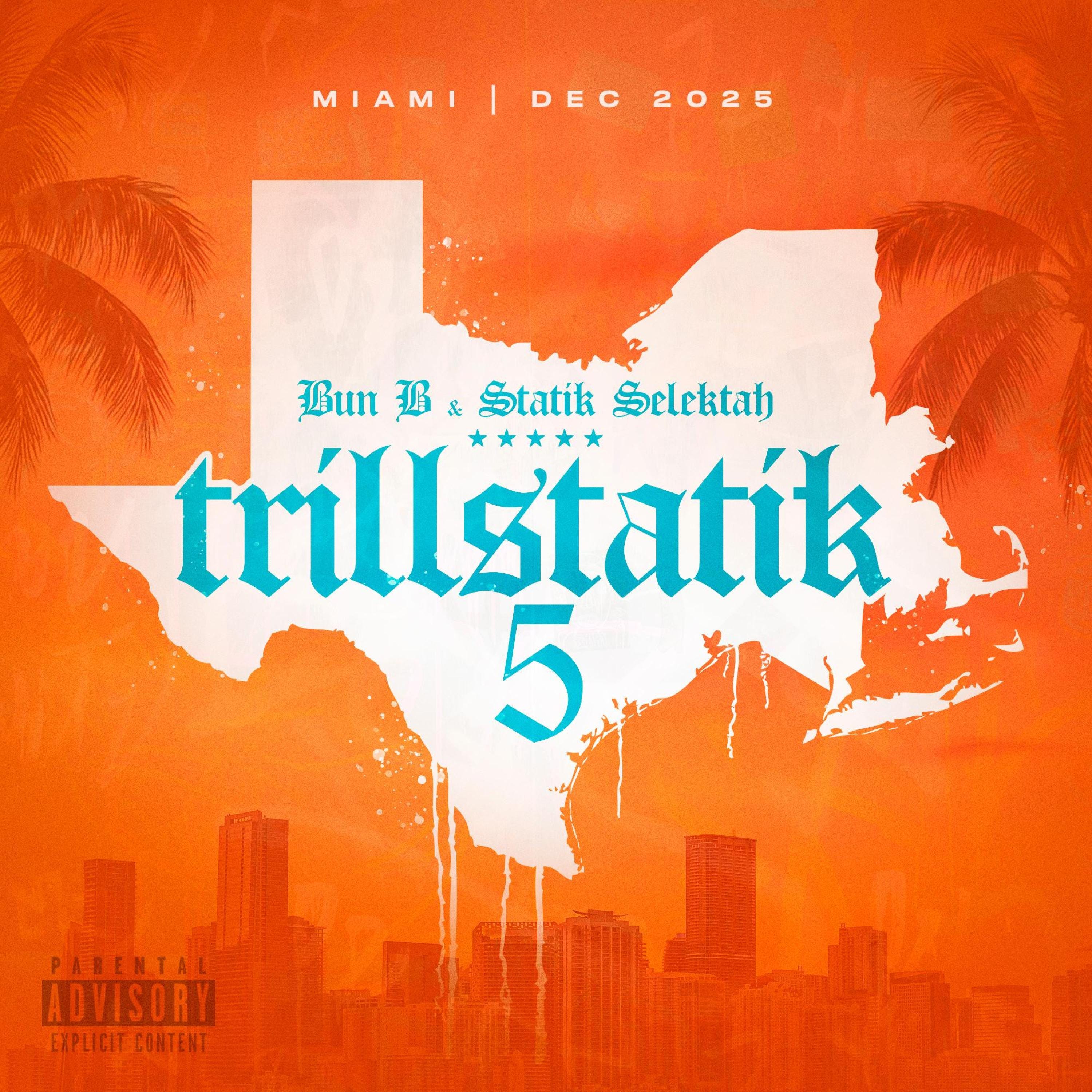
The opening interlude at the end of “You’re Mine” stacks geography like a calling card, and the album never stops announcing where it is.
“That’s right, motherfuckers, we are back
Trillstatik 5, live from Miami Beach, Florida
You already know we back at it again, baby, like we never left this shit
The trill OG, Bun B, and Mister Showoff himself, Statik Selektah
From H-town to Boston, all the way to motherfucking Miami Beach
And now, with no more further ado, we present to you motherfuckers, Trillstatik 5.”
Bun B raps about the “Land of the coconuts and the palm trees,” where the “Cocaine cowboys and bitches on knees,” and the setting saunters throughout—not as tourism, but as temperature. The drums run warm. The grooves leave space for veteran voices to stretch out. Statik’s loops land somewhere between early-afternoon casual and late-night alert, and Bun sounds like a man comfortable in the room, ready to talk, not chasing perfection.
That comfort comes from the format. This was recorded December 6 at the Kimpton Anglers Hotel—one session, guests walking in as the stream rolled, no time to workshop a hook or rethink a lazy couplet. The constraint shapes everything: thirty-one minutes, eleven tracks, almost no fat. Performances carry first-take energy, where their voices still warm, ad-libs unpolished, verses that don't double back to clean themselves up. Some of that means directness. Some of it means rappers falling back on familiar muscle memory when the booth doesn't give them room to hesitate.
Bun B is fifty-two years old, and he raps like the door could get kicked in at any second. The intro to “Junkyard Dogs” tells you everything: “We was just talking a minute ago about, um, about how we a lot more mature now... But that’s now. And we, we trying to hold this shit together, to be honest. Steady about to crash out already.” That tension between the elder who’s survived and the street voice that never fully clocked out runs through every verse he touches. On “You’re Mine,” he’s “cool as the night air, smoked out, riding on speed boats,” but the warning arrives within the same breath: “Don't fuck with these folks, they ain't kind/You get out of line and—.” The threat cuts off into the sample singing “you’re mine.” Busta Rhymes picks it up, all volume and vein-bulging authority, “Eighth wonder of the world, nigga, don’t push.” Bun doesn’t need to finish the sentence. The posture does the work.
That “don’t try me” energy could get monotonous if it stayed in one register, but Bun keeps shifting the context. On “Crooklyn 25,” he’s chilling in Brooklyn “with a blunt and a beef patty,” playing the out-of-towner who refuses to adjust his demeanor: “Posted up with NEMS at the FYL store/You try me and I’ll leave you with your left eye swelled, bro.” The intimidation reads almost playful, borough-hopping confidence from a man who's spent decades walking into other people's cities and holding court. But on “Bringing Polo Back,” the bravado cracks open into something more reflective: “I saw some things I probably shouldn’ta seen growin’ up/The thugs with the drugs and the fingers they was throwin’ up/Livin’ the fast life with fast women and fast cars/Doin’ shit that coulda had my fast ass behind bars.” The scars show up, and with them, the pivot: “The time we used to spend chasin’ after bein' grown/Now all we tryin’ to do is chase paper and be at home.” That’s a man who’s earned both modes and knows the distance between them.
With every song containing a feature, Talib Kweli appears twice, bringing the competitive New York tradition Bun B has always respected (“Tom Cruise ‘cause my stuntin' is still classic/Top Gun lyrics, my spirit is still maverick”), and his density forces Bun to tighten up, match the wordplay, stay alert. NEMS hits “Crooklyn 25” with Coney Island bark and a willingness to swing on anyone: “All your shit is trash/What the fuck is you rapping for?/Pack it up, take your whole career and I punt it to Canada.” Bone Crusher, yes, the “I ain’t never scared” rapper, drags “Junkyard Dogs” toward his signature sloganeering (“Dictation from the boss, titanium in the voice/Reporting from the knock from the land of the lost”). Termanology and Tony Sunshine bring mixtape-era New York posture to “Let Me Know,” Term bragging about “OG plug still moving white things” with the kind of cocaine nostalgia that feels more ritual.
The Miami setting shows up most explicitly on “To the Ceiling,” where Premo Rice, Billie Esco, and Robb Bank$ turn the session into something approaching South Florida flex music. The beat breathes. The hook (“Money on the floor, we got art to the ceilin’/Livin’, one hell of a feelin’”) is an invocation for rappers who’ve made it far enough to enjoy the spoils without apologizing. Bun slides in at the end, comfortable on the blade, “ridin’ blades, and I’m paid like a banker,” letting the setting dictate the mood.
But the tape’s most interesting thread might be the prayer that keeps surfacing in the middle of all the hard talk. “Evening Prayer” gives you the most explicit version: Recoechi arrives from Chicago with a word saying, “Praying to God right now to please make these serpents surface/So we can cut their heads off, put them right back where the dirt is,” and Billie Esco follows with “I could win a war with no guns/But I still got things with beams about as bright as the sun.” Faith and firepower occupy the same verse without anyone trying to reconcile them. Bun’s contribution turns domestic: “You go to the store and your mama pray her baby gonna be right back/Yeah, it’s hard and it’s ugly and it just ain’t fair/When the people that you love ain’t there/But we gonna send up a prayer.” That’s survival language dressed in Sunday clothes.
The thread continues in JFK’s outro verse, which breaks from the session’s dominant tone entirely. “He’s scared he’s gonna die, he hits three meetings a day” is about addiction recovery and daily terror, smuggled into the closing moments of an album that otherwise traffics in flex and intimidation. It’s the kind of confession that only makes sense in a one-session format, where someone walks in with whatever they’re carrying and puts it down before they have time to reconsider. The tape lets the moment exist.
Statik’s production holds all of this together without calling attention to itself. The drums swing with enough pocket to let Bun B ride without rushing, and the loops favor warmth over aggression. Nothing here tries to compete with the voices for attention. The beats on “Crooklyn 25” and “Still at It” feel like classic boom-bap drums that hit, perfectly chopped samples, space for rappers who know what they’re doing to do it. On “Evening Prayer,” the groove turns contemplative, matching the spiritual language without overselling it. This is producer-as-host music, as Statik sets the table and lets the guests eat.
Great (★★★★☆)
Favorite Track(s): “Crooklyn 25,” “Evening Prayer,” “Bringing Polo Back”