

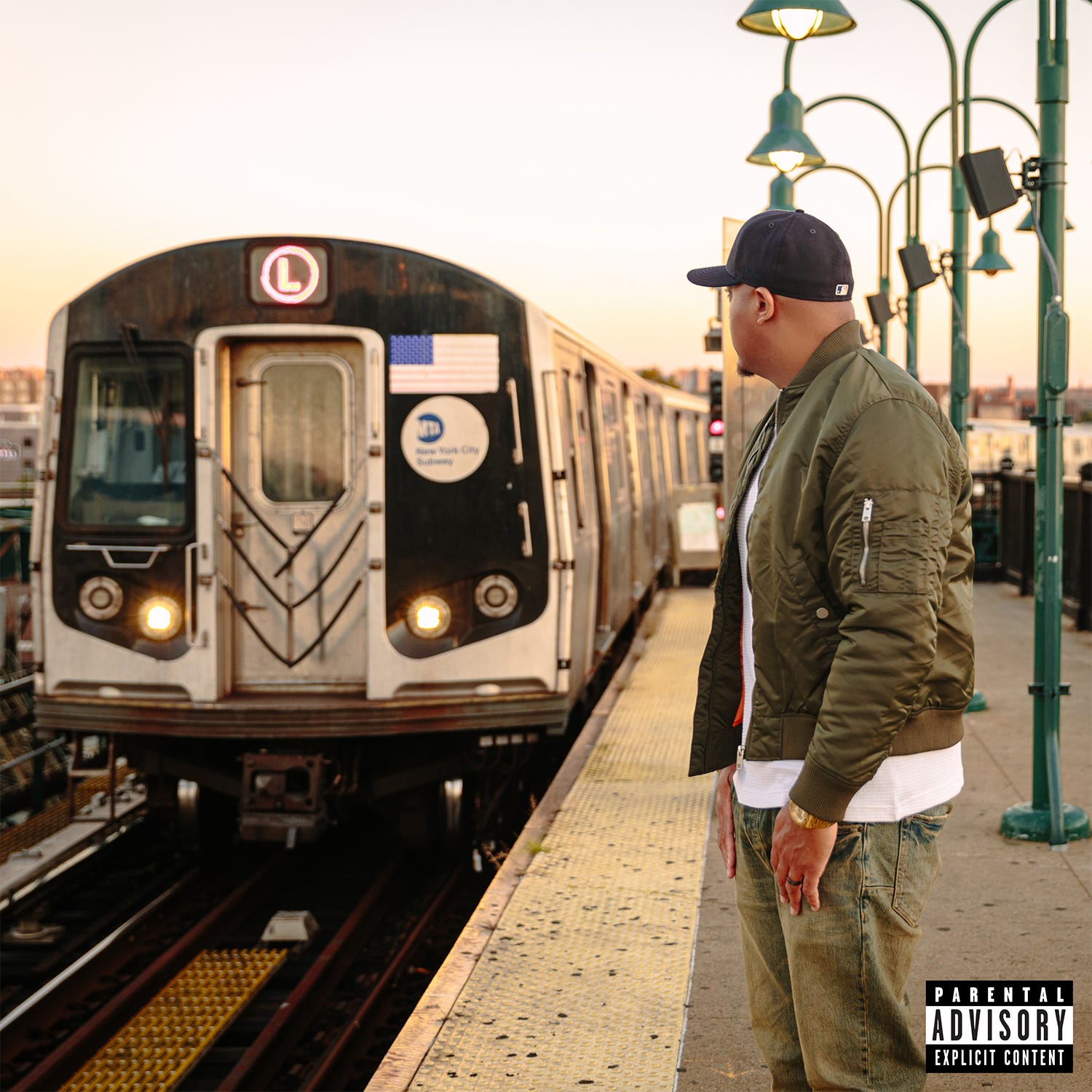
Nine tracks and thirty-five minutes. That’s all Skyzoo needs to say what he has to say on Views of a Lifetime, and he doesn’t waste a bar. The Brooklyn rapper dropped Keep Me Company last November, an album about growing up and being lonely, about becoming someone new and wondering who from your old life will follow. This one begins after the dust has settled. You’ve already become someone new. Now you’re reflecting on your life, and what’s been worth it and what hasn’t. The goals you had when you started, did they come full circle? Did they matter? Skyzoo isn’t here to give you the answers. He’s here to ask the questions aloud, over 9 beats that give his pen room to do what it does.
The opener, “Tags at the MoMA,” begins with a spoken setup about being “All City.” For graffiti writers, being All City means your name is up everywhere, on all the train lines. Skyzoo explains what it means like a teacher, then spends the rest of the track applying it to his life in bigger terms. Being All City is about a method, a procedure beyond hitting up every physical location. “My escape route could be wagered out in Sotheby’s,” he says. “And that’s worth more than your run-of-the-mill.” The bar sounds cool, but it’s also a reality. He’s spent the past twenty years making pieces that get showcased in basements, so what is all that work worth now?
This tension, between art and value, continues throughout the entire project. On “Love Day,” he says, “I put culture over money, I put strangers over me, yeah/I still picked up a bag but ain’t know range what it could be.” He admits to picking art over money, and that doing so has a calculable financial cost. He’s not complaining, he’s keeping track. On “Half Bloom,” he repeats, “I’ll probably never know how it feels to sign to a major/But I cope when I’m a ghost, and they slide me they paper.” The ghostwriting reference isn’t lamenting, simply stating facts. He figured out how to make a living off his writing without selling out his own name. But this project questions what it all amounts to when he can’t speak freely about his own wins.
What makes Skyzoo unique from most rappers operating in this lane, is the way he approaches faith. Islam and Christianity both pop up frequently throughout the album, often in the same bar, but not in the corny, holier than thou way it comes across in most rappers’ bars. It feels necessary. “All praise due like the Jumah, cause they be ducking 12 in my ummah,” he says on “Pardon Me,” referencing the Friday prayer and their tight community. The opener to “Devotion,” which is also produced by Conductor Williams, says he’s “thumbing a Quran with a Jesus piece in the duffle.” It doesn’t come across as contradictory as it does in so many other rappers raps. The beat is drums with a single horn sample. So when Skyzoo says “for me and mine, shoulder to shoulder,” it feels like a promise.
“Hope & Pray” extends this into elegy. The song is about leaving the park early, about the people who didn’t make it, who knew what they knew and couldn’t show up the next day because of it. “To all my teammates at the park that was true to they post/But couldn’t show up there tomorrow ‘cause they knew what they know.” The DJ Manipulator production is warm, which makes the subject matter even more devastating. Skyzoo’s reaction to these friends lost isn’t anger, it’s prayer. “May she finally rest/Peace to her family, maybe they finally blessed/May nobody be next.” The lure is specific: “Here’s to long lives/Long cries for Ruby Ray McCoy, may nobody be next.”
The other tension throughout the album is solitude vs. partnership. Skyzoo repeatedly refers to being one of two: On “Tags at the MoMA,” he’s “one of them one of ones with the duos.” On “Pardon Me,” he “wrote everything two for one, like it’s better in pairs.” On “The Soloist,” he wonders, “What if you were better off alone, and the song, it turns out to be all a single note?” The Other Guys’ production on that song is empty and spacious. “One seat at the table got me sitting like Salaam. So when we turned into me, I just shifted my regards.” He’s not complaining about being alone, but describing how it happened. So when we turned into it, I just shifted my regards.” He’s not complaining about being alone, but describing how it happened.
“The Wager” might be the most complete song on the album. The Cartune Beatz production is harder, with a knock and a looped heavily filtered vocal, and Skyzoo doesn’t pull any punches. “Double down, knowing how you wanted more stardom/Playing with people lives like dollar store condoms.” The game treats people as disposable. The wager can be as small as choosing a location to park the cars, to literal gambling on horse races, to how you decide to dress. The decisions add up: “Win or lose, I grew up seeing my friends on the news. A lesson for all you learn is a lesson for all you lose.”
Fatherhood comes up in quick flashes instead of lectures, appropriately. “My son is seven with waves, he look like ‘97 Ma$e by the swings/Every seven days a weekly routine.” On “Love Day,” he admits, “I miss my son’s first steps working on Retropolitan,” then defends his work: “So you saying that you never heard it, I got a problem with.” “Sky Is Like” is the most clear in its intention as a craft experiment. The beat doesn’t sample Nas’ “Nas is Like,” but DJ Manipulator managed to create one that feels like Preemo without really sounding like him. Skyzoo proves he can follow the blueprint that Nas set for making a flawless song around the scratching hook structure: “Sky is like the writer/The greatest balancing act that ever came off the steps.” This isn’t false confidence. He proves himself with bars (also listen to “I Was Supposed to Be a Trap Rapper”). If he could reference a bibliography at the end, it would include Bobby Seale, Ryan Leslie, Ta-Nehisi Coates, and St. James Place.
The production throughout these tracks is diverse. Camoflauge Monk’s beat on the opener swings, built around a heavily filtered sample. Tuamie’s work on “Pardon Me” continues the chemistry they have, followed by the warmth of Thelonious Martin’s work on “Love Day.” Leo Confident closes the album with “Half Bloom” on a beat that isn’t too sad but still bangs. Views of a Lifetime is a working writer’s assessment of everything he’s made, and what it has cost him to make it. He doesn’t over-romanticize the hustle and even admits to the financial loss of choosing to value art above all else. “Half Bloom” is a suitable name for a project about a career this deep into the game. He isn’t done, and he won’t be anytime soon.
“Since no one write like I write, I rightfully stayed.” — Skyzoo on “Half Bloom”
Great (★★★★☆)
Favorite Track(s): “Pardon Me,” “The Wager,” “Hope & Pray”