

Album Review: Water to Wine by Cashus King & Big O
Cashus King and Big O build fourteen tracks on the miracle at Cana. Addiction, grief, and Black history become his most exact writing yet.
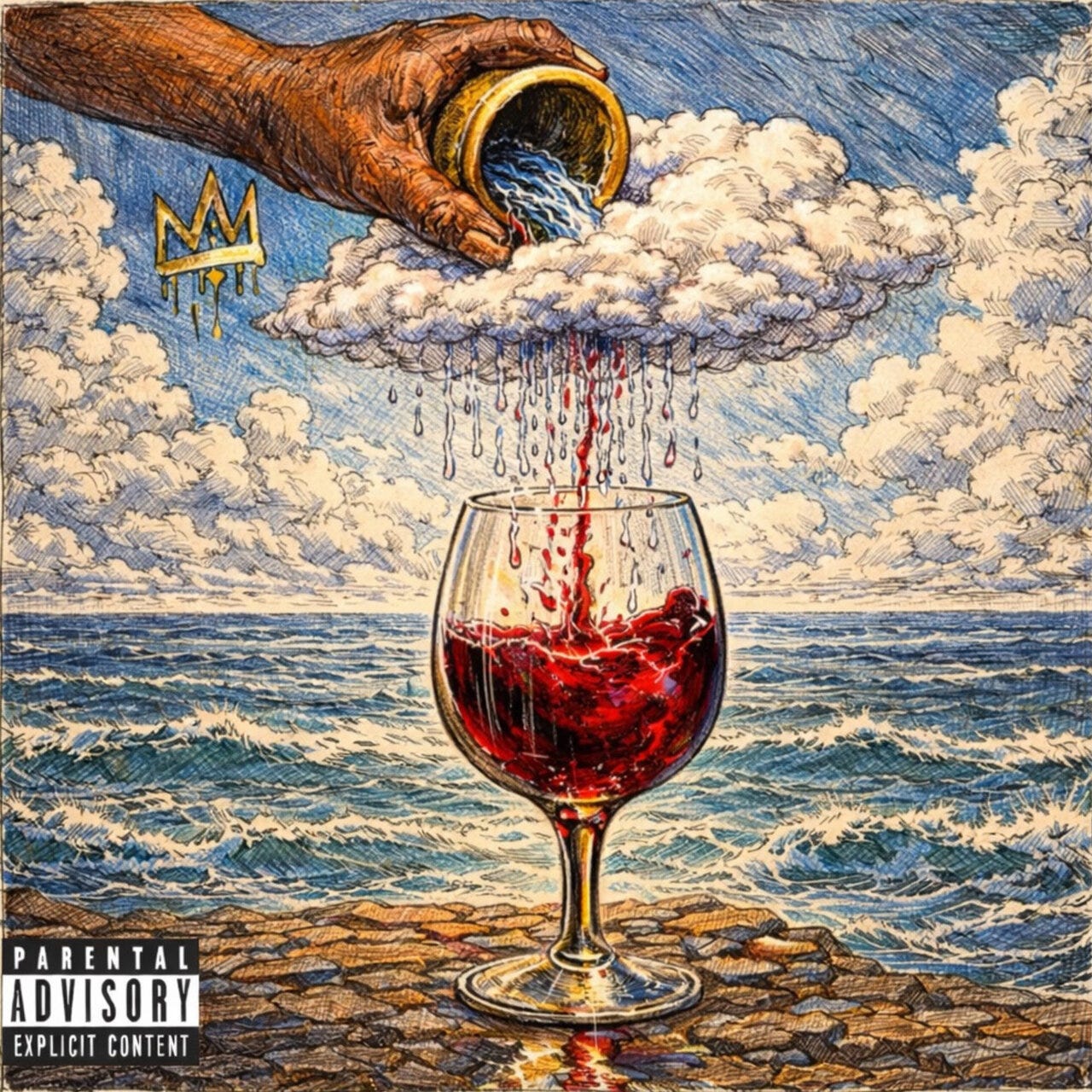
At the wedding in Cana, they used up the wine before the party was finished. A guest instructs the hungry servant to fill six stone jars with water, and what is poured back outshines the initial source. John presents the scene with a handful of verses, the first of the miracles, and the reason it is entered in the book is that it shows who the guest is. Cashus King, the Los Angeles rapper who appears to have recorded for most of a decade as Co$$, takes the parable at its word and tests it through a whole album generated entirely by the British producer Big O. The water continually shifts image on him, from street rain to soda to holy water, and the cycle of alchemic change remains the same before his eyes.
Before the rapping is introduced, “Barry Water” has a passaged sample. played out behind a mock-glacial bass pulse. Barry White sets the tone of “We are all gods on this planet, every man and every woman. We create life. We can take life. We control what goes into the sea, whether the fish can live or not.” Then we get to the rapping on “LikWid (Big Fish),” where the main streets flood out into a watery future, where cartels and junkies and coppers all flow with the same perfect like and he weaves it among the lines, sweet-tongued, police keeping the cuffs wired, snitch caught in the crowd who’s actually a rat on signal, and in the final bars the folk are no longer folk. “We ain’t got limbs, we got fins, swim with the big fish,” he sounds.
Cashus again turns the street back through history, once the water he’s made it to begin with, on “Precipitation,” where he compresses the slave ship and forced conversions into two bars, “Gave you a new god, slave whips, then plantations,” then continues on into the Spanish conquistadors putting the children in cages, Imperial nations inventing hate, then stealing it from those they first discovered. The chorus connects the rain with the idea: “Precipitation wet the vine, turn the wet to wine.” Fashawn shows up less patient to the weather, name-checking COINTELPRO and Jim Crow and Halliburton and adjusting the metaphor’s inertia, “I’m not sitting waiting on precipitation/I’m rain dancing ‘cause I been impatient,” until a sampled voice pulls the song back into slavery as a framework designed for oppression and Black survival as the measure that exceeds it. That same indictment becomes really Black on “Dark Agua,” moving through rigged elections, war corporations, and a system prepared for the elite, and in the chorus, abandons the blaming of a specific perpetrator, “They is you, they is me, they society,” just the same. Big Tone takes the final verse to a cell, convicted of something the nation was founded upon, and a final sample drives it back to today, to US policy and the death camps in Gaza.
He reaches the densest when his rapping is threatening on “Drippin’ (Soakin Poems).” He transmutes writing into voltage and amperes. He jams his cleats into the sockets, electrocutes the feeling, kills the devil with the tongue, folds up song and greenback gospel and gospel in one jacked-up run. His one phrase that approximates commentary is his dig at the grabbers: “Bozos to Bezos to Bushes and the Ellisons/AI wrecks got the humans out there selling skin.” His soaking poems and dripping are the wettest designation he can assign to writing this aggressively, and the whole zapping profit stays attached to it. Cherry Cola allows the air to re-enter. Samuel Adeoti’s keys warm the pocket, the bounce dissipates, and P-Rawb and L.O.U. change the track into a coast-to-coast relay while Cashus is the most precise voice on it. Soda is his icon of feeble emceeing, “All them raps is flat, I twist your cap, you ain’t got no fizz,” and he proclaims himself Word God, master of the utterance, in the same breath. Before any of it, the introduction instructs the children listening to put their own soda to the side and consume water.
Nothing is lower than “Drownin’.” Cashus wrote for those who know what it is to be drowning. Water rushes into his lungs as he gasps for air, anchors of grief pull at his ankles, and every time he approaches the surface, another wave crashes him back down. For the days he can’t speak of the pain, he writes of it, and pinpoints its essence: the overdose that could be the last one. The chorus can’t provide the elevation he keeps trying for: “I can climb on top of the mountain, I’m still drowning,” and the rise and the fall are one phrase. “Holy Water” takes all that damage into a rehab room. Cashus states the deal outright: God’s sober and the devil’s the drug, and the third verse enacts the admission. A man named Troy makes his case first, and the room chirps back. Then Cashus speaks. “My name is Cash, I’m an addict,” he intones, three months clean, and he thanks them for letting him find his purpose and be of service. He stays on the level of simple confession the entire time, even acknowledging the loved ones he alienated to make the meeting.
Begging my mother pardon, Cashus offers his most measured penance on “Like Lava for Water.” He propels the tribute through Like Water for Chocolate and the warrior Tita, a mother who goes to war like Xena. He thanks her for picking up the tab when his dad got laid off, for procuring a worlds/Out of the war he got dealt him, and leaves the whole debts on one line: “When my father went MIA, my mother was there/If my mother disappears, I wouldn’t be here.” “Hydration (Reign)” counters the decline, lifting. Samuel Adeoti plays the piano, rain and reign pun playing toward Black dreamers, doubt as the drought and blessing as the rain that breaks it. He tells them to keep watering the plants of their fantasy and anoint the doubt for the liquidation.
With more guests without leaving the water, “Streams” runs the softest of the bunch, an ensemble drifts down the Amazon and the Congo and the Mississippi, Shari keeping the melodic hook so Blu can barely sit in the song. Blu hopes that’ll be enough, rapping about constantly burying his people and about a daughter he was kept from fathering, the mother telling him don’t bother, and he comes to rest on the line that holds his faith together: “But God walked water.” “Potions” makes the clearest swerve, a West Coast funk glide where intoxication and medicine pour from the same bottle. G-Holy answers from Philadelphia, a verse out of fourteen-floor projects and crack corners and the pill era, closing on a roll call of the dead. Underneath all of it, Big O keeps the world intact, the same breakbeat grain and low-end weight beneath every change of color, so the funk on “Potions” never breaks off from the rest of it. The writing thins out on “Swimmin’.” Cashus piles on the bravado, fish and sharks and Superman and the Flash, walking on water and talking to the Father, and the song is chasing motion more than meaning. It’s the most kinetic thing here and the thinnest, all flex and Flash and backstroke with little underneath.
The water finally turns to wine, and there is no cheer to be found. On “Wine,” Cashus is back in the unforgiving desert hunting for a pond, a forsaken soul stalking a warning to the well, praying to Nefertiti to free him from writer’s block. The change that has eluded him has been revealed in a produced adage, “Turn the water to the wine and turn the wine to art.” The sophistication is not pure, however. His father’s passing re-emerges as the first loss of childhood; the last in the verse halts, naming three metaphors for the departed, Charlie Harvey, Arthur Johnson and Christopher Miras. Then Cashus asks the question that the songs keep turning over, and flatly asks with no more to say, what you living for, who you living for. The miracle, when it arrives, is placed directly beside the grave.
Great (★★★★☆)
Favorite Track(s): “Precipitation,” “Drippin’ (Soakin Poems),” “Wine”