

Album Review: When It All Falls Down by Jakhari Smith
A Sacramento songwriter turns suicide ideation into these tracks of unguarded confession, and the bravery outpaces the craft just enough to make you wish he’d trust the pen more.
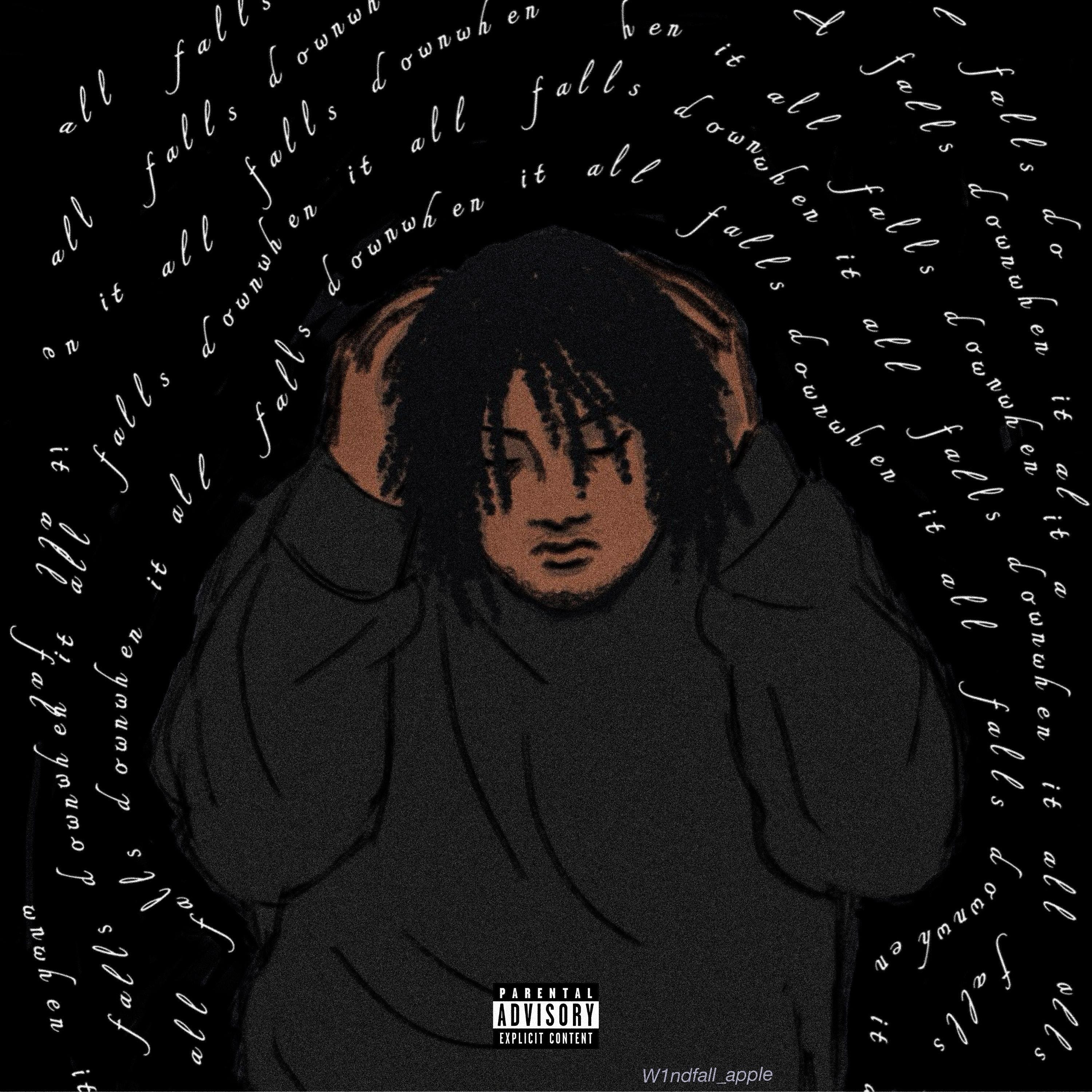
South Sacramento doesn’t generate a lot of national music press. The city has its own hip-hop lineage (Mozzy, Brotha Lynch Hung, the whole Midtown and Oak Park circuit) but it’s not the kind of place where a kid with no musical background starts journaling after losing his grandfather and ends up with a catalog inside of three years. Charles Tillman Jr. died in April 2020, and the notebooks came after that, and the poetry that came out of the notebooks started bending toward song structure by mid-2021. Jakhari Smith, born in 1997, raised on the Laguna Creek side of the city, had never cut a track before the grief settled in. By 2022, he’d submitted “Far Away” to NPR’s Tiny Desk Contest and turned enough heads to build a local following. When It All Falls Down is his fourth full-length in three years.
Most of When It All Falls Down is about wanting to die. Smith puts it plain, without much cover. On “Needs,” he admits he hasn’t responded to texts in weeks, he barely tries because he’s scared to fail, and when he looks in the mirror he can’t identify what he sees. The line “Maybe ‘cause a piece of my soul will live when I’m gone” is him trying to explain why the music matters even when nothing else does, and it lands hard specifically because he doesn’t dress it up or slow down to let you absorb it. He drops the line and keeps going.
On “Questions,” every line is a question. Am I wrong to try to hurt myself? Do they notice it’s harder to smile? Will they listen to my art when I’m gone? Jayda Irene’s spoken-word intro about colorism and not loving her own face adds a second dimension to the self-doubt that Smith couldn’t have generated alone. WIDDA K’s chorus on the same song pleads with a doctor to take the pain away, and the three voices together make the loneliest song on the record feel, briefly, communal. On the title track, produced by Timur Bakirov, Smith opens with “Therapy can’t save me/I’m stuck up in a maze” and then wonders how depression can be a phase when his demons never leave. He prays he makes it to another night. Night, specifically. He’s not asking for a new morning. He’s asking to survive until dawn.
The next set of songs belong together even though they sit far apart on the tracklist. “Baby Boy” is written entirely from his mother’s perspective. The first verse is her talking to her newborn, promising to love him, admitting she has her own issues but swearing she’ll be there. The second verse is years later, and it’s all domestic nagging. Clean your room, comb your hair, fold the laundry, Mrs. Johnson called about you clowning in class, and that PlayStation is about to go in the trash. Before he leaves she wants her hug and her kiss. The spoken outro is her yelling at him to turn the game off and get in bed. The affection lives in “Boy, you lucky that I love you” and “If you need me, you can call me, Imma answer quick,” not in grand declarations but in showing up, daily, irritated, present.
The adult Smith writes back on “Proud of Me.” The kid was on the carpet with a controller, dreaming past the city limits, lonely in the house while mama worked nights. Does this pain still follow? Did you hold on to your soul? Are you proud of me? Now the grown version tells him every step is strength, that the music is all he’s got, that he planted seeds and left the rest to grow. “Baby boy, I’m proud of me.” She gave him love through routine. He gives it back to himself through a letter across time.
Nothing else on the record takes a risk the size of “Conversations in the Dark.” Smith stages his depression as a character, an old acquaintance who shows up friendly, claims he’s changed, then walks him to a closet with a locked box and a gun. The whole thing plays out as dialogue. Smith begs, insists he’s got more to do, that music has been pulling him out of his worst stretches. The depression doesn’t care.
“I can do what I want
Who gon’ stop me in this bitch?”
Once the trigger’s pulled, it’s permanent. Smith screams. Then: “Shit, man, it was just a dream.” Lee’s production stays spare enough to keep the spoken exchanges from tipping into skit territory, and Smith’s delivery in the begging sections, especially in “Please don’t take me out/I got so much more to do/Finally finding happiness/This music chase away my blue,” carries actual panic in the voice, not a performance of panic.
The features run uneven. nisamina’s hook on the title track gives Smith a melodic anchor he can’t quite build on his own, and her voice sits well against his grainier delivery. Yufi’s verse on “Lord Knows” brings an entirely different register, pulling from Islamic prayer, referencing ancestors, delivering the phrase “the vessel is flawed but all the parts are sailing,” and the contrast between his devotional approach and Smith’s exhausted pleading makes the song feel wider than anything else here. Kiana Alyse shows up on the closer and adds sweetness, though the chorus she sings alongside him is the kind of motivational refrain that could appear on any number of independent R&B records without distinction. The production roster deserves more attention than the songs give it. Nkosana and remy jones built the warm, clean pocket that “Baby Boy” lives in, and Francesco Busi and Jacob Ismael’s beat on “Stronger” lets Smith’s voice stretch into places it doesn’t usually go. But several of the midtempo tracks, “Open Your Eyes,” “Lord Knows,” “Stronger” among them, share a similar piano-and-pad bed that blurs their identities. When the tracks are saying different things, the beats shouldn’t all agree on the same temperature.
Where When It All Falls Down stumbles is in the distance between what Smith feels and what he can do with a melody. Several cuts cover the same ground (I’m depressed, I don’t know who I am, I’m scared I won’t make it, I keep going for my family) and the lyrics in those moments hit real, specific notes. But the hooks tend to flatten the specificity. “Life getting harder/My days longer and longer” on “Stronger” and “Lord knows I try/I’ve been working from day to night” on “Lord Knows” both do the same job, and neither does it with enough surprise to earn its own space. Smith’s verse writing is often stronger than his chorus writing, which means the parts where he’s saying the most get interrupted by refrains that say less.
The clearest Smith has been on any of his records is “Fate (Interlude),” where he drops the singing entirely and just talks about why he writes. Behind the beat is just a guy explaining that writing was the only thing that cleared his head at night. It makes you wonder whether the record would’ve hit harder with more of that directness baked into the songs themselves. Smith closes with “Momma, I Made It,” and the crucial thing about it is the tense. He doesn’t say he made it. He says he can’t wait to say it. The whole song is pointed at a finish line he hasn’t crossed, and the album ends there, on the wanting, still driving.
Above Average (★★★☆☆)
Favorite Track(s): “Baby Boy,” “Conversations in the Dark,” “Proud of Me”