

Anniversaries: Scorpion by Eve
On her second album, Philly’s sharpest MC wrote breakup songs, crew anthems, and a pop smash—all while running out of time.
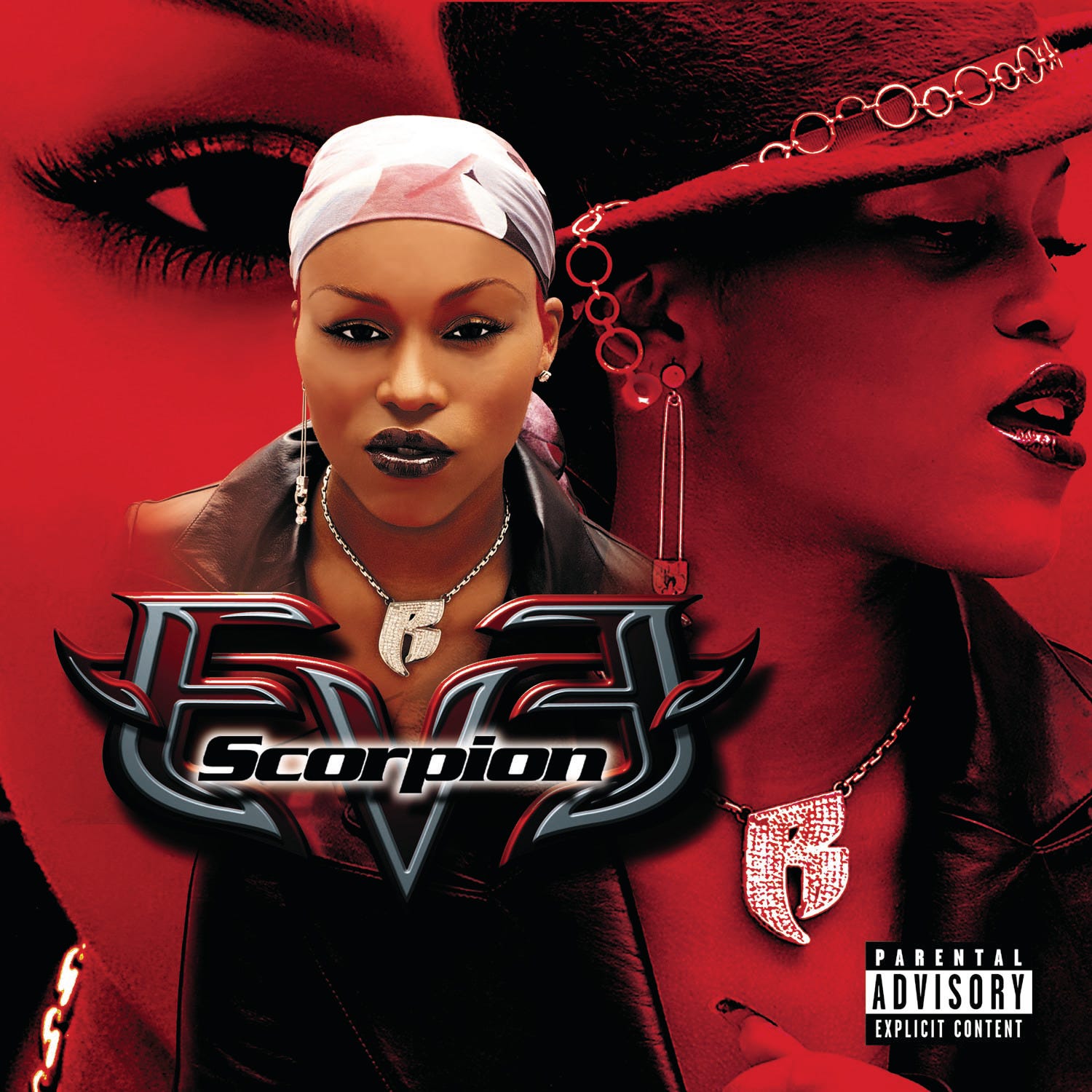
The short list of commercially viable women in rap could fit on one hand, and most of those fingers belonged to New York. Lil’ Kim and Foxy Brown had staked out the luxe-provocateur lane and were drifting toward diminishing returns. Ms. Lauryn Hill, whose Miseducation had detonated three years earlier, had retreated almost entirely from public life. Missy Elliott was about to drop Miss E... So Addictive but hadn’t yet. Da Brat’s last album had underperformed. Trina was brand new and still confined to Miami bass circles. The space was simultaneously crowded with precedent and empty of anyone currently filling it. Into that gap walked Eve Jihan Jeffers, 22, from Philadelphia by way of a Ruff Ryders boot camp that had already made her debut go to No. 1, and carrying a sophomore album she’d recorded in roughly eight weeks at a rented house in Miami. She had burnt her hair off trying to dye it red for the cover shoot. It wound up looking better short. That kind of accidental resourcefulness runs through all of Scorpion.
Eve had two months because Interscope wanted the record fast, and the Ruff Ryders operation, run by the Dean siblings and powered by Swizz Beatz and DMX, moved on instinct and deadline pressure rather than careful A&R development. She’d spent the period after her debut struggling with depression, overwhelmed by the speed of her own rise. “I was 21,” she told Ebony in August 2001, “and there was nobody I felt I could really talk to who understood what I was going through.” The other complication was personal. Her boyfriend at the time was Stevie J, the Bad Boy hitman who’d produced records for Biggie, Mariah Carey, and Puff Daddy. He co-wrote and sang on “Let Me Blow Ya Mind,” contributed to the album’s R&B-leaning production, and appeared in a skit called “3 Way” that played their relationship for laughs before the record turned around and gutted it for real. In a Rolling Stone profile that year, Stevie casually told a reporter about Eve’s spending habits. An intrusion she clearly hadn’t invited. That friction became material.
“You Had Me, You Lost Me” is the meanest thing on Scorpion, and it earns every decibel. Over a distorted electric guitar riff that owes more to rock radio than to anything Swizz Beatz would cook up, Eve does not cry or plead or try to understand. She catalogs offenses with prosecutorial calm: the lies, the other women, the way a man can make you feel stupid for ever trusting him. She delivers it like someone who has already packed a bag and is reciting her reasons aloud to make sure she doesn’t unpack it. “You Ain’t Gettin’ None” covers adjacent territory with less fury and more ice, Eve withholding sex as leverage, completely unbothered about it. These aren’t generalized empowerment anthems. They are specific dispatches from a woman whose private life was being narrated on record by a man sitting in the same studio, and the specificity is why they land. Eve said in 2001 that she wanted to be known for standing for something beyond having men pay her bills, and on these songs she’s putting that claim to work, writing her way out of a situation she couldn’t fix by arguing.
People inside the Ruff Ryders camp pushed back when Eve said she wanted Gwen Stefani on “Let Me Blow Ya Mind.” She remembered the resistance clearly in a 2021 Stereogum interview: the A&Rs weren’t sure the pairing would connect, weren’t sure how audiences would receive a ska-punk singer on a rap record. Eve and Stefani had never met in person when they recorded it (they only talked on the phone), and didn’t stand in the same room until the video shoot. Dr. Dre produced the track and reportedly pushed Stefani hard enough during the session that she cried. None of that tension is audible on the finished record, which rides a clean, sprinting Scott Storch keyboard loop while Eve talks directly to her doubters. She mentions unnamed rivals who don’t write their own material, a jab widely read as aimed at Kim and Foxy, and she drops it casually, like gossip she’s too busy to dwell on. Stefani’s hook does the emotional work the verses don’t need to do, turning the song’s competitive edge into something you could also play on a summer drive. “Who’s That Girl?,” the other big single, operates on pure swagger, Eve bragging with a singsong “la la la” refrain that lodges in your skull and stays. Eve is talking about being watched, wanted, scrutinized, and enjoying every second of it.
The Ruff Ryders tracks on Scorpion are a mixed haul, which is typical of any album forced to honor a crew roster. “Scream Double R” pairs Eve with DMX over a frantic DJ Shok beat, and while both rappers throw heat, the production lacks the gravitational pull of a Swizz track. “Thug in the Street” fares better because The LOX and Drag-On give Eve something to push against, and Styles P’s verse in particular has a menacing weight that raises the stakes for everyone on the song. The real highlight among the group cuts is “Gangsta Bitches,” which brings in Da Brat and Trina for what amounts to a three-woman cipher about refusing to be tamed. Eve sets the terms, Da Brat raps with a caffeinated fury she hadn’t shown since Funkdafied, and Trina, still new enough to be hungry, punctuates each verse with the brand of frank sexual boasting that would become her signature. It works because nobody defers. Three MCs from three different cities and three different lanes all decide to go hard at the same time, and the beat, a sinister Swizz production, has the room for all of them to swing.
Where Scorpion gets quieter, it also gets more interesting. “Life Is So Hard” puts Eve alongside Teena Marie, whose R&B pedigree and gospel-trained voice belonged to a completely different world than Ruff Ryders. It’s about exhaustion—not the performative exhaustion of celebrity, but the daily kind, the weight of bills and bad relationships and trying to hold your own composure when everything around you is slipping. Eve raps about wanting to give up but being too stubborn, and Marie wails the hook with a conviction that could fill a church. “No, No, No” samples Dawn Penn’s reggae classic and features Damian and Stephen Marley, pulling Eve into a dancehall groove where she sounds looser, less guarded, willing to let the riddim dictate her cadence.
And “Be Me,” the closing proper track, features Mashonda on a low-key confessional where Eve talks about the gap between her public image and how she actually feels when she’s alone. The toughness drops away on these songs. Eve admits the pitbull-in-a-skirt persona was exactly that, a persona, and that behind it was a 22-year-old from Philly who had purchased her mother a house and was still figuring out whether the man in her bed deserved to be there. On “Cowboy,” one of the first songs after the intro, Eve raps about trying to flip quick money and asks a simple question: can you dig this? No explanation, no waiting for approval, just a woman standing in the middle of a Swizz Beatz beat that snaps like a rubber band, talking fast, and if you catch it, you catch it.