

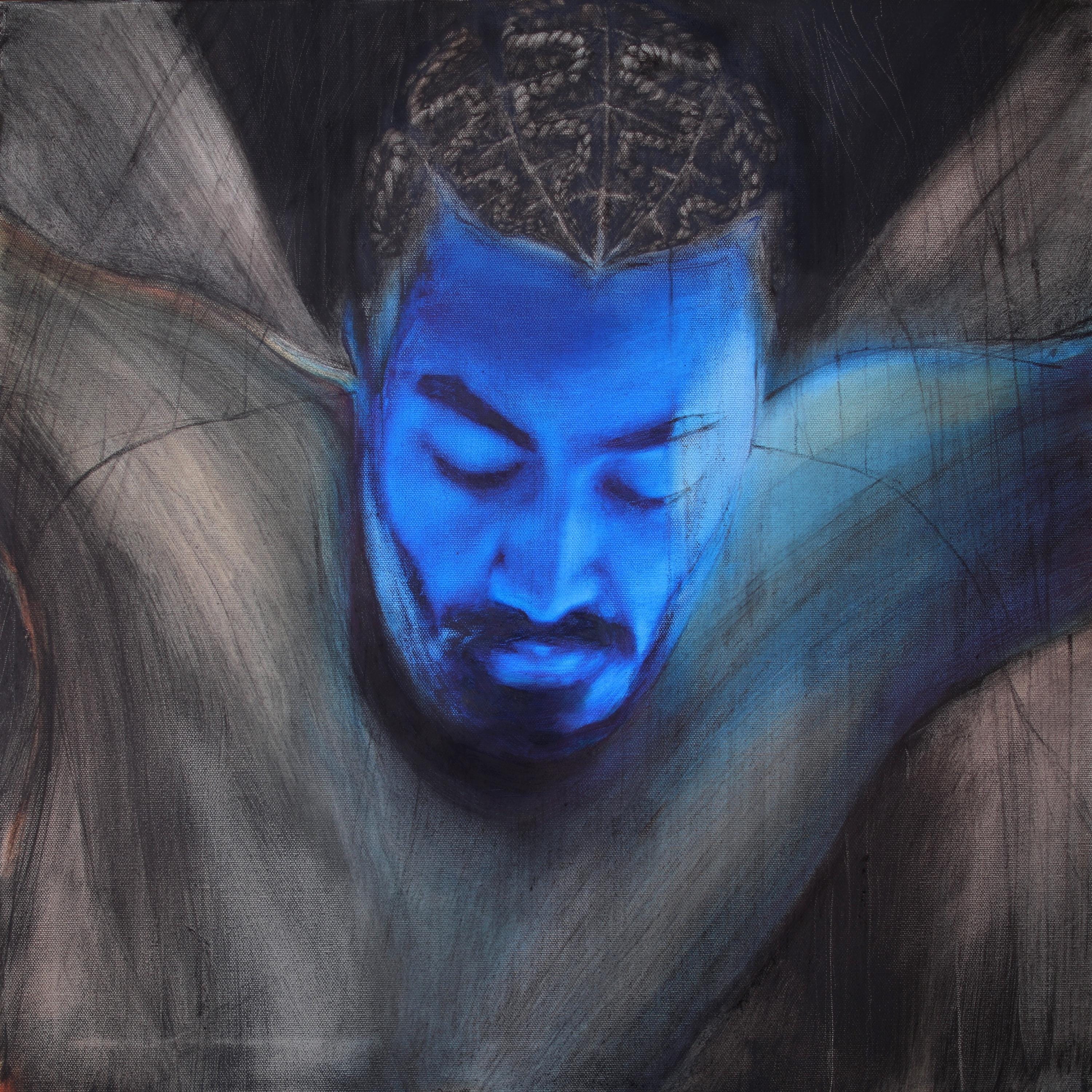
Over the past half-decade, Sage Elsesser’s path has taken him from skate parks to the forefront of New York’s hip-hop underground. The Los Angeles-born artist first made his name as a skateboard prodigy and streetwear model, famously skating for Supreme and designing album art for friends, even before he began quietly crafting his own insular brand of rap. Under the moniker Navy Blue, Elsesser channeled his personal struggles into music, debuting in early 2020 with Àdá Irin—an album that charted paths through familial trauma and grief, reading like a holistic diary and the literary equivalent of burning sage to cleanse a haunted home. That project introduced the Navy’s penchant for vulnerability and spiritual reflection, but it was only a prelude. In the final days of 2020, as the world lingered in a quiet, chaotic spiral, Navy Blue released Song of Sage: Post Panic!—a second full-length offering that would fully realize his vision of self-healing through sound.
Sage Elsesser had transformed from a skateboarding wunderkind into a burgeoning rap sage. The album’s very title plays on his name and the ritual of burning sage, signaling a cleansing of emotional wounds through music. Where Àdá Irin offered rich reflections on honoring lineage and surviving untenable conditions, Post Panic! dives even deeper into Navy Blue’s psyche. The vibe throughout is calm and bittersweet, as if the 23-year-old rapper has sunk into the recesses of his mind and is sifting through years of memories with gentle determination. There’s a sense that Navy is both documenting his scars and actively trying to heal them in real time.
Much of Navy Blue’s music feels like a spiritual ritual, with the artist using beats and verses to ward off darkness. In fact, his songs scan as holistic diary entries, the musical equivalent of burning sage to cleanse one’s surroundings. Across Song of Sage: Post Panic!, he continues this practice, confronting pain head-on in order to release it. On the opening track “Dreams of a Distant Journey,” Navy reflects on the growth he’s experienced and invokes ancestral imagery: “Horns blazing, only some forget the sunken ships/I often reminisce, what spirit guides a calm regret/Look myself in the mirror, start tearing up as I reflect,” he offers, placing his healing process front and center. In these lines, he not only acknowledges personal sorrow but ties it to a broader history—the “sunken ships,” a poignant reference to ancestral trauma from the African diaspora. This ritualistic cleansing of the past defines the album’s essence. Navy Blue is making music to purge pain and find renewal.
What stands out is how vividly it renders memory and emotion as three-dimensional landscapes. Navy Blue’s past pains and pleasures materialize in his lyrics almost like physical scenes unfolding in the mind’s eye. Mental cobwebs gather in the corners of his conscience; old regrets loom like kaiju—giant monsters towering over a cityscape. Yet amid these haunted visions, family members and loved ones appear as glowing beacons guiding him through the gloom. On the track “1491,” he illustrates this dynamic with striking detail, rapping, “So many photos on the wall at most the times I was caught/I was caught in a web that I had spun myself, the damage did a lot,” recalling how he’s often ensnared himself in lingering grief.
Navy Blue dances between specificity and enigma, a balance that gives Post Panic! much of its quiet power. His writing is deeply personal and descriptive, yet he often withholds as much as he reveals—as if safeguarding parts of his story even while sharing it. “I write for those who know me,” he remarks on the track “Deep Water Blue,” a line that is an invitation and boundary. It suggests that these songs are coded with meaning for family and close friends, even if outsiders may only grasp fragments. On “Aunt Gerry’s Fried Chicken,” for instance, Navy Blue offers a fleeting, heartbreaking glimpse of a family tragedy: he recalls hearing his mother’s screams after his brother was shot, a moment of raw anguish that pierces the album’s fabric. Then, almost immediately, he lets the thought dissipate, choosing not to dwell on the graphic details. We’re left with an outline of the pain, the exact picture left to the imagination.
On “Self Harm,” he allows us closer to the heart. Over a misty, slow-burning beat, Navy’s voice audibly cracks and strains as he confesses to breaking down in tears in front of his partner while he was “blazing like a comet.” The phrasing is poetic and a touch cryptic—is he describing being high, or burning up with emotion?—but the vulnerability is unmistakable. It’s a powerful image of a young man unafraid to cry, even in the throes of pride or intoxication. We understand the weight of what he’s experienced without needing every detail spelled out. Between Àdá Irin and Post Panic!, he honed his skills as both rapper and producer (indeed, Elsesser had spent the late 2010s sharpening his beat-making chops and collaborating with the likes of Earl Sweatshirt and MIKE in the underground circuit). On Post Panic!, he pushes his boundaries further, experimenting with flow patterns and song structures in ways that hint at his expanding ambitions. “Poderoso,” for example, finds Navy adopting a zig-zagging bar structure that calls to mind the off-kilter rhyme schemes of New York veteran billy woods. His verses dart unpredictably, stretching and contracting the meter as if testing its limits—a style that rewards attentive listening.
Then there’s “Deep Water Blue,” which surprises with a double-time cadence on its hook. Navy fires off the title phrase in a rapid, rolling rhythm, demonstrating a nimble agility over the beat that we hadn’t heard from him before. Neither moment feels like a gimmick. These shifts come across as an artist challenging himself, adding new tools to his kit. Even Navy’s more straightforward tracks carry a refined energy that sets them apart from his earlier work. “224” exudes a kind of hard-won lightness—it’s jubilant in tone, buoyed by a soulful loop, yet grounded by Navy Blue’s earnest delivery. The song radiates confidence, as if he’s learned to ride the beat with less effort and more impact, like a skater landing tricks with smooth precision after endless practice. With an album that, while heavy in subject matter, glides gracefully from track to track, its creator visibly leveling up in real time.
For all its meditations on trauma, Song of Sage: Post Panic! is ultimately a work of healing and hope. Navy Blue steers us through some dark waters, but he never abandons the search for light. In fact, gratitude and spirituality are the anchors that keep the album from drifting into despair. Throughout the project, Navy frequently alludes to faith, ancestors, and a higher purpose guiding him forward. Family, both living and departed, are his guardian angels—their presence is felt in nearly every song, whether in dedications, prayers, or memories that spur him on. His late father, for example, is tenderly honored on “Breathe.” Over a somber, piano-laced beat (and a guest verse by Yasiin Bey that feels like a blessing in itself), Navy raps, “Papa on a mantle/The warmth of his smile bring tears to my eyes/The war of a long life, cry if you gotta/Most the trauma tied to my father,” acknowledging how his dad’s long life and eventual passing shaped him. It’s a moment of grieving and reverence intertwined—the kind of moment that gives Post Panic! its soul. Elsewhere, on “Tired,” Navy Blue finds solace in an almost meditative acceptance of life’s fragility. “It’s soothing to know the body is just a shell,” he exhales, sounding relieved as much as weary.
The penultimate track, “Moment Hung,” even broadens the scope to a collective struggle, as Navy speaks on the injustices facing Black people in America and beyond:
“They killing sons and babies and mothers
Thеy kill our fathers, our aunties, and uncles
Thеy killing us blind, but notice our color
They televise the demise of our brothers
They televise the demise of our sisters, shit got me livid
I need a moment to gather my spirit, much more than lyrics
Speak to the chosen, nothing left but a family broken.”
Yet even here, amidst anger and sorrow, he seeks strength in unity and understanding. Navy Blue’s reverence for tradition (he literally shouts out elder NYC wordsmith Ka on the record, and brought legends like Yasiin Bey into the fold) helped narrow the degrees of separation between two generations of talent. In doing so, Post Panic! crowned Navy Blue as a new disciple of that lineage—an heir to the introspective, socially conscious style of artists like Yasiin Bey, Ka, and the Wu-Tang poets, even as he forged his own identity. For himself, Post Panic! proved transformational. It was, in many ways, the record where Sage Elsesser came into his full voice as an artist.
In the years since, he has recreated himself again and again—a little stronger, a little more humble each time, committed to an ongoing metamorphosis. Subsequent projects saw him refine his craft further, expand his sonic palette, and even briefly step onto a larger stage (signing a deal with Def Jam in 2023 before ultimately returning to his independent roots). Yet no matter how far his journey has taken him—from skate clips circulating around Brooklyn to a devoted global fanbase hanging on his every word—the spirit of Song of Sage: Post Panic! remains at the core of Navy Blue’s art. Its virtues of healing, honesty, and heritage continue to guide him.