

Anniversaries: The Big Bang by Busta Rhymes
Dre’s perfectionism gave Busta Rhymes his best-sounding album. It also became the place where one of Rick James’s supposed last recorded moments ended up, rerouted past his own death.
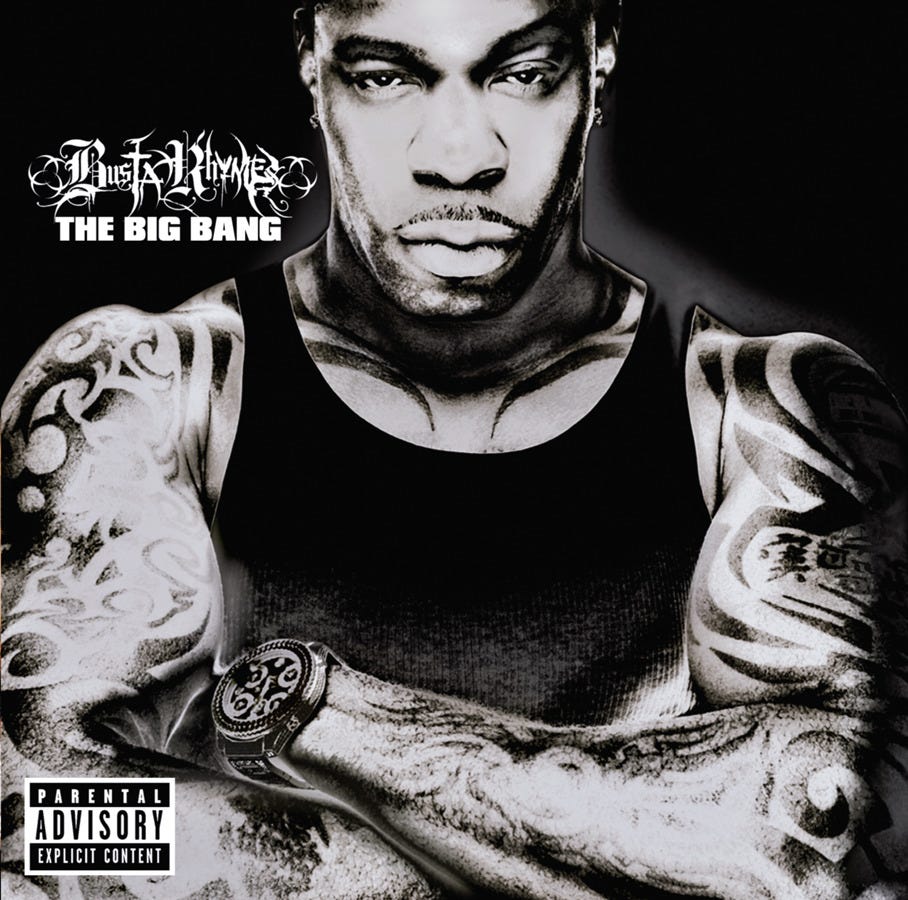
In November 2005, the MTV crew crammed into a Manhattan barbershop, owned by the producer Cory Rooney, to watch Busta Rhymes have fifteen years of hair shaved off his head. Those dreadlocks had been on his head since he was seventeen, a senior at Uniondale High; he had grown them in December 1989, the month he had signed the paper that put his signature on his first record deal with Leaders of the New School, and he later said on camera that the moment he signed the contract was the day he had stopped combing his hair. Underneath the locks was a Caesar cut, short, and a face that had taken off twenty or thirty pounds of Busta. His new deal had afforded him a new body. The new deal was with Dr. Dre.
Trevor George Smith Jr. was born in Brooklyn in 1972, raised in East Flatbush and rapping by his early teens. Leaders of the New School phase yielded two albums nobody really remembers, besides the fact that one of them featured Busta on A Tribe Called Quest’s “Scenario,” where an 18-year-old pushed past Q-Tip and Phife Dawg and made a posse cut into a career. His solo career has now produced six albums over the course of a decade—The Coming through It Ain’t Safe No More—but, at least commercially, he lost Elektra after one, and he lost J Records after two; by early 2004, he had been through three label systems without a #1 hit, then Aftermath came calling.
Aftermath in 2004 was the most dominant hip-hop label in terms of commercial appeal. Eminem was fresh off The Eminem Show; 50 Cent was basking in the residual glow of Get Rich or Die Tryin’; The Game was about to release The Documentary. Signing a thirty-two-year-old Brooklyn veteran who hadn’t had a hit in three years appeared to be anointing a legend. Instead, it meant that, almost two years later, the wait at Record One in Sherman Oaks continued. Dre doesn’t put beats out on a schedule, and this album wasn’t on one, either, as Dre only produces on his own schedule, once he’s happy with the sound, so the album was promised eighteen months before it even existed.
Busta’s body is present on the cover before the music is. It’s a bare tank top, with veins protruding down his arms, his chest sliced, his jaw set. The album must prove whether the newly sculpted Busta Rhymes is really Busta Rhymes over the first minute, at least: a piano figure that walks along the line where waist height would be comes down from Mark Batson and Dr. Dre, no rush on any beat in it. Q-Tip, on his second turn on this song, “Get You Some,” still slides into the track on the beat as he had done on “Vivrant Thing,” sweet, with a breath of a sly tone, the oldest man on the track sounding the youngest. Marsha Ambrosius sings with the tone of exhaustion as she watches people leave a room. For once on an album opener, Busta has stopped sprinting—his rasp continues to stack syllables, but the pace under the rap is brand-new.
The first single was “Touch It,” built by Swizz Beatz, centers around a one-bar loop under a robotic filter (clearly taken from Daft Punk’s “Technologic,” which itself sampled some Italian progressive house). Busta fills the verse primarily with boasts about his own existence, and it works; it went gold on downloads before the album was widely purchased, and its remix featuring Mary J. Blige, Rah Digga, Missy Elliott, Lloyd Banks, Papoose, and DMX to the original looping beat was the staple club track in New York throughout the summer; nobody at radio thought twice about how content—free it was, and for the most part, I’m with them on this one.
Stevie Wonder opens “Been Through the Storm.” He has already started on his highest singing by the time the track proper starts, laying his voice over the gospel piano figure from Sha Money XL and Black Jeruz while Busta has yet to open his mouth. The first bars that Busta writes after walking into the mic are an accounting of his losses: the lives he’s lost in his old neighborhood, his downward spiraling career that was so deep he thought it might end him, and a decade of bouncing between record labels that had no idea how to market him. This is the first time on one of Busta’s albums that he has sounded tired while being entirely transparent about it, and taking that up right after Stevie makes for half of his work.
Nas’s contribution of the evening on “Don’t Get Carried Away” arrives already half-checked out (the way Nas sounds whenever the beat actually connects), and Dre’s beat here, string section loop that sounds like a chase scene from a giallo film, allows Busta to rap all around him; it’s his cleverest moment on the album. In “You Can’t Hold the Torch,” featuring another return by Q-Tip and Chauncey Black on the sung hook, it’s simply two veterans lecturing the youth on a flow that still nobody has bested for fifteen years. Their confidence and the underlying weariness actually sell the boast of authority.
Will.i.am’s contribution on the song with Kelis on vocals has really only dragged down the album’s average by nineteen years now, and in interviews, Busta has stated that he wished he had put “I Love My Bitch” on a different album-one that was better suited for a rapper who tends to keep his romantic affections at arm’s length, which is actually still possible, just four tracks down, on “I’ll Do It All,” where LaToiya Williams proves that one can make more of a sparse piano melody than Kelis can on an entire beat made by will.i.am and a sung hook passed back at her.
On “Legend of the Fall Offs,” a low piano figure taken from Return to Forever’s “Do You Ever,” and a digging percussion sound are put together, the source of which still remains a mystery. Busta has put himself in character as Death itself, speaking to a rival that is no longer alive (or relevant): his first-ever use of a whisper was on this track. It’s unheard of from his Leaders of the New School days, from the Extinction Level Event albums, and even from Genesis. A skit, placed after Busta’s verse, finds his buried foe pleading for his life from within the grave, dirt continuously falling around him, the piano never stopping. He steps off the mic for the final few bars, but delivers them to us over the body:
Rick James was already deceased for two years by the time this album was shipped to stores, so “In the Ghetto” is a duet recorded 25 years apart. DJ Green Lantern and Dr. Dre found the main vocal for this song, an acapella from James’s 1981 hit “Ghetto Life.” They added a snippet from his 2004 BET Awards performance, where he glares at the audience and mutters a line that had become a Chappelle Show joke months earlier, and the audience responds as he continues to sing the same line, half a step before his coffin, taken away a little over a month later. Busta takes that phrase, turned to a boast on his own song’s outro, against the 1981 original, the two samples unaware that they will eventually end up sharing a grave.