

Bad for the Morale of the Office
earthsignchels raps her father’s cancer death, crude and tender, and Audre Lorde wrote her mastectomy and her one-breasted body exactly as they were.
If you are sick enough, or if someone dear enough to you dies, the people around you begin to manage how you do it. Put on the form, and nobody has to imagine the thing that’s gone. Keep your voice down, out where other people are dying too. Show gratitude.
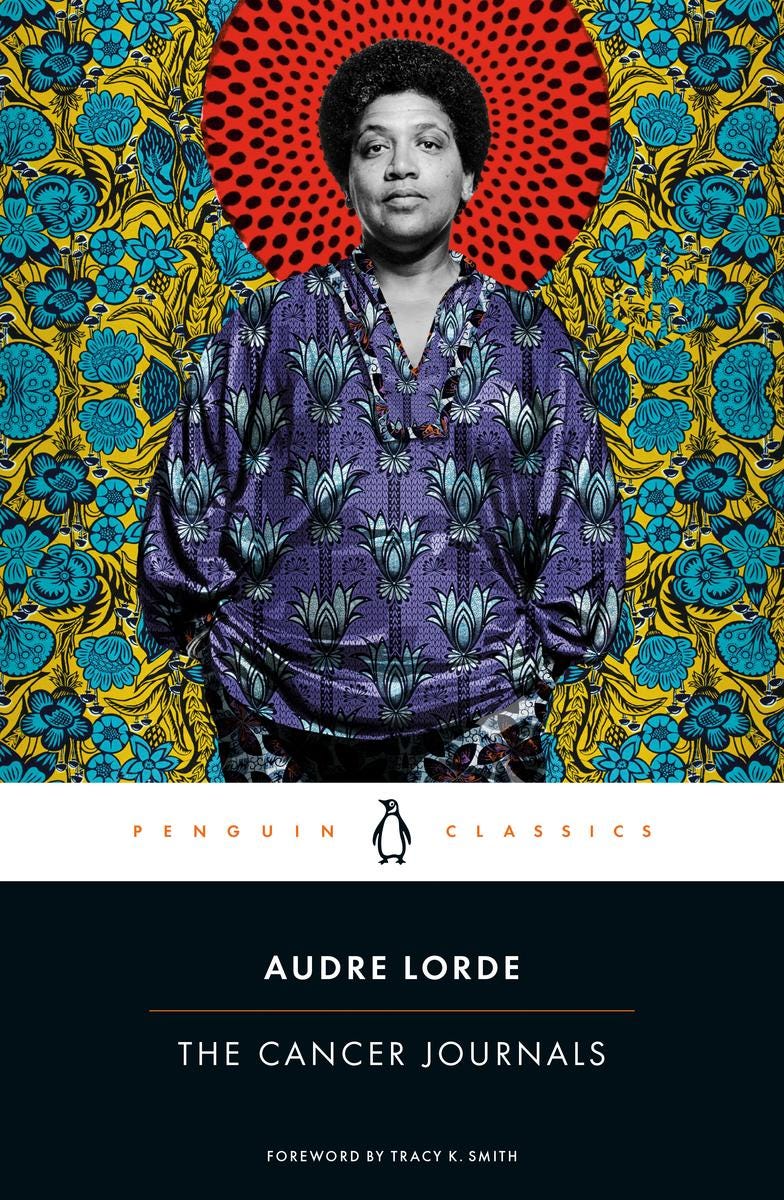
Look more or less as you looked before. That instruction came to Audre Lorde in the fall of 1978, in a recovery room in New York, and, later, in the office of her breast surgeon, where a nurse informed her that one-breasted women were bad for the office morale. Lorde, the Black lesbian feminist poet, had just lost her left breast, and she’d spend the next two years writing The Cancer Journals, a spare volume of poems and diaries, in which she turned down that role. The Chicago rapper who records as Chelsea, earthsignchels, breaks that same instruction, from the other end. Her new single, “Daddy Died,” is four minutes of a daughter saying her father died, at full volume, with no regard for politeness or room etiquette.
“My daddy died.” The line was delivered as insipidly as if you were reading the forecast, never peaking, always returning throughout the song. Chelsea hangs everything else on the line, and it’s what she hangs that sets her elegy apart. “My daddy died, so I don’t take no shit from niggas.” With that rap, death immediately becomes a method of traversing the world. Beat later, it’s swagger and sexuality: “Fits sucking on my titty, screaming ‘fuck regime’.” Then, “Bad Carmel ting/Bad bad Billie Jean.” His legacy to her, in other words, is the hardness he leaves behind. “I get my way, then act up daddy taught me that,” and act up she does. Her father’s death takes the form of a bodily crisis only once, early on: “No life inside his body gave me heart attack.” As his body falls still, hers is pummeled.
Lorde came out of anesthesia feeling colder than ever before. But the word had already entered the space when she was out, “the gong in my brain of ‘malignant,’ ‘malignant,’” slicing through the drugs “like a fire hose trained on my brain.” She screamed. She begged, and the nurses—“very put out by my ruckus”—sent her back to her floor sooner than expected. In recovery, her pain manifested in howls and curse words, which earned her a shot and a shushed warning: “Be quiet, there are sick people here. ” I have a right to be here, she responded, because I’m sick too.
That injunction, “Be quiet, there are sick people here,” is the domestic counterpoint to the stand Lorde would make over the next two years. The world wanted her to fill the space in her bra with a wad of lambswool and pretend everything was fine, and the breast surgeon’s nurse articulated the expectation succinctly: to maintain a certain kind of office morale. Present yourself. Do not take up too much space with what happened to you. Chelsea has likewise received her versions of this prescription, and she issues them a clear directive. “I don’t give a fuck about them niggas/Don’t need to be cool with them.” She soon switches her aim: “I don’t give a fuck about these bitches.”
The war in both women is loud, and for both it takes shape as armed resistance. Lorde embraced it, without apology: “I am not only a casualty, I am also a warrior,” and was ready for anyone who flinched. When Moshe Dayan stood in the Israeli parliament with a patch over a vacant eye socket, she observed, no one suggested he wear an eye patch, no one worried that his appearance was bad for morale. The world treated him as a veteran, as a hero. But a one-breasted woman was expected to wear padding. Chelsea’s is a more raw fight, one that moves with little analysis. “Don’t test me, I’m prone to get filthy. “A moment later, “I brought a cannon you can hop in and explore.” His death made her a dangerous woman, and she invites you to feel it.
Despite the threats and braggadocio, however, Chelsea doesn’t maintain her shield. Midway through, the war turns inward, and she delivers a stark and raw confession: “It’s war up in my head at times.” A few lines later, as if discarding her bravado like shed skin: “I’m crying and shit.” Both the vulgar and the heartbreaking lines appear in quick succession. Even her vision of aliveness, in the wake of everything, sounds surprisingly tender: “Waterfalls and butterflies, the air I breathe is crisp.”
His death seeps into the body for both women and persists long after the initial crisis. For Chelsea, the truth is the most stark, arriving in the late minutes as she articulates what has ended him: “I scream bloody murder, cancer diagnosis/Every part of me’s been burned I’m just the ashes.” She casts herself as the leftover char, the residue of the fire already passed. Lorde bore the same phantom pain for years. On the third morning after surgery, she journaled, “the pain returned home bringing all of its kinfolk,” and one ache resided specifically in the phantom breast: “hurt as if it were being squeezed in a vise.” This absence never entirely leaves.
A fundamental distance separates the two women, a difference more resonant than any superficial similarity. Lorde is speaking from the crucible of her own dying. Cancer took up residence in her chest, forcing the removal of her breast. She meets the scar in the mirror, wondering how much time remains, what to do with it. Chelsea is speaking from the bedside of another’s deathbed; her father has the disease. The extent of her longing to bring him back is nearly cosmic: “I’ll sell like all my soul to get my daddy back.” And she cries out to the one who ordered the departure, “God has final say; he chose to remove access.” Lorde, in contrast, processes that same event of the loss of control as the ultimate form of freedom: “Who can ever have power over me again?” And still, despite her rage at God’s decree, Chelsea offers her father her own child’s gesture: “You lived a good life/1956 bullseye.”
A Reach for Recovery volunteer presented Chelsea with a packet containing a soft sleep bra and a lambswool insert resembling a pale pink breast. “You’ll never know the difference,” was the promised reassurance. Lorde, after four decades lived with the lost breast, knew better. “Sure as hell I’d know the difference,” she later wrote. Alone in her bathroom, she tentatively tucked the artificial breast into the hollow of her bra; it “perched on my chest askew, awkwardly inert and lifeless,” its wrong color peeking through, a form unrelated to any me she could imagine. Taking it out again, she observed, it felt “strange and uneven and peculiar to myself, but somehow, ever so much more myself.”
Both women finally find voice through dialogue. Lorde directs her voice outward to all those who are keeping secrets, who are silent about their pain, sharing her own hard-won realization: “My silences had not protected me. Your silence will not protect you.” Chelsea speaks into the silence of a person who can no longer hear her, the father who watched her grow up but can no longer watch her succeed: “You been seeing me on TV/I’m yo little rug rat/Really doing it, dad.”
It’s the report of a child delivered into an unhearing void. Neither woman silenced herself. Lorde continued to write until cancer claimed her, the warmth of her own blood a testament to life, while Chelsea’s message of her father’s death rings out, unanswered by the room around her.