

Black Skin, White Neighborhood
The seventh track of 4 Your Eyez Only, released in 2016 and inspired by a true story, “Neighbors” portrays the landscape and challenges of being a Black man in America.
J. Cole is a storyteller. A good one. As one of the most influential prospects in the lyrical landscape of American rap over the last decade, Cole showed very early in his work that art and life move side by side, to the point of merging and getting confused with each other. Art is not reality, but it becomes one of the tools, one of the ways to understand it. But what do you do when the line that separates art from facts looks that thin?
In March 2016, during the making of his fourth album, 4 Your Eyez Only, J. Cole had the house he used as a studio in North Carolina raided by SWAT. After complaints from a neighbor, the U.S. task force opened an investigation on the suspicion that the residence was operating as a drug-selling spot. To the officers’ bad luck, J. Cole wasn’t present at the time of the raid, and all they found was an empty house with a few microphones in the basement. The incident was recorded by the home’s security cameras, and the story was told in song form on “Neighbors,” released in December of that same year.
In an interview with Complex, Elite, the album’s executive producer, gave more details about what happened. “The ‘Neighbors’ story is crazy. Basically Cole rented out a house in North Carolina. It’s not for him; it’s like a safe haven/creative workspace for all the Dreamville artists and producers. We call it the Sheltuh, and a lot of the album was recorded there. It’s basically a studio in a basement, in the woods. It’s also in the suburbs of a pretty wealthy neighborhood in North Carolina. So you have, predominately, African-Americans coming in and out of this house. Ubers coming, and every once in awhile you’ll see a group of us outside on the porch smoking weed. So the neighbors started getting real paranoid,” the producer explained.
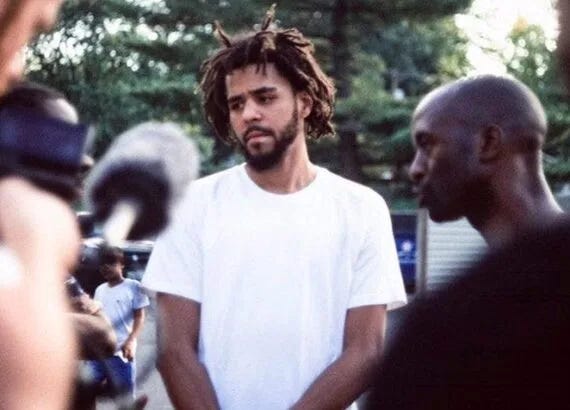
In the album documentary, available on the YouTube channel of Cole’s label, Dreamville, you can access footage from the house’s security cameras during the police entry. The raid videos were also used as material for the visuals in the song’s music video.
The tragicomic episode serves as a starting point for a reflection Cole brings into the composition. With or without financial power, being a Black person in America is, inevitably, being doomed to be watched, living in hostile territory. “A Black man in white territory.”
The first sound you can hear in the opening seconds of “Neighbors” is a sample from “Forbidden Fruit,” from J. Cole’s second album, Born Sinner, released in 2013, played in reverse. Sampling, as an indispensable element of hip-hop culture, is born from the possibility of reinterpreting something that existed in another time, updated, with more nuance. From that point, it’s possible that Cole revisits his own work as a way of establishing a meta-language relationship with the public. Cole now seems to understand, in a more complex way, the responsibilities and challenges that fame and money place on the body of a man like him.
Right after that, Cole’s somber, heavy voice fills the empty space, hungry for verses, delivering the line: “I guess the neighbors think I’m selling dope.” Cole’s tone gives you the spirit of an exhausted man. Then he continues the stanza, exclaiming: “I’m heading back to the South, mama.”
The place the rapper refers to is the state of North Carolina, in the southern region of the United States. Early in his career, when he was taken under Jay-Z’s wing, J. Cole had left the city of Fayetteville, located in Cumberland County, where he grew up and spent part of his adolescence, to try to make it in the economic epicenter of New York. But when he returned to his state, Cole did not go back to his hometown.
Fayetteville is more than 90 kilometers away from where J. Cole bought his house-studio, in the northern area of Raleigh, the capital of North Carolina. With 45,000 inhabitants, the area known as North Raleigh has one of the most financially well-off parts of the state. According to the United States Census Bureau, in 2022 the median household income in the city of Raleigh was $75,000, almost $10,000 more than the overall state average in North Carolina.
Raleigh, despite its diversified ethnic composition, like most states in the federation, shows a strong predominance of white individuals in its territory when compared with the presence of African Americans and other ethnicities. According to the collected data, in 2010 the white population came to represent approximately 57% of the city’s total inhabitants, 28% more than the Black population in the region at the time.
“A Black man in white territory”—that’s how, simply but accurately, J. Cole paints the picture of his return to North Carolina on “Neighbors.”
In the first stanzas of the song, Cole presents the dilemmas of the situation, comments on the path he took with a village mindset, all the pain he went through away from home in the fight to survive, in the pursuit of living the American dream. In the position he was in before fame and money, things like the terrifying possibility of being dead at 16, given the marginalized conditions around him, hovered over his head.
That mindset of having to make things happen very early, the pressure to “win in life,” was a live issue for Cole. But it’s also something that reflects the life experiences of other young Black people from the outskirts of the United States who, like him, find themselves from a very young age taking on responsibilities inversely proportional to how little time they’ve actually been alive. Poverty pushes these teenagers into the labor market earlier, and if they don’t, the lack of prospects makes crime the eventual destination for many of these boys, far from any possibility of a normal youth.
But Jermaine made it past 16, defied the statistics, dodged the destiny programmed by the oppressions around him, and music allowed him to prosper. Shouldn’t that be the end of his complaints? If all the pain caused by lack, by scarcity, is gone, what still troubles him? The pursuit of the American dream, the pursuit of stolen humanity and the possibility of reclaiming it, brings an unavoidable perception with it. Even with all the money and recognition within reach, to society, Cole will never be a white man. And then, this time, it was the police who came knocking to remind him.
During his performance at the Made in America festival in 2017, Jermaine expressed his feelings about the song, the reasons he wrote it, and clarified his move to Raleigh.
“Two years ago, I finished the tour—of the album Forest Hills Drive—I looked at my life, I looked at my career, and I thought, ‘you know what?’ I got to a point where I achieved some things, I’m happy, it’s time to go home. I spent a long time in New York trying to make this happen. And then I went. The first thing I did when I came back was go to the suburbs and buy a house… And I got this house for one reason, just one reason. It was always my dream to have a house with a studio inside. And bringing people into it was always my dream,” Cole said, and then he projected the raid images on the big screen.
“I think it was the neighbor who lives behind me. Because every time he’s back there cutting that grass, he puts out a racist energy, I can feel it. The truth is, from far away I can hear him whispering something like, ‘these damn niggas in my neighborhood.’ He called the police and they did what they did. But even though he was wrong, I take a little responsibility too. And I’ll tell you why. Every time a Black guy makes some money in this country, where does he move? Nine times out of ten, he goes to live next to someone who doesn’t feel comfortable with his presence. But we go anyway, because we feel accomplished. But what we should do is buy property in the neighborhood we came from and build a better community,” he concluded in another passage.
The effects of racism on the psyche of a Black person are immeasurable. And maybe, among the harms caused by racial dehumanization, it’s the one with the greatest lack of research and data, due to the very difficulty of documenting these psycho-aggressions. J. Cole admits he went through a kind of post-traumatic stress that made it impossible for him to sleep peacefully after the raid on his home. In the song, the rapper uses the word “paranoia,” which in the dictionary is linked to the psychiatric concept in which the diagnosed person shows delusions and a persecution complex.
 | A guest post by
|