

Blues at the Top with Bessie Smith
Through the combination of toughness in her temperament, her technical command, and her stature as a performer, Bessie Smith would give vocal blues some of its strongest claims to distinction.
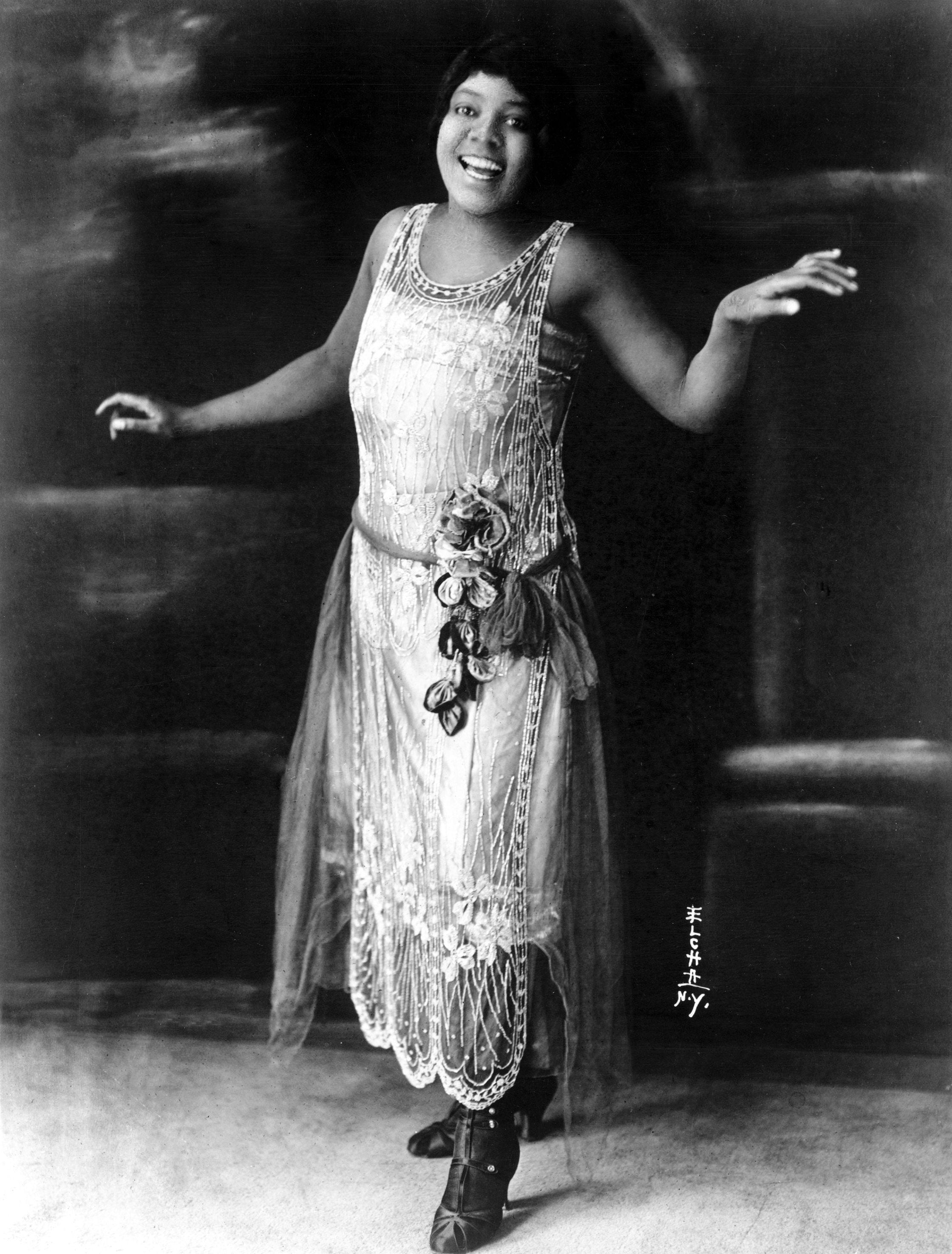
The early years of recorded blues were dominated by women, singers of “vaudeville blues” (or “classic blues”) who performed on Chicago’s South Side, in Harlem, and in traveling shows. This urbanized, theatrical blues, closely associated with jazz, made a spectacular start on record in August 1920 with Mamie Smith’s Crazy Blues, whose sales revealed an unsuspected demand. Singers from theaters and cabarets then poured into recording studios. But beginning in 1923, women with direct ties to the poorest Black communities supplanted the other voices of vaudeville blues. They were Gertrude “Ma” Rainey, Ida Cox, Clara Smith, and above all Bessie Smith, the “Empress” among these queens in a class of her own.
Orphaned in childhood and raised in Chattanooga by an older sister, Bessie Smith was singing and dancing in the streets of the Black neighborhood of Blue Goose Hollow at age nine, fascinated by the minstrel shows that came through town. Her gifts as a performer earned her an appearance in a local theater. Around 1912, she joined Moses Stokes’s troupe as a dancer and met Ma Rainey, already highly popular, whose example helped her establish her own stage presence. As she became better known as a singer, Bessie worked the circuit of tent shows and venues controlled by the Theater Owners’ Booking Association (TOBA), including Atlanta’s 81 Theater, which served as her home base. In Philadelphia, she put together an orchestra. In 1921, she auditioned for the Black-owned label Black Swan but was rejected, her manner and singing judged insufficiently refined and, to put it plainly, coarse.
The decisive year of 1923 saw her appear in a musical with Sidney Bechet, make her recording debut, and enter into a painful marriage with Jack Gee, a night watchman in Philadelphia. Impresario Frank Walker, who had heard her onstage years earlier, brought her to Columbia through pianist Clarence Williams. Her first record paired a version of Alberta Hunter’s Down Hearted Blues with Gulf Coast Blues. It would sell two million copies in a year, drawing attention to a rich, deep contralto and a command of diction that would continue to develop. That success intensified recording activity centered on the blues. Bessie and her namesake Clara Smith both recorded for Columbia and went on to make excellent duets.
Ma Rainey and Ida Cox belonged to the Paramount roster.
Bessie recorded more than 160 titles from 1923 to 1933. She benefited from the rise of radio, and her powerful voice, refined through studio work, was recorded at Columbia under some of the best technical conditions available at the time. With electrical recording in 1925, her phrasing gained nuance, while her feeling preserved what remained rural in this “diva.” Grand, deeply affecting, bawdy with a hint of melancholy, and often comic, Bessie would bridge the country-blues singers recorded after 1925 and the jazz vocalists who emerged in the 1930s.
Popular from the rural South to the urban North, she became the highest-paid star on the TOBA circuit. She went onstage in wigs and pearl ornaments and traveled by train in a private railcar outfitted for her entourage, though she indulged in less showiness than some of her more flamboyant rivals. The title “Empress of the Blues” came from the press. She was a dark-skinned woman with a large build whose face and voice could express abandon as readily as anger, and sexuality in all its dimensions. There was something graceful in her physical solidity. Crowds demanded her and adored her on tours that also brought her before white Southern audiences.
Her repertoire emphasized an independent personality (I Ain’t Gonna Play No Second Fiddle) that was borne out, at least in part, by her life. As generous as she was tough, she could stand up to racist strangers while calling those who failed to defend her cowards, “straighten out” a crooked associate, be stingy with musicians, or lavish help on someone in need. But she drank heavily, and her marriage to Jack Gee became a tragicomedy punctuated by infidelities on both sides, with Bessie having relationships with both men and women. The couple separated without divorcing, and she lived in an unmarried partnership with an old friend, Richard Morgan, until her death in 1937 following a car accident near Clarksdale in the Mississippi Delta.
Among her accompanists were major figures in jazz and blues: cornetists Louis Armstrong, Joe Smith, and Tommy Ladnier; pianists James P. Johnson and Fletcher Henderson; trombonists Charlie Green and Jack Teagarden; and reed players Buster Bailey, Don Redman, Coleman Hawkins, and Chu Berry. Her recordings with Armstrong include masterpieces such as St. Louis Blues (1925), where, against an organ backdrop, the cornet answers Bessie’s languid tone with brisk, sharply articulated countermelodies. Backwater Blues (1927), a twelve-bar blues at a lively tempo in which the singer gives voice to a victim of the Mississippi floods, is often cited as her finest recording; the relationship between the inexorable simplicity of the sung account and James P. Johnson’s swinging piano remains endlessly compelling. Other notable titles include Empty Bed Blues, After You’ve Gone, Poor Man’s Blues, Me and My Gin, and Need a Little Sugar in My Bowl.
Bessie Smith’s career was damaged by the 1929 crash, which shook the recording industry, and by the arrival of talking pictures, which sounded the death knell for the vaudeville style. She nevertheless appeared in the short film St. Louis Blues and continued performing in public. Her final studio sessions, supervised by John Hammond in 1933, show an effort to adapt to the new era that would belong to swing (Do Your Duty).
Everything stopped for her after a collision between the car driven by her companion and a truck traveling ahead of them on September 26, 1937, between Memphis and Clarksdale. The 43-year-old singer lost too much blood before being transferred to a Black hospital. Thousands of people filed past her body in Philadelphia. Her grave, however, remained without a headstone until Janis Joplin and a former employee of Bessie’s had one erected in 1970.