

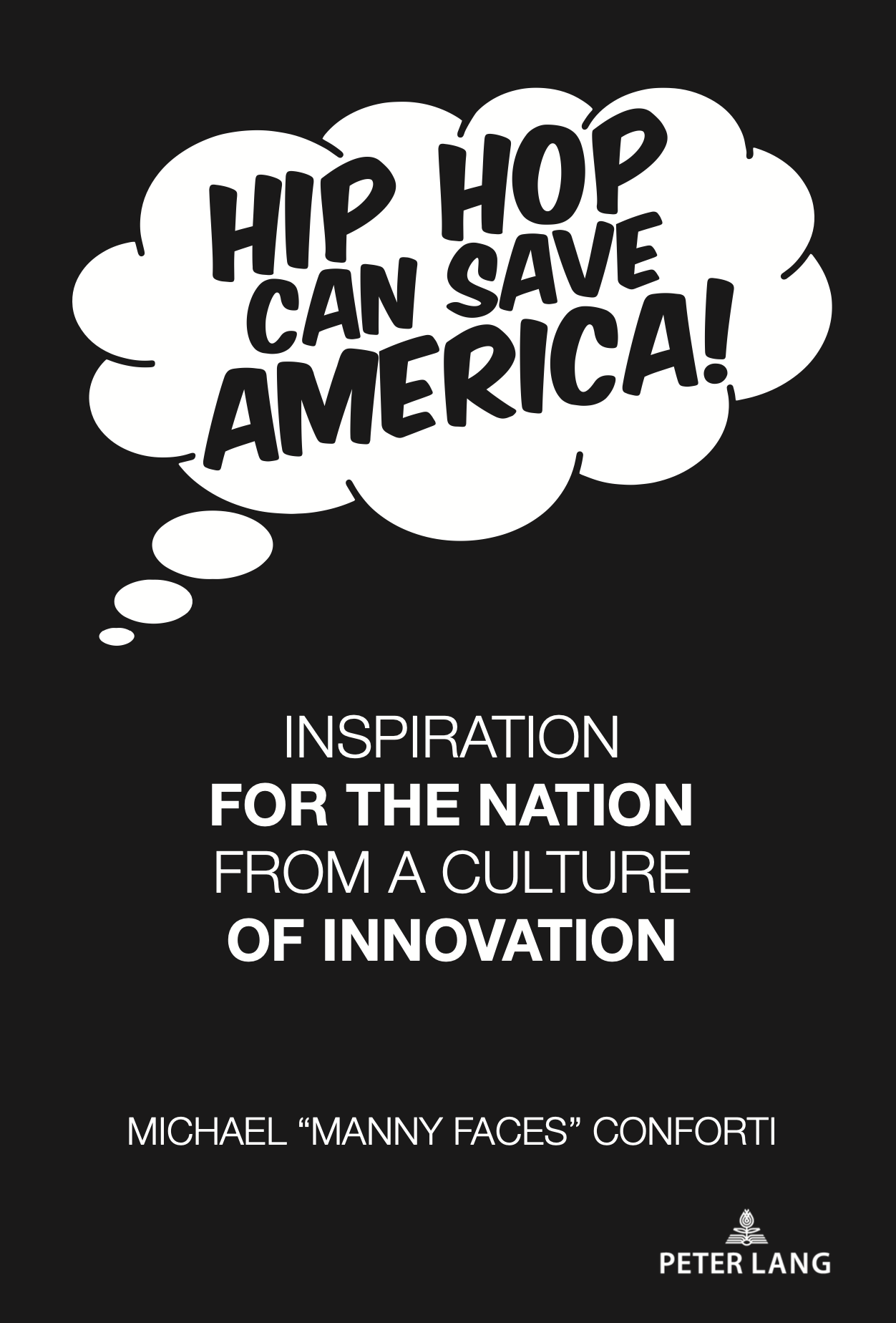
Book Review: Hip Hop Can Save America! (Inspiration for the Nation from a Culture of Innovation) by Manny Faces
Michael Conforti built this book from scratch, one conversation at a time. Published by Peter Lang, it collects seven years of interviews with educators, counselors, archivists, and technologists.
Purchase from Amazon
Purchase from Peter Lang
Purchase from VitalSource
Purchase A Signed Copy
That’s his name, and it’s been that way for decades. Manny Faces spent years covering the NYC scene through Birthplace Magazine before he noticed something. People were doing work with hip-hop that had nothing to do with record sales. Teachers, therapists, archivists, tech instructors, you name it. They were getting results, and nobody was documenting it. So he started a podcast. Booked the guests himself, edited the audio, produced the theme song, made the artwork. The whole thing. Now it’s a book, and the guests he assembled tell the story better than any thesis statement could.
Dr. Ian Levy runs a recording studio inside a New Jersey school. Not a music program—a counseling tool. Kids come in and make what Levy calls “emotionally themed mixtapes.” One student worked through his grandfather’s death by writing about it. Another processed trauma the same way. Levy didn’t invent therapeutic songwriting. He just understood that hip-hop already had the framework built in. The catharsis was always there. He gave it a room and a microphone. Word spread. The studio became known as the place to go when you needed to talk about things. Kids who never sought help before started showing up on their own.
Richard Achee teaches coding through beatmaking. His program, PythonMC, runs on EarSketch software, as students learn variables, loops, and conditionals by manipulating sounds. The pedagogy is clever, but the insight underneath it is simpler: immediate payoff keeps people engaged. Hip-hop’s whole approach to creation, improvising within constraints, flipping something from nothing, is computational thinking. Achee’s students actually learned to code. Some of them went further than that. He sees beatmaking as the entry point, a way to reach kids who might never have considered programming and show them they already have the mindset for it.
Ben Ortiz holds it down at Cornell, assistant curator of a hip-hop collection with over 500,000 artifacts. Concert flyers. Demo tapes. Graffiti photographs. Materials most institutions would have thrown away decades ago. The collection started in 2007 and now comprises around 40 archives. Ortiz calls himself a cultural watchdog, in that he’s fighting the constant pressure to sanitize or commodify what he preserves. When he talks about hip-hop producing “organic intellectuals” who could “become the power,” he’s pointing to a generation that grew up in the culture and now holds positions of institutional authority. The archive is evidence of that shift. What was once dismissed is now being preserved by an Ivy League university. That means something.
Jarritt Sheel, who passed in 2022, provides the book’s most urgent chapter. He was a music educator who spent years arguing that hip-hop belongs in formal curricula alongside European classical traditions. His case was technical, with students learning to DJ acquire signal flow, mixing, EQ, the same audio engineering principles taught in any sound design program. Real skills, transferable skills. But music education remains stuck in what Sheel called a “Germanic European model” that refuses to engage with Blackness. The #HipHopMusicEd movement he helped build was an attempt to change that, one school district at a time, one converted administrator at a time. He details a student named Rameen who became a professional DJ through the program and learned business skills along the way, including booking gigs, managing money, and building a brand. Sheel’s line about hip-hop’s communal ethic stays with you: it “argues for bringing all my boys with me too.” That’s the difference between the culture and competitive individualism right there. His death gives the chapter weight, but Manny handles it without sentimentality.
Dr. Bettina Love and Dr. Gloria Ladson-Billings are the main theorists in the field. Love’s formulation point is that teachers should ‘be hip-hop, not just use it’ is a perfect example of everything wrong with the gimmick approach. You cannot take a culture’s useful elements and deploy them in a different context wihout understanding the culture in which it is embedded. Her project, Get Free, uses hip-hop culture in teaching civics as a form of resistance and community control. The most underdeveloped and most developed communities, in the unique constellation of the circumstances of their creation, are those which demonstrate creativity, improvisation, and social and emotional intelligence, as well as the grad attributes of the community of the condition in which hip-hop is located, the most.
She is not sorry for speaking of hip-hop culture as the best and most representative of what humanity has to offer, the most developed and varied in the fullest scope of all of its attributes. Ladson-Billings has been the grandparent of culturally relevant pedagogy for several decades, and speaks of the educational potential of hip hop in terms of resourcefulness, flipping something from nothing, keeping the beat fresh, and doing more with less. She tells of the Black Panther in STEM teaching, illustrating for the students that true genius does not mean abandoning one’s culture. Both of these scholars are attempting to stretch the already thin institutional recognition of the culture and place that reluctance in the place that most justly belongs, to the discomfort of the participants in the production of the Black culture.
Mikal Amin Lee is a teaching artist in schools, at Rikers Island with Cyphers for Justice, and abroad. He calls hip-hop journalism an authentic form of storytelling that forces America to see and acknowledge its problems. The young people he works with, who are incarcerated, demonstrate what the culture can do in places where traditional systems have failed, where school, and counseling, and care, didn’t reach, but a cypher might. His chapter on Germany illustrates the mobility of these methods across borders, cultures, and languages. The potential of hip-hop is not only in so-called ‘urban’ communities. Lee highlights the importance of meeting the current generation, in contrast to older generations who look down on new artists. This is especially difficult for those who grew up in the Golden Era, but Lee does it.
The more you read, the more you learn. Every chapter tells the story of a different professional, yet every single one of them seems to arrive at the same conclusions. You’re better off being real than chasing after gimmicks. There will always be push back, so be sure to fight the good fight, and be ready to back it up. There are people in hip hop who study the art of critical thinking and cultural analysis. They do it through involvement, not through education. They obsolete the culture that is of greater value than the interests of an academic institution. They don’t build the hip-hop’s activational value. They simply see it and create value, as an addition, to the very same thing.
What runs through every chapter is the receipts. Levy’s studio has a location, students who showed up, and outcomes that can be tracked. Achee’s PythonMC has a curriculum and graduates who actually learned to code. Ortiz’s archive has 500,000 artifacts and a catalog system. Sheel had Rameen and other students who became working professionals. The book avoids using hip-hop’s value as self-evident. Every claim gets grounded in specific programs, specific students, specific results. That discipline separates this from the usual “hip-hop is important” hand-waving. Manny assembled people who’ve been doing the work long enough to show what it produces.
His introduction lays out his own credentials without overdoing it. Grew up embedded in hip-hop, learned production and DJing, worked as an independent journalist covering the scene for years. His father was a sociology professor, which might explain Manny’s comfort moving between academic language and the culture’s vernacular. He can translate. The podcast blossomed from noticing practitioners doing work that nobody was documenting, and the book extends that mission—give the conversations permanence, get them in front of people who need to see them.
Manny’s role as interviewer and synthesizer shapes everything. He knows when to let practitioners carry their own arguments and when to extend the implications in his “Afterthoughts” sections. The best chapters are the ones where he trusts the guest to do the heavy lifting and keeps his commentary brief. He includes discussion questions that position the book for classroom use, which makes sense given the academic press context, but the core appeal is the conversations themselves.
Subscribe to his YouTube channel and Substack below!
First, I would like to commend you on your book review; I enjoyed your review. I think Hip Hop Can Save America. It makes perfect sense when you consider how hip-hop provides young people with a way to process emotions, share their stories, and feel heard in spaces where traditional methods often fail. Long before schools, institutions, or therapy rooms recognized it, hip-hop was already doing the work helping kids survive emotionally, not just succeed academically.
Couldn't agree more. I often find a similar kind of creative flow in my pilates practise, where movement becomes a form of expression. What other unexpected avenues do you think hip-hop has yet to unlock for us?