

Deciphering JAŸ-Z’s Roots Picnic Freestyle
An a cappella verse with nothing under it but his own voice, and he sorts the room into one owner and a crowd of workers.
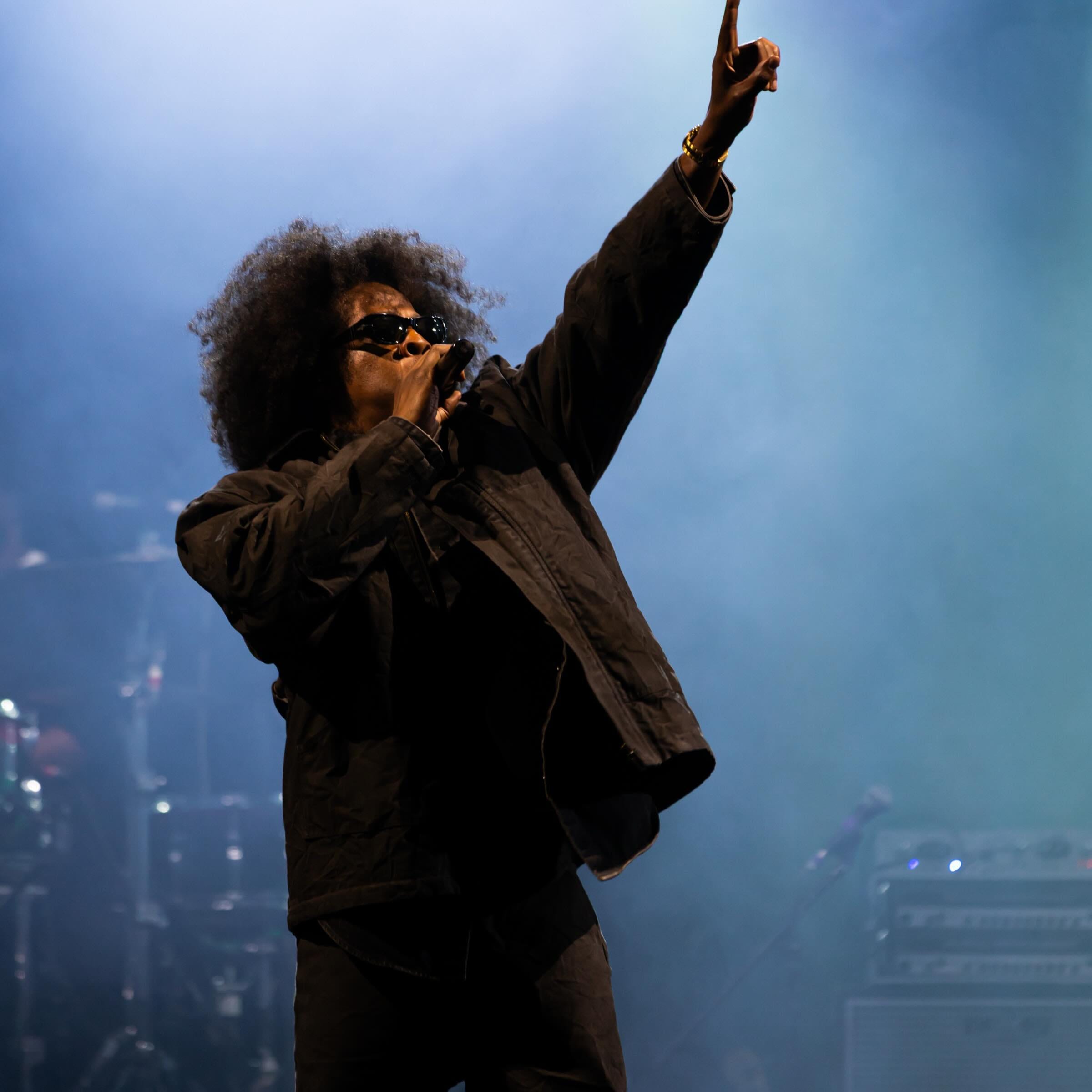
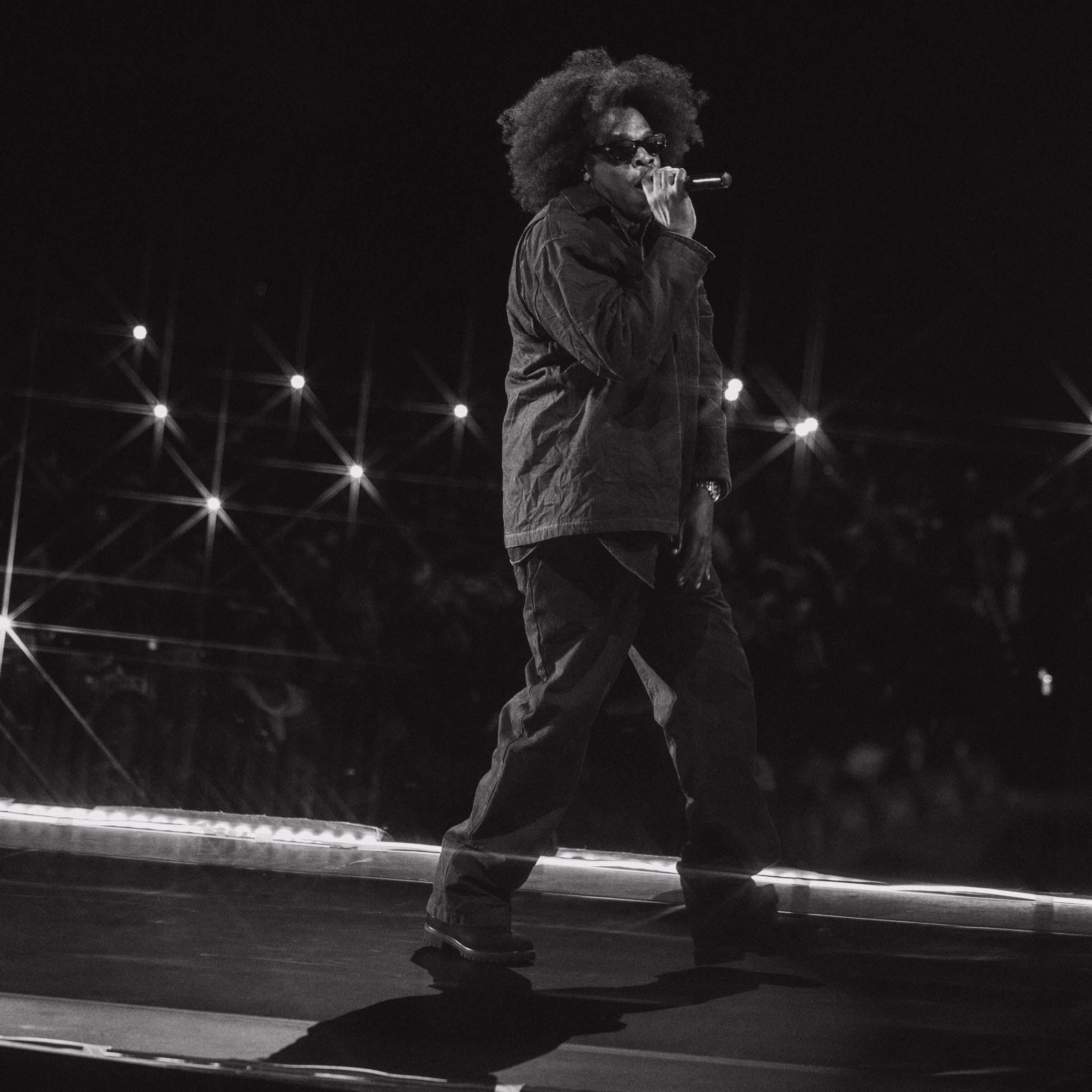
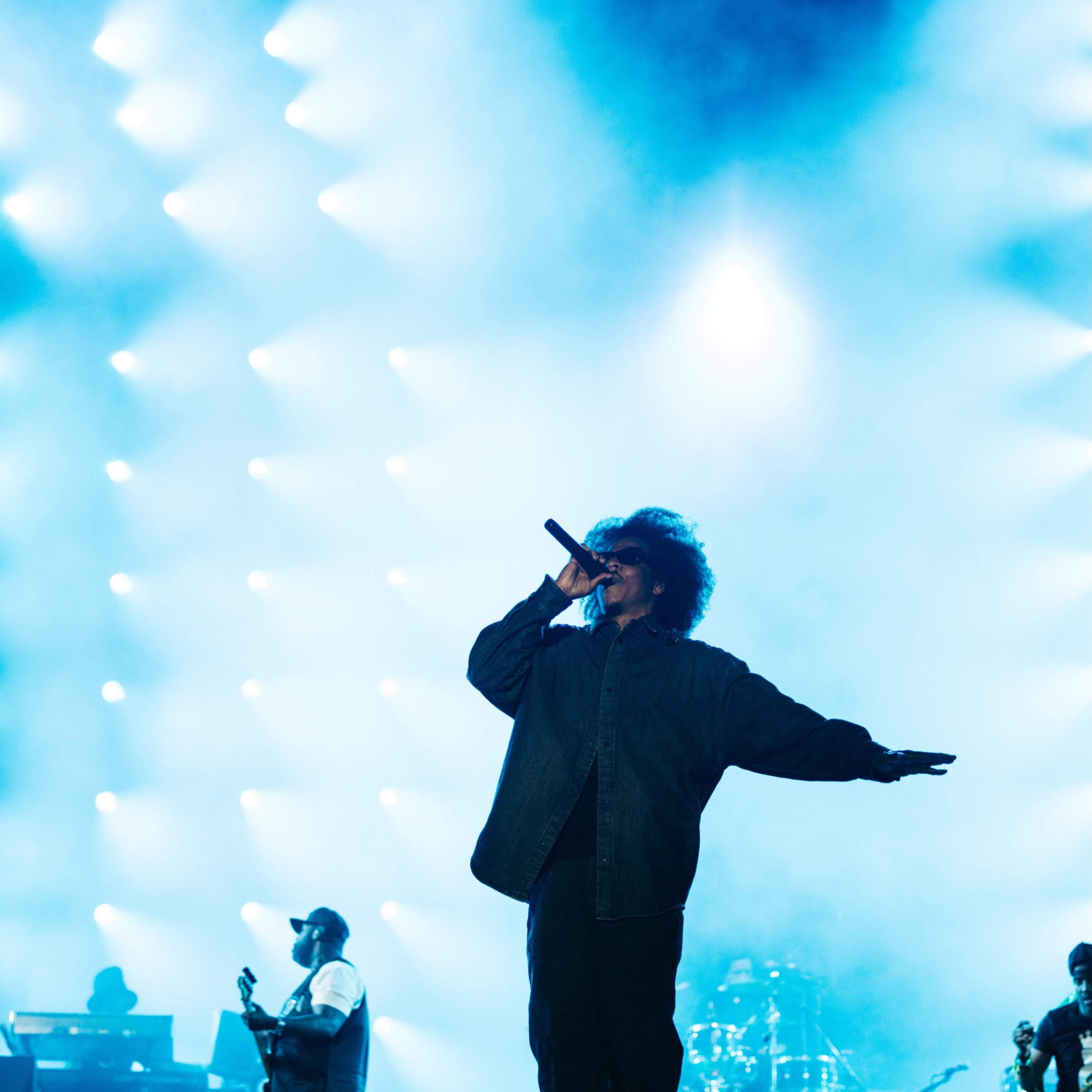
The first night of 2026’s Roots Picnic overran on Belmont Plateau—the wide, green slope in Fairmount Park where the festival made its home this year—and the person who closed it hadn’t performed on a stage in years. He wandered out Saturday in an afro that had grown out and nothing but his voice behind him. Shawn Carter, whose recently-relabeled—with an umlaut—stage name is JAŸ-Z, rapped the entirety of his set a cappella, no beat, no chorus, no features, one verse, from top down to the last bar. The Roots have hosted the festival for two decades, and they were his live band from his 2001 MTV Unplugged set onward, but this time they stood down. Without any beat beneath anything he said, the writing was all that was there, and in it, he constantly divided the room into owners and workers.
When he says, “I still own you suckers, I’ll Marlo you niggas,” it sounds more like a deed. Not a diss (shoutout to The Wire). On the opposite side, Tory Lanez and his Dad, Sonstar Peterson, ain’t safe: “The Roc’s not crumbling, the leprechauns have magically run out of pranks/Your son on the federal jail-line mumbling something/About having, too much in his drink/You know how dumb that is?” The most protracted run goes on the ownership and the publishing of his writing, and everyone in earshot falls to one side of the line. “The crackers got your publishing, gangsta, go talk tough to them,” he raps, then “Don’t talk success to me, you niggas is workers,” then the contract clause: “In perpetuity is how you contract is worded.” The long line of phrases is widely read as a shot directed at Drake, for the issue of him owning his catalog, which, while never specified, provides more emphasis on the lyrics than context. Owner and worker are the only ways he draws the line, and he constantly frames himself as someone who never had to look up at anyone: “Niggas look up to Hov, I never looked up to them.”
His freestyle lives in the ways he picks up and walks away with another’s song. Roberta Flack’s “Killing Me Softly” turns in his throat into a threat, “I’m the one who strummed the pain, that hill (Ms. Lauryn Hill) you could die on” turning to “I’m killing ‘em softly, what’s understood don’t need to be explained.” Public Enemy’s “Public Enemy #1” and “911 Is a Joke,” a track on the delayed response time of the cops, turns into “But 911 is a joke, public enemy number one I’ve been ranked,” the nonexistent aid turning to the establishment’s enemy. The Wire is giving him the cadence of the show, the Marlo Stanfield rhyme of “You want it one way, it’s the other” turning into a threat: And he built the value of his name upon the bones of Destiny’s Child’s “Say My Name.” Each song becomes a thing that he can command or that he can weaponize; it is not much different from his approach to the publishing of his work, but instead applied to popular songs.
Several of the lines perform double and even triple duty. “It’s gon’ cost you a B to even say my name” brings to bear a B as in billion dollars, a B as in wife with the initial (Beyoncé), and a B as in the title of the Destiny’s Child song on which it’s based, all within a few syllables. His eldest alias conflates the idea that the game is over with the thought of that change coming “My next update, the Jig is up,” and “Wrong chart champ you gotta look up again” conflates looking up with 90x—the concept as well as his standing on the charts (someone surpassed him with the most number one albums as a male solo artist). Personas, as well as the scoreboard, inhabit a handful of the same words. Such density is perhaps the facet of him left nowhere to hide on an empty stage—no one trick pony line offers a surface for a rhyme to latch.
The lawsuit itself looms large in the initial bars; it is recounted from beginning to end from his perspective. The lawyer filing the December 2024 assault complaint against him is described as an “1-800 ambulance chaser,” and the suit is recounted as an attack he ultimately withstood. The suit was dropped and dismissed with prejudice in February 2025, and his attorney reports no money changed hands in connection with it, and he denies the allegation entirely. His bars narrate his own victimization and only that.
“The Roots remember, even when the trees pretend.”
Family bookends the grievance. At the top of the section, his grandmother stands as his foil against the years he spent vindicating his name: “Hattie’s turning a hundred,” and his first threat is that had she died before he cleared his name, he would have tracked down every one involved in playing “these silly games.” Under this interpretation, the entire grievance functions as an act of defense, the name cleared on behalf of someone who perhaps would not have lived to see it cleared. His children also serve a similar role when midway through, “My children is some of them” shares space with “Have you niggas no shame,” both universally accepted as his response to public discussion of his kids, and also fiercely protected just like their names. At the end of the freestyle, he’s back with her again: “Hattie loves her Shawnies,” his grandmother pronouncing his son’s nickname by spelling out “S-H-A-W-N” with an extra letter that makes it that much cuter to him. Her love is perhaps the only thing in this entire package given and not taken.
The politics run is the thing the decoders skate by, and it’s doing much more than what they believe. The rapper’s adversaries are not other musicians: “A rapper cannot be my opp, I have MAGA Republicans,” he rhymes, and “Them shots came from the very top of the government, good luck with ‘em. He asserts that the lawsuit that was filed against him was from politicians and that he is speaking back from a place higher than any level any of them can attain: “I’m governed by God, you tryna break the covenant.” Afterward, the use of a homophone shifts the dispute into currency. “I reign for forty days” can be seen as a decree from a monarch, as well as the deluge of the forty days of rain from the scripture; the torrent that results is directed toward the jewelry: “My neck get flooded again/Wrist’ll get flooded again, my net worth went up again.”
The void left by the removal of the stage is the ideology itself, not cushioned by anything. For thirty years, the music has been powered by one system-the man in ownership against those merely borrowing the time-and now it is present without the beats, without a catchy melody and without someone with the authority to share the burden. The lawsuits, the kids (whether you take it as shots toward Ye or Nicki), the borrowed tunes, Oschino (“That nut ass nigga still stuttering”), Dame Dash (“Niggas teeth is tumbling out they mouth and somehow/I’m the one whodunnit, it’s a murder mystery, gang”), even Jaguar Wright (“Quest introduced me to Jaguar, I don’t know why I still fuck with him”), the discussions of popularity in relation to whomever that may concern; all these things are sifted the same way. He has booked three sold-out nights in Yankee Stadium in July; the conjecture of his first full studio album in almost ten years remains unresolved. Between the grandmother and his offspring, it is the boundary between owner and laborer that he protects most ardently, and in the stark nakedness of the empty stage, he revealed all that with no underpinning other than his own voice.