

DMX and the Making of Pain as Doctrine
Every rule Earl Simmons lived by was forged in deprivation, and none of them included an exit clause.
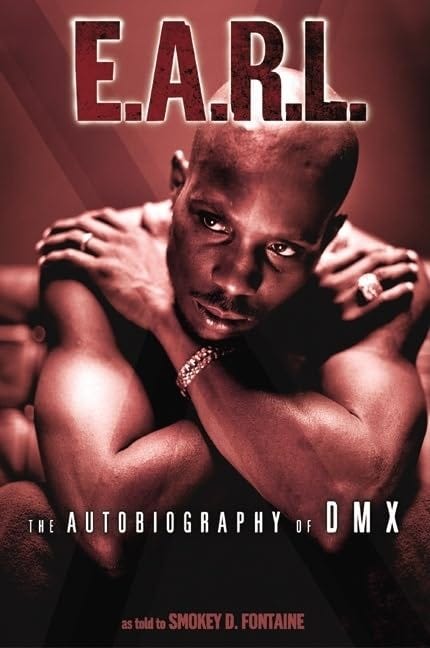
In the prologue of E.A.R.L., Smokey D. Fontaine catches up with DMX on the shoulder of an Arizona highway. The engine is still running, the door flung open, and Earl Simmons is walking toward nothing. Just a desert sky going orange and red. Minutes earlier he’d been on an ATV, covered in reddish-brown dust, calling Tashera on a tiny black cell phone to tell her how beautiful the sky looked. Play-fighting with Phoenix, a three-month-old pit bull, cracking jokes about his security guard’s tight jeans. Then seven miles of highway and the mood flipped completely. He asks Fontaine if he has nightmares. Every night, he says, folks rock him to sleep whispering “We love you DMX!” and then pull out guns and shoot. “When am I ever going to be able to just relax and be me?” A good afternoon and a terrible one inside a single hour. That pattern followed him everywhere he went.
DMX built his code young, and he built it in a stripped room. His mother’s punishments in their Yonkers apartment escalated in stages over months: a weekend locked in, then a full week, then thirty days with every toy removed, the door shut, nothing permitted except meals and water. Earl memorized the cracks in his wall during those stretches, made the paint bubbles look like faces. The ceiling paint peeled off in long strips if you pulled slowly enough, and when that game ran out, the zipper on his pants became a fire engine (the top was the truck, the zip was the ladder). White Fang got read five times. The group home at Andrus had already trained him for solitary living before he turned ten; School Street just extended the sentence. “I became good at shutting everyone out,” he says in the book, “and everybody else in the apartment did the same.” Four closed doors in one apartment, four separate worlds. And the survival skill that carried him through childhood turned into the wall that blocked every relationship he tried to hold onto afterward.
A body that kept failing him taught the next rule. Bronchial asthma inherited from his father put Earl in the emergency room so often the hospital held him for weeks at a stretch. Doctors strapped him into a crib-like bed with a white net over it and pumped in medicated air while he lay pinned, breathing in and out for hours with no way to move. One attack was so severe the paramedics carried him out on a sit-up stretcher after his heart flatlined. His sister told him about that later; he was too young to retain it. Then a car accident: a small boy crossing Riverdale Avenue for a lollipop and a superball, hit so hard he skidded under a parked car. He healed. But afterward, an insurance man showed up at the apartment offering $10,000 in settlement money, and his mother refused it. “My family is Jehovah’s Witness and our faith teaches us to be self-sufficient.” Earl knew that cash was meant for him. Even as a child he understood the math. The adults responsible for you will choose their beliefs over your body. The state will net you to a bed and call it medicine. And the money you’re owed will be waved off by someone who figures God covers the remainder.
On the roof of his grandmother’s building, where he started keeping strays, Earl figured out dogs. “It seemed the more love I gave them, the more love they gave me back,” he writes. “And dogs didn’t know betrayal.” His pit bull Boomer became the most feared animal on the block. Earl’s favorite move was parking Boomer on top of the blue USPS mailbox outside his grandmother’s place, where half the street would cross to the other sidewalk rather than pass within range. Older kids who used to rough him up gave that up once the dog flanked him. Boomer was protection and reputation folded into a single animal. But in Baltimore, Boomer killed stray cats by the dozen, piling the bodies in an alley corner that nobody else dared touch. Earl raised him to be dangerous and smart, loved him for both qualities. He also bred fighters and threw pits together in the projects. His version of loyalty was the version he could command. Total devotion backed by the possibility of harm. The only bond he fully trusted was one where he also held the leash.
Ready Ron was from Brooklyn, and Earl thought he was the best rapper alive. Twenty-seven years old to Earl’s fourteen. The arrangement was simple: Earl beatboxed while Ron rapped at shows and small performances. In return, Earl got his first real picture of what an MC could do, five or six minutes of nonstop rhyming, a crowd eating out of your hand, words landing for the first time in a way that felt like being heard. But Ron also handed him a blunt laced with crack cocaine, a “woolie,” the new thing on the block. No warning about what it would do. “He didn’t tell me how differently it would affect my life,” Earl writes. “He didn’t tell me of the war that I would have to fight to kill my desire.” The man who showed him performance handed him the chemical that would chase him for three decades. After crack, the word “need” reorganized itself entirely. Earl had gone years hungry for food, for attention, for a room he could control. Addiction replaced all of those hungers with one craving that overrode every other instinct, and the doctrine absorbed its cruelest amendment: the person who lifts you and the person who wrecks you can wear the same face.
At Valhalla Correctional Facility, after spitting in a captain’s face and catching a year of solitary confinement in Lockdown Block 3K, Earl found X. “See, DMX was the rapper,” he writes. “But X, X was someone different.”
“X was hunger. X was rage. And when I found X locked up in that cell, I knew that I was losing Earl.”
The split was not a stage trick or a branding exercise. It was an operational decision. Earl could be hurt. X could not. X wanted no letters, no visits, no photographs from home. “Don’t send me pictures, don’t come see me, nothing. Just let me handle my bid.” In the cell, X wrote “Born Loser” while inmates banged on metal bars twenty deep for a beat, rapping until the COs showed up with billy clubs:
“The born loser, not because I choose to be
But because all the bad shit happens to me.”
Earl was the person who suffered. X was the engine that converted suffering into bars. Once X existed, though, Earl had to keep feeding him darkness to stay productive. And every audience he’d ever face would want X before they wanted Earl.
That first prayer came out of Valhalla too, months of cold and dark with nothing but his own thoughts groping above the ceiling. He wrote it in solitary:
“Lord, why is it that I go through so much pain?
All I saw was black, all I felt was rain
I come to you because it’s you who knows
You showed me that everything was black because my eyes were closed.”
None of that was the language of healing or gratitude. It was a status report filed to a commanding officer. DMX prayed the way he fought, with desperation and formality in the same breath. Every album that followed carried a prayer track, a conversation with God tucked at the tail end of records otherwise loaded with robbery stories and the sound of barking. But Black audiences purchased both halves (the aggression and the plea) with no visible need to square one against the other. It’s Dark and Hell Is Hot and Flesh of My Flesh, Blood of My Blood both went to number one in 1998, the only rapper besides Tupac to manage that inside a single calendar year. The public ate his pain as fast as he could produce it, and the industry packaged his code into a product cycle that required him to keep living at his worst. His faith was real. The audience treated it like a closing credit.
Fontaine asked where they should begin telling his story. “I don’t know, dog,” Earl told him from the shoulder of that Arizona highway, the sky gone purple and gray. “You’re just going to have to catch it without catching it.” And then he kept walking, past the convertible with the engine running, past Phoenix barking from the passenger seat, toward a horizon that was already darkening. Tashera was back in New York expecting their third child. The nightmares would come again tonight. Fontaine hit record anyway.
We still miss you, X.