

EP Review: Miami Lice: Season Four by Aesop Rock & Homeboy Sandman
Eight years off the clock and the two oddest pens in indie rap still won’t explain themselves to anybody.
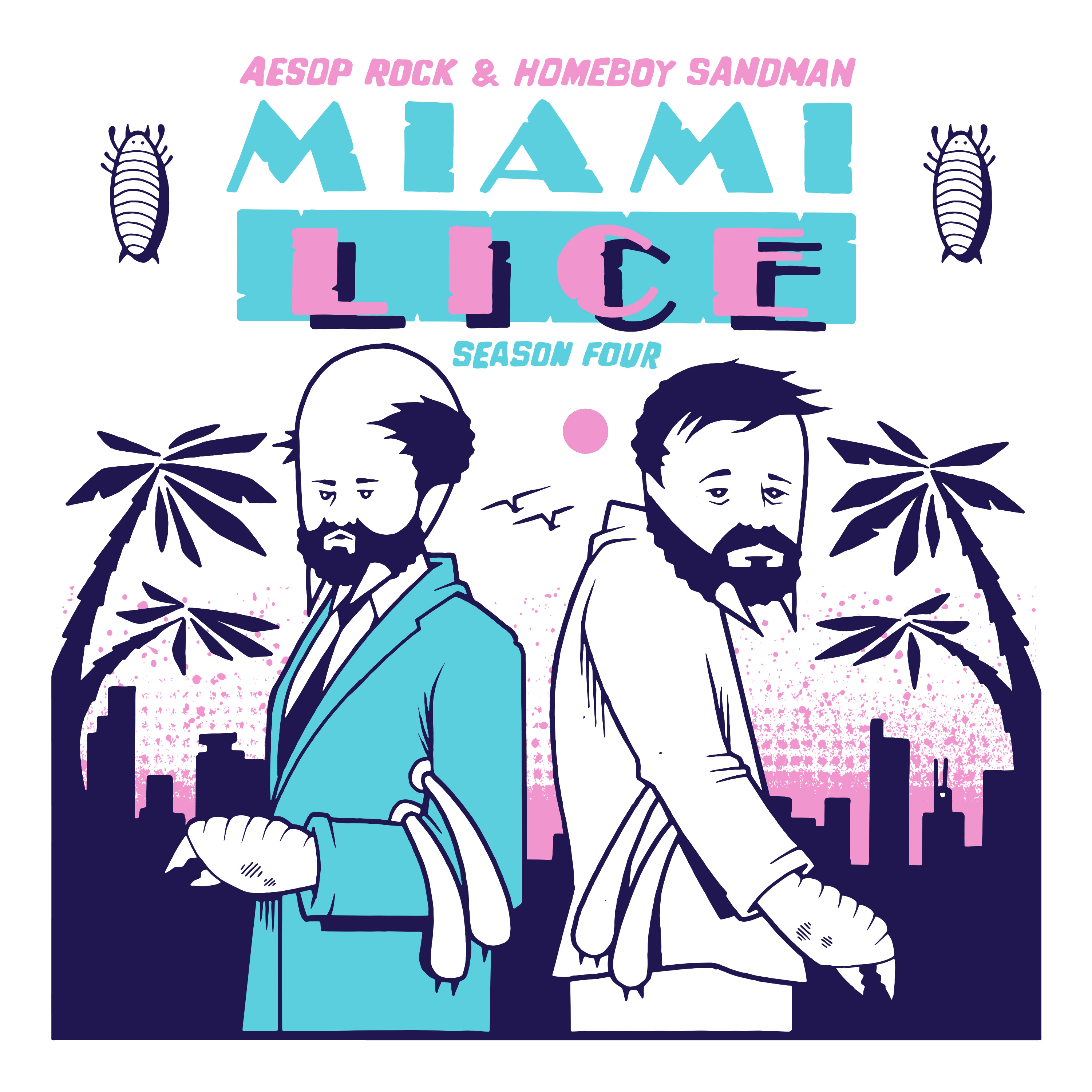
Lice started in 2015 as a free five-track EP on Aesop Rock’s Rhymesayers page, two New York indie rap lifers who liked hanging out enough to record together. Aesop Rock handled the beats. Homeboy Sandman showed up to rap. No features, no label push, no press cycle. They put out Lice Two: Still Buggin’ the next year, Triple Fat Lice in 2017, and then nothing for eight years. Both kept busy on their own. Aesop made Spirit World Field Guide and Integrated Tech Solutions, Sandman put out records with Quelle Chris and Mello Music Group. But the Lice project just went quiet. Miami Lice: Season Four resurfaces with the same format, same rules, same two people. Aesop produces everything, Sandman raps on everything, and nobody guest-appears. The title winks at the gap by calling itself a season, and that’s the only concession to the fact that they’ve been gone.
Aesop claims he survived MK Ultra, that his optimism is all Shrinky Dink, that the body scrub is sea salt and Mexican avocado with strawberries from California and seaweed from Tobago. He calls himself the best-smelling fucker in the foxhole. Three songs later, he’s parachuting out of a Peppa cub looking like the guy from Up, splitting the sea in half while the rains wash away the chapter and the verse. Sandman, on the same tracks, won’t complain about the cost of life, tells his landlord to go ahead and hike the rent, and admits he’ll sit in the dark until he’s sleeping on a bench. Then he overturns it: “I can’t see stars, light pollution/My solution? Pull the plug/Hack the system, plant a bug/Give it all back to the plants and bugs/Nah, I’m kidding, I like being warm.” The split between these two is the whole engine. Aesop buries his meaning in surreal pile-ups where every line tilts away from the last. Sandman drops his meaning flat on the table, then grins at you. They don’t write anything alike and they don’t need to.
Half this EP thrives on institutional distrust, and the funniest thing about it is that nobody raises their voice. On “The Burgers,” Aesop asks what’s in the burgers and then answers for three straight verses of mystery meats from different merchants, cats and dogs and missing persons, Swiss cheese and sacrificial virgins, Bilderbergs, rat poison, dish detergent. Sandman’s turn adds psyops on the bill, free will sizzling on the grill, descendants of the slaves turned slave to the rhythm. The whole cut is an absurd litany of everything wrong with everything, and the punchline is “forget it, don’t sweat it, just add cheese.” On “Uh-Oh,” Sandman never got detention because he left teachers too traumatized, asked too many questions like what took so long to change the name to Commanders from the Redskins, and already knew the answers but was furious the cafeteria food was causing cancer. Neither of them sounds angry. They list the rot and keep their humor dry, which makes the content land harder than a verse full of indignation would.
On “The 1,” Sandman spends an entire song identifying himself through a long chain of specifics. The bald rapper that doesn’t shave his head. The one who after shows gives everybody handshakes. The one that isn’t on Insta, thinks it’s too sinister. The one who only eats plants, who has all the conspiracy theories, who doesn’t use the N-word, who loves God but isn’t religious, who doesn’t care about medical or dental. Every line is “the one that” and then a fact. It could get tedious and it doesn’t, partly because the facts are funny (he’s the one everybody thinks is mental) and partly because Sandman commits to the bit so fully that the song becomes its own argument. You know exactly who this person is when it’s over, and he never asked for approval. Aesop’s version of the same impulse carries across “Moving Day” and “Who Sent You?” without the direct address. He uses a shoe for a phone. Computers explode when he walks into a cubicle. He draws a door in a wall and pushes it open. These images don’t explain anything about him, and they don’t have to. He is the person who thinks these things up. That’s the whole identification.
The back-and-forth format holds for most of the EP, but a couple of the middle songs lose their footing. On “Homework” in particular, the trading of verses settles into a groove that feels routine. While both rappers give strong individual bars—Sandman’s “I don’t care for you calling it rare form/Just seems like a rare thought since I make the rare norm” is among the best couplets on the record—but the seams show a little. The ping-pong can dip into autopilot when neither verse quite talks to the other, when the exchange moves parallel instead of connected. “Uh-Oh” gets away with the same structure because its verses are shorter and stranger, and because Aesop’s wildebeest line (“Love is the answer, in lieu of love, release the wildebeests”) is too weird to feel mechanical.
Sandman found his voice from on the wire and under fire, he tells us on “Evolution,” and didn’t really have a choice. Then Aesop, on his verse, is at the dog park practicing small talk with neighbors. “What kind of dog is that?” and “Oh yeah, this weather sucks”—and then suddenly he’s jettisoning his whole life story to a stranger. “Nobody here invited a horse. I had to go and make it awkward just to quiet the chorus.” He lands on the bigger picture being a light in the forest, for more people to come forward to and light their cigars. Born in New York, he’ll retire in the stars. The EP is full of moments like that, where a line arrives out of nowhere and sticks. Sandman bowls 300 with a human skull. Aesop comes in peace and goes in similar fashion, though he adds a smoke machine and pinch of theatrics. Sandman insists it ain’t a sandwich if it’s open-faced. These two talk about rap the way you’d talk about going for a run, something you do because your body knows how, because you’d feel wrong if you stopped.
Favorite Track(s): “Burnt Mauve,” “The 1,” “The Burgers”
Really fun record, so glad to hear Lice again. Agreed on some of the middle tracks feeling a bit routine, I honestly wouldn't mind a guest rapper or producer coming in to shake things up occasionally. Favourite song was probably The Burgers, felt like the best meeting point between Aes and Sand's styles. Great review!