

Falling in Love with Bruno Mars All Over Again
A world-class superstar who needs no introduction enters a new chapter in romantic mode. The biggest release of 2026, an overwhelmingly entertaining record for the era, has already arrived.
From the grand stage of the Grammy Awards to Don Quijote discount stores. One moment he’s on the other side of a screen, and the next he’s showing up at a Don Quijote in Shibuya. Bruno Mars is a global superstar who also pulls off the vibe of a flashy party boy who could be living in your neighborhood. To put it in terms of recent songs, he sings about the preciousness of love on the rock ballad “Die with a Smile” with Lady Gaga, while on the other hand he’s playing drinking games on the carefree pop track “APT.” with ROSÉ. That’s the range. Fans are tossed around like a rollercoaster by these polar extremes, and they eat it up. And now, this once-in-a-generation entertainer’s first solo album in ten years, The Romantic, is generating massive buzz even before its release.
Right at the start of the new year, he posted “My album is done” on his social media, revealing the completion of the new record, and followed up by announcing a tour tied to the album and the release of a lead single. The new song “I Just Might,” released shortly after, is, broadly speaking, a ‘70s-style retro pop soul track. It’s a quintessentially Bruno, easygoing love song about how he might just fall in love if the woman he spotted on the dance floor can dance with the same glamour she exudes in appearance. It’s an upbeat track in the same vein as early hits like “Marry You,” and the way it calls to mind nostalgic soul-to-pop songs like Leo Sayer’s “You Make Me Feel Like Dancing” could be seen as an extension of Silk Sonic.
Silk Sonic, his collaboration with Anderson .Paak, was a unit that recreated ‘70s soul/funk with the legendary Bootsy Collins as their presenter, singing sweet soul and disco with total sincerity while maintaining a self-aware, tongue-in-cheek perspective on their own retro posturing. The silent partner who contributed to the sound-making behind the scenes was D’Mile, who co-produced the new song “I Just Might.” Born the same year as Bruno, 1985, and hailing from Brooklyn, New York, D’Mile was active as a protégé of Rodney Jerkins in the 2000s and was involved in songs by Mary J. Blige and Janet Jackson. He had been supporting Victoria Monét since around that time, rose to the forefront through his work with Lucky Daye and H.E.R. in the late 2010s, and claimed Grammy glory in the 2020s.
Bruno, who had been paying attention to D’Mile’s body of work, met him through a mutual acquaintance, James Fauntleroy. It’s fair to say that D’Mile was the one who laid the tracks for Bruno to walk as a full-fledged R&B singer, after Bruno had shifted his center of gravity toward R&B on 24K Magic, which featured James’s contributions. Before Silk Sonic, the two co-produced Charlie Wilson’s “Forever Valentine” and Arashi’s “Whenever You Call.” Charlie’s track also involved The Stereotypes, who had contributed to 24K Magic and other projects, and who had lent their hand to “Please Me” with Cardi B and “Fat Juicy & Wet” with Sexyy Red; they were part of the team that pulled Bruno toward the R&B/hip-hop side. Of course, Philip Lawrence, who has contributed as a member of The Smeezingtons since the early works, and bassist Brody Brown, who was also part of the 24K Magic production team known as Shampoo Press & Curl alongside Philip, are key members of the brain trust as well.
The lead single “I Just Might” was co-produced by Bruno and D’Mile, with Philip Lawrence and Brody Brown also participating in the songwriting. From these credits alone, one can imagine it was crafted in the lineage of 24K Magic and Silk Sonic. The musicians are the same crew who stood on stage with Bruno when he performed “I Just Might” at the recent 68th Grammy Awards: trombonist Cameron Weyraum, trumpeter Jimmy King, saxophonist Dwayne Dugger, bassist Jamareo Artis, keyboardist John Fossitt, and his brother Eric Hernandez on percussion, among others who have supported Bruno as The Hooligans. They function as Bruno’s equivalent of James Brown’s JB’s, generating groove through the power of live instrumentation.
Starting with Silk Sonic’s “Leave the Door Open,” which mimicked the sweet soul of The Stylistics, and continuing through Lucky Daye’s “That’s You” and “Die With a Smile” with Lady Gaga, the songs Bruno has made since teaming up with D’Mile have exhibited a grander soul-to-oldies scale and a more pronounced romanticism than his earlier work. This mature approach can be seen as proof that Bruno, who turned 40 last year, has grown musically with age, and it’s intriguing that the new album’s title became The Romantic as part of this trajectory.
The album jacket, featuring a bust-up portrait of Bruno’s face, also catches the eye with its simple, monochrome artwork. The roses and chains framing the jacket, along with the lettering, evoke Chicano (Mexican-American) art and lowrider culture. The word “romantic” itself is emblematic of that culture. Come to think of it, Bruno shot the music video for the aforementioned “Please Me” with Cardi B at a diner called Tacos Mexico in the barrios of East LA. He’s not of Mexican descent, but he has Latin (Puerto Rican) roots, and as someone based in LA, the Chicano community is likely a familiar presence in his life… though that’s merely speculation. However, considering that Bruno has shown affection throughout his career for the kind of sweet soul and doo-wop favored in that community (sometimes called Chicano soul, meaning the soul and oldies that Chicanos listen to), the new album’s jacket and title make perfect sense. You could pick up on that vibe from the “I Just Might” music video as well, in which Bruno plays every band member himself.
Additionally, when you look at the mixing engineers on “I Just Might,” you’ll notice that alongside Charles Moniz, who has been involved in every album since Unorthodox Jukebox, the horn engineering credits include Gabriel Roth and Anthony Marsino. Gabriel Roth, also known as Bosco Mann, is the founder of Daptone Records, and Anthony Marsino is a member of The Mkays, who release music through Daptone-affiliated labels. This connection echoes the use of Daptone associate Homer Steinweiss on 24K Magic and Silk Sonic tracks, but the fact that key figures behind retro/vintage soul, including current Chicano soul acts like Thee Sacred Souls (here meaning soul played and sung by Chicanos), are credited as engineers feels like it may contain a hint about the album’s direction.
By the time this issue hits shelves, the full picture of the album should be clear. In any case, “I Just Might” alone made it obvious that Bruno will deliver his brand of soul with the kind of overwhelming accessibility that transcends generation, race, and nationality. Bruno is such a perfectionist that D’Mile sighs over it, and he surely poured enormous time and effort into everything this time around. Will The Romantic be among the year’s standouts? We will find out, but until then, revisit his discography.
Doo-Wops & Hooligans (2010)
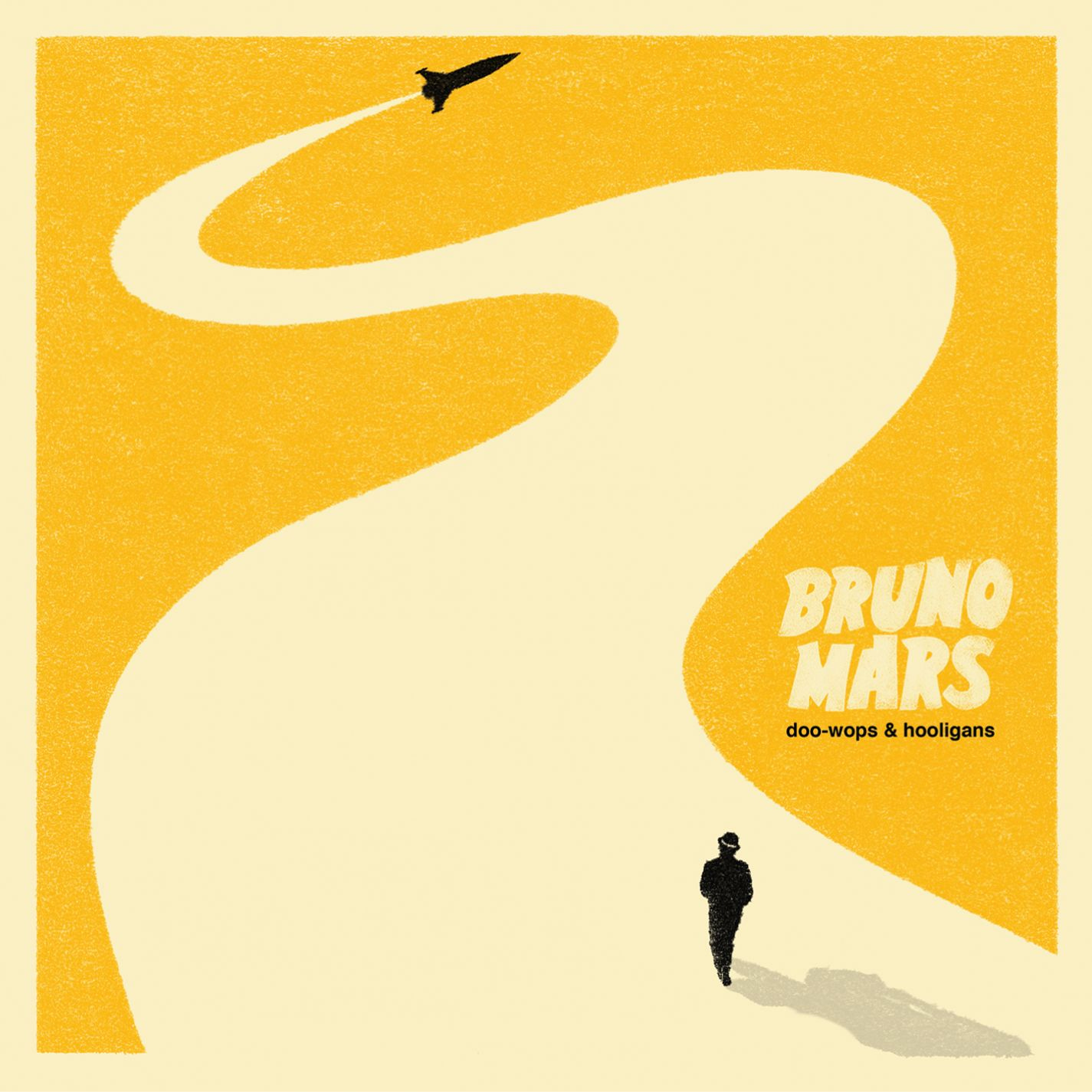
Looking back now, the period around 2010 when Bruno Mars debuted could be described as a transitional era from rockism to poptimism. Born in Hawaii and of mixed Puerto Rican, Filipino, Spanish, and other heritage, he was, in a sense, an artist without a prescribed genre. However, the fact that he possessed a melting pot of influences, from Elvis Presley to Michael Jackson, R&B to rock to funk, ultimately became a massive weapon. To be multicultural is, at the same time, to be accessible to everyone.
Doo-Wops & Hooligans is essentially his recipe book. The opening track “Grenade” is Michael-style pop soul. “Just the Way You Are,” built on piano riffs and breakbeats, is a straight-ahead ballad. The retro funk-rock of “Runaway Baby” sounds like a fusion of Little Richard and James Brown, and this flavor hints at what would eventually become “Uptown Funk” and “APT.” The fact that he could assemble such a wide-ranging set of songs and score massive worldwide hits is a testament to nothing other than his songwriting skill and his ability to pull off any vocal approach.
Ironically, though, critical opinion was split when the album was released. The representative negative take boiled down to: “Does a collection of pop songs with no concept have any real meaning?” As a result, from this point forward, he cleared that hurdle by bringing a theme to each subsequent album. The 2010s were an era when genre boundaries dissolved. Bruno Mars was ahead of that starting point. In other words, this album anticipated the streaming era that was to come.
Unorthodox Jukebox (2012)
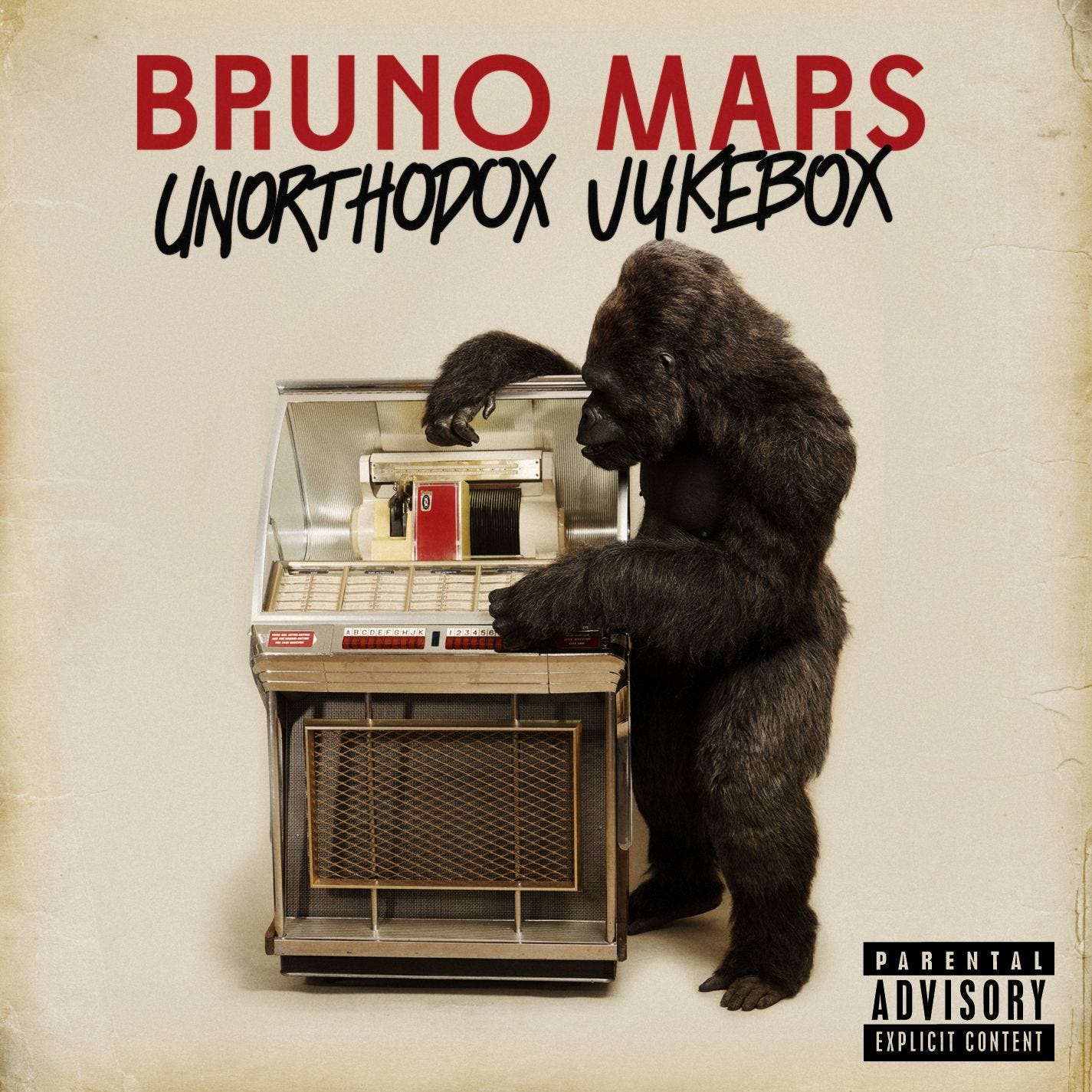
Unorthodox Jukebox was the definitive step in which Bruno Mars went from being simply “a young guy who writes good songs” to “a star who engineers pop music.” After the previous Doo-Wops & Hooligans, which still had a strongly organic, singer-songwriter feel, the groove and sonic architecture on this album clearly entered a new phase. The bass pushed boldly to the forefront, and the rhythms acquired a physical, hip-swaying undulation. The guileless romantic transformed into a showman who consciously played up a playboy persona.
“Locked Out of Heaven,” a reinterpretation of new wave reminiscent of The Police; “Treasure,” which modernized Prince-style 80s funk: every track is armed with a killer hook, demonstrating an editorial ability to cross genres and ultimately funnel everything into pop. Yet at the time, this writer didn’t fully absorb its brilliance. The retro sensibility and soul revival were already part of a wave being pushed forward by Adele and Mark Ronson (who also contributed to this album), and I had somewhat coolly filed this record away as just another hit in that lineage. I suspect many people felt the same way.
But listening now, after the entrenchment of the 80s/90s revival, the resurgence of disco, funk, and new jack swing, the global spread of city pop, Y2K nostalgia, and the culture of fragmented hits driven by TikTok, the impression changes dramatically. This album seems to have already presented the finished form of that wave on the eve of the revival. Its floor-oriented, groove-first rhythmic design resonates with the warmth and sweat of a living body, especially now, in an era overflowing with countless AI-generated sounds. 2012 was still a time before the kind of new-yet-old disco pop exemplified by Dua Lipa’s Future Nostalgia existed. Viewed that way, this album feels not merely like a success, but like a masterpiece that was just slightly ahead of its time, one that arrived far too early.
24K Magic (2016)
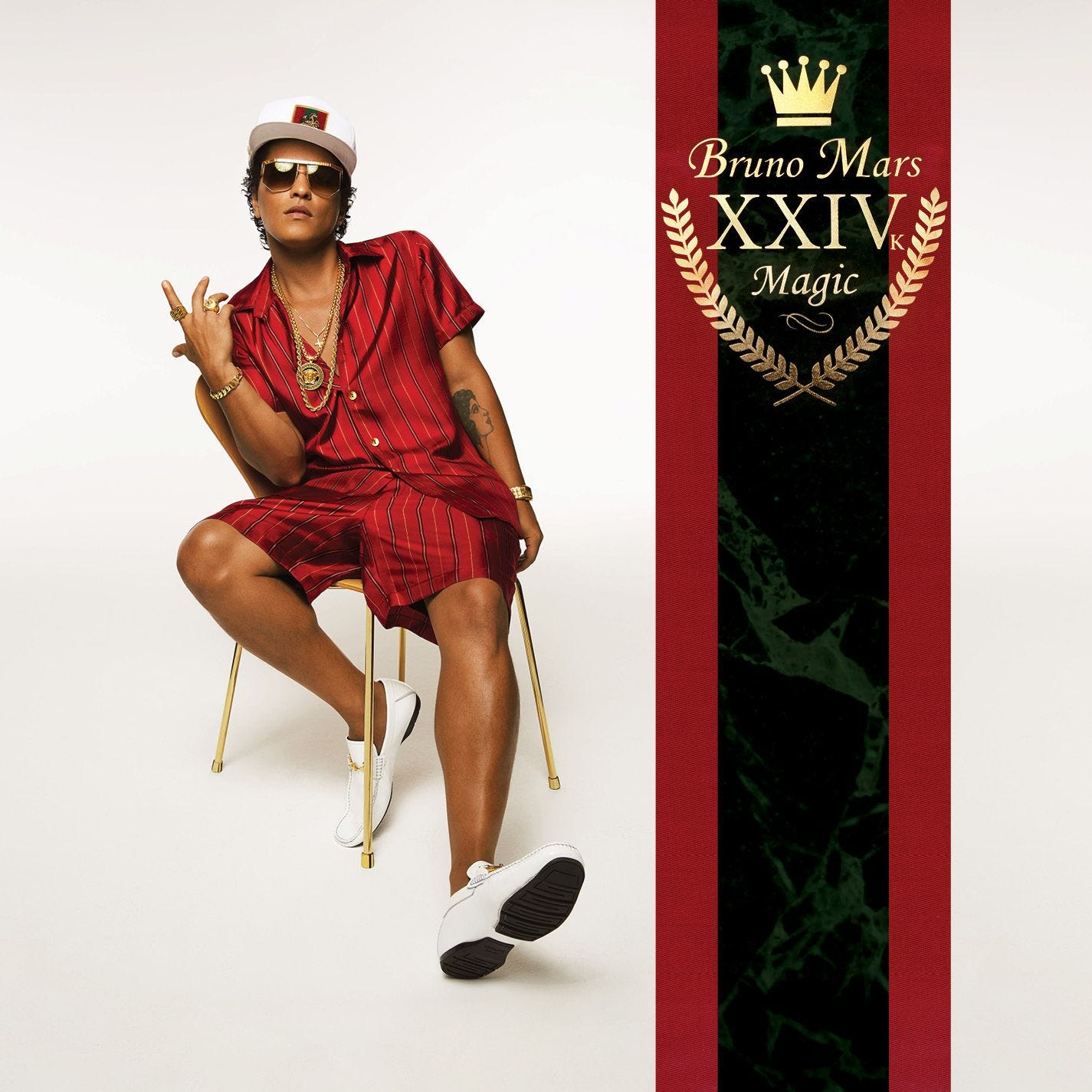
This album sits on the extension of “Uptown Funk” with Mark Ronson and “Treasure” from his own Unorthodox Jukebox. The opening title track “24K Magic,” which kicks off with a talkbox battle cry from Mr. Talkbox (Byron Chambers), is a boogie-funk number that sounds like an 80s classic by Zapp/Roger Troutman or Grandmaster Flash & The Furious Five reinterpreted through a G-funk lens. Led by this title track, the album delivers all nine songs with irresistible catchiness, themed around gold, parties, and sex, matching the jacket image of Bruno posing with a back-alley swagger. The whole thing carries an exhilaration similar to Michael Jackson’s Thriller. The second track, “Chunky,” a bottom-heavy yet smooth mid-groove, is something like the “Baby Be Mine” of this album’s Thriller. Naturally, MJ has been Bruno Mars’s idol since childhood. But in contrast to MJ, who went from the soul/R&B field to become the King of Pop, Bruno used this album to shift toward R&B while maintaining his universal appeal as a pop artist.
The entire album was produced by Shampoo Press & Curl (a new team consisting of Bruno, his close collaborator Philip Lawrence, and Brody Brown), a minor update to The Smeezingtons. Depending on the track, The Stereotypes and Jeff Bhasker, among others, joined the fold. James Fauntleroy, who would become an indispensable presence on Bruno-related songs from this album onward, also contributed songwriting and backing vocals. What this crew set out to create was an homage to R&B from the ‘80s through the early ‘90s.
“Perm,” a funk track that recalls the call-and-response between James Brown (JB) and Bobby Byrd, brings to mind “Feel Right,” the Mystikal-rapped track from Mark Ronson’s Uptown Special, but it also feels close to the sensibility of when Full Force worked with JB in the late 80s. “Versace on the Floor,” a bittersweet slow jam dripping with 80s black contemporary style, evokes the work Maurice Starr did with New Kids on the Block and Perfect Gentlemen. “Straight Up & Down,” with its elegant harmonies, plays like a reimagining of Shy’s “Baby I’m Yours” as a mid-tempo slow groove. At first, these unabashedly straightforward homages made my head spin.
The album closes with a melodic ballad in the ‘70s soul-to-AOR vein, co-penned by Babyface, and nostalgia permeates from start to finish. That said, tracks like “That’s What I Like” incorporate trap conventions, vocals included, reminding you this is still a product of the 2010s. I was enjoying it all with innocent enthusiasm, but from a racial standpoint, some voices accused Bruno of appropriating Black music and culture, given his lack of Black roots. On top of that, criticism emerged that the album was too steeped in nostalgia to qualify as contemporary R&B. The album ultimately became one that raised the question: what even is genre? Afterward, by forming Silk Sonic with Anderson .Paak and bringing in D’Mile as a production partner, Bruno would go on to prove that he wasn’t merely borrowing R&B as a costume. And it was 24K Magic that served as the biggest turning point in his career.
An Evening with Silk Sonic (2021)
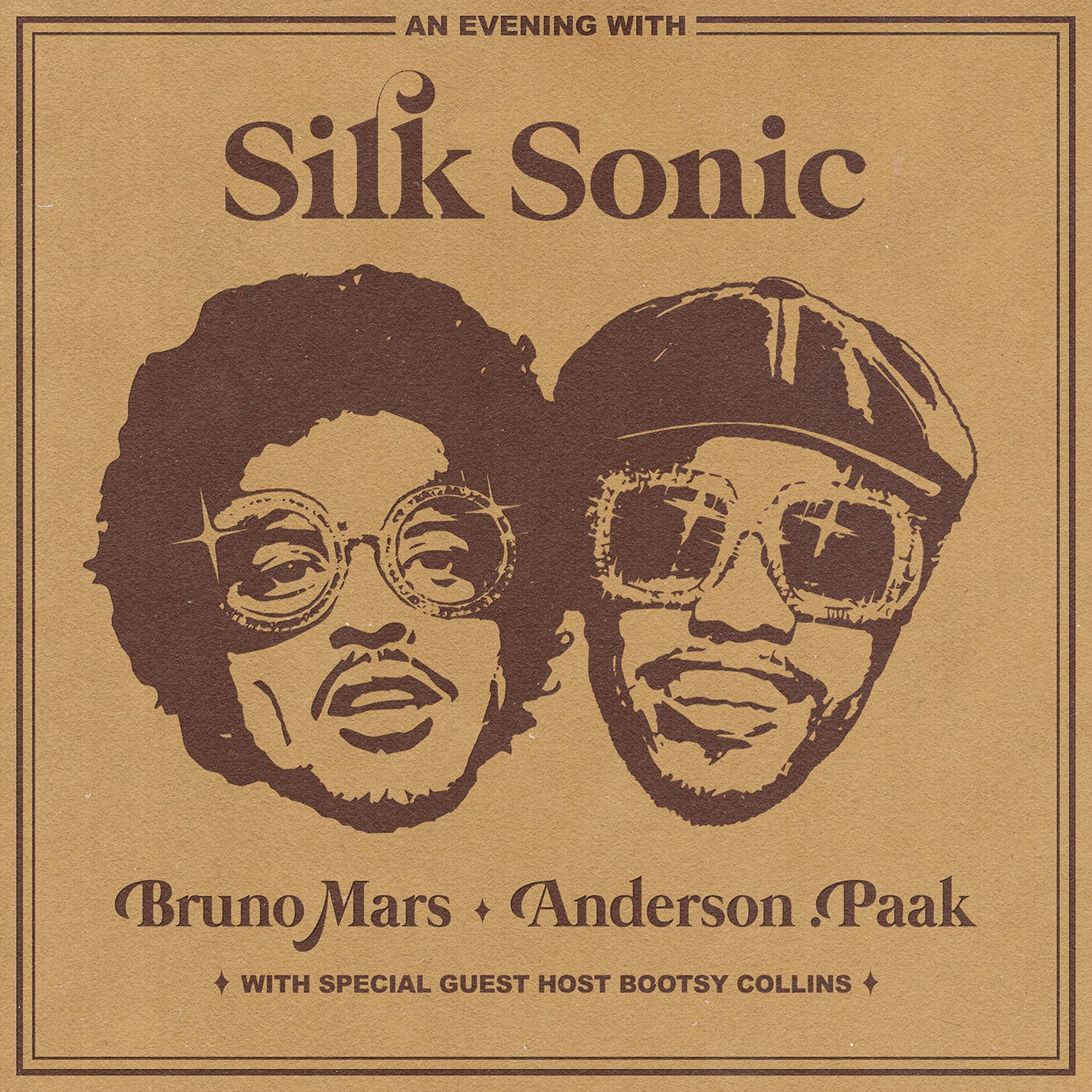
An Evening with Silk Sonic is the product of a fateful one-night encounter between Bruno, who was charging full speed down the path of tailoring America’s “old but goodies” for a new era, and the multi-talented Anderson .Paak. After serving as the opening act on Bruno’s 24K Magic World Tour, .Paak immediately hit it off with him, and the two began making music together as a natural progression. The success of this album reminded us all that musical chemistry matters far more than any balance of name recognition.
If there was one drawback, it’s that both of them are extroverts who are simply too entertaining. Just when they’d established the world of an old-money playboy on the single “Leave the Door Open,” they turn around on “Smokin Out the Window” and paint the picture of a man who’s been used and dumped by a woman with kids, puffing on a cigarette. It’s as if they took a Saturday Night Live sketch and converted it into an R&B song. The reason? They literally turned jokes from backstage banter into tracks. In other words, the whole thing started as an inside joke.
That brightness illuminated a world stuck in the long tunnel of the pandemic. The ability to get even the times on your side is a prerequisite for becoming a superstar. Bruno Mars has that quality. On top of that, both men possess deep knowledge of and love for soul music and are skilled musicians in their own right. The instrumental arrangements that make up the tracks are impeccable, and Bootsy Collins’s participation as a narrator added depth and prestige.
At the time, the sheer quality of “Leave the Door Open,” which won four Grammy Awards, was so towering that the other singles seemed to pale in comparison. But listening back now, five years after its release, you realize that the most enjoyable way to experience the album is to listen to all ten tracks straight through in sequence, soaking in its silky, exquisite sonic world, and that this is exactly what the album was designed for.
Anderson .Paak, who is also a rapper, truly shines on the funk-oriented tracks. The protagonist of “Fly As Me” seems to have stepped right out of a 70s blaxploitation film. “777” is a fitting song for Bruno, who has ties to Las Vegas, but .Paak’s rap verse snaps you back into the 21st century. Revisiting this album, it truly is one night where the magic of one plus one multiplied exponentially.
After the long-running success of this project, Bruno sharpened his performance precision through residency concerts in Las Vegas with his band The Hooligans. Anyone who attended the twelve dome shows across Japan in 2022 and 2024 would have felt that upgrade firsthand.
Having gone through a divorce, .Paak released the album Why Lawd? in 2024 under the NxWorries name, a project with hip-hop producer Knxwledge. His activity pace has been a bit slow for him, but he also made headlines in a different arena with rumors of a relationship with Mariah Carey. Neither of them has denied the possibility of a Silk Sonic sequel. After The Romantic, here’s hoping the two team up once again.