


Five 2010 R&B Albums is a time-capsule series that revisits five distinct projects from a year when R&B was in flux—still tethered to radio cycles, but already bracing for streaming shifts, digital edits, and a changing industry pulse. Fifteen years later, these albums read less like trends (well, depending on the list) and more like blueprints for how artists held on to emotional directness, full-album ambition, and layered vocal craft in an era that was quietly reshaping what R&B would become.
Sade, Soldier of Love

When I first heard the lead single “Soldier of Love,” I thought, “Oh, maybe this time they’re getting closer to hip-hop.” It’s not as if the beat is especially intense, and if it weren’t Sade, it might be only the kind of change you’d miss. If you look at the previous album, Lovers Rock, from more than nine years ago, the drum pattern on “Flow” was hip-hop-like, and yet the hip-hop-ness of “Soldier of Love” is different from that. Is it that “soldier” image, and the marching-band-like drum roll in the drumline, that calls up that kind of image? It’s not new, not at all. How do I put it, it’s like Soul II Soul’s “Keep On Movin’” has reincarnated in 2010, that kind of feeling—maybe you could call it that UK-soul kind of thing. And yet, for Sade, it’s commercial enough, even if it feels like they’re aiming for it. When was the last time they had a single like this?
There are people who make music in order to live. There are people who live so as to make music, throwing themselves into music. There are singers for whom music and life are together. Especially with Black music, often the music is together with the community. But with Sade Adu, none of those feel like they apply. Listening to this new work, I thought about that, especially. One more thing: on the previous album, there were songs with titles like “Slave Song” and “Immigrant,” titles that felt like they were saying, yes, I’m putting a statement in here, but on this album, there isn’t that. “Skin” is a heartbreak song that can even look sensual, and the reggae-tinged “Babyfather,” which includes Adu’s daughter Ila and Stuart Matthewman’s son Clay, also comes out with an open, stretched-out feeling.
There’s something strange about the impression you get from the jacket, too. A flamenco dancer standing at Aztec ruins? That nationality-unknown image is taken on by “The Moon and the Sky,” which opens with a Spanish-sounding guitar. Then, when you shift your eyes to the inner sleeve, a monochrome, landscape-painting-like photo jumps in. That’s right—whether it’s “Morning Bird,” where the strings and piano are beautiful, or “Long Hard Road,” where the acoustic guitar stands out, or “The Safest Place,” which strongly smells of introspection, it’s like a landscape painting. Sade Adu is a strange person: even though the music is this stylish, up to now she’s seemed almost indifferent to sleeve work, but this time she’s brought it close to the music.
And “Be That Easy” and “In Another Time” are waltz-time ballads, and lately Sade has been really good at this kind of tune, like she’s reinterpreted Southern soul in her own way. No wonder, considering that on the 1984 first album they even covered Timmy Thomas’s “Why Can’t We Live Together.” I love this kind of plain—Sade. — Phil
Jaheim, Another Round
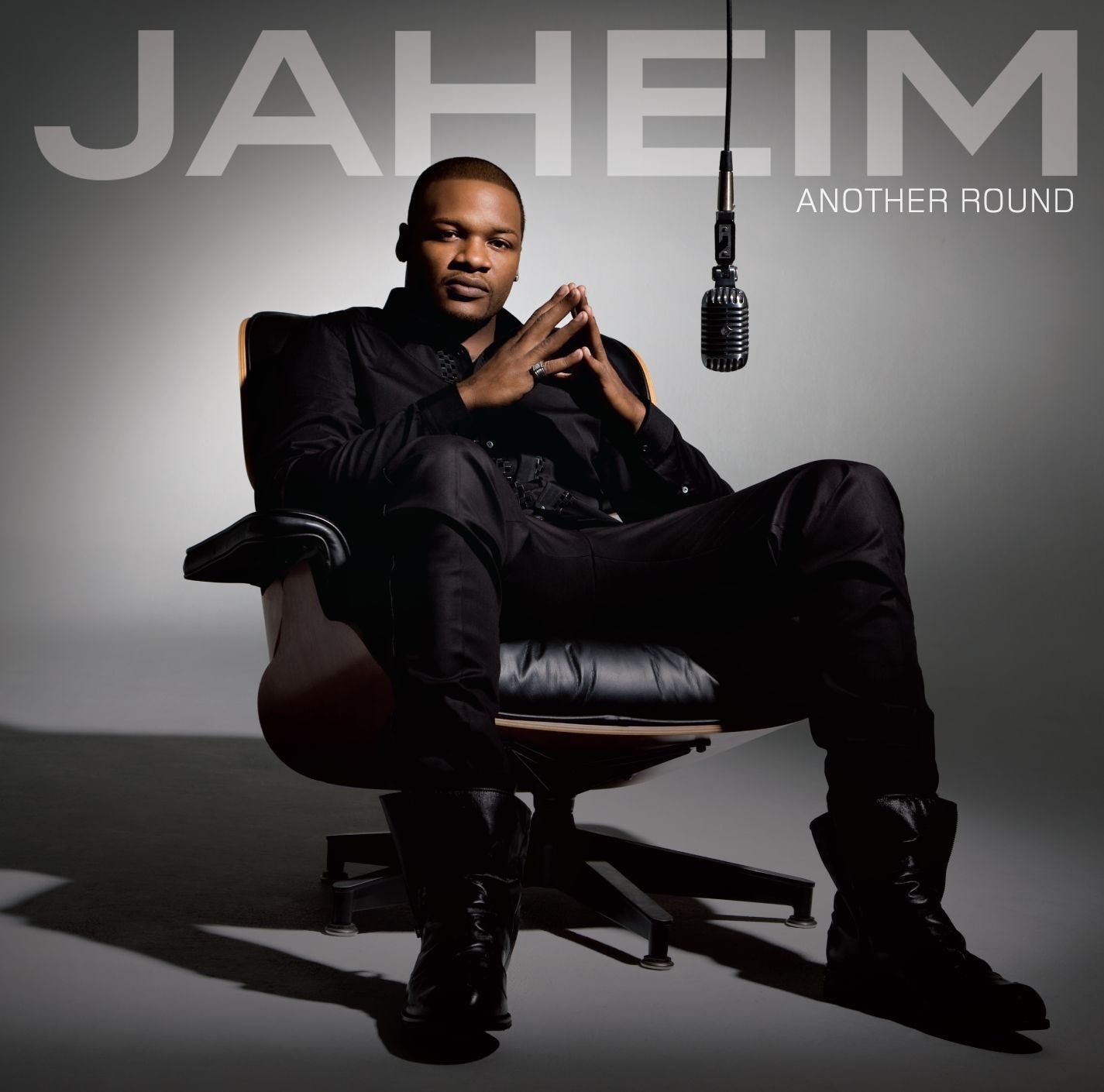
Jaheim is a man who, surprisingly, doesn’t change himself. Since making his album debut in 2001, without leaving the side of KayGee, who picked him up, he’s kept singing ghetto love with a compelling voice that sounds like Luther Vandross made thicker. To be accurate, he left three “ghetto series” albums behind and moved from Divine Mill/Warner to Atlantic and, with a fresh start, released the fourth album, The Makings of a Man, in 2007, so you could say his environment changed to some extent. But even after experiencing that kind of change, on this fifth original album, he’s still teamed up with KayGee on five songs, the most of any participating producer, so it’s hard to think anything other than that he’s consciously chosen not to change. You can also see Darren “D” Wright and Wesley “Wes” Hodges here, who go back with him as well. The strength of those bonds makes Jaheim look even more attractive, as an image of loyalty and manliness.
Of course, the biggest reason he doesn’t change is that there’s no need to change. He doesn’t reach the million-sales first and second, but the third and the post-move fourth also broke 500,000. In recent years, when there are few albums that reach a million, 500,000 is fine to call impressive. In other words, it shows that the artist image Jaheim built at debut, and the musical approach that folds in old soul, has kept being supported by the market for more than seven years. While many singers get swept up by the times and flail around, there was no need at all for him to budge.
The fact that the first single from this album, and the opening track, “Ain’t Leavin Without You,” is an uptempo sample-based KayGee track feels like it proves that. What’s used is The Whatnauts’ funky “Help Is On The Way,” the one De La Soul once laid in bluntly on “Ring Ring Ring (Ha Ha Hey).” KayGee’s skill in tightening up a groove where the bassline pulls and pulls is real, and Jaheim’s vocal skill, laying the song onto the beat with exquisite timing, is also incredible. Attention tends to go to his vocal tone, but this kind of bounce, specific to a hip-hop generation, deserves more evaluation. For sample tracks, the impact of “Impossible,” where JR Rotem samples Percy Sledge’s “When A Man Loves A Woman,” is also intense. It’s the same method as Sean Kingston’s “Beautiful Girls,” where JR got a hit using Ben E. King’s “Stand By Me.”
Of course, like always, the album is packed with plenty of midtempo old-soul-like songs that welcome fans warmly. The title track “Another Round” is the one thing that feels a little out of place, combining that retro style with trance synths, but the rest is basically within expectations. Even so, despite a direction you could call conservative, I can’t bring myself to deny this album at all. When Jaheim softly shakes his voice, then pops charmingly in the high range, on the delicate gospel “Til It Happens To You” built around electric piano and drums by KayGee and Battle Roy, or on “In My Hands,” where KayGee and James Poyser and others seem to have studied Luther’s signature ballad down to the last detail, I end up expecting more and more from him as a Luther follower. He doesn’t change, but his soul has clearly gotten deeper. — Seraphina Joy Clarke
Latif, Love Is Love

Latif’s second album was released only in Japan at the moment. Timing-wise, attention will probably gather on his cover of the late Teddy Pendergrass’s “Love T.K.O.,” and the fact that it’s handled by fellow Philly people Ivan & Carvin makes it beautiful. Those same Ivan & Carvin also produce the midtempo “Leaf In The Wind,” wrapped in neo-Philly mellowness. Since Latif had already worked with them on Musiq Soulchild’s “Teachme,” it’s no surprise the fit is good. Also, Ne-Yo participated in Musiq’s album, but Latif was already a sweet-voiced tenor singer-songwriter before Ne-Yo, so it feels inevitable that on this album, he also teamed up with Stargate. The already-talked-about “Promise Me” and “Don’t Wanna Be” are straight-up on the Ne-Yo “So Sick” / “Sexy Love” line, and Latif’s sweet way of singing is sharp. The Ryan Leslie return from the previous album (this time he even guests) gives “U Think U Know” as a one-loop track, a bittersweet mid-dancer where the sweet voice stands out, and up through the middle, there’s one mellow, beautiful song after another. After the Oak-produced mid-ballad “Departure,” which calls Mario to mind, the “current” feel increases, and in the back half, with euro-house-tinged “Sun Comes Up” and the futurist-sounding, title-matching “Future,” bright synth sounds fly around on uptempos that come at Chris Brown (yuck).
Because it’s a clear, straightforward work that seems like it would go over well in overseas, maybe that’s exactly why it’s hard to be valued in the U.S., but Latif, showing artistic talent while pushing straight ahead on idol-R&B without hesitation, is really refreshing. A full, good release. — Tai Lawson
Joyo Velarde, Love and Understanding
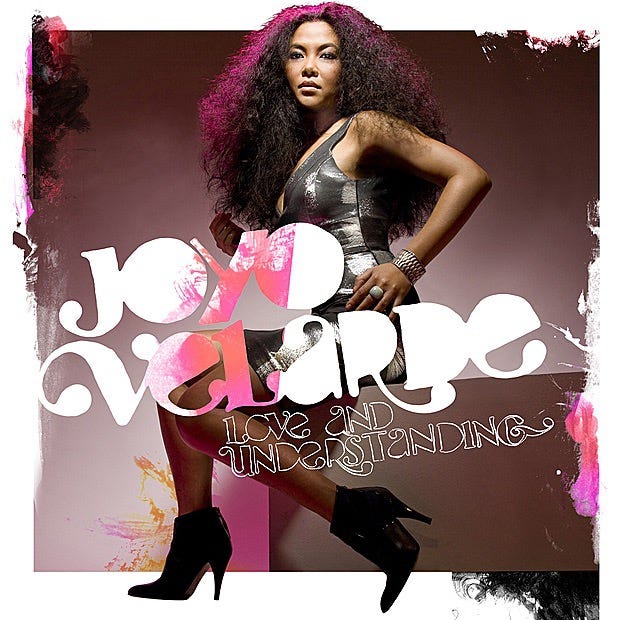
The debut album by the songstress of the West Coast label Quannum Projects. Joyo Velarde is a Filipina from Manila who lives in the Bay Area, with a unique background of having studied opera in Rome. You can hear her singing on Latyrx’s 1997 song “Balcony Beach,” so she already boasts a career of more than ten years. Quannum compilation albums featured solo songs from her, too, and in 2002, she released the single “Sweet Angels,” but full-scale activity had to wait until the 2008 mixtape, Hey Love! And then an EP came out one year before this album, and now, finally, this album arrives.
Running this album, as with her prior solo work, is the other half of Latyrx, and her husband, Tom Shimura a.k.a. Lyrics Born (half Japanese and half Italian American). With West Coast connections, Jake One, Asa Taccone, Headnodic, and Nelson from the Braxton Brothers also lend help. Asa’s opening “Mama’s Got A Brand New Swag (So Exquisite)” is a heroic funk that brings to mind an Amerie Rich Harrison track or something around Ledisi’s recent work, but after that it moves mainly through mellow mid-to-slow R&B. Joyo’s sensual high tone sometimes brings Minnie Riperton or Teena Marie to mind, but especially the way it locks into the more Teena-like recent feel of “Strong Possibility,” “Ticket To Love,” and “You Got Me (In the Mood)” is, in a word, wonderful. Only the closing “On and On” is personally not so great, but aside from that, there isn’t a single throwaway. This is a masterpiece. — Imani Raven
Maysa, A Woman in Love

Released without waiting even a year and a half after the previous album, which went No. 1 on the Contemporary Jazz chart and also hit a best of No. 13 on the R&B chart, Maysa has covers taking up a majority: standard jazz like “‘Round Midnight” and “Willow Weep For Me,” Michel Legrand and others’ “What Are You Doing the Rest of Your Life?,” Doris Day’s “When I Fall in Love,” and Michael Jackson’s “The Lady in My Life,” and so on. The high-quality way of letting a soulful, silky voice ride on an urban jazz sound, with restraint, will probably also play well for jazz FM stations, and it’s impressive, as you’d expect. But originals like the blue bossa “Am I Wrong,” “Love Theory” with Will Downing, and the title track “A Woman In Love,” which brings to mind early-‘90s UK soul, aren’t inferior to the covers at all—if anything, they’re far more interesting. — Keziah Amara Reid
Ate this tf down