

H. Rap Brown’s Long Road Toward a Different Kind of Freedom
His rise from Baton Rouge classrooms to headlines carried a mix of clarity, confrontation, and consequence. That same force followed him into his years of exile, imprisonment, faith, and decline.
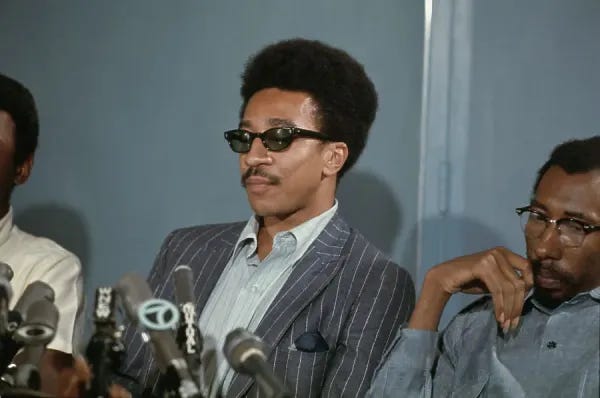
Hubert Gerold Brown came of age in Baton Rouge during the long twilight of Jim Crow. Born on October 4, 1943, he grew up in a working-class family—his father, Eddie Charles Brown, worked for Esso Oil, and his mother, Thelma Warren Brown, took in domestic work and later taught elementary school. By adolescence, he had a gift for verbal sparring in street-corner games of the dozens, a quick, rhythmic wit that earned him the nickname “Rap” long before it became shorthand for a musical genre. After a short stint studying sociology at Southern University, he followed his older brother to Washington, D.C. in the early 1960s. The Nonviolent Action Group (NAG), a student affiliate of the Student Nonviolent Coordinating Committee (SNCC), drew the young organizer into a world of campus sit-ins and community meetings. By 1965, Brown was chair of NAG, able to mobilize college students and poor residents alike and unafraid to criticize President Lyndon Johnson to his face over federal foot-dragging on voting rights.
The movement thrust him toward Alabama, where SNCC sent him to run voter-registration drives in Greene County and to cultivate local “freedom organizations” that would challenge Democratic control at the county level. When Stokely Carmichael was driven from public life by mounting legal troubles in 1967, SNCC’s executive committee elevated Brown to national chair. The man who had been a consummate field organizer suddenly became the personification of a generational revolt. He changed the final “nonviolent” in SNCC’s name to “national,” signaled solidarity with independence struggles in Africa and Asia, and openly cited Mao Zedong and Régis Debray. To reporters, he declared that Black Americans were not bound to obey laws devised to exclude them; “violence is as American as cherry pie,” he said, a line that distilled the rage of those who felt America’s racial hierarchy had been built and defended by force.
Brown’s rhetoric had consequences. In July 1967, he stood on the hood of a car in Cambridge, Maryland, and railed against economic exploitation; comparing the town’s Black residents to colonized peoples around the world, he told them that if the town refused to “come around,” “this town should be burned down.” Shortly afterwards, he was wounded by police buckshot, and fire tore through the city’s predominantly Black Second Ward. States’ attorneys and the Justice Department charged him with inciting to riot and transporting firearms; soon his name appeared in memos from J. Edgar Hoover’s COINTELPRO program instructing agents to discredit and neutralize emerging militants. Brown spent much of 1968 moving between court appearances and jail cells, and his chairmanship ended when Phil Hutchings took over the floundering organization. He briefly served as “minister of justice” for the Black Panther Party, but the weight of indictments and constant surveillance pushed him underground. In March 1970, two of his associates were killed by a car bomb en route to his trial; a warrant followed, and he disappeared.
The fugitive came out in October 1971 amid the gun smoke outside a New York City bar. A shoot-out with police left one officer wounded, and Brown was charged with armed robbery. A jury convicted him, and he entered the grim halls of Attica prison for a five-year term. In Attica, he encountered Dar-ul Islam, a Sunni movement emphasizing community self-sufficiency and orthodox religious practice. The prisoner who had once called for burning down the system now took the name Jamil Abdullah Al-Amin, learned Arabic, and prayed five times a day. Those who visited him later said the conversion was sincere, and that the charisma that had electrified college campuses now drew men in the yard into prayer circles. Behind the walls, he broke with the Black Panthers’ Marxist language and embraced the Qur’an.
Al-Amin left Attica in 1976, determined to build a different kind of revolution. He married Karima Al-Amin and settled in the West End of Atlanta, a neighborhood of boarded-up houses and corner liquor stores. With other members of Dar-ul Islam, he purchased a decaying Victorian home and restored it as a mosque. He opened the Community Store, a small grocery that also served as a cultural center, and quickly became known to residents as “Imam Jamil.” He counseled young men away from crack cocaine, arbitrated neighborhood disputes, and organized midnight basketball games; the civil rights firebrand, neighbors recalled, seemed more like the mayor of the West End than a national radical. In the early years, he sat on stoops with teenage boys, quoting scripture and telling them that the knowledge of self was the most potent weapon. His store’s worn wooden counter displayed Qur’ans and soy milk, and there were as many rumors of him giving food to those who could not pay as there were of him preaching hellfire.
Law enforcement watched the transformation with suspicion. Police in Cobb County stopped Al-Amin in 1999 for driving a stolen Ford Explorer; during the stop, he flashed a police badge from White Hall, Alabama. An investigation found that he was not an officer and that the badge was not legitimate, and he was scheduled to stand trial on theft and impersonation charges. When he failed to appear in court, two Fulton County sheriff’s deputies, Ricky Kinchen and Aldranon English, were sent to serve a warrant at his store on March 16, 2000. The encounter turned deadly. Deputy English later testified that the man they confronted fired at them with an assault rifle, mortally wounding Kinchen and injuring him. English said the shooter had gray eyes; Al-Amin has brown eyes. Both deputies reported striking the assailant, but when Al-Amin was captured four days later in rural Alabama, he bore no bullet wounds. The weapons were recovered in the woods near the scene, but no fingerprints or DNA linked him to them. In 2002, a Fulton County jury convicted him of murder and aggravated assault, and he received a life-without-parole sentence. On the same day, a judge ruled that his original arrest had been the result of an unconstitutional search and seizure.
The trial haunted those who had known the militant or the imam. Former SNCC colleagues pointed to the absence of physical evidence and to an eyewitness who testified he was “absolutely positive” that Al-Amin was not the shooter. Years later, federal inmate Otis Jackson signed a deposition confessing that he, not Al-Amin, shot the deputies, but the testimony never reached jurors. Prosecutors argued that he had both motive and opportunity and invoked his incendiary speeches from the 1960s as evidence of his predisposition toward violence. In the courthouse gallery, his adult sons listened as prosecutors played recordings of their father’s young voice promising armed resistance. When the verdict came, many wondered if the jurors had convicted H. Rap Brown rather than the imam.
Prison officials treated Al-Amin as a high-risk inmate. At Georgia State Prison in Reidsville, he acted as imam for a small group of Muslim prisoners, petitioned for halal diets, and sought to build a mosque within the facility. An internal investigation found no wrongdoing, yet the FBI used the inquiry as justification to transfer him to federal custody. He spent seven years in solitary confinement in the federal supermax at Florence, Colorado, locked in a soundproof cell for twenty-three hours a day. His supporters described the transfer as part of a pattern of harassment that stretched back to COINTELPRO’s files; the bureau compiled more than forty-four thousand pages on him without new charges. In 2014, doctors diagnosed him with multiple myeloma, a cancer of the plasma cells; advocates reported that he received little treatment and developed an immense facial growth that went undiagnosed. A 2017 court ruling found that prosecutors had violated his constitutional right not to testify but nonetheless declined to overturn the conviction, and a federal appeals court two years later agreed that misconduct had occurred but judged it harmless. As his health deteriorated, he was transferred between prisons and eventually sent to the Federal Medical Center in Butner, North Carolina.
By the time he reached Butner, friends said, the man once famous for swagger now moved with the careful grace of an elderly imam. His son, Kairi, and a team of lawyers petitioned courts for a new trial. They enlisted the Innocence Project, arguing that exculpatory evidence had been suppressed and that a government informant scheme had poisoned the investigation. Support networks raised alarms about his swelling face and swelling legs; they circulated photographs of him with a tumor on his cheek and described neglect by prison doctors. In early 2025, supporters pleaded for an emergency transfer to a hospital, warning that “we’re in real time watching the system murder my father,” as Kairi Al-Amin said during an online panel. The Federal Bureau of Prisons eventually moved him to a hospital ward at Butner. On November 23, 2025, after months of severe decline, he died there at age eighty-two. His son, Kairi, confirms the news on his Facebook.
Jamil Abdullah Al-Amin’s life leaves a contradictory imprint. In the 1960s, he embodied a strain of Black Power that rejected moderation and insisted that self-defense was not only lawful but necessary; his mantra that “violence is as American as cherry pie” came to symbolize the rage of a generation that felt excluded from the promises of the civil rights movement. Those speeches fed the FBI’s perception of him as dangerous, and few of his critics ever forgot the Cambridge fires. Yet in Atlanta, he became a fixture of the local Muslim community—a shopkeeper who taught teenagers to pray, a clerk whose aging hands passed out fresh produce and scripture in equal measure.
Through more than two decades in prison, he remained an imam, leading services in cramped cells and memorizing verses for prisoners who could not read. Supporters say he was a political prisoner who carried the weight of COINTELPRO; detractors see him as a man whose militant past caught up with him. His story speaks to the ongoing tensions between radical dissent and state power, between calls for liberation and the criminal justice system’s response. From the playgrounds of Baton Rouge to the yards of Attica and the aisles of a West End grocery, he never stopped demanding that the dignity of Black people be recognized—and that demand continues to echo in movements for racial justice and in debates about the politics of memory.