

In Memory of the Robert Taylor Homes
Open Mike Eagle returns to the Chicago housing project that made him, years after the wrecking ball took it away. Every bar is a brick laid back in place.
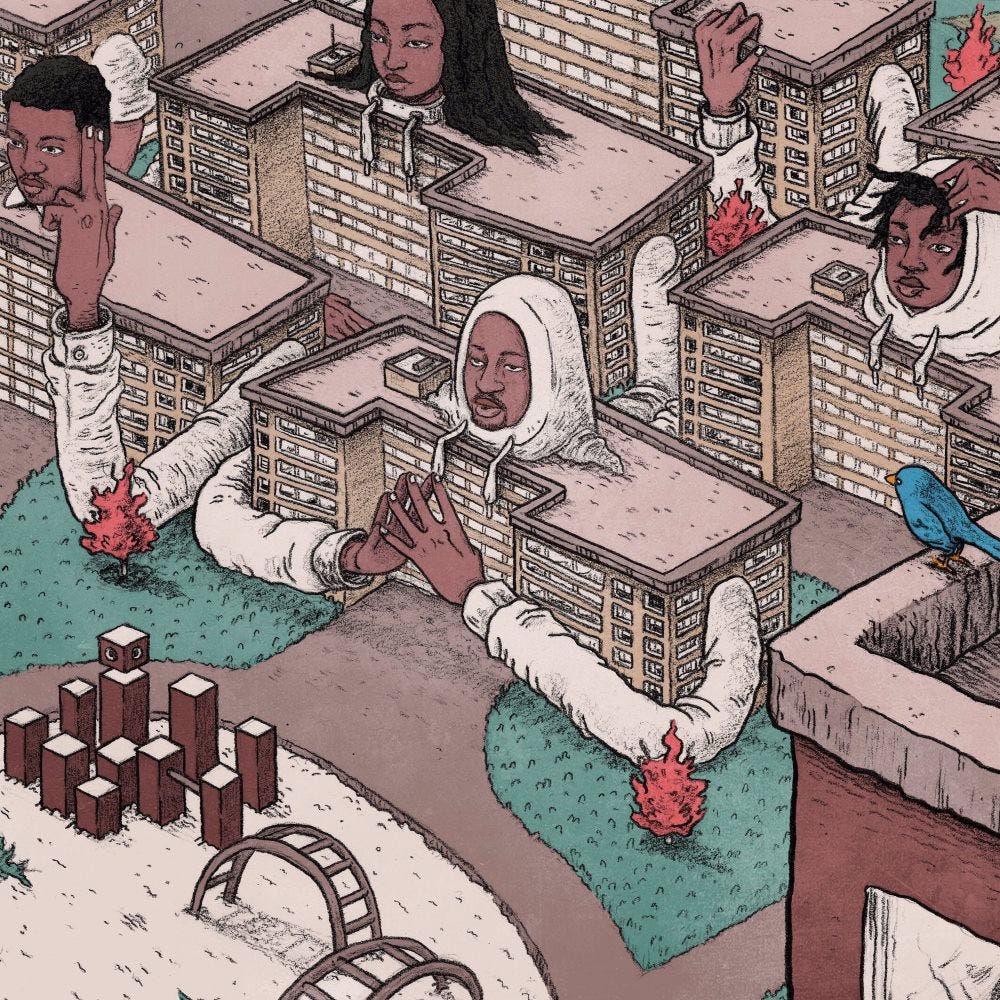
In 2007, the Robert Taylor Homes are demolished. Open Mike Eagle, who grew up on those streets, wants to remember them. A boy looks out of his window with a melancholy expression, surveying a landscape now stripped bare. It feels like standing before a still life painted in urban tones. The silence is barely broken by the whistle of the wind as the mind snaps suddenly to the past. The world once looked like a black-and-white postcard, and those empty spaces were filled by towering buildings. That boy has grown up now. Feet planted firmly on the asphalt, his gaze fixed on the place that watched him grow. We are in the Robert Taylor housing project. From Chicago’s South Side, we see the surrounding landscape through the eyes of Michael Eagle.
The story of this sliver of Chicago is told by the man, now Open Mike Eagle, on Brick Body Kids Still Daydream. Released in 2017, it is a kind of memorial, and every bar brings back to life what no longer exists.
With Nas, we visited Queensbridge along his boulevard of memories. Common, in “The Corner,” described a glimpse of the violent neighborhoods where he was raised. Not far away, Mike gazes mournfully at streets now empty.
“We live in a space that should have never existed.”
Between the bars, the memory of the Taylor Homes comes back to life. Today, in their place, there is only a clearing as vast as it is desolate. With Mike, we wander through the ruins of the mind, traced over the places of his childhood. Tolstoy would say that time is a warrior. Here with us, though, it sets its weapons aside: it will be a simple spectator. By reconstructing the memories, we will uncover the story of the complex. Demolished in 2007, it gave birth to the man behind Open Mike: Michael.
Carried along by the beat, we are transported inside the complex. On “How Could Anybody Feel at Home,” nostalgia is our only companion. The places that watched a young Mike grow up are gone now. Looking back, the rapper reflects: he lived in places that should never have existed. He also sets the microphone aside, if only for a few moments. He puts on a mask, becoming Iron Hood. On “Brick Body Complex,” we meet a Superman of the ghetto, the sole guardian of those homes now destroyed. If “the body is a temple,” here it takes on a more familiar shape. Between the bars, brick by brick, the memories resurface. In the track’s official video, Mike faces a peculiar adversary. We are not in the fictional Latveria so often invoked by MF DOOM: this time, the enemy stands right in front of us. A man in a suit and tie charges at the buildings to reduce them to rubble.
“Can I make an impact if I strike the right tone
And keep saying words into microphone.”
Iron Hood has lost. The well-dressed man surveys the ruins of the complex in triumph. It no longer exists, but every bar sets the memories dancing. “Daydreaming in the Projects” is not just a track but a testimony laid down between kick and snare. Between the silence and the streets, what matters is survival. The rapper says it himself: this is a track for people like him. Close your eyes and imagine you can still hear those kids fighting dragons among the housing blocks. Mike is not just a rapper but an artist who commits nostalgia to canvas, or rather, to beat.
“Ghetto in the way I move
Watch me groove, I’ma sing my blues.”
What is the ghetto? That is the question echoing through the notes of “Breezeway Ritual.” With the rapper, we breathe the heavy air of the housing projects. The silence is broken by the carefree shouts of people who now see only the shadow of their home. “Ghetto” as in a mausoleum of dreams and memory. The story comes to life of those who, for a little warmth, can only turn on the stove burners. These are the monotonous days of people who simply survive. Mike collects memories and blood as he watches the world, trying to understand it.
“Ghetto,” meaning those streets Michael feels are home. He himself admits how difficult it is for him to identify as a “Los Angeles rapper.” The man behind the microphone grew up in the Chicago he describes in his verses. Every person he shared those streets with has something to tell. “My Auntie’s Building” lets their voices be heard again, voices otherwise scattered across the empty space left by the demolished complex. Mike describes the apathetic gaze of those who erect and destroy those apartments. And in the end, despite the rubble, those stories will go on living.
The ghetto he identifies with no longer exists: his own body has been uprooted from the earth.
“That’s the sound of them tearing my body down, to the ground.”