

JAŸ-Z, Kanye West and the Road 2 the Throne
Teacher and student, partners, comrades, and each other’s fiercest rivals. The story of JAŸ-Z and Kanye, who built a joint album together.
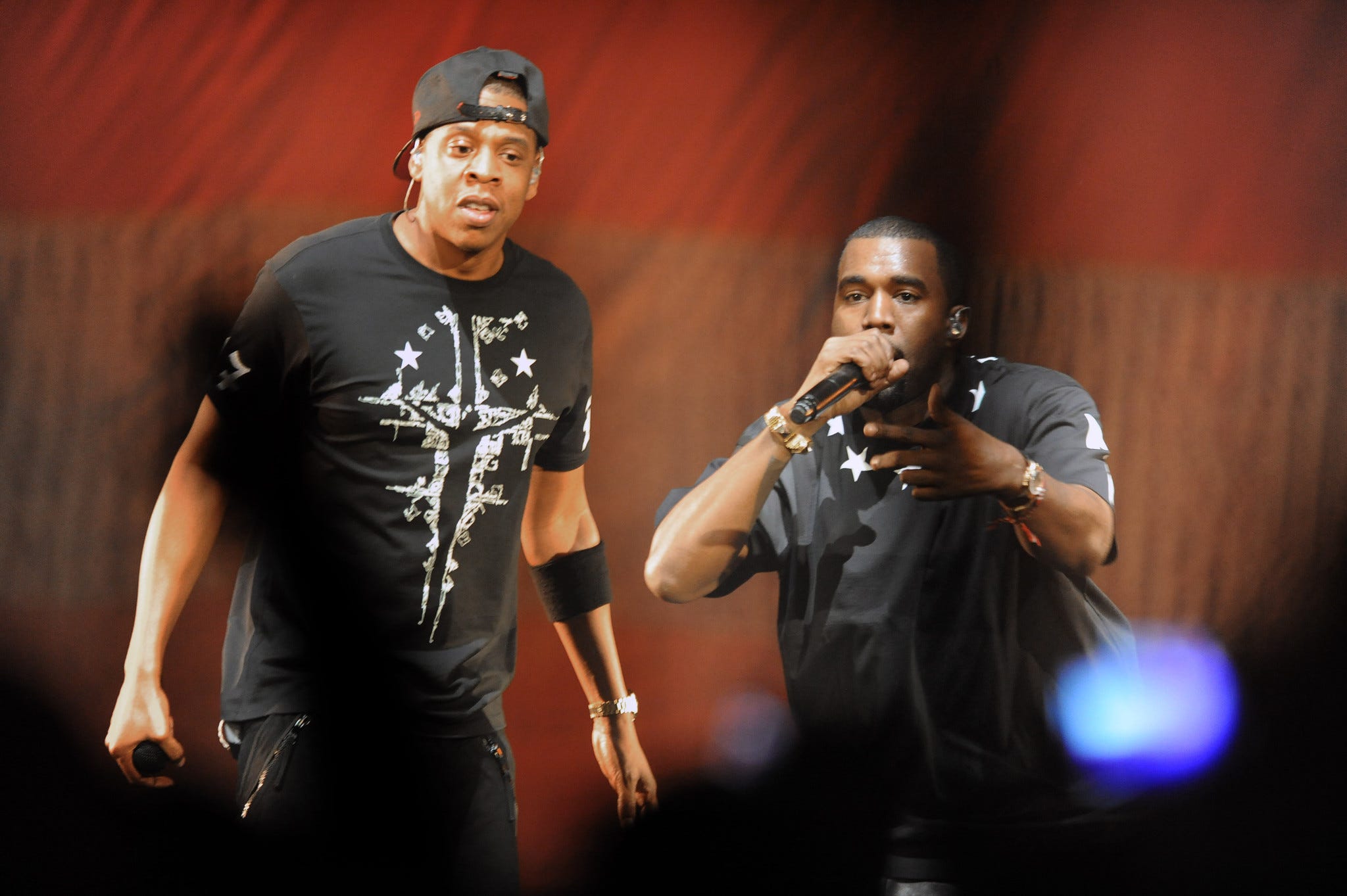
Start your career from the streets of Brooklyn. After a long foundation, JAŸ-Z, a man who climbed to the top of the hip-hop game with his talent as a lyricist and his good intuition in choosing beats. That career has been realized according to the “blueprint” he drew himself, but isn’t there one unexpected thing? That’s why Kanye West, whom he discovered, has become such a big figure. The history of the two people who released Watch the Throne together this month, fifteen years ago today, dates back more than twenty-five years.
The scene at that time was a time when the bouncy punched beats by Timbaland and Swizz Beatz were exterminating the sampling-based track, which had been mainstream until then. While rappers who couldn’t cope with this big beat revolution were dropping out of the front line one after another, JAŸ-Z (he was born in 1969) was already young. In fact, he is the same age as Ice Cube, and Everlast easily rode the bouncy beat and competed for hegemony with DMX and Ja Rule, the stars of the same Diff Jam series. However, originally back in high school, this was a man who honed his skills against the Notorious B.I.G.
Born in 1977 and raised in Chicago, Kanye was deep in his apprentice years at the time, playing his beats for anyone who would listen and selling them off one song at a time. A beat went for a thousand dollars or so, and when he learned that his friend Just Blaze had sold one for ten thousand, he apparently spent his nights crying into his pillow. Even so, No I.D., his mentor in beatmaking, saw the talent in him, and Kanye produced three songs on Changing the Game, the only album by the women’s duo Infamous Syndicate (the group Shawnna was in) that No I.D. put out. He also supplied three tracks to the album by Harlem World, the crew running under Mase, and was starting to make a name in the scene. On top of that, Kanye was serving as an assistant to Deric “D-Dot” Angelettie, the producer behind Bad Boy’s golden era, and there are rumors he was involved uncredited in D-Dot’s productions (on Tell ‘Em Why U Madd, released in 2000 under D-Dot’s Madd Rapper alias, he handled six songs). All of that probably had something to do with catching JAŸ-Z’s interest. When they first met face to face, though, JAŸ seems to have been thrown.
Both JAŸ and Kanye came out of single-mother households (as do roughly 40% of Black families), but Kanye’s mother Donda was an intellectual, a professor at Chicago State University. Raised with middle-class values, Kanye figured it would be rude to show up without dressing well, and turned up in a brand-new size-M T-shirt (an abnormally small size by the hip-hop fashion sense of the day) with Gucci loafers.
JAŸ-Z liked the beat anyway. He handed Kanye the title track of The Truth by his little brother Beanie Sigel, and used one of his tracks on his own The Dynasty: Roc La Familia (2000), released the same year. Originally planned as a Roc-A-Fella Records crew album taking in Beanie, Memphis Bleek and the rest, that record pointedly passed on Timbaland and Swizz Beatz and turned into a place to give chances to trackmakers who were still up-and-coming at the time—or at least not famous nationally—like the Neptunes, Just Blaze, Rick Rock and Bink!. It was a side project of sorts for JAŸ, but when Kanye’s production on “This Can’t Be Life,” built from a sped-up sample of a soul classic’s vocal part, drew attention, JAŸ decided to adopt the approach across the board on his next album.
That album is The Blueprint (2001), the most beloved of all JAŸ’s work among fans. Full of homage to hip-hop’s golden age yet fresh-sounding, the sample-based tracks—with JAŸ’s rapping taking to them like a fish to water—didn’t only soothe New Yorkers knocked flat by the September 11 attacks that happened on its release day; the record won support on a national scale. The hip-hop specialist magazine The Source gave it a perfect five mics, and JAŸ-Z pulled well clear of DMX and Ja Rule to become the victor of the Three Kings era (?). On that masterpiece Kanye contributed four songs, more than anyone else on it: the lead single “Izzo (H.O.V.A.),” which used the Jackson 5’s “I Want You Back” boldly, and “Takeover,” the diss song that set off the battle with Nas, among them. On the follow-up The Blueprint 2: The Gift & The Curse (2002) he handled four more, starting with the Beyoncé duet “‘03 Bonnie & Clyde,” and two on the next one, The Black Album (2003), working as JAŸ’s strategist on the music side. With The Black Album as his last, JAŸ-Z, feeling he had gone as far as a rapper could go, retired from rapping to concentrate on running Def Jam. And as though trading places with him, Kanye stepped out front.
Kanye’s debut as a rapper was apparently a brutal proposition, though. He had reached the top rank as a producer, but that middle-class character described above sat far too far from the ghetto quality a normal rapper was expected to have. Turned down by Capitol and by Def Jam proper, Kanye went crying to Roc-A-Fella and finally debuted with The College Dropout (2004). The album, which collected material he’d been making since 1999, contains zero gangster-themed numbers. What it took as its subjects instead was religion, family, and his own insecurities. On the cover is a stuffed bear rather than the man himself. Un-Roc-A-Fella in every possible way, the album nonetheless entered at No. 2 and became a hit far bigger than any Roc-A-Fella rapper other than JAŸ-Z had managed. Where Memphis and Beanie amounted to scaled-down reproductions of their big brother, Kanye pulled in the kind of listeners who were also playing A Tribe Called Quest and the Roots.
On the follow-up Late Registration (2005) he brought in Jon Brion, the rock-world producer behind Fiona Apple’s work, as co-producer, and put together a grand, dense sound built with orchestration. Picking up support from culture-minded white rock fans as well, he ran up the stairway to stardom. Alongside supplying tracks to outside artists at a furious pace, he sent out singer John Legend and Consequence, from the Tribe circle, on his own GOOD label, and produced the whole of Common’s Be in 2005, building his own family separate from Roc-A-Fella. Kanye’s method—bringing distinctive talent into the family from outside rather than leaning on childhood friends with the same sensibility as his own—would go on to influence Lil Wayne, Rick Ross, and JAŸ-Z himself.
JAŸ-Z, for his part, evidently couldn’t stay satisfied working behind the scenes, and came back after three years with Kingdom Come (2006). Sonically the album was gorgeous and beyond reproach, with Dr. Dre mixing every song, but the lyrics, which emphasized that he’d become a sensible adult, went over badly with fans who had been waiting for Jigga to return. JAŸ corrected course in response with American Gangster (2007), released the following year as a work inspired by the film of the same name. Deploying the gangsta lyrics of his debut era across the whole record, he won his core support back. This time, though, the sound took a step backward. Bringing in Sean C & lV, Just Blaze, DJ Toomp, Pharrell Williams, and the Bad Boy production team—you can understand the “this is the sound I actually love” impulse behind it almost painfully—couldn’t give listeners the freshness of the Blueprint days. And so JAŸ found himself needing to make a masterpiece nobody could argue with.
On the other hand, from the experience of the tour with U2, Kanye turned his musicality to the sound with gaps in large-scale venues. Released his third studio effort, Graduation (2007), which incorporates electronic and Dirty South flavors. Winning the same-day release showdown against 50 Cent’s Curtis, he hit the peak of his career—and then his mother Donda died suddenly from a failed cosmetic surgery. Consumed by regret (“If I had never moved to L.A. she’d be alive.”), Kanye’s private life fell apart, and his engagement ended because of it.Buried in himself, he gave up rapping and released the problem LP 808s & Heartbreak (2008), which sang loneliness and emptiness with an auto-tune on a cold, hammering track. Now that Kid Cudi and Drake were bubbling during that phase, the album can no longer be said to be a particularly excessive work, but at that time, there was a risk that it could have a thick career. Nevertheless, it was probably because of JAŸ-Z’s strong support. JAŸ had seen the future of hip-hop in that sound.
The proof: on The Blueprint 3 (2009), JAŸ-Z not only entrusted half the songs to Kanye, who hadn’t taken part in the previous album, but installed him as co-executive producer. Letting organic-sounding numbers like “Death of Auto-Tune” and “Empire State of Mind,” which JAŸ himself presumably led, coexist with numbers in the 808s & Heartbreak vein, he recorded his biggest hit since the comeback. And it’s still fresh in the memory that when Kanye, his private life as chaotic as ever, famously interrupted Taylor Swift at the MTV Music Awards and took a beating from the press, JAŸ shut it down with a line about not whipping a dead horse and defended him completely.
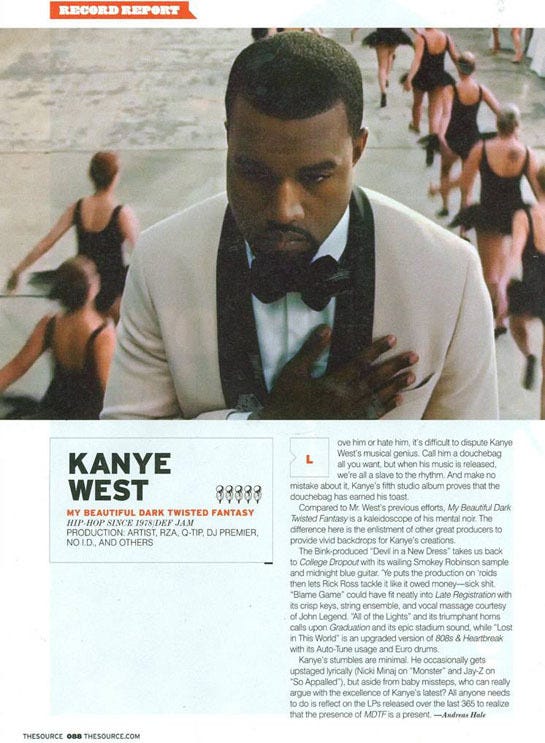
Kanye then went into seclusion in Hawaii, pouring an enormous amount of time into making an album. RZA of Wu-Tang Clan, Q-Tip, DJ Premier, Pete Rock and other architects of ‘90s East Coast hip-hop were invited out to Hawaii one after another, and it was reported as news at the time. The finished My Beautiful Dark Twisted Fantasy (2010) came out a heavyweight record, the culmination of everything Kanye had done to that point, taking five mics in The Source and praise from rock-side media like Rolling Stone and Pitchfork as the album that represented 2010. But not everything those pioneers made on their pilgrimage to Hawaii ended up on it. So where did the tracks those celebrated trackmakers handed over go?
The answer is probably in Watch the Throne. Listening back through the tracks he’d been given, Kanye must have concluded that JAŸ-Z suited them better than he did, and gone on to conceive a joint album. Reported last August as a five-song release due before the end of the year, the project expanded all the way into a full album. It came together as a collection mixing Kanye’s own productions with tracks from Lex Luger and others, but for a Kanye who had gone as far as a sound creator can go while steadily losing hold of what he wanted to say (count the number of guest rappers on My Beautiful Dark Twisted Fantasy), a record where he tests himself as one rapper against a genius rapper had to be a return to first principles. At the same time, for a JAŸ-Z with the prior offense of turning The Dynasty: Roc La Familia into an album under his own name alone, this record can be called proof that he recognizes Kanye as an equal partner rather than a little brother. After all, a man who finishes his own albums in half a month or so respected Kanye enough to wait more than six months for this one to be done.
JAŸ-Z and Kanye as they stand now are partners and rivals at once. JAŸ-Z has put Roc Nation into full operation, distributed through the Epic run by his Def Jam-era boss L.A. Reid, releasing work by newcomers like J. Cole and Jay Electronica. Kanye’s GOOD, on the other side, has settled its distribution with Def Jam, and with Pusha T and CyHi plus the acquisition of Yasiin Bey, it’s showing the kind of development that calls the old Roc-A-Fella to mind. Just as they did the past ten years, these two will surely be the ones firing up the hip-hop scene for the next ten. And that must be drawn into JAŸ-Z’s “blueprint” too.