

June 2026 Roundups: The Best Albums of the Month
June 2026 buried the rest of the year in two weeks. Seventy-some records deep, and the drop-off doesn’t start anywhere near the bottom.
There is no comfort here. June is the month in which rap men run out of clean places to bury their pain. Vince Staples spends Cry Baby inside a vocal booth calling out America and its evil ways; Maxo Kream calls a street that, like his depression, he can take nowhere when he raps O.Y.N; T. I. compares the hospice-ward death of a friend to the child dying for his country he witnessed on Kill the King; BabyChiefDoit ends an unsent letter to a live father by wondering whether he’s proud or ashamed. Mach-Hommy chuckles through one umpteenth feigned homage to Coming to America to word from his pastor in a single breath, and Swamp Dogg, eighty-three, scrawls a letter to a sleeping three-year old: Why is there a flag on my papa’s coffin? They have nothing to lean on except God, the gun, and the booth.
The women transformed the pain into power. Jessie Reyez catalogs all the tools she has at her disposal to wreck her ex on A Little Vengeance and states she will not use any of them; Chlöe finds a conman at a Motel 6 on Resurrection and denies him dignity in the death; PLUTO counts her pounds before she opens her mouth and makes sure men ask; Ama loses two fights with herself and wins every other one. kwn writes seduction to other women in the obtuse language of late- '90s American rock anthem, and Inayah is so enraged that a public breakup happened that she’s still steaming about it a week later. Acutely funny, clever and almost never asking for pity.
Nothing else this month was live or tight. Sparklmami did her single-take debut; Jalen Ngonda kept trying to rescue a soul’s ruin instead of its pursuit; Devon Gilfillian would rather wager a band in a room over a screen; Cécile McLorin Salvant lugged an orchestra behind the songs she selected for hurting more than for splendor. Down below, Mickey Diamond and Jules Clay kept balancing the firearm with the Scriptures, and MXKA blew over the women who usually get sung at with corridos tumbados. So far, this has been the densest month. Keep reading and scrolling.
K, Le Maestro, 2 LIVE!
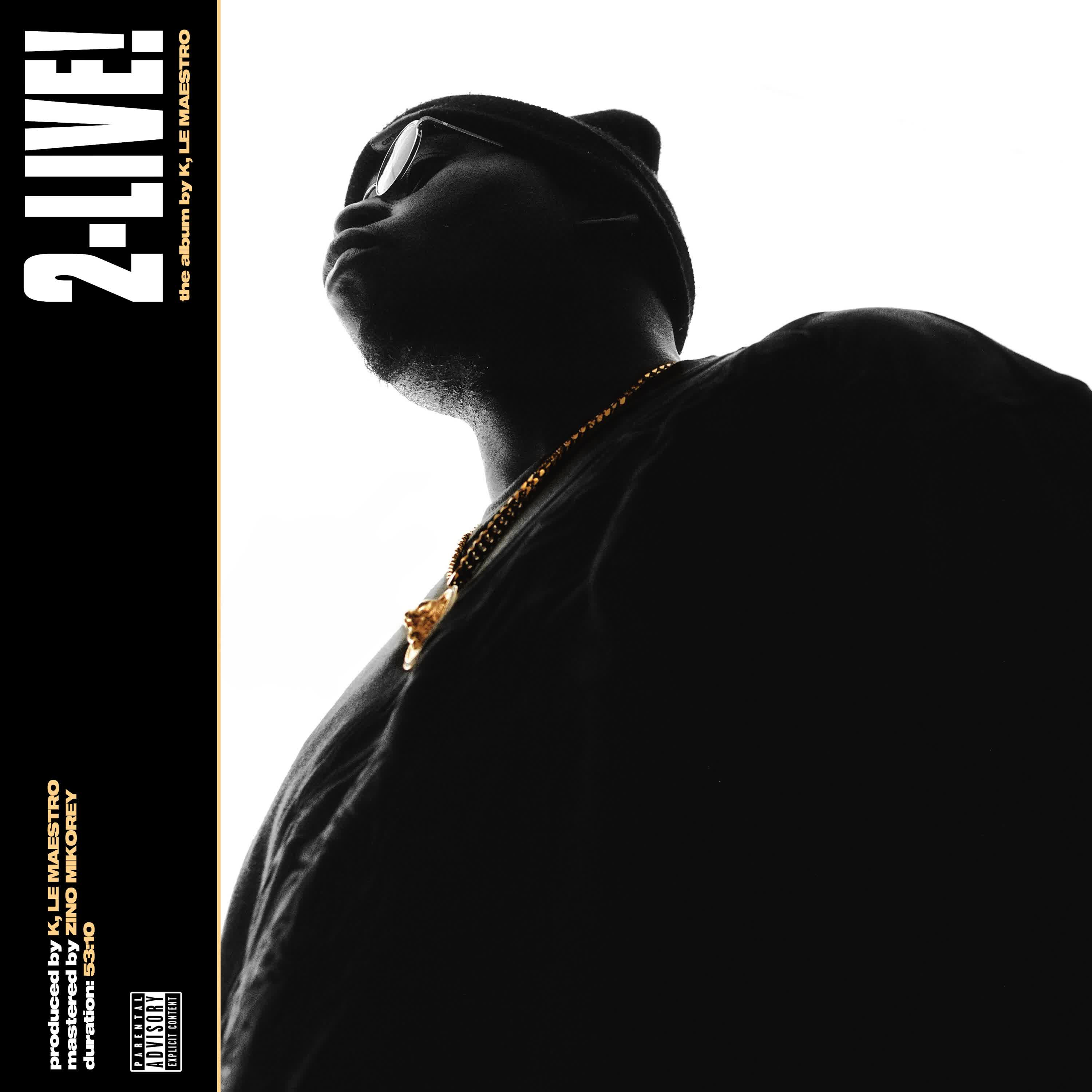
Flipping somebody else’s record into something that will go viral is a parlor trick a thousand SoundCloud kids can execute; taking a roomful of guest voices and making it sound like the album is the output of one individual is the harder job, the one that separates a beatmaker from a bandleader. K, Le Maestro has spent most of the last decade engaged in the first task, a UK beatmaker known in London for the ongoing “NOT DROPPING” flip series and a 2021 debut, Whip Music, which was done in overt deference to J Dilla and Madlib. 2 LIVE!, the sophomore effort arrives five years later, featuring over a dozen rappers and vocalists and one producer so confident in his headlining ability that he points out how good his beats are at every possible opportunity between tracks. No guest on the list can out-rap Reuben Vincent. “HANDS UP” rides James Poyser’s keyboard gloss and a busier call-and-response thud under a call to the room: “I say fuck it, throw your hands high,” and Vincent laces the verse with belief and hunger in a tight press. He starts in the project—“My pops was playin’ pocket, mama prayin’”—pleads with the lord “One more chance, word to Big Poppa,” and lays the grieving out naked—“The little brother who died about it can’t live without it.” It’s a brash young boast, but Vincent provides it with the gravity of somebody who’s already put names to headstones to get to the mic. —Harry Brown
Mach-Hommy, 5786 AM: Easy Listen
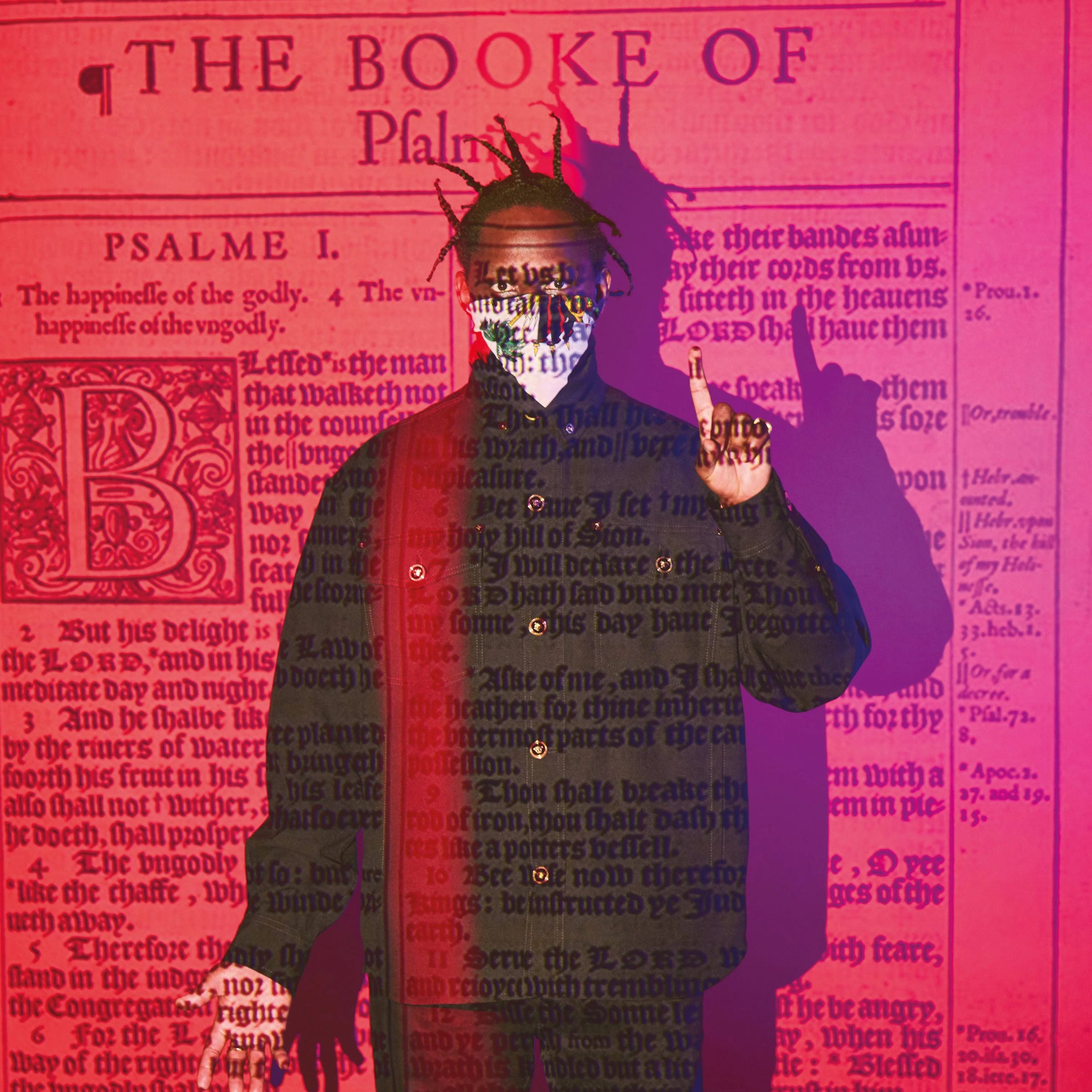
Mach-Hommy sells his LPs like fine art and rarely has his catalog streaming isn’t chasing the algorithm, and this new record directly names the joke stone-faced. 5786 AM: Easy Listen comes out on a limited LP and cassette run with no standard rollout; its title juxtaposes the Hebrew calendar year against the Latin phrase for the age of the world. Easy listening isn’t at all what’s offered. Mach-Hommy, who claims Newark and Haiti as his own, has spent the last ten years dropping verses so dense and so many of them are referential that at least a casual listen barely gets at them, and throughout these thirteen Playa Haze-produced front-to-back tracks, he elevates the challenge further and laughs while doing so.
That challenge is clear in “Name, Image, Likeness,” where he piles the boasts on so thickly that they continue to fold over onto each other, Mach moving from a hickey to a plus-sized suit to “Hot shit coming quicker than a ride or die on the jitney” before anything settles. He runs an entire Eddie Murphy routine in the verse and tells a woman to refer to him as Prince Akeem before swinging the globe around, “and land on we’s like Eddie.” Then, the hook evolves into near-scripture: “I am the coin where the light of God shines through/‘Cause God and I are one and not two.” He traverses the gamut from a Coming to America bit to divinity in the span of less than one breath and doesn’t pause to flag the shift. —Lance “LX” Brooks
Ama, AMA

While Ama’s debut was a heap of effects and abstraction that buried the writer, this one downshifts, focuses on the vocals and words, and almost none of it behaves. The London singer, who used to make music under the name Ama Lou, spends most of it orchestrating the conversation, funny and mean and horny and, before it’s through, bare. She loses two arguments with herself. The rest of the time, she’s the one who calls the ending time.
She doesn’t feel sorry for the guy on “Friend Zone” who recently gave up on convincing himself he’d been successfully keeping his crush on the down-low. He’d always been obvious, you see, he’d never been a real contender, and “Can’t you see that you’re just not qualified to handle me?” sounds a lot more like a performance review than an eye-roll. “Different High” even starts off like a dance party at the club, hardens into a declaration of principle, and ultimately takes on the role of duress: “Born to entertain, not to explain.” Out she walks in all of them before the other person finishes. She has the contrary perspective on “So...,” which opens with the admission “played God and made sure I did not catch any feelings”, and goes on for most of it about the toll that protection took: the good man she threw back; the wasted time, and now with a regret that’s almost sweet in its final apology “I’m gonna wish the boy luck because I’m a silly old maid.” —Monica LaSelle
Wiki, Ancient History
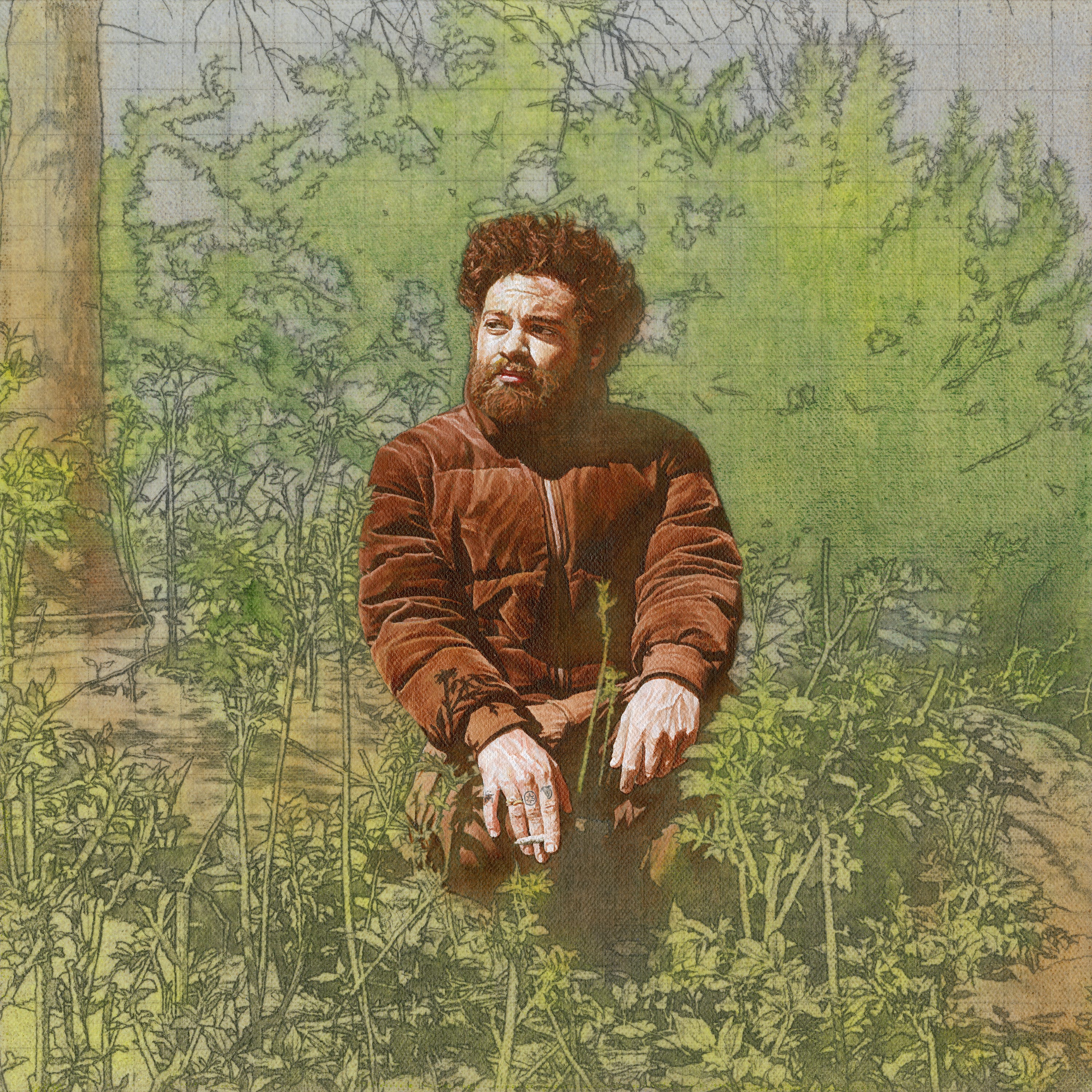
Wiki has spent a decade turning New York sidewalks into fodder. His voice is more abrasion than a sales pitch. Nasal and fraying, half-spoken and half-jabbed, it comes out like a conversation caught three sentences in, before he’s become aware he has an audience. On “GTFOH,” he has declared himself a tragic poet most recognizable to bodega cats and stoners before immediately knocking that bullshit down: “The grind is just a jump, I can’t fuck around, it’s over for sure,” he declares, and then can’t help himself but throw “Can’t do it again” into the second half. “Right Away” pushes forward in this similar way, list after list of things he can’t do: “Can’t drive, can’t cope, can’t hide, can’t run,” before he lets the chorus talk him up before he’s even convinced.
The park is the only place in New York you’re allowed to enter without a card. A voice clip from some film about a man who could never leave work (He had to be there every morning at the same time, could never take a vacation) sets the stage, before “Park” turns into this lazy, sunny track of place after place: Seward, Tompkins, Riverside, Jackie Robinson, Central, Marcus Garvey, Prospect, St. Nick’s, names that all blur into a walking tour he can do asleep. “What it say on your paystub? You welcome to enter,” he points out; “same to the faces with their names on the benches.” He’s playing badminton with monks and has lost four hours without meaning to. Has put his watch away. Has worked the whole shift and slept on the bench. —Phil
kwn, and all pride aside

R&B has always had a role for women to flap their lips about sex, from Millie Jackson’s lewd monologues to Adina Howard’s appetite on “Freak Like Me” to Janet’s submission on “Rope Burn.” The mode has hardly ever gone away, but in the UK, it has largely been sidelined into the whispered, internalist alternative R&B that has defined the scene for a decade. kwn, 26 and from East London, writes against that grain, in the simple diction of late-90s and early-00s American seduction anthems, aiming the approach at other women; a woman addressing a woman she’d like. She first came to attention for her naked bravado, which didn’t need pity, then continued it, far past where bragging stops, and as a follow-up to with all due respect, and all pride aside has to accommodate wanting someone that’s unobtainable.
For most of “all fours,” kwn sounds completely in control. “I could never date a bitch that don’t wanna make me main course,” she begins, “I don’t want much, just want you obsessed with me.” But the swagger stumbles over the single obstacle it can’t overcome: “I want you, even when you don’t want me/I guess karma came around and brought a player to their knees.” And then “heaven’s in your hands” is addressed to a person she loves and is losing; folded around a simple plea to her mother to be ok, she attempts to remain poised, asking the dying not to “Ruin all this gangster I got,” but only for affirmation, an assurance that she was enough. She doesn’t grow up throughout this album, and nor would she have to; instead, she stays exactly like that—plain and exposed, open to loving people who couldn’t care less about her in return. —Marjani Fields
Mickey Diamond & Big Ghost Ltd, Blood of the Lamb
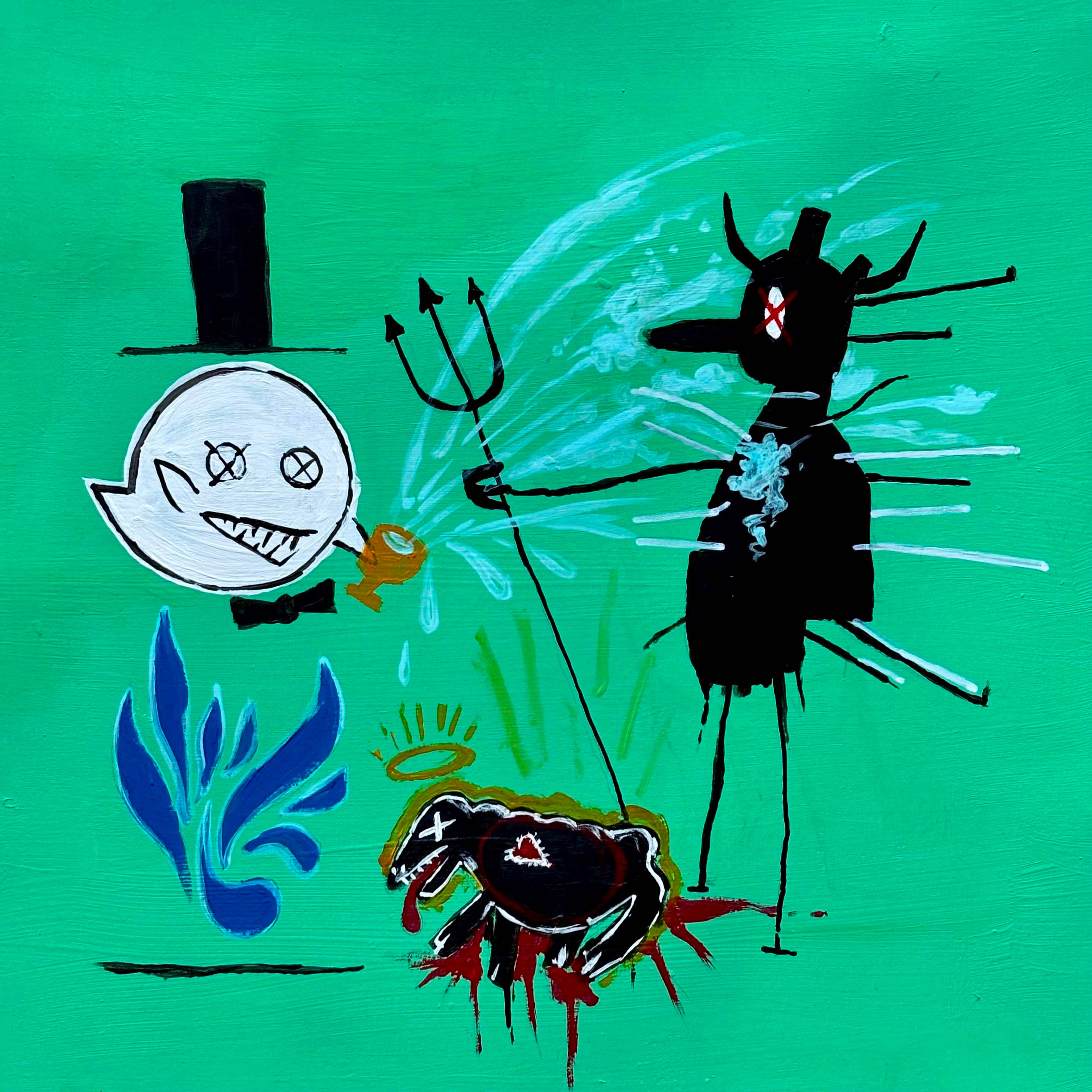
After only just over a year, having three albums in a year under the same producer can surely strain any partnership to breaking point. The three-album run that Big Ghost have just completed sticks to the same one soul-and-gospel lane and one raw voice for the whole duration, without ever venturing into any form of melody. That voice is that of Mickey Diamond, one of the most fertile underground rappers that Detroit has produced this decade, and one thing he does on this last chapter, which he mostly sidesteps elsewhere, is to argue. Scripture permeates the vernacular throughout; communion, stigmata, holy water, the lamb’s blood all refer to money, loyalty, paranoia, grief, Mickey midflex is always questioning aloud the veracity of anything, and everything said.
The question marks arise loudest on “Communion,” where Mickey states a commandment and immediately questions the integrity of it. “Thou shall not take another man’s life,” Mickey states before immediately throwing out the part missing from the catechism: “What if he had it coming? Can I ask for forgiveness?” Mickey isn’t sure that you can promise something without meaning it, and that it can count as repentance. “Promise, but I don’t mean it, does that pass for repentance?” The verse continued until he reached a question to which there is no easy response: “They painted Jesus white, so how are we the chosen people?” This arises out of the honest bewilderment of one brought up within a faith attempting to square it with the reality of a world that dictated it to him. —Owen Baptiste
BlackMugen, Born$aviiior
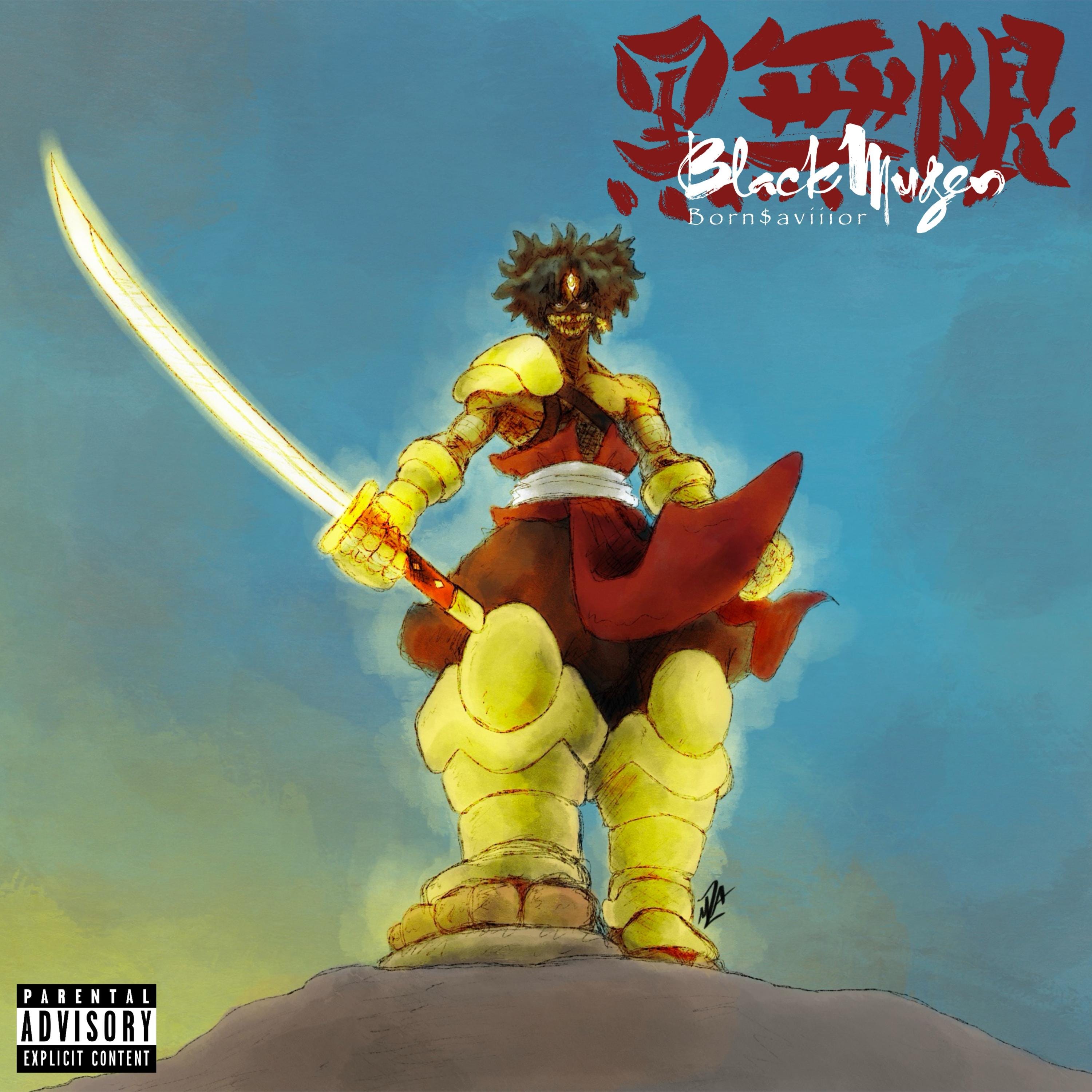
The Black$hinobi Clan operates on a platform that plays the role of a comic book logline and a Sunday sermon. A band of Asiatic warriors trained in ninjutsu and ancestral power; they’ve been sent to rescue the original people and to destroy the empire of the Devil. Through the album, the one warrior (BlackMugen) trains to be the savior of Satan and crowns himself with the prophecy. Black$aviiior is “the final chapter” to the battle with Satan, one warrior training to be the savior and possible fulfillment of the prophecy. Five Percent doctrine and Nation of Islam run this one; the legacy runs through Rakim, Brand Nubian, and Poor Righteous Teachers, where the Black man is God, and the devil is literal. Anime and martial arts films are the mythos; dragon masks, hypertime chambers, and “Mugen” glossed within the songs as being infinite. It’s weird that the two seem to merge seamlessly; the crack between sermon and anime never shows.
What the armor was keeping from the world: Grief. The blood is present all throughout the entire record, as kinfolk unable to stomach his ascension, and on “M(eye)nd of a Warriiior” he states simply: “Received more real love from strangers than my own kin.” The cosmic map narrows by the end of the record, towards a family tree. On “DaChosenOne” he lays out Fred Hampton, Tupac, Nipsey Hussle, and Huey Newton as his guides before setting them aside for Susie, his great grandmother, an angel he thanks for saving him during his lowest lows, stating himself as Susie’s grandbaby for life, and ending the track with her voicemail; an old woman asking about him, reminding him to call back, and saying ‘all this love and stuff’. All of the dragon masks and the ninja blades, the record is strewn with, were built to protect the boy who saved that voicemail. —Nehemiah
Beedie & Nice Rec, BOUNDS

Kintsugi is the Japanese art of restoring broken bowls with precious metal, the line of the break exposed rather than concealed. Making a rap album out of that concept is a strange one, even odder, being that it comes from Beedie, a hard-working underground MC whose albums seem to slow to a halt no more than once a year so that he can take a breath and think about what he’s doing. Nevertheless, he’s an elite lyricist that no one questions, and partnering with one beat-maker for under thirty minutes is his normal routine. Nice Rec gets the whole show for BOUNDS, where he turns his scars into the loudest thing in the room. This gives Beedie his most gripping writing in years, gliding front to back.
Always, damage comes before the gold first. In “FEARS,” he pinpoints it to what feels like the source, delineating it with tongue-in-cheek diction as a “fatal flaw” and then more explicitly owning trauma as the thing he’s always tried to fix. “kintsugi” introduces the same fissure in the body, personifying himself as shattered into a thousand pieces and observing that he is held together by where he has fractured. Around the time of “SCARS,” the damage is overtly suspect, gussied up as “badges of honor” worn proudly, recognized to be the surest signs of trauma turned to triumphant survival. —Nehemiah
Wyclef Jean, Clef Notes — Quantum Leap, Vol. 1
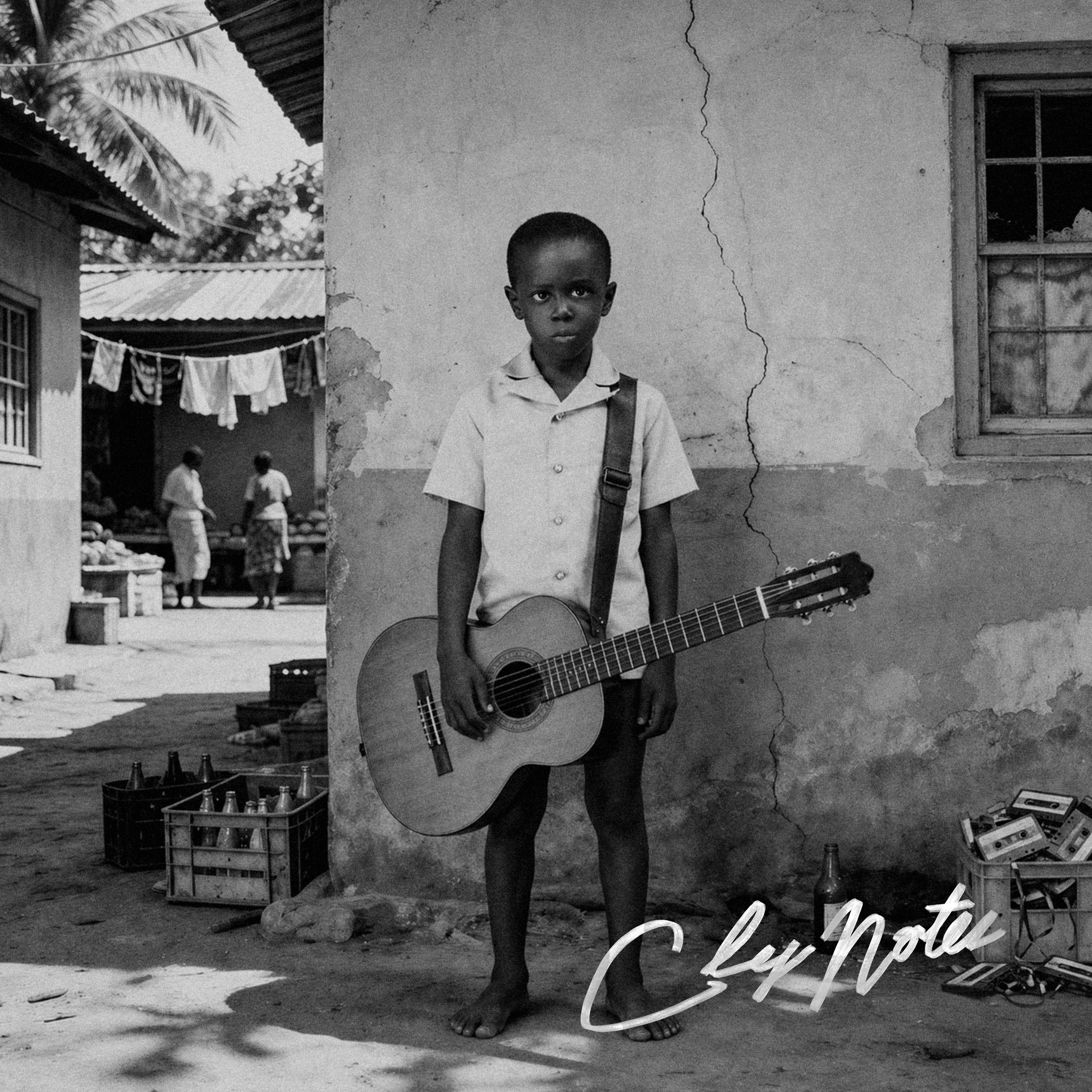
Wyclef Jean has always tended to overstuff his verses, and the mismatched order of the track finally gives the tendency a form. Most of it is delivered in the griot way, a host guiding someone around a neighborhood, singing in a sing-song flexibility so wide you could mistake it for song. The dates here ping pong from 1990, sliding backwards to 1994, then forward again to 1991, and skipping forward to 2010 and 2011, shrinking back to 1997, then racing to 2030, and it does it all even while the song titles are all shuffled through 3, 5, and 7. Listening to it in that order, the dates describe a life the way you could keep it in your head, in shards, the loud parts smothering the dull.
The same backward pull applies in “1994 - Boom Bap” when the memory gets its soundtrack. He contemplates beepers before cell phones, a shiv art trick caught from a youngun leaving Rikers, rakes thrown down outside the barbershop until a man called Little Fatts got put down, and the hands stopped. The chorus is a chain of R&B phantoms, Frankie Valli, Ralph Tresvant, and Oran “Juice” Jones, reflection decked like a chain. Rapsody arrives and already makes everything more precise. He rambles; she’s truncated and urgency-powered, describing herself as “Quiet, chill like Thelonious, a Monk amongst all the pandemonium,” affirming fishing for dope boys and preachers alike before the knockout, “I’m not Toby, I might be Kobe.” He loops low, steady, and hard; she jumps on him like this is the song she’s been waiting for all year. —Mina Abdel
sha ray & DJ Haram, Critical Thot
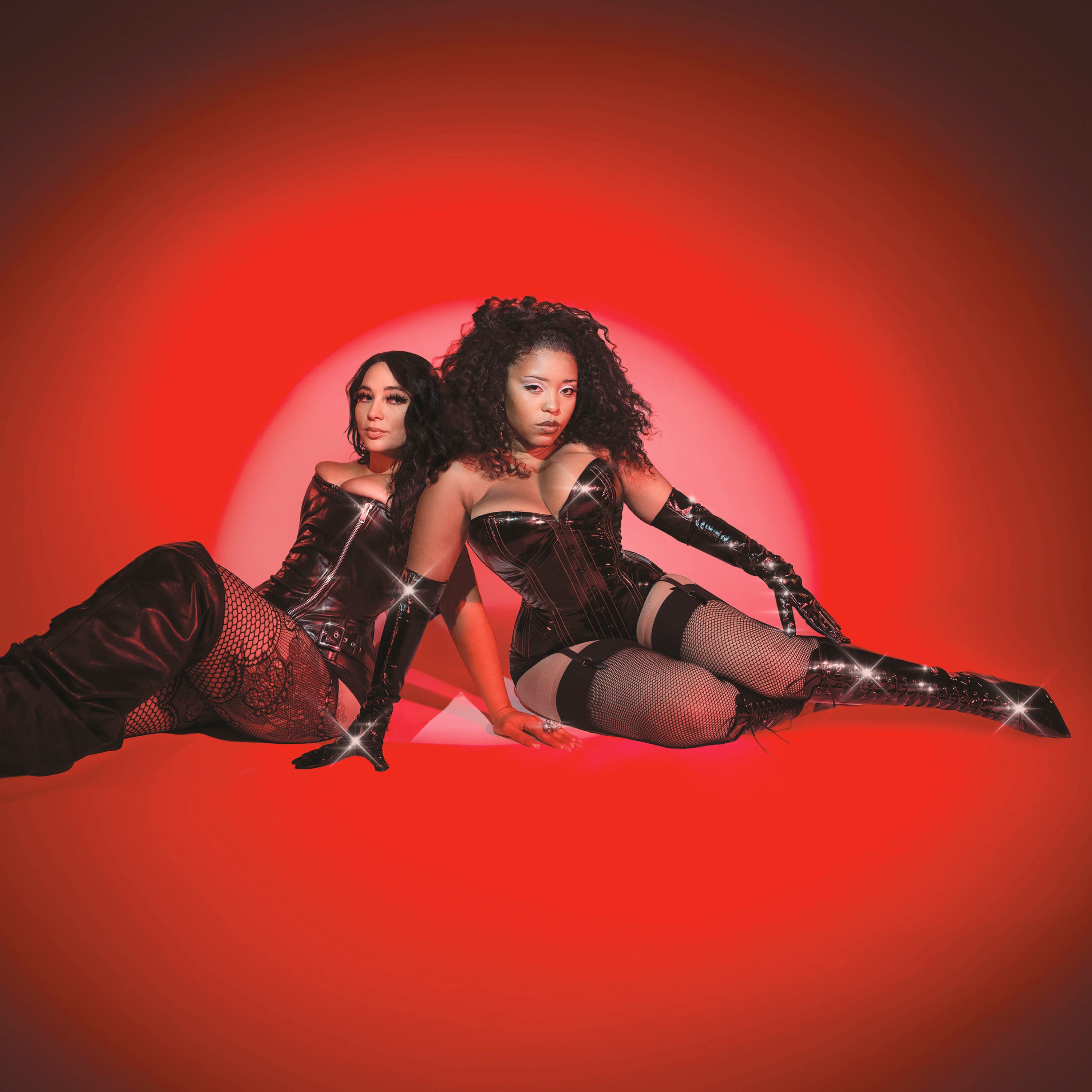
The critical thot, that belladonna of rap, is the kind of figure constructed for gazing at, which has figured out that attention translates into power. Critical Thot begins with a trancelike state. A voice, eyes rolling back, rattles in an unknown language, asserting it has no body and answers to no one. An older name smolders below this, before the guise seals itself around its user with a snap. That is sha ray, the Bay Area rapper and producer whose debut project arrives with the support of DJ Haram, the New Jersey-raised, New York-based producer, who collaborates with Moor Mother on the group 700 Bliss and who last year ran underground-rap through experimental club-music on Beside Myself. Over beats produced by both on Backwoodz Studioz, sha ray embodies both the belladonna of rap and the princess with the Uzi: fully formed, weaponized.
The male figures in sha ray’s songs exhibit contradictory modes simultaneously. “They ain’t listenin’ when a bitch talkin’,” she observes on “Champagne and Bouquets,” then, “Watch they neck swang when a bitch walkin’.” She has monetized the space between these two states. All of the flexing, the value assigned to the allure, the pricing has circled this concern of whether these men regard her truly human. A deeper listening of “The Material” opening trancelike scene strips away the pretense. The voice with rolling eyes speaking an indecipherable language, the slow decay of an older name below—it’s the image of a person being hollowed out to fill the void left by a figure of public veneration and payment. sha ray introduces this hollow before anything else, even a boast, to ensure her struts are hard-won. The belladonna was forged from that which was taken, and she shows the ravaging process before placing it on the crown. —Koda Lin
Vince Staples, Cry Baby
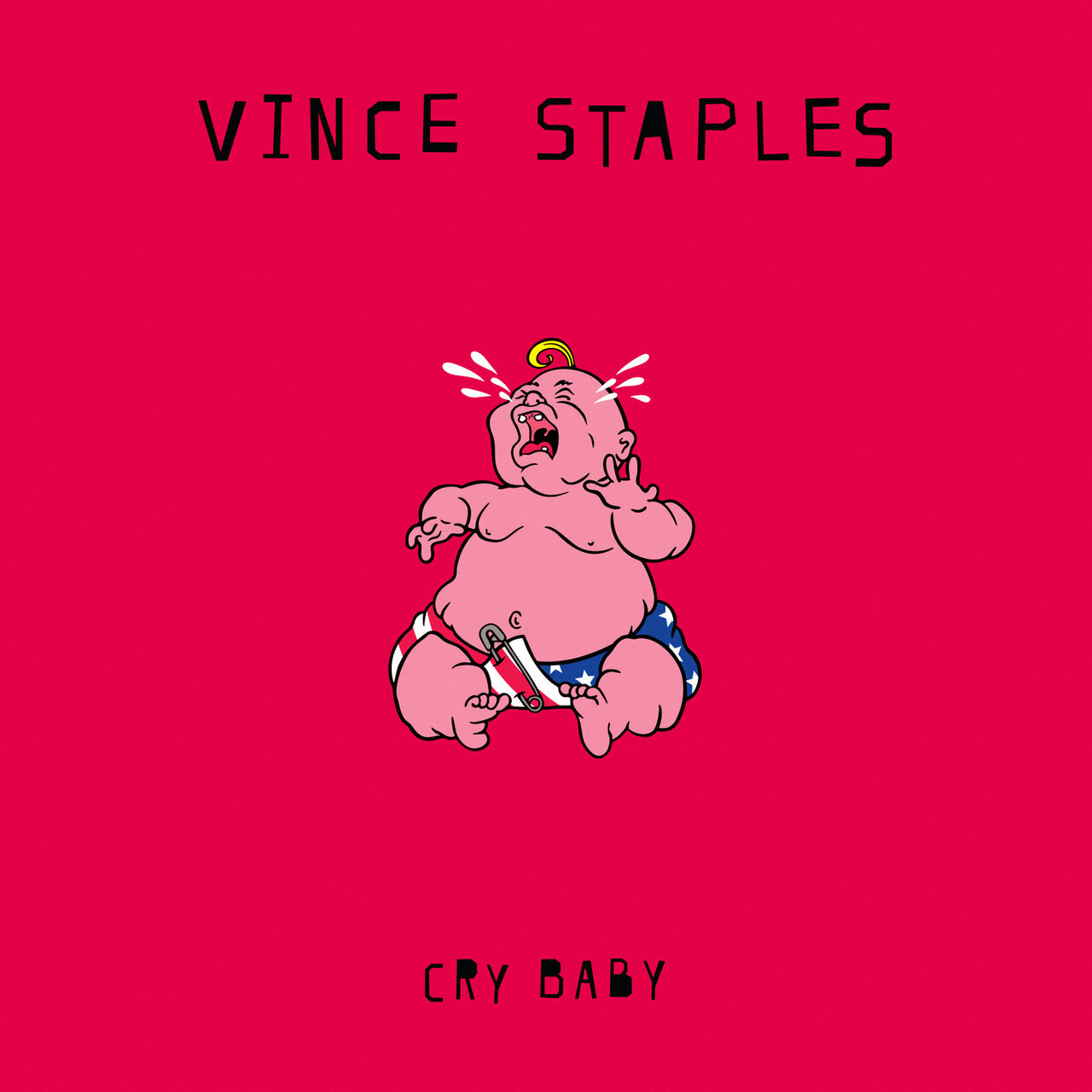
For the past two times the camera was pointing inward, the previous two instances detailing Ramona Park and the original block; and years of disappointment and the toll of a decade of constant focus, the next time. Both small and tightly packed, Vince Staples had taken his own measure of both Long Beach and himself. Cry Baby flips the camera around to the country where it was made and runs through his songs live with guitars, no longer programmed drums, and though it moved, outward it keeps the camera still on his body, though his subjects were not his own.
Behind the flags, beneath the police lights, the songs constantly retreat into a solitary, weary man. “White Flag” takes up a refrain of surrender, “White flag, I don’t wanna fight no more,” over a verse that pulls in the police again: the kid stopped in his car, an alien in his own vehicle, a broken marriage he leaves to Amy Winehouse; “Love’s a losin’ game, like Amy sang.” “The Running Man” is denser, more terrified, the grim reaper and a revolution and Grand Central Station cramming one verse, before the bridge clears everything out of the room to let him confess that he hasn’t seen a therapist, hasn’t looked to Jesus much-that pain is all that’s left. “Do You Know the Devil” is the bargain itself: a sinner asking if we know the devil, admitting he might have sold his soul, before confronting God with the only instrument he has, “What am I supposed to do without nothing but a vocal booth?” That last line provides the title; the crybaby is a man all alone in the vocal booth with no therapist and no choir, only the microphone. —Phil
PLUTO, Diary of a Young Lit B*tch

In strip-club rap, money has a clear agenda. Moving from the men at the railing to the women working the floor, the track itself belongs to whoever is being funded or who’s getting put on the run. PLUTO reverses this script. She measures out her own funds prior to opening her lips, and the men in Diary of a Young Lit B*tch do the asking of her. Who gets her time is up to her. She is funniest when she has money on hand. A Jeffrey Dahmer reference blurs past in “I Fell In Luv,” “Can’t eat off his plate, no Jeffery,” buried in a hook where she falls in love with her wrist, then a woman, then the blue cheese mixed with green salad, then the empty plate. Under the flexing is that line that turns the joke from clever into savage, “I love that they knew I was poor, now I be chillin’ when rent due.” She presents a windfall similarly as a shrug on “What You Know,” “It’s crazy how I rap for fun and made a mil’ before the new year,” then removes a broke man from the equation, “You too busy bein’ broke, I’m stuffin’ racks inside this purse.” —Cierra Marcel
Bebe Rexha, DIRTY BLONDE
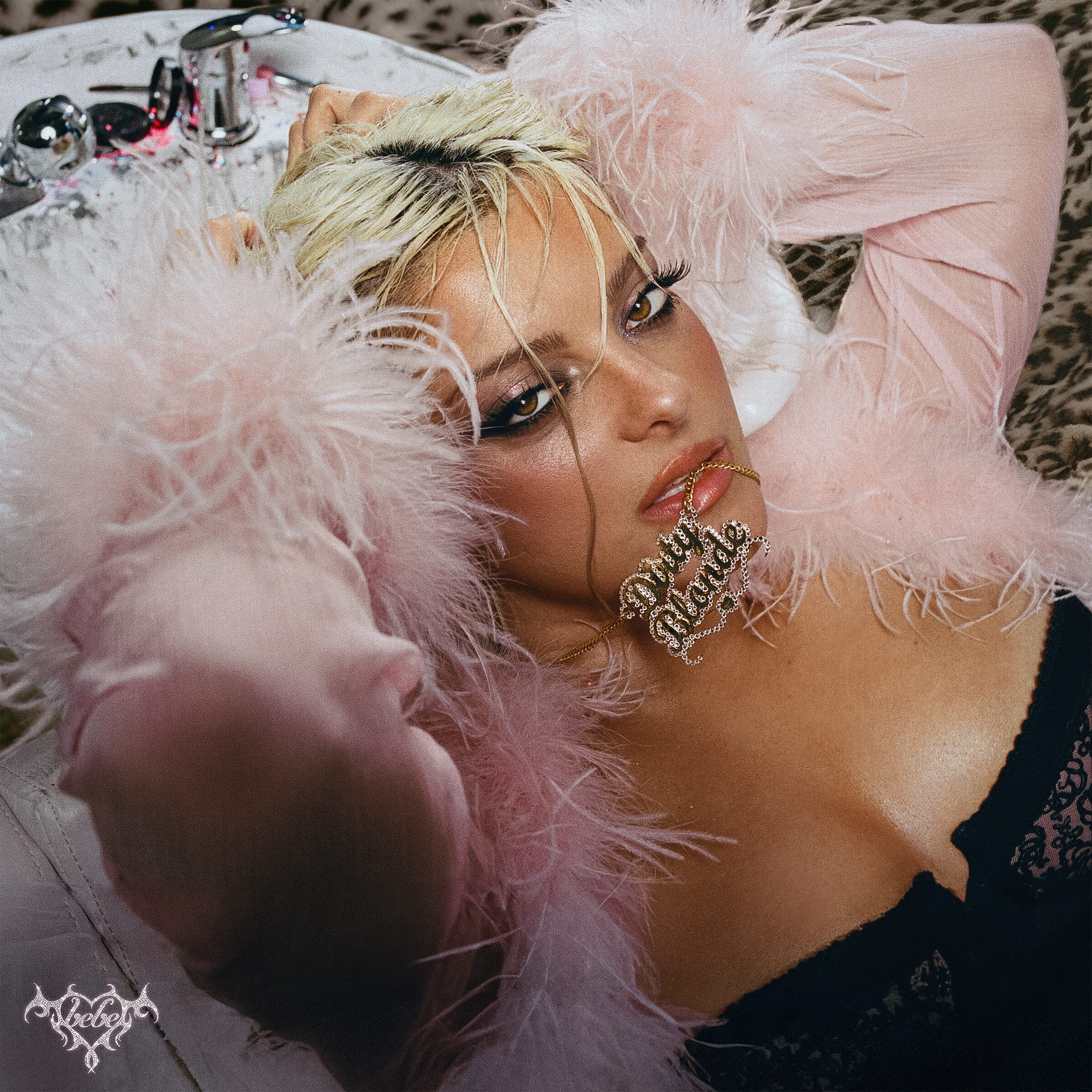
Everything here is post-midnight. Somewhere in a club, someone’s telling the bouncer not to turn on the lights. The dark’s got work to do. Rexha stuffs her tracks with material they were never made to contain. The hook stays intact, the confession travels on the inside of the record. “Lord, forgive me,” Rexha asks on the open of “Hysteria,” “If I don’t make it home tonight.” Two lines later, the track’s all crowd-work—“Turn it up, make it bounce/Hysteria in the crowd/Got the world in a trance”—and the prayer is never answered or acknowledged. Rexha speeds past the house of an old flame in “Time” and flat-lines her position (“I wasted all my best years on you,” “I’m fucking bitter, but I’m not a victim,” “I had to lose and let you win, to love myself again”), and you know, that’s the line, that’s the end of the story. The chorus circles round one plain statement of truth—“So many good times/But I never had a good time,” and that tells me more than all of “New Religion” does of a successful one. Halfway through “The Way I Want You,” having just admitted to still calling him up at 4AM, and admitting that “the pills don’t work the same anymore,” Rexha hits the joke—”I talk to my therapist like a billion times/And that bitch is overpaid.” It follows with the real reason we’re all still depressed (“my anxiety won’t go away”) and a perfect sentence for any bad relationship (“sick and tired of being sick and tired of loving you”). All that uncomplicated meanness is the greatest thing to come out of Bebe Rexha’s DIRTY BLONDE. —Oliver I. Martin
Qwel & Nightwalker, Divided Times
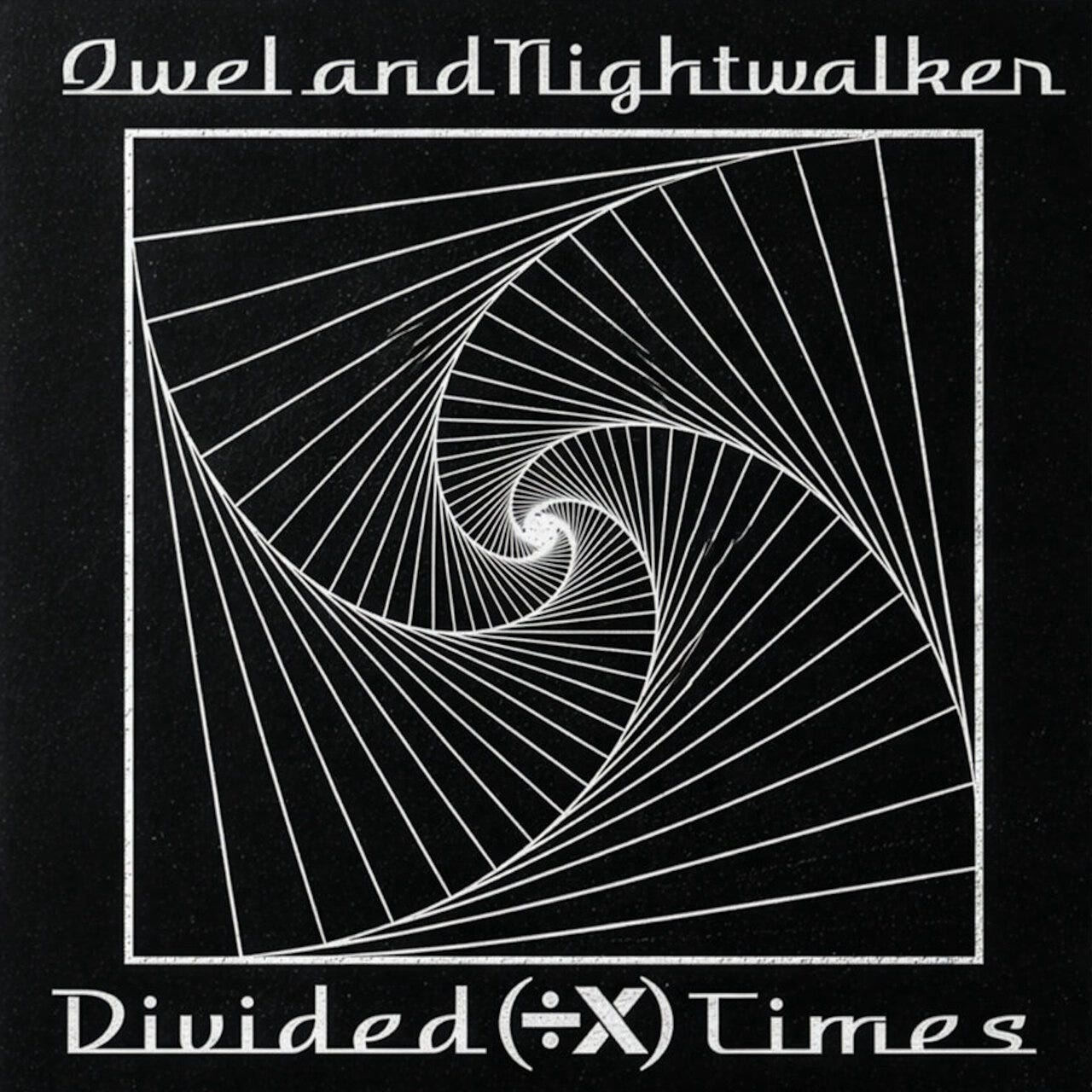
The Chicago rap we were introduced to around Galapagos4 in the early 2000s stole a lot in any given bar, dredging crews who could creak open a verse until it was threatening to shatter. That was Qwel, who spent the rest of that decade and the majority of the next constructing a discography with Maker, releasing records of similar tight bandaged verses, revered by the people who care to listen to this niche and unseen elsewhere. On Divided Times, he passes the entire slate of production and hasn’t sounded so self-possessed in a long time. Nightwalker keeps the tracks brooding, steely, and pedal to the floor, and Qwel gets himself erect in the space. “Got me a job, bought me a clock,” Qwel raps at the beginning of “Buy More Clocks.” He and a beat are munching through a treadmill rhythm when the words, a kernel of wage slavery, part some air: “The thoughts, your sleep, your peace, your breath/Every little bit of me, but let me keep the rest.” From here, Denizen Kane and Jam One get meaner, squeeze the last out of the poem with a literal purpose: “Capitalist dream, it’s a pyramid scheme/It’s an anti-poor people killing machine.” Qwel, though—that’s the difference: the way the pace of his speech tightens and then bursts away to nowhere in turns, the way the story turns a bend that the track doesn’t. That’s a lot to ask of one rapper. He delivers. —Harry Brown
Jalen Ngonda, Doctrine of Love
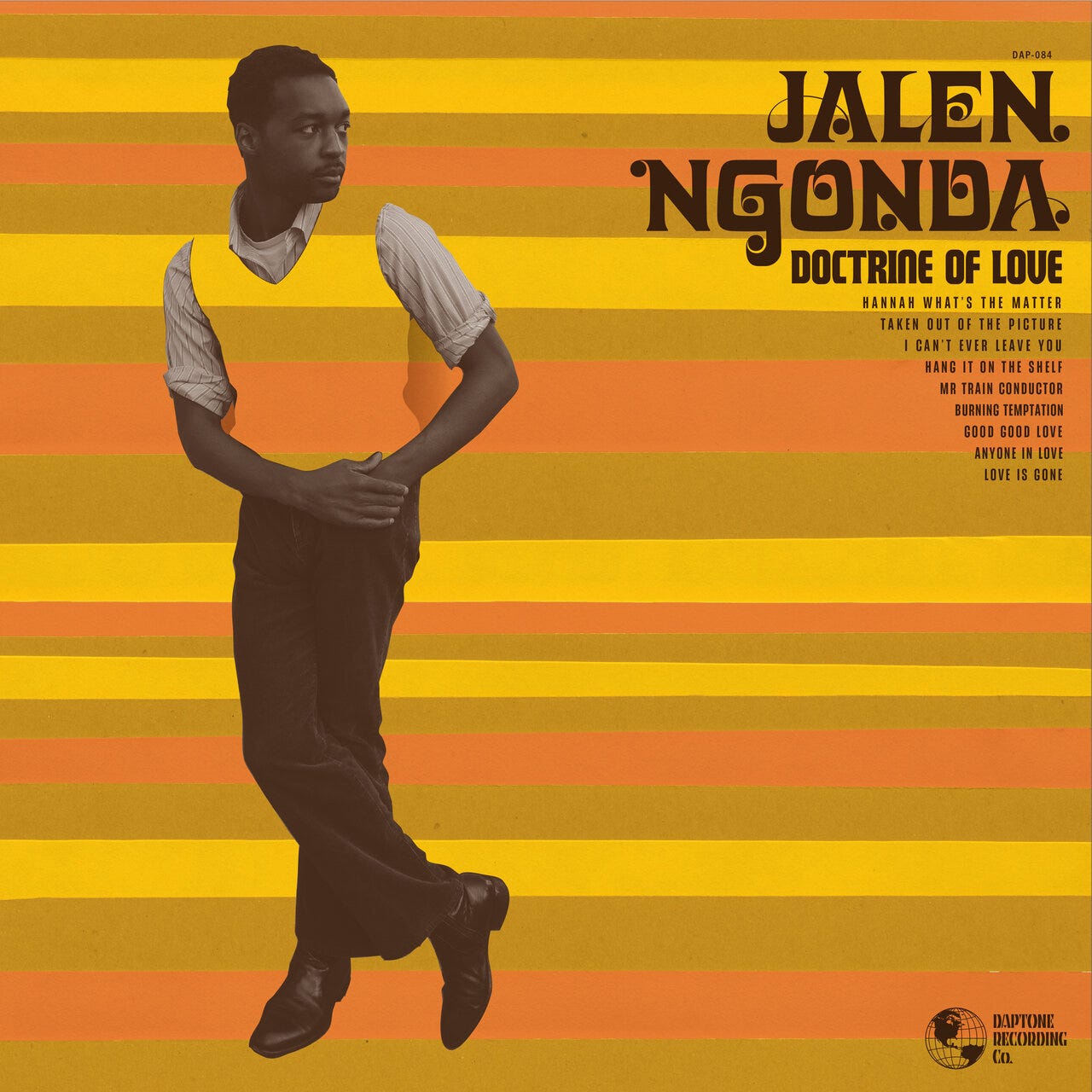
Revivalists tend to chase the pleasures of soul, the courtship, the slow dance, the warm glow of being desired. Jalen Ngonda—who taught himself to sing it as a boy in suburbia D.C., on his dad’s records, before taking it to a bedsit in London—instead keeps trying to salvage its wreckage. Come Around and Love Me, his 2023 debut, was more or less an earnest young man wanting to get inside. The new songs make that young man endure another terrible week. He pleads, he laments, he hovers in the wrong place, at the wrong side of a closing door. Ngonda keeps putting himself in the position of being the one who screwed up. He spends “Mr. Train Conductor” pacing at a station, begging the man at the engine for a ticket home, back to a woman he has wronged: “Can you get me to my baby’s arms again?” And the admission is delivered so effortlessly: “I foolishly made her cry,” he sings, before word gets to him that another has “knows just what to do” better than he. Leaving cost him something that he can only name by its absence. He states it plainly: “I feel less human than before.” It’s this same passive surrender that fuels “I Can’t Ever Leave You”: a woman “won my heart just like a game of cards” and she maintains control. He sang “You treat me like a dog does a shoe” and says “I’ve had enough” but still can’t break free. “In your eyes I see a summer sky,” he says, but “in your heart I feel the blade of a cold, cold winter’s night.” He sees the winter there and stays through it.
There are ten years behind “Hannah, What’s the Matter?” and, by his own account, nothing has gone wrong in any of them. He has got his proofs: “a long white Cadillac to take us near or far,” “roses and lilacs that shone by evening stars,” and a “sweetener that make me feel so nice at home.” He has got the goods, yet something’s slipped away from him, and he keeps asking the same question: “Hannah, what’s the matter... Tell me where did I go wrong.” Ngonda gave this man every piece of proof of a good life and put him down in the middle of it, holding a Cadillac and flowers, incapable of finding the hurt. —Imani Raven
S!LENCE & tenten, DRY CLEAN ONLY
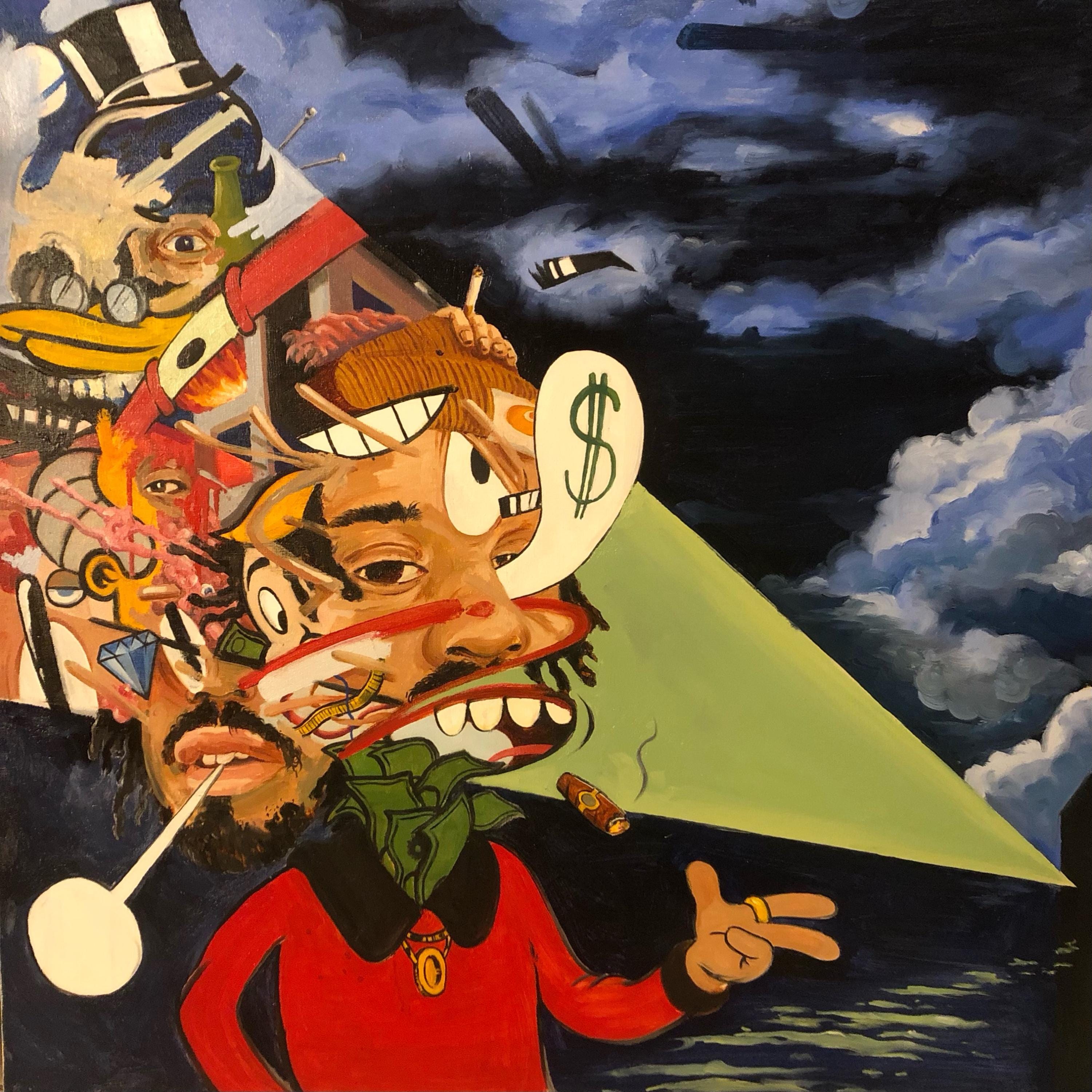
The underground music scene in New York City is defined by density. On DRY CLEAN ONLY, a verse here is a thicket you have to push through. From out of that scene and off the loose collective centered around phiik, Lungs, and Fatboi Sharif comes S!LENCE. He has it all locked in a private language that doesn’t include a key. He’s built that language out with the producer tenten, who provided every beat on the project. It all kicks off with a dry-cleaning store clerk explaining matter-of-factly (in a tone that suggests he’s explained this hundreds of times) that dry-cleaning isn’t dry at all, that clothes are soaked in chemical rather than water and, you could even say, is organic. From there, money, pride, faith, and a brutal winter are processed through the same lens of maintenance and what it means to be controlled by one’s need. Garments pile up—Issey Miyake trainers, ACG gear, Grand Seiko watches, a vintage bubble jacket—before dapping up Mr. T, still wearing dry-cleaning tags attached to the back of his attire. —Phil
Amanda Sarmento, ECLIPSE
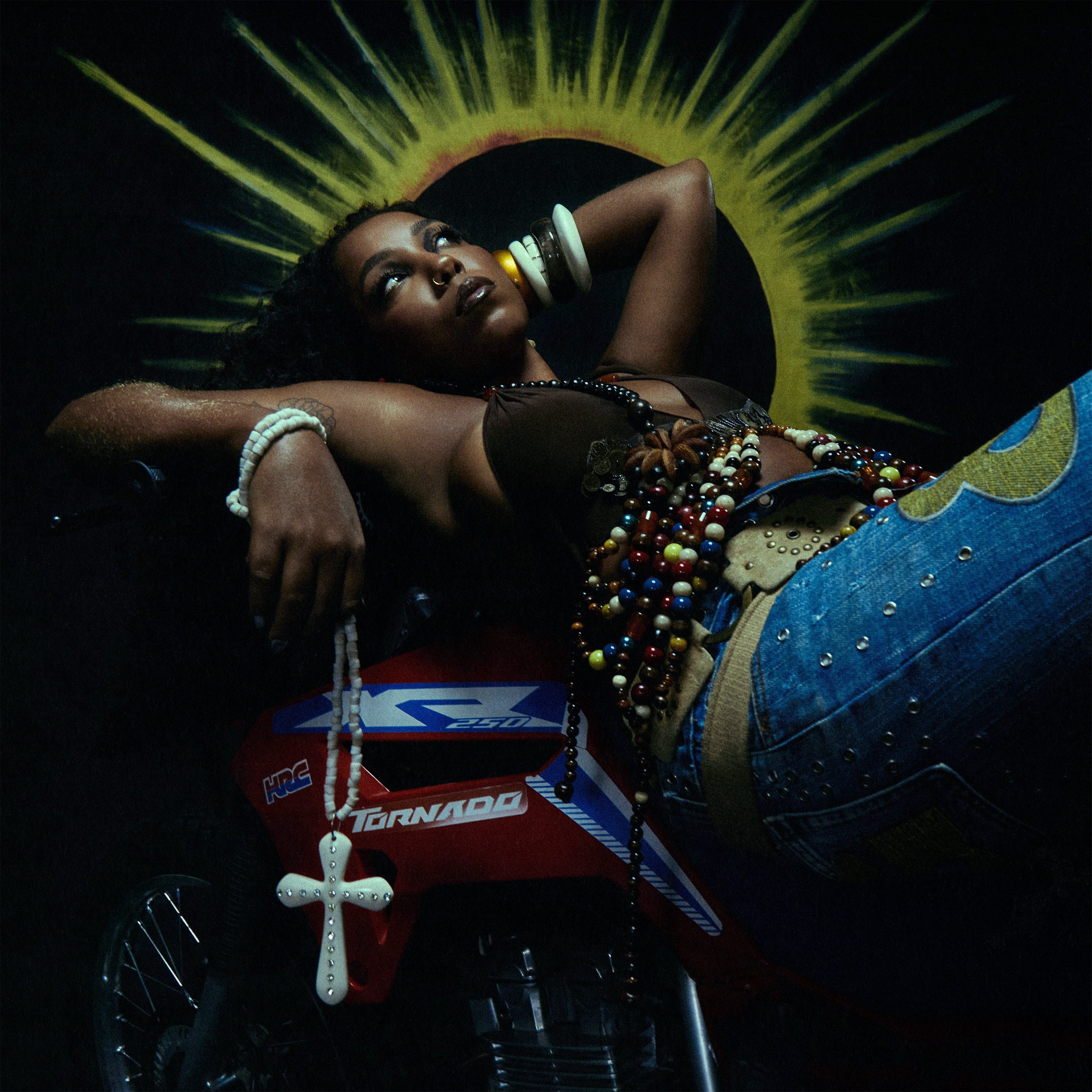
For five years she sat on one song, holding it back until it was sweet enough to let go; the sweeter a song felt to her, the more assured she knew it was great. That song was “Mulher,” and the carioca singer and rapper Amanda Sarmento finally unleashed it on ECLIPSE, a debut she perfected from front to Back with producer Iuri Rio Branco. His beats stay shadowed even as the rhythm rises, mostly programmed drums and booming 808s underneath minor synths leaning toward club-pop and afrobeat. What she does, over and over, is want people she knows she will have to leave, every craving reached with its departure already planned. Her man works the graveyard shift and won’t answer on “Você no Plantão,” and what she needs from a life comes clear, “quero uma casa, quero filhos, estudar,” set against his tiny radio and her car, his mother pleading the Lord to take her in his stead as “o reflexo das luzes azuis” blurs over the walls.
Iuri Rio Branco speeds the drums up on “Mulher,” and she bears the fangs to match, “Vim da selva, sou leão, sou demais pro seu quintal,” built around the verse she’s claimed comes from the writer Beatriz Nascimento, a woman whose name was hate and whose nickname was love. She’s just as commanding with no man in sight, driving an all-women team across São Paulo on “Assalto,” beauty turned into slickery, “Eu sou bem feroz, eu conheceo a fauna.” “Submersa” goes the other way, out to open water deep enough to no longer breathe, the writing rushing down to the chest at the bottom and the key that might free it. The coolest punchline is “Não Ligo,” the number erased on purpose, a pair of heels and crimson lipstick, a last call made just to inform him it’s finished, “Agora eu liguei só pra te avisar que eu não vou mais me importar.” She disconnects first. —Rosa Delgado
Catch, The Elephant In the Room

South London’s road rap is almost never allowed time for a story to breathe; at such a breakneck pace running on threat and tempo, the lyrics are necessarily racing too fast for grief or doubt to dwell. South London’s the same patch that propelled D-Block Europe’s cool-ass flow into the chart stratosphere and a set of postcodes worth of drill into the public psyche, but for a few years, Catch has been one of the few exceptions, recording from its depths and speaking from those depths. She is a storyteller in the way someone will often tell you the worst of their life story first, so you don’t have to hear it from anyone else. She grew up on the road long enough to be full of stories, as you can tell on her debut mixtape, The Elephant In the Room. She raps as an openly queer woman, putting her desires for women on the same lines as the trap and the parole board, with no change in register and no italics.
Catch tells in the close, close, close detail of someone who has been in the room. She opens “Imagine Being Me” at the gap she grew up in, moving from dining halls to dinner halls, selling cocaine in school, while her friends swam, doing prison calls instead of ringing girls. She watches two of her OGs shoot at each other, then a ricochet hits a woman, and then keeps moving like the fake road that she nods out into. On the third verse, she is twelve again, “Playing with my friends and having weird thoughts when all my school friends were linking girls.” She denies having a crush on a girl (Kayla), and traces her desire for girls back to a Lil’ Kim poster on her brother’s wall. That same eye checks “Playhouses” where she says, “I can tell she loves her child, I see all the playhouses/But they eat dinner with the fork I flip the yay ounce with.” She isn’t writing from above, she’s on that push lawn with the playhouses, holding the fork. —Jill Wannasa
Paul Wall, Fortune & Glory
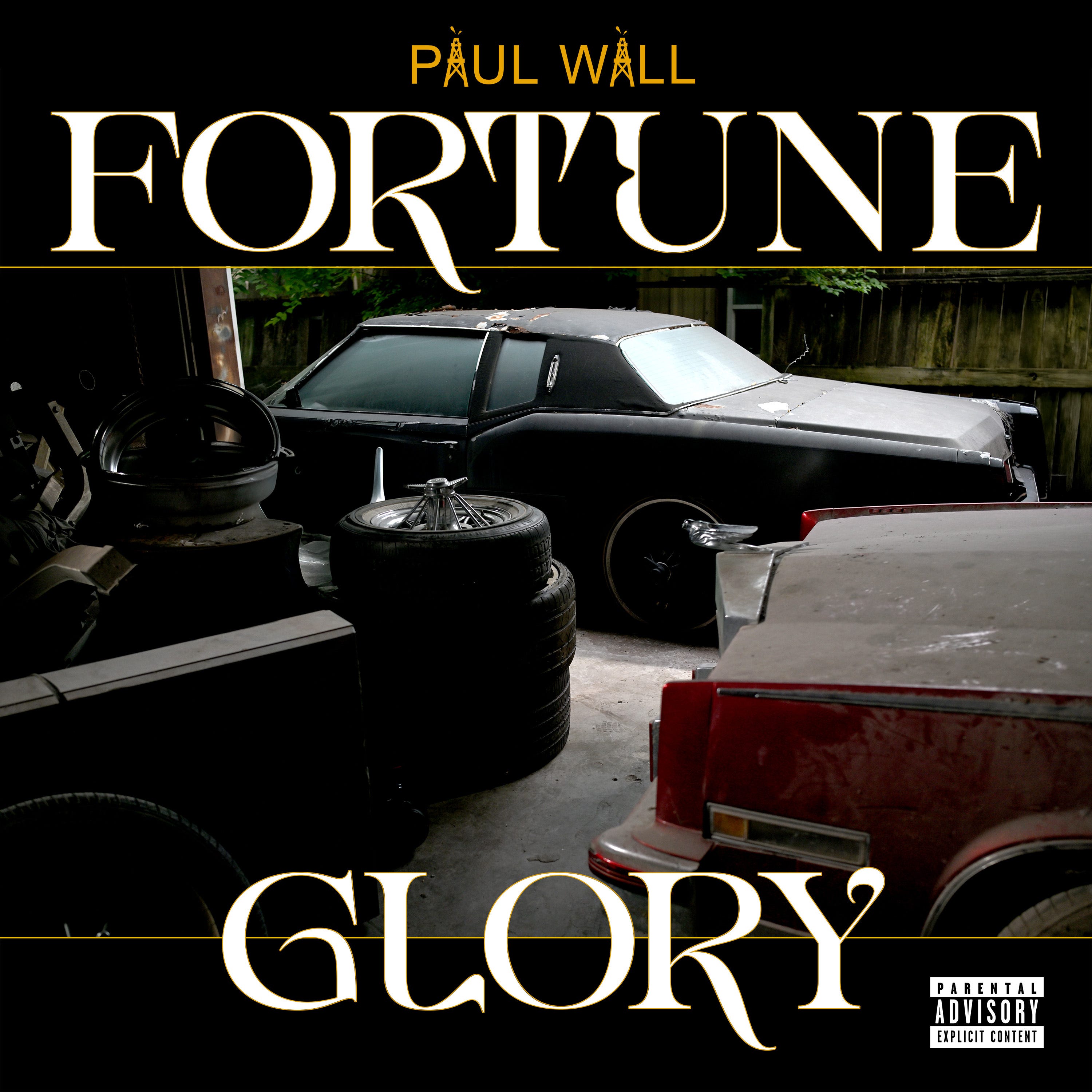
It seems like Paul Wall is one of those rappers who has stayed consistent and never gets the appreciation. The man has just made it out to the boulevard slow enough that the cars beside him are going to notice, and then lets the low-end knock from a block up the way from him, and he maintains the level of even, lazy drawl that he has all along. This drawl is the connection throughout—he has never been someone rapping fast, always maintaining his familiar level of cadence and never pretending that the only reason he is rapping in the first place is for anything else other than getting money and cars, or things that will let him get that. It’s the furniture around this talk that is updated. The hustle references are expected; they include current things like crypto wallets, feelings on election night and intermittency diets.
He’s using brands to describe his achievements on “Top Tier” instead of adjectives; the paint on his car is from House of Colors, and the work was done by Eddie, and the car itself “look like it came out last week,” although it’s a “masterpiece from scratch.” His respect for friends, including “Screwball and my dog, Big Ken” and his respect for cars such as the engine from “Kendall Motors,” both feature as proper nouns on “HT to the TL” in similar fashion to this; by “Elbow Room,” he’s made his colorful train lines across Houston the colors moving along the boulevard: “There go that blue line comin’, they ain’t playin’... I see that orange line candy wet shine, it sparkle/Purple line out here comin’ down, just gettin’ started.” The trains on the map have become a display of his cars driving along the boulevard, where he’s “all civilian traffic like I’m herdin’ cattle.” All of the objects turn into solid, visible nouns whenever he gets into the topic of his vehicles, and the lines all begin to stop bleeding into one another. —Rafael Greene
YG, THE GENTLEMEN’S CLUB
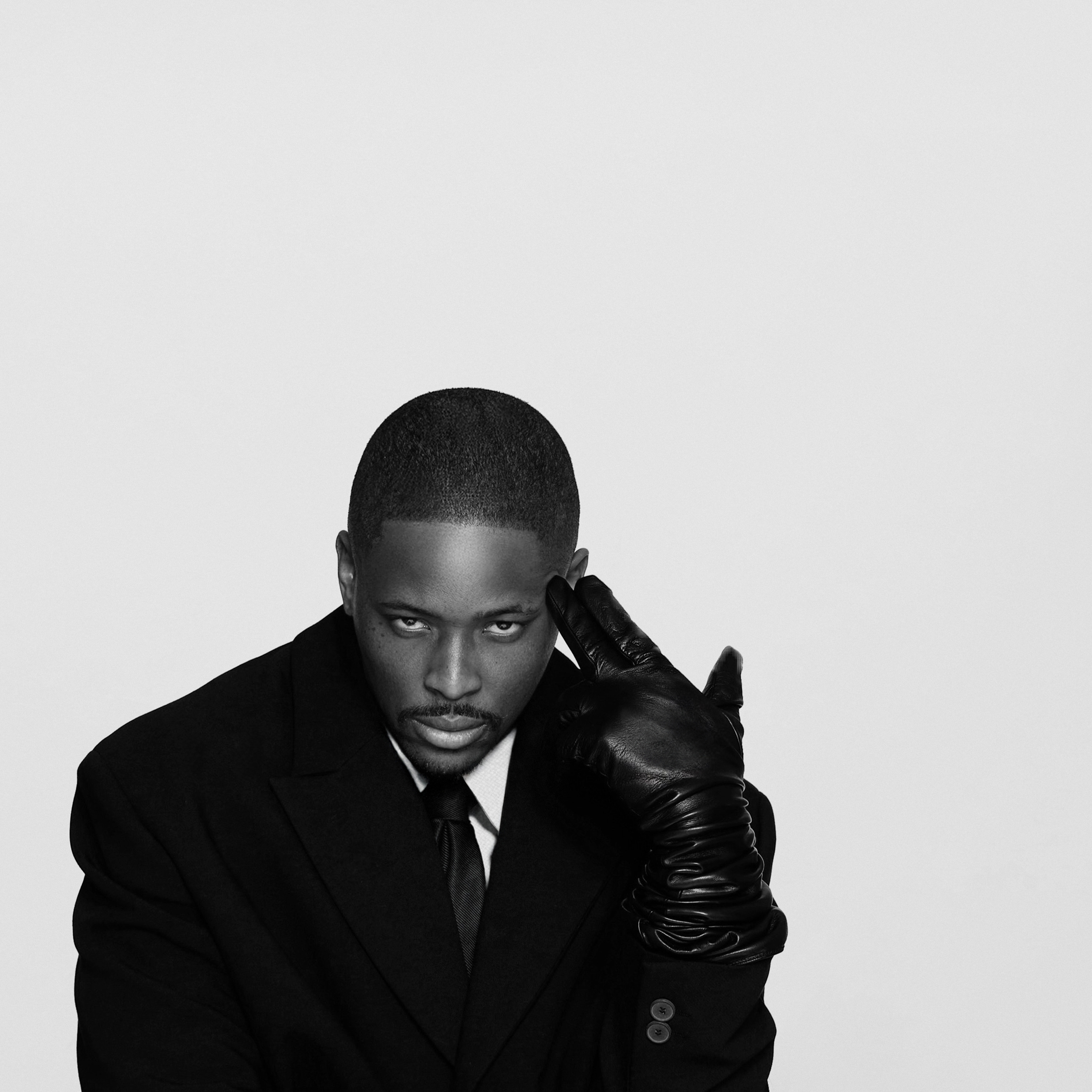
YG kicks off his latest album that revolves around women, money, threat. He put out “2004”—his childhood survival of sexual assault—on rotation in the rollout for the album last year, and while the track’s not here, the statement about trauma remains behind the deeply introspective bent these songs maintain. And finally, with a suit like that, he’s out and says the part his music held under wraps—the bodies in the closet. The transaction starts with a question: How much for a hit? YG narrates it in character on “Hitman,” outlining a target he’s despised since he was a teen, the chorus a flat showdown, “I don’t like you, and you don’t like me/The last man standing is how it’s gon’ be.” He’s tapping the target’s shoulder, and the face staring back at him sports the exact same cherry-red Philly as him; it was himself. Buddy’s hook to “Mid Life Crisis” is four simple words repeated about wanting to live or die and why. In a shared closing verse with Buddy, it goes over the same bleak ground again and again before a gunshot finally sounds. What perseveres, though, is heavier. His daughter, on the phone, is telling him she misses him, while his gun is still in his hand. —Phil
Prof, Good Time Boy
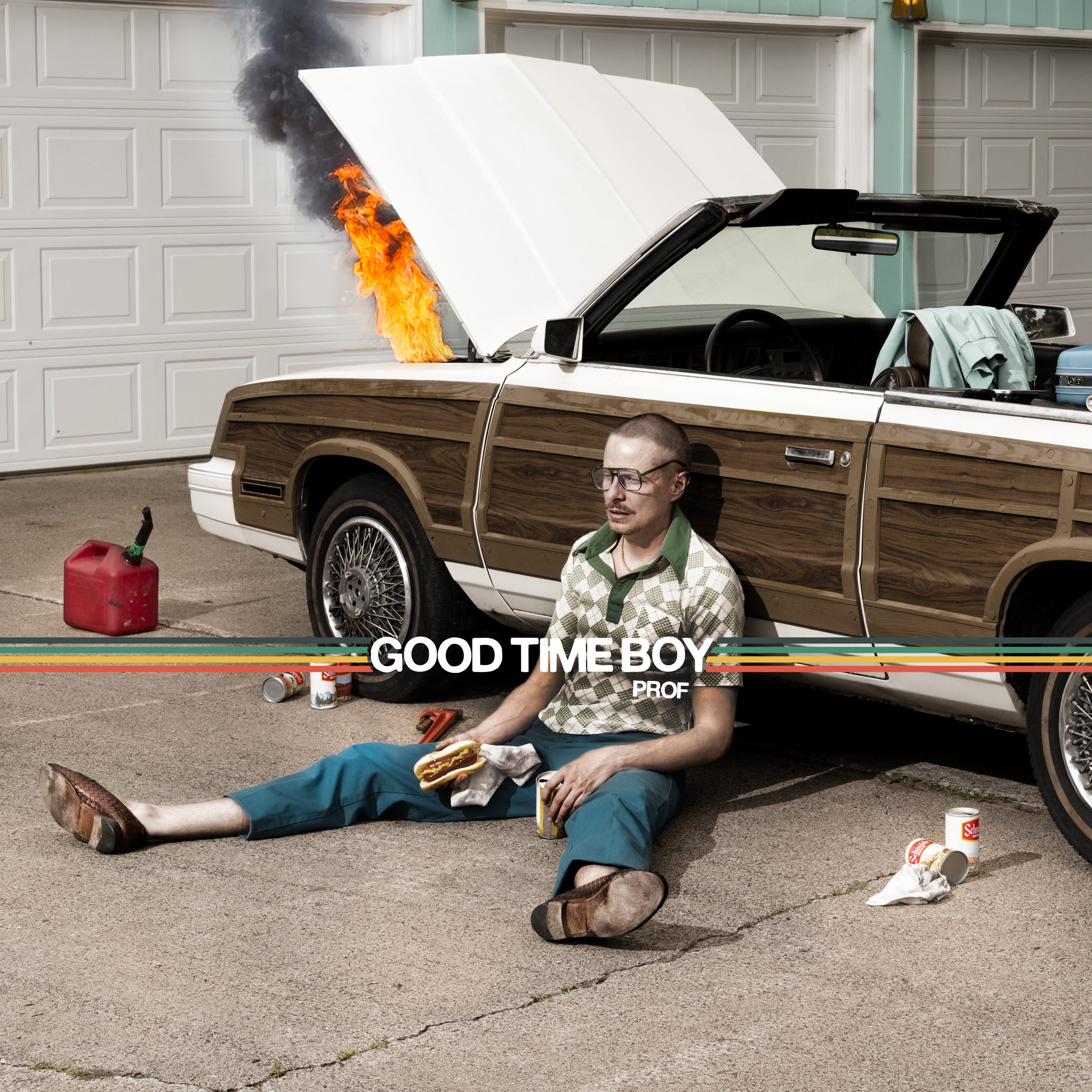
You’ve always known you could pack a decent-sized room anywhere in the Midwest for twenty years, and all you had to do was set the world’s insane man on fire behind the last act on your bill. That these shows had become the stuff of regional legends was precisely due to the fact that they contained the rawest mashes, those that can’t even begin to be considered permeable for digital translation. That was the world of Prof’s Stophouse. Because this Jacob Anderson’s peculiar putrescent strain was recognized too early by majors as too weird for them to touch, and frankly, too unstable even to approach. The air around him smells like hairspray and kerosene, just like on Good Time Boy. “Reaching for Fire” is the opposite of cockiness; Prof gazes into the mirror, seeing his father, talks about the struggle of shielding his daughter from the demons he has, and admits, “I got drugs that I just can’t kick,” with the burden of a beat that sounds like it is moving under a thousand pounds. Then you have the title track, right smack bang in the middle, which finally pulls out the frowny face to accompany the playful gloom, revealing grinning death and happy pain are different sides of a coin. The anthemic, soaring “Good Time Boy” uses piano keys and a chanty chorus, and while Prof might be wailing his heart out in the clear sense of glee, his lyrical subtext seems desperately seeking help, begging “I’m the luckiest man on earth… Would you mind if I have a good day?” —Oliver I. Martin
Beth Orton, The Ground Above
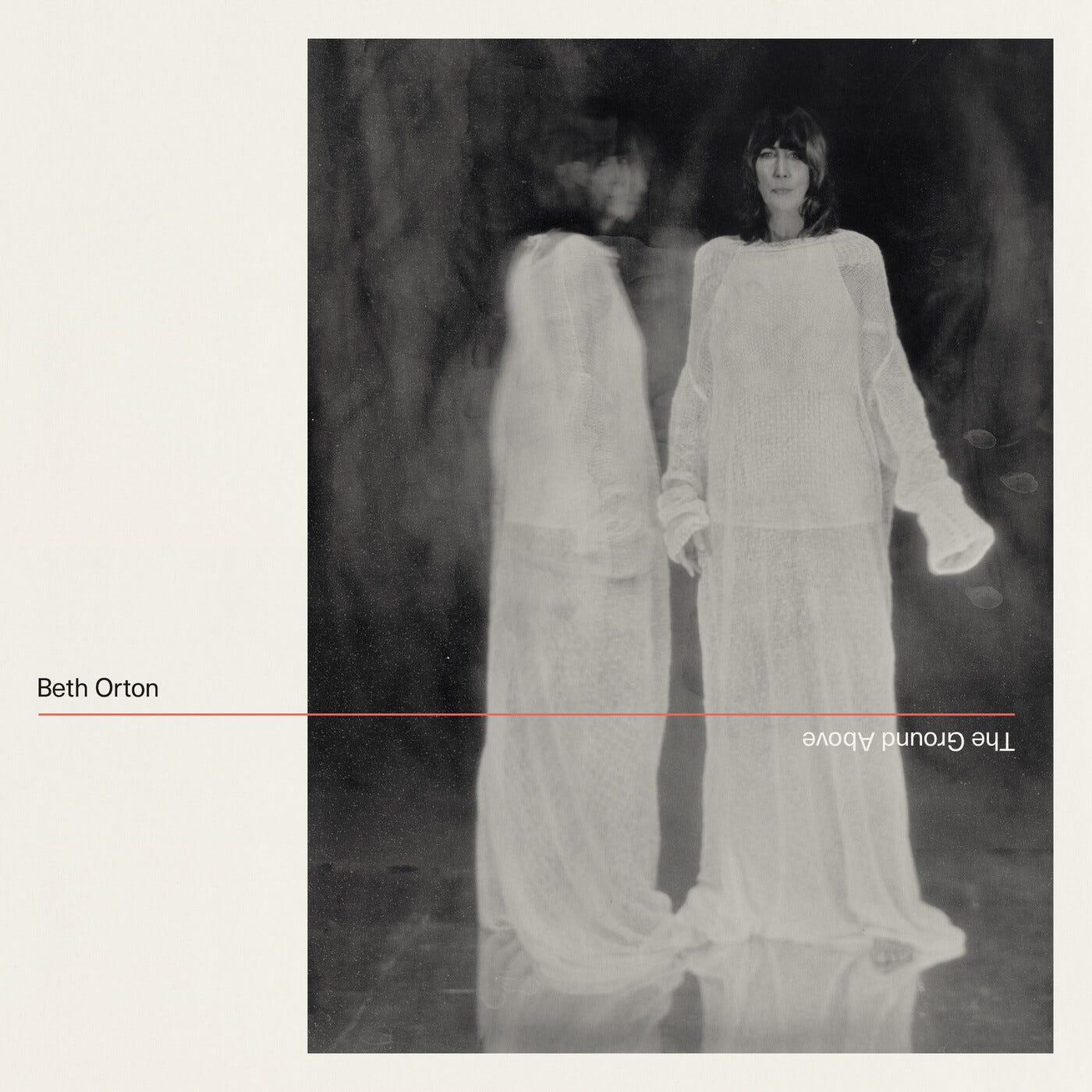
It’s been thirty years and one single called “She Cries Your Name” later, Beth Orton is permanently catalogued under the category folktronica; for the most part, she has put the laptop aside. Beth Orton’s ninth album, her self-produced follow-up to Weather Alive, released in 2022, entrusts a live band (drummer Tom Skinner, multi-instrumentalist Shahzad Ismaily, Portishead guitar aficionado Adrian Utley, and Christos Styliandes, throughout threading trumpet) with the work while the English singer-songwriter sits in the middle of it sounding more straightforward than she has in ages. A haunting eight-and-a-half-minute title track grows through mourning from the first note, and the album spends the rest of its length reaching upward toward something like dawn. Orton has said love and grief are the same animal to her, and she explores that premise on these eight tracks, motherhood and political dread and the stuck-to-it-ness to stay all muddled into one. Sam Beste, the pianist for Amy Winehouse, plays with a patience that leaves her space to breathe. On “Otherside,” she plays with the idea that the first birdsong of the morning is just the birds telling each other that they survived the night, and rides it upward to the light, seeming happy to have done so. —Charlotte Rochel
Jules Clay, Hate the Sin Not the Sinner
According to the belief, when the gun is dropped, salvation is thus found. This corner of Buffalo is not acquainted with the memo. Jules Clay, who goes by Wordplay Clay and makes the majority of these songs with the producer Skip the Kid, found God somewhere in the journey and kept the gun as a habit. With Hate the Sin Not the Sinner, he prays while the bullet is already in the chamber, and he does not want to choose one over the other. The most decent portrayal is on “GEMS.” Clay shouts, “Lately, I been reachin’ for my Bible more than my gun,” but after it, he takes it back: “But still keep my gun for the creepin’.” He talks about the fight with his demon as the hardest battle he has ever fought. On “Halos & Horns,” he just doesn’t split it any longer. “I don’t rock a halo or a set of horns,” he raps, and stands in the gap and stays there. The moral dilemma that he is facing is that he has to choose between the angel on one shoulder and the devil on the other. He gives the only possible answer to the question on the bridge of “DOMS,” that is, neither. In his grip are both the gun and the Bible, to which he responds to both and neither of which he puts down. —Termaine M. Scott
Hit-Boy, HITstory 2: Success Is a Dirty Word
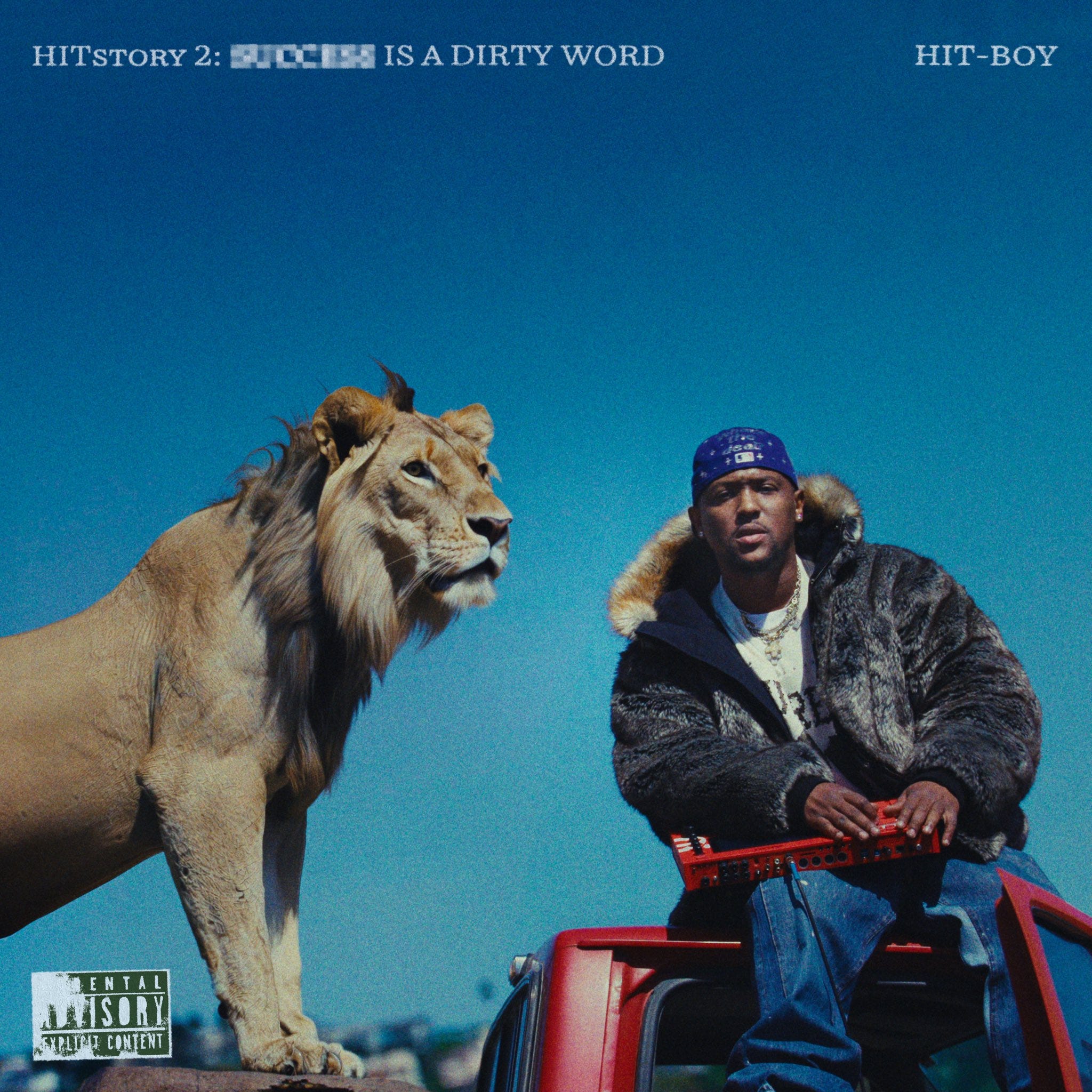
In the 1975 episode of Good Times, a cash-strapped James Evans endures a debutante ball by constantly having his leg pulled by his daughter’s wealthy boyfriend’s dad, who can’t stop referencing the housing project the Evans family is living in. Backed into a corner all night, James tells him, “Now, I busted my butt a lot of years to get out of here, and I made it. Now, you make it sound like success is a dirty word, brother.” Hit-Boy pulls this dialogue to the start of HITstory 2: Success Is a Dirty Word, his follow-up project under the moniker he established when he became everybody else’s hit maker. Fifty years later, the sentiment holds up for the producer he borrowed it from. He takes this further on the project’s title track, with him in therapy describing whether or not he’s in good spirits as depending on whether he’s tallying streams or relying on his actual friends. “I turned my heart into a rollout, I turned my pain into a pitch deck, how the fuck I sold out?” he raps. There are plaques on the wall and cracks in his spirit, and, with no acrobatics, he delivered each sentence in his flat, unimpressed tone. His group chat overflows with yes-men while his true friends fall quiet, and though his family tells him that they’re proud of him, they barely look at him when he’s in their presence at home. —Rian Frost
Jadasea, Holly Grove
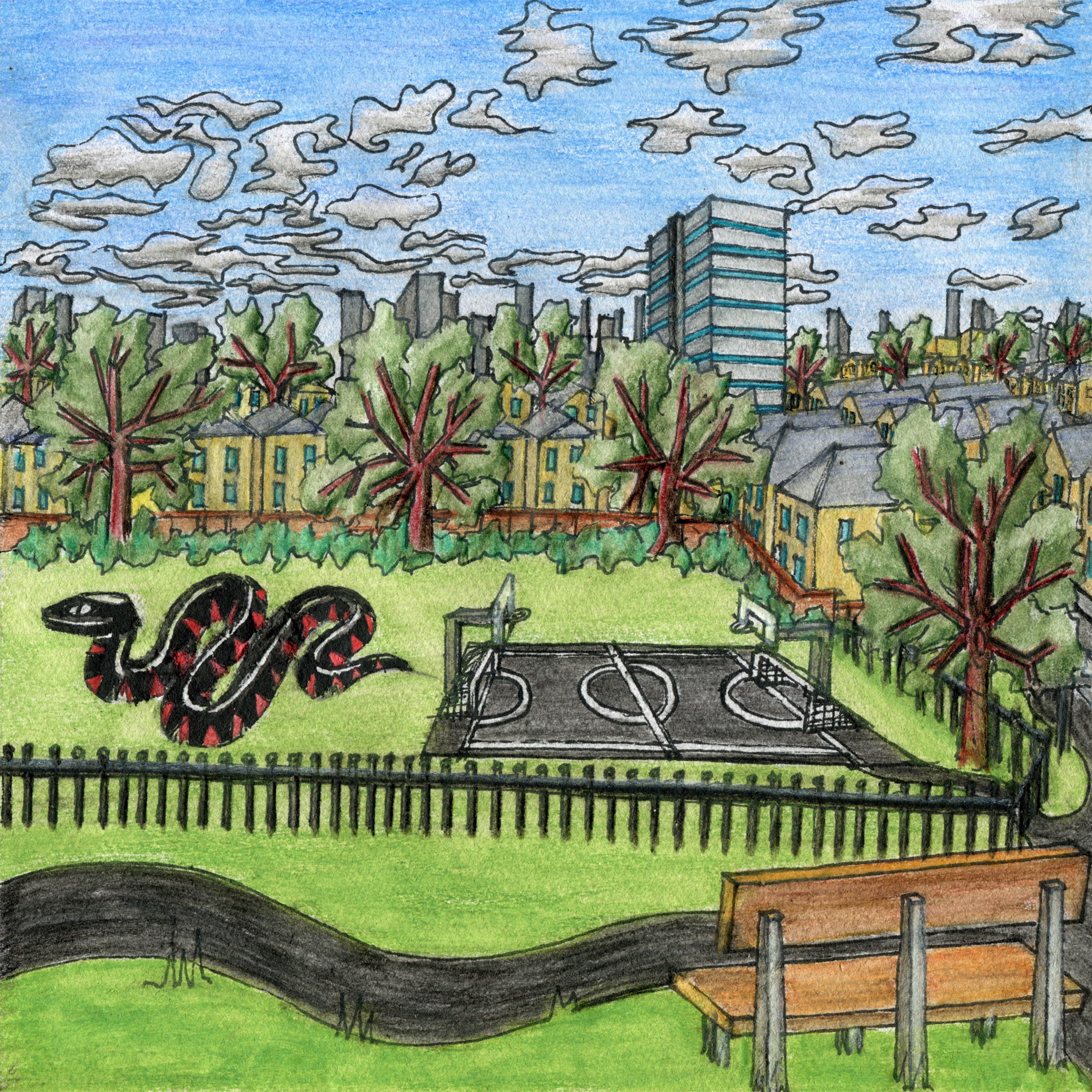
A strain of underground rap lurking mostly between South London and NYC bedrooms runs on one common obsession: the voice sinking beneath the beat instead of over it. The producers pursue obscured clarity, short loops, avoiding catchy spots for beats, and a minute of obscured production over a full arrangement. Jadasea has been hanging out in that same terrain for a long time. And he pushes the sunk voice as deep as possible. The mix eats him alive on purpose, his voice arriving out of the bottom of the mix with the bass mishandled; the South London territory is perhaps one of the only aspects he can get clean, Peckham, those streets that he keeps returning to. The beats keep the bass and sub-bass to the front, whilst letting the top end get all enshrouded and elusive, and the heaviest ones push the weight forward to the point where nothing other than the sound of himself and his bandmates remains in the room. On the record itself, Harrison, who does the majority of the beats, builds “Cobra” as one of these, simple but distinctly pronounced, with the structure of the track framed by a low-end anchor, with the drums bringing more force and more physical impact than anything else around it, and the mix sustained in that underground hum and murk. The strangest mix here is “Mind Game,” wherein low frequencies engulf everything and then thin out suddenly near the end so that the track is contracted inward, as if everything’s pressed into a tiny tunnel. —Koda Lin
Sha Hef, Hustlin Ain’t a Sin
Being in prison for five years allows a guy sufficient time to deeply ponder his own conscience. Returning home, a guy usually would turn the matter of time around the other way, thus proving that he outsmarted the system in his own game. Sha Hef does a stranger thing with it. For the better part of this decade, he has been skiing down this path, often sitting next to Jay Worthy and the LNDN DRGS crew, and it was never grace that he was seeking before. Now he is not able to stop, probing whether a dealer who kept praying the whole time is allowed to get into heaven with everybody else, or if the work that fed him is the only thing that excludes him. A child’s bedtime prayer is what he runs before his pistol on the title song, “Now I lay me down to sleep/Pray the Lord that pole I keep,” and he straight away asks if there’s a heaven for thugs and he would rather choose twelve jurors than six pallbearers. In the song “Gotti,” the mode of boasting now is read differently. The hook (“Monday I’m all alone... And it’s a blue Monday”) really points out that he is the only one here, and on the next hearing, he kills the time the only way he knows: “Take five hundred blue strips and count ‘em up just for the fuck of it.” All that counting looks just like a man in a cell marking off the days of his time, and Sha Hef seems to understand it. The boasting was never really about the money; in fact, it was about keeping his hands occupied while he was waiting to get the news about his place in heaven. —Okoye
Conway the Machine & DJ Whoo Kid, I Heard You Paint Houses

The first half is made of threats; they’re constructed economically. Conway turns wealth into danger without missing a beat on “20 Shots”—the speeding Porsche and the four-person Lamborghini within the same breath, the very next a nonchalant gesture: “Heard in his family someone died, I almost cared.” The hilarity of his ruthlessness stems from the detached way in which he reports. The narrative of the killing is nothing new for him, and that much he knows—what saves it from being tedious is the fact that the boast and the corpse never stop showing up together.
On “Long Kiss,” which uses Biggie’s “Long Kiss Goodnight,” Conway recaps his trade as if referring to an operations manual: “I sold base, I sold flake,” and then its chemistry, “I learned put some soda in the pot, the white expanded,” and then the exit; “Took the label’s money and ran, it’s like I vanished.” The verse concludes with a single-handed testament to a singular truth: “No friends, only this .38 I trust.” It’s in the cooking bars that the writing is the loosest and the most assured, a history brought so close he could reach and touch it. Conway’s production isn’t all over this tape. A tape like this pays to borrow others’ records (which we dearly miss), hoping the writing will do enough to earn back the expense, and the drops and movie skits of Whoo Kid are scaffolding that stops being relevant after a few listens. What stands is a rapper who, onto a 50 Cent or an Eminem instrumental, bends toward Buffalo without notice. And who writes of what wounds him, when the menace leaves him, in the same bare hand that he uses to count bodies. —Devon Kai Brooks
Sparklmami, in this body

Ariella Granados’s mother kept stacks of CDs moving through the house in Texas, corridos and norteños, cumbias, boleros, a little Spanish rock and the odd electronic record, and from about age ten to fifteen she sang in a church band with her cousins, driving out on weekends to play services around the state. At the University of Illinois at Chicago, she later built her childhood home again in ceramic and recreated the telenovelas she grew up on against a green screen, art-school work that kept circling memory and the rooms she came from. She records now as Sparklmami, and her debut is the first time all of that material gets to move at once, in real time. She and her band cut most of in this body live, in single takes, and she has said she sang straight from her subconscious onto the recordings.
The homesickness gets a face on “quisiera.” Singing in Spanish to her mother, she reaches for a closeness the distance won’t allow. She opens by wishing she could tell her how all of it feels, “Ay, mi madrecita, si te pudiera contar/Sinceramente cómo se siente estar yo aquí y tú allá,” and she settles on telling her it isn’t easy. The chorus holds two wants at once: “Ay, madrecita, ah, cuánto te extraño/Oh, cómo quisiera, ah, que me conociera.” She misses her, and at the same time she wants her mother to actually know her. The second verse goes harder and quieter: “Tú estás allá y yo aquí/Tú hablas más y yo a mí/No me escuchas, no, ni yo a ti.” You stay over there and I stay here, you do the talking and I talk to myself, you don’t hear me and I don’t hear you. It runs longer than anything else here, and it is where she says what she means with the least cover. —F. Qureshi
Infinity Song, INFINITY SONG
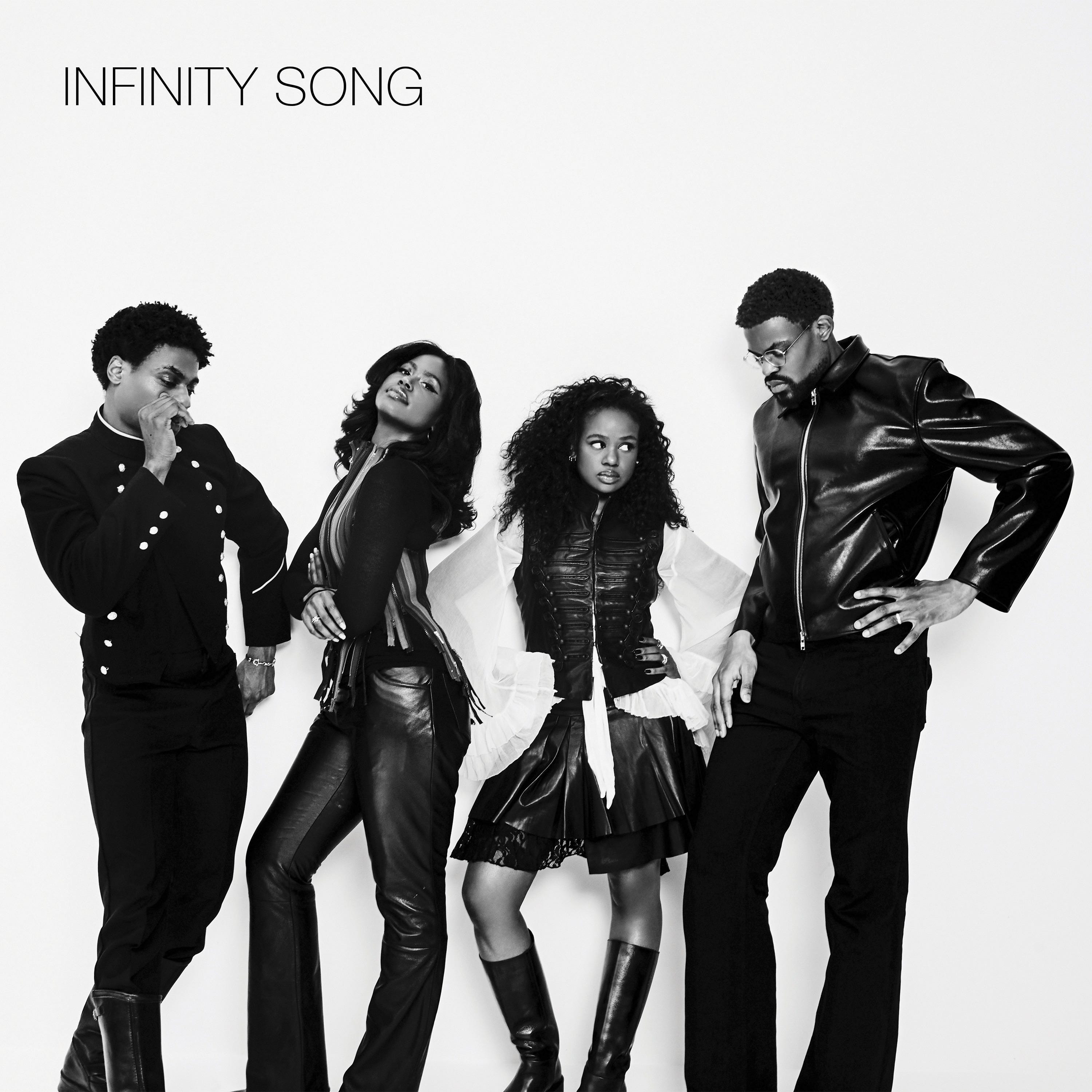
Four kids who grew up around a Detroit choir decamped for the east and began street-performing the loudest, liveliest rooms in the city—Bethesda Fountain, Times Square, the marble floor of Grand Central. They knew before they were signed that a song stands or falls on the way voices nest against each other, and Abraham, Angel, Israel and Momo Boyd carried that subway apprenticeship with them to Infinity Song and Roc Nation, a decade ago, and the method hasn’t changed. Voices first, the band stays a half-step behind. The songs that stay with you, though, are always about the leaving, and the person left behind, and the songs here just keep letting them bleed into one another. “Michigan” is all water—lakes that love the singer back, “But not as much as the rivers do,” under the surface a worry that the state, itself, is already gone, and “It was a kindness to us all/To leave the last place we were kids,” and nothing now feels “The way it was in Michigan.” “Sayonara” takes that loneliness west, and leaves the singer stuck, worldly rich and homeless, grass nowhere greener, until the whole saga boils down to one plea, “Can you leave the porch light on?/ I want to come home.” “Running Away” brings that ache to another person who is always keeping “an arm’s length/Of distance between us.” The bridge cuts: “I was the shoulder you leaned on when you cried/Now I’m the corner you’re trapped in when you lie.” —Marjani Fields
Dice Raw, The Insanity Project
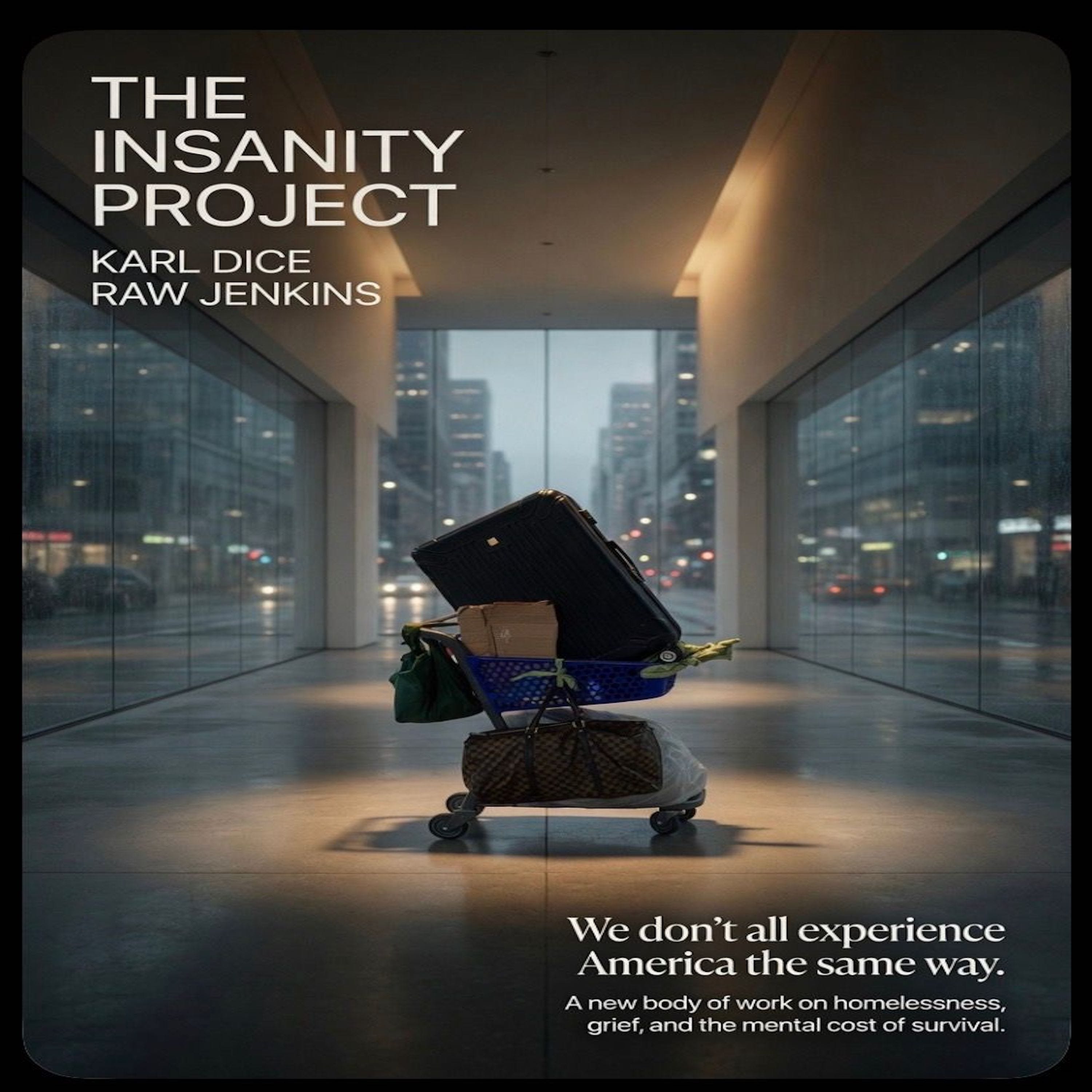
For the last three decades, Dice Raw’s writing has worked outward, toward characters, city, and audience—words he knew somebody else would be performing on stage or recording. The language goes inward, at his family, at his head, at the neighborhood that raised him, at a violence that’s never entirely a metaphor. The rich material here, like the frightening material, is true, and he’s giving it equal weight. “Honor Thy Parents” takes us even deeper. When he hears from a doctor that his mother has cancer, he replies without fuss or hyperbole: “I cried that day and cried every day since.” The verse says her name: Pamela. He returns, too, to a father who died on New Year’s Eve, a stranger whose family’s tales described him as a philandering, cheating sack of. A prayer follows that God might “smack him right in the back of the head” when he sees him: “I swear on everything you can see/I could still spit at his ghost and make him do my taxes for me.” Both of the verses—hatred, grief—work best when they live in the same rhyme, and in this one, he is least inclined to put on a show. And although the exotic boasts will eventually disappear, as will the cumulative death tally for listeners, the story of the mother making the world right with frozen pizza will remain. —Janelle K. Moore
Serengeti, KennyV
Kenny Dennis is a sixty-something, deep-fried, real estate lawyer from the South Side of Chicago—passionate about the Bears, mad about the Cubs, and unashamedly dedicated to “drip.” He’s married to a steady partner named Elaine and in love with a woman named Jueles, who supposedly died in a plane crash in ‘93. David Cohn, better known as Chicago MC Serengeti, has been rapping as the alter ego for over a decade; here, he hands him a cell phone and a livestream. Kenny talks into the “chat,” reading comments, showing off his fits to a room full of trolls and fans, letting the stream run as the women on either side of thirty years tear at him from off-screen. His voice stays nasal, blunt, less singing than speaking, the rhymes locking up like deadbolts as the train of thought derails.
In “STINGER”—Kenny’s long single verse where he trades bars with his own memory while driving along Lake Shore Drive—Elaine appears amid grocery bags. She’s built him “a whole cathedral out of coupons and some space,” comes home in the winter with exact change for the rent, the devotion he calls “No fireworks, nah, more like heating vents.” Jueles, however, weighs nothing. She walks back into a Portillo’s counter thirty years after the plane crash she never took, and Kenny almost drops the chili cheese. He can tell that “JUST TURN YOU BACK ON HOW YA BEEN” comes off to the chat as “Chat would say KD’s done crashing out.” He takes her with him anyway, second-guessing his decision from the passenger seat of a winter Grand Prix while she sleeps with one hand resting on his chest. In the freezer aisle later on that song, he’s “stunned and alone,” holding “banquet Salisbury steak like a rotary phone,” then it’s Portillo’s downtown again, him watching Jueles walk slowly through the lunch rush under the fluorescent lights until his knees buckle. —Harry Brown
T.I., Kill the King
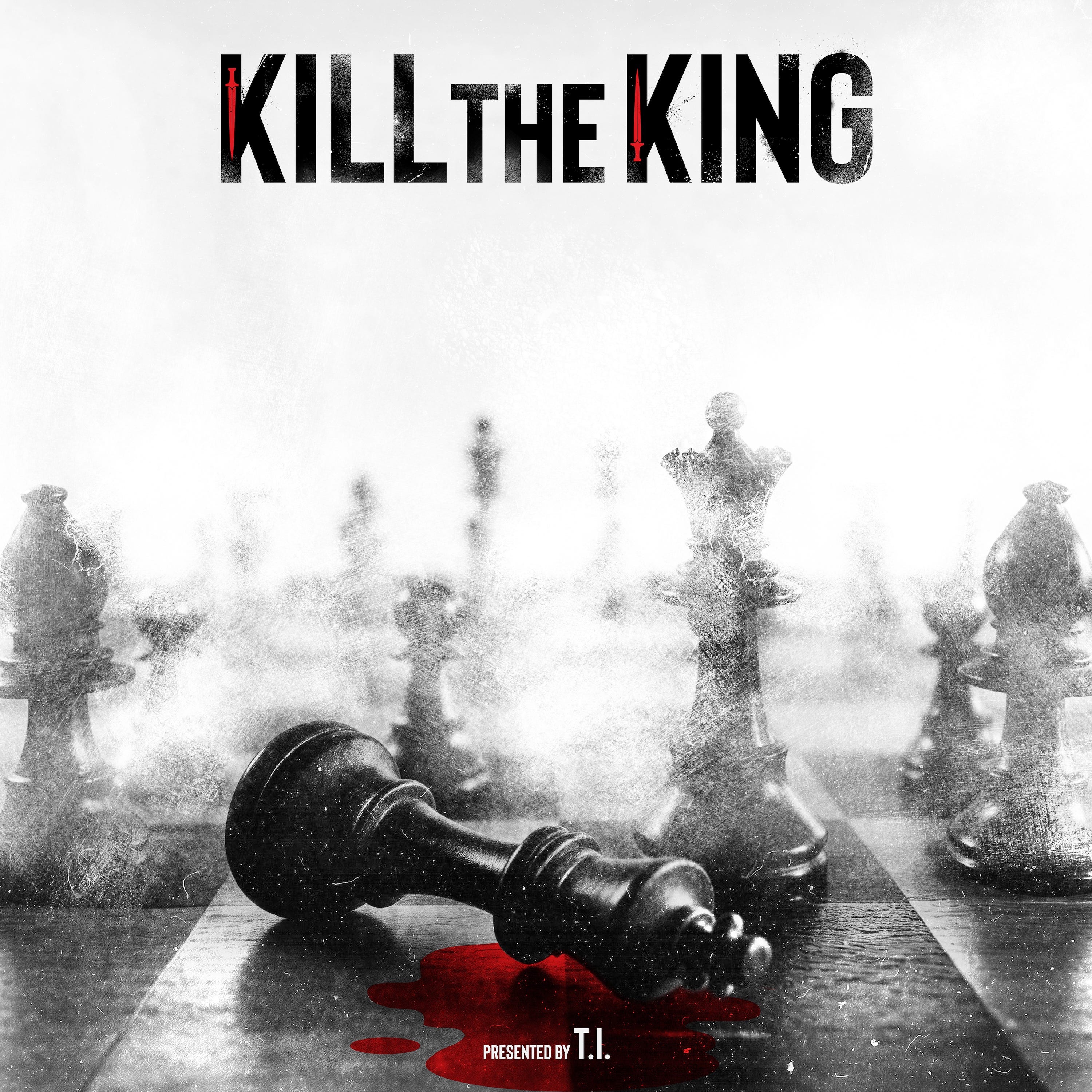
Throughout history, the title of King of the South has only been associated with one person and has always served as a challenge to anyone interested in seizing it. Clifford Harris is the person who has worn it for the longest time and claimed it out of Bankhead a quarter century ago, for he has always been the one to stand for it, no matter the hit records or the federal cases or the long period of time when it was taboo to even spell his name out, let alone to be called a rapper. The claimed title of Kill the King that T.I. gave to his last album is a chess idea transferred to him by Big Boi, as he says. The reference to the crown, which is the king’s seat, draws attention to the fact that this is the primary target, while the ego that has been accumulated around it is the aspect that needs to be eliminated. After the boastful words are done, T.I. practically transforms “LLOGCLAY” into a trap beat-based elegy, and the second verse is the rawest writing here. He is next to a partner dying in hospice, the doctor calling it over, and he gives the response of diagnosis with “fuck your diagnostic.” He converses with the dying man like they are brothers, calling him “this your little brother talking,” and when that doesn’t work, he declares “grieving, drunk, just speedin’ in the fucking rain,” having the thought of what to compare it to, only finding it like this, “Snowfall episode, my uncle Jerome died in real life.” It’s the most alive he sounded in years. —Phil
JRDN & Lane Hall, Lane Hall

Few things come to mind when imagining a warm, low-slung soul band from Halifax, a port on Canada’s east coast, not known for fishing boats and fog banks, let alone soul music born in Memphis or Philadelphia. JRDN is the Nova Scotia singer flush with a decade of touring for clean, radio-friendly, solo R&B before he even named a band for his live work. That snags him some weight. His voice stays open-throated and in front, while the bass keeps things warm and nice. He saves the best writing for “Flowers.” A story-song about a chap who worked “Papa’s farm since the day he could stand,” and passed flowers the whole life through for somebody else’s use, and got nothing back. JRDN keeps the voice to the bare minimum and holds down the story until the end, where the man’s dead and they’re turning up late with the bouquet: “I wish he got his flowers in his day/But there’ll always be flowers laid on his grave.” Far and away the most heart-wrenching, and importantly, the most giving, a life spent cultivating flowers for someone who, it seems, arrives late with the bouquet at the funeral. —Amaya🎀
Lync Lone, Life Is... Fleeting

For some MCs, the measurement of their career comes in bars; for others, in months. The second category is what a Rochester writer has resembled over the past two years, dropping full-length after full-length to Bandcamp and the streaming services, self-recorded and self-released under his Gonzo! Records imprint—the Hunter S. Thompson streak laid across everything like a coat. We’re talking about Lync Lone, and Life Is... Fleeting pulls one pressure tight underneath, time running out, and the daily question of what that makes us do—stop short or keep going? They don’t take turns between dread and willpower; they meet you on the same bar.
Weed shows up almost anytime a verse does and seldom to swagger. The hook to “Bearer of Bad News” is laid bare: “As long as the smoke keep twirlin and the blunt keep burnin/I don’t really ever got too much complaints,” content rented out blunt by blunt. The stronger chemicals become more of an aid to see than something to rage with: “Shroomwich” starts off with Lync Lone eyeballing his reflection in a puddle, “I look inside a puddle and see a portal to be immortal,” boredom defeated through the science. “Fidelio” brings him into an alien world with the same stuff, shrooming out toward a long silence while whatever eyes hang in the atmosphere cast his passage back upon him. The trip doesn’t get him away from the thoughts; it just douses him into them a little better, a more well-defined darkness than the sober sort. —Wesley Durham
Mica Millar, A Little Bit of Me

A soul record normally distributes the credits. On this one, one name seems to pop up in nearly every role: writer, arranger, producer, and vocal engineer. Mica Millar produced every track on her sophomore album this way and released it on her own label, Golden Hour Music. In Miraval in Provence, the players feel like a real band, with Daniel Weatherspoon on keys, Jay White on bass, Adam Smith on guitar, and Keyon Harrold on trumpet, although every direction still flows from her. The songs developed over the three years that followed a 2020 accident, which broke her back. She’s spoken of her recovery time being roughly nine months, and including relearning to walk. None of this is a confession. She reports to no one now, and it is when writing hardest that she finds herself again.
The title song establishes these parameters, and it establishes them from the inside out. “I cannot get away from that little bit of me/And I tried to be what you wanted, but that’s not loving me” is the chorus, which could be read as a break-up song, except that the blame falls back on herself for bending. The verses reflect the same sentiment. “I claim what I own/I rule and so grow” and then “I’m clearing it all out, finding the space to be alone.” On the bridge, she rummages through past rooms to prove who she once was. “In black and gold I find memories of mine,” and the song ends with her there, alone under the stars, remembering herself most. —Raya Sinclair
Jessie Reyez, A Little Vengeance

Most breakup albums aim for the dirtiest thing the singer could possibly say, and then say it. Jessie Reyez just keeps going back for the worst and then recoils. On A Little Vengeance, she performs like a person who knows where all the bodies are buried but would rather make sure you know that she’s consciously electing not to exhume them. She sings and speaks, slips into a rap cadence where a statement needs some muscle and across all of it, maintains a mental tally of everything she could do to the man who wronged her and chooses not to do them. The clearest illustration is “DUSTY,” where she iterates each piece of leverage she holds over the ex and announces, line by line, that she will not use them. “You lucky I don’t hit your wife and tell her that you still reach out,” she sings, then “You lucky I don’t leak those pics that you still got the nerve to send.” The threats are specific, and the mercy conditional. On “MADAME JOYCE’S INTERLUDE,” she lets her guard completely down for a story about the one time she didn’t hold back her leverage, going through his phone and changing every suspicious woman’s number by a digit so they’d no longer reach him. The switched digit lands more impactful than anything subsequent she attempts for peace.
The weapons she refuses to brandish against him find her anyway and turn on her. In “iBREAK,” she’s awake at 1 am to his call, then confesses, “I break, I break it all for your love,” and cycles through the arsenal she celebrated in the breakup anthems to find it ultimately useless against her own memory. “UR HEARTBEAT (WHO DO U THINK ABOUT AT 2AM?)” goes all the way: “I don’t wanna move on/Just wanna finally learn your weapons,” then cuts the pretense: “Like it’s platonic, but I want u in my bed.” It turns out the power she held over him, and the scar she has left upon herself, is the same hand. The closest she ever comes to contentment is to whisper to herself, alone in the dark, that she still wants him in her bed. —Alexandria Elise
Dylan Sinclair, Make You Feel
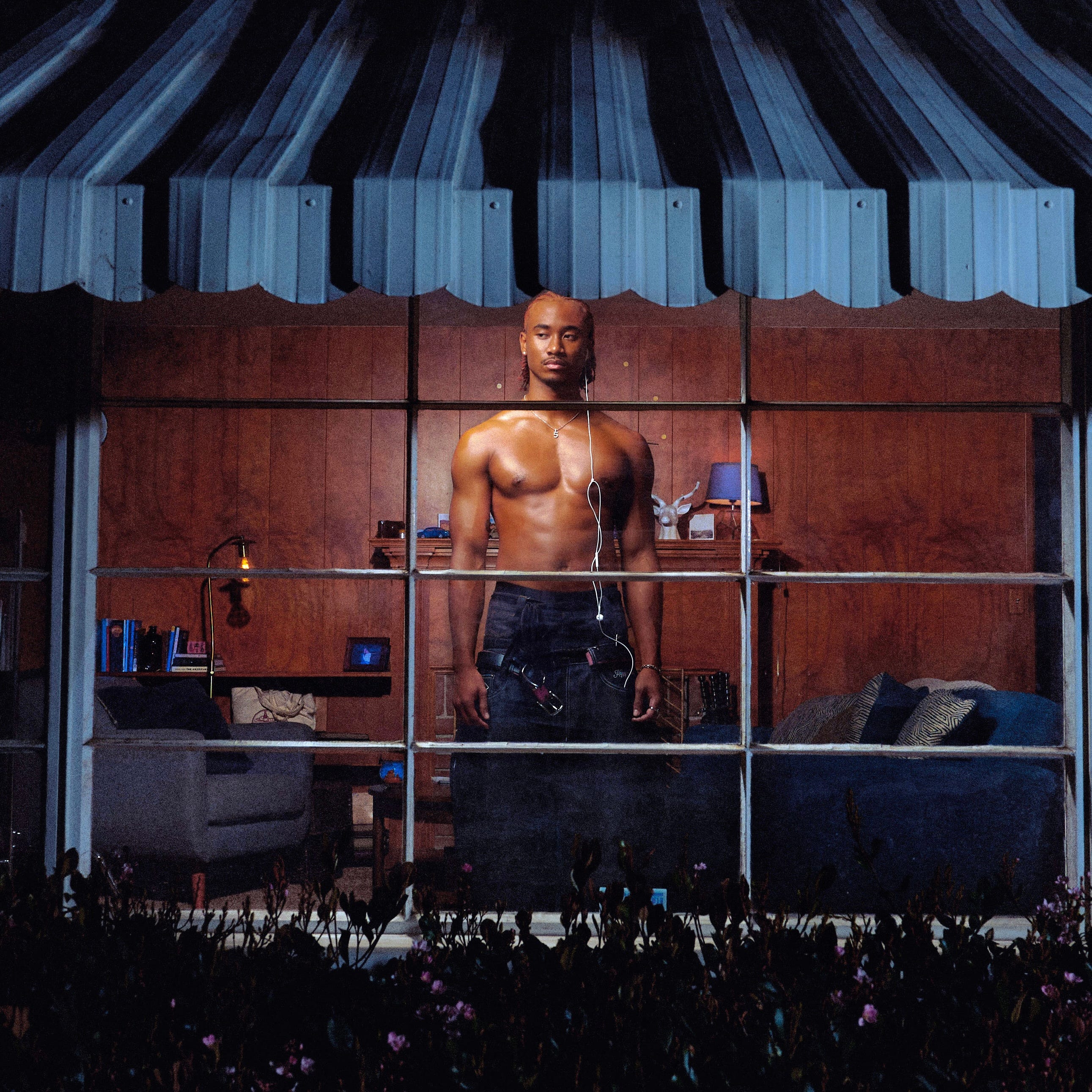
The most extreme statement to ever grace Make You Feel: an avowed promise to slay. To a lover who, for a few minutes on the song, hears it as evidence of how far Dylan Sinclair’s love can go—a vow to come and retrieve any man too willing to meet her eye on the floor—he matches it with all the shallower forms of desire running on the same logic. Money is at the ready for her to carry, the camera is wanted in the bedroom, instruction issued to step away from the club doors. But across the breadth of this mixtape, mostly through the Canadian singer’s collaborations with producer Jordon Manswell, that desire is rarely anything less than ownership. In “Denim,” for instance, penmanship may at times prove to outweigh the rest of the singer’s arsenal, transforming his presence into clothing. His existence is defined as a piece of her wardrobe. A possessiveness also peeks through the track, as “Stay Home” turns it up a notch. The whole song is a directive. Turn down men trying to link with her, don’t accept drinks, don’t answer what your name is, and come over to my house instead of doing anything else. He readily takes responsibility for all the hearts he’s smashed on “Safe to Say” and assures her he won’t ever be like that again, that he wants to know whether she will be his lady while having babies. He even says that, “When you around, I start to get possessive/And I’m not ashamed.” He is, through and through, the same person, but the language is contained in a proposal. —Jill Wannasa
Pearl & The Oysters, Monkey Mind

Around the time the second inauguration in January 2025 approached and fires burned across Los Angeles toward people they knew, French-American duo Pearl & The Oysters were—they confess—teetering on the brink of outright panic. So Juliette Pearl Davis and Joachim Polack did what they always knew to do with terror: transform it into extraordinarily upbeat pop. They penned the nearly three weeks needed to write Monkey Mind with analog fanatic Jonathan Rado and mostly tracked it live to tape with friends in Los Angeles clustered around them, dubbing it after the Buddhist term for a brain in constant states of flight from one anxiety to another.
It charts a full single day: “Sound Asleep” opens and closes the proceedings in peaceful stillness, while the title track’s verses accelerate as the mind awakes, and then, at the other end, “Sound Asleep” reprise cues the descent back toward sleep. Sandwiched inside is “Doom Mood,” probably the smartest song Pearl & The Oysters have ever recorded: a deadpan communication from the information age where the lyrics unfold in nested, circular palindromes, all over a set of ‘70s-rock chords as instantly satisfying as a double-fisting soda sip. The bossa, city pop, and exotic water under their skins remain ever present here, but have grown more fluid and natural here than in the heady confines of headphones worlds past. The album came out of a “growing malaise with a cultural climate plagued by digital alienation and generative AI slop,” a sentiment that in the circles around this newsletter feels akin to a church hymnal. Turn this one up loud as you scroll past whatever else might be bothering you today. —Charlotte Rochel
Eloise, My Man & Me

So many singers make a breakup album as if you can pull the ingredients out of the men, the rooms and the different heartbreaks. Not this one. This one takes one man, one love, one long argument, and turns it over and over from every angle with Eloise, a London songwriter who’s spent her few EPs refining her feelings smaller and smaller. Here she goes into the heart of a relationship that was already more than half wrong, tracing its arc from adoration to bitter contempt to whatever it is that makes two people stick together for an unnaturally long time. She names his problems for him early on, and she stays.
On “My Man & Me,” the charges against the man come long before the argument for him. He’ll take her hand, and then let go of it; she’s pretty sure that he makes her unhappy; he tells her he can never love her the way he loved a woman called Amy, and when she asks him why he can’t, he says, “Well, can you blame me?” She has good reasons to leave, but instead she calls him “the best man I know.” Eloise sings it all over the gentlest waltz-like sway-warm, easy, her voice dipping around the chords as much as landing on them. Her tone sounds more loving than bitter, and that makes it work. “I’m living off his nerves, ain’t no doll at first glance,” she admits, and then says, “but I think you’re more than I deserve.” “How Lucky” keeps the same sentiment from a slightly different perspective, the gratitude arising from the memories of men before him, of the “men who were boys/Who would sleep as I cried.” The small, unglamorous detail is key: he told her she looked pretty drinking wine and with her pink hair while drunk, and it was more believable. —Sameira
Nduduzo Makhathini, The Myth We Choose
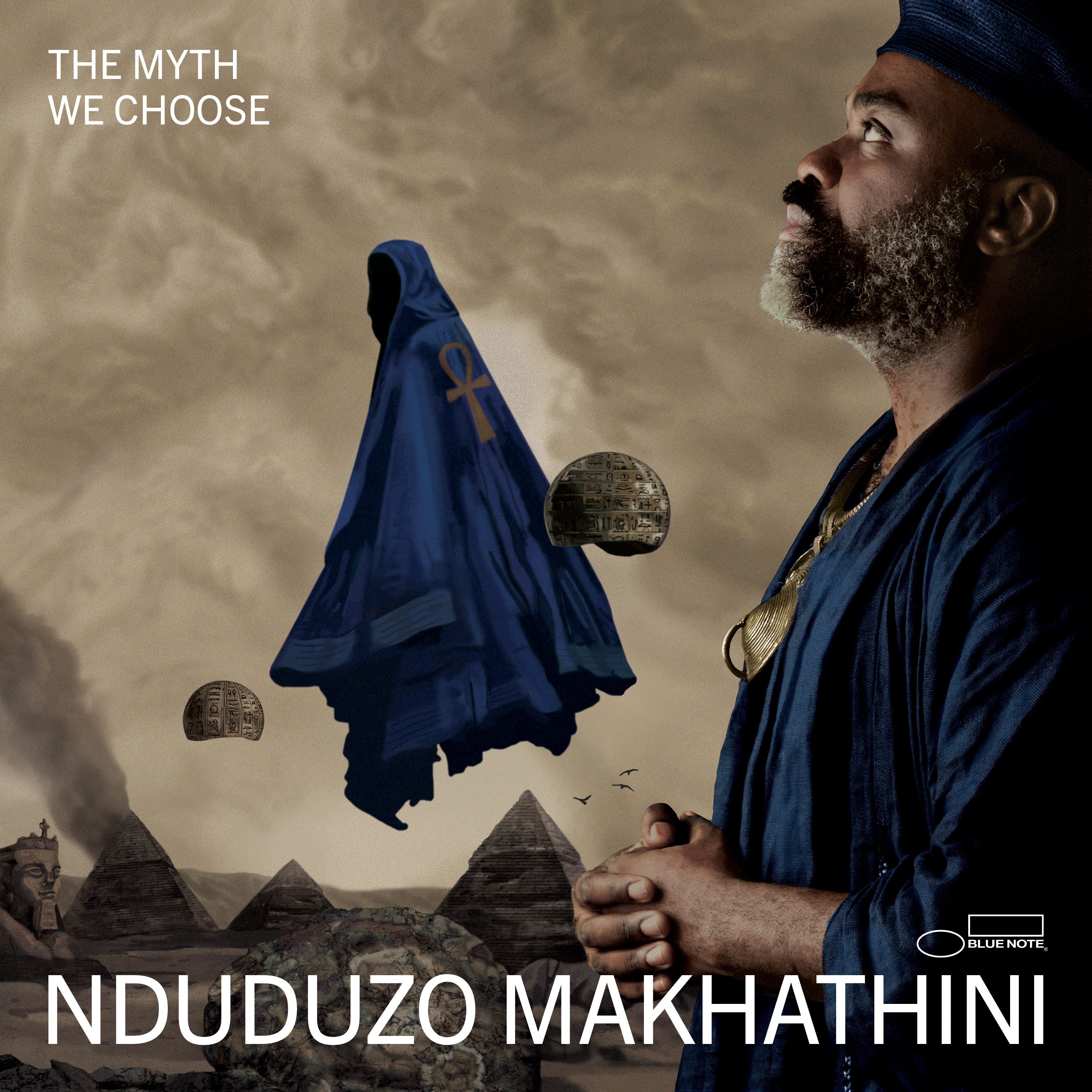
In another life, he is a sangoma, a healer by traditional definition and has stated that the concert is a ritual to call the room to show up for the event. As such, the second new record by South African pianist Nduduzo Makhathini, his fourth to be released on Blue Note, comes packed with much more than just great songs. Makhathini and his trio (Dalisu Ndlazi, bass; Lukmil Perez, drums) tackle the questions driving the entirety of the record: in what narrative do a people choose to exist? He was taught his spirit-driven style of jazz from the likes of Coltrane and McCoy Tyner; his innate sense of song is derived from Bheki Mseleku, Moses Molelekwa, and Abdullah Ibrahim, and every element of it can be felt spinning beneath his fingertips.
His new someone is his child here. Thingo Makhathini co-produced and pushed the record towards the electronics and the grooves that no other Makhathini would have brought you. It’s his ideas here, the synth textures that hug the playing instead of resting on top, as Makhathini puts it. “Kuzodlula” with Robin Fassie on trumpet opens up the idea of forgiveness or, as Makhathini puts it beautifully, to forgive the unforgivable. The flute guest across “Liyoze Line Nangakithi” is Shabaka; the pianist vocalizes a vocoder on “Ekuqaleni”; a Black Coffee-helmed house update of “What People Say” has jazz dipping delicately under the beats; Thando Zide offers neo-soul “Tethered” for enduring love over an insuperableforeignness that‘s now been crossed over; sweetest of all, a love song to fathers who are brave enough to say love out loud: the tshivenda “iwalo a Mubebi” which offers a grandiose notion of a genesis myth shrunk to manageable size for one‘s family. —Brandon O’Sullivan
Nectar Woode, Naturally
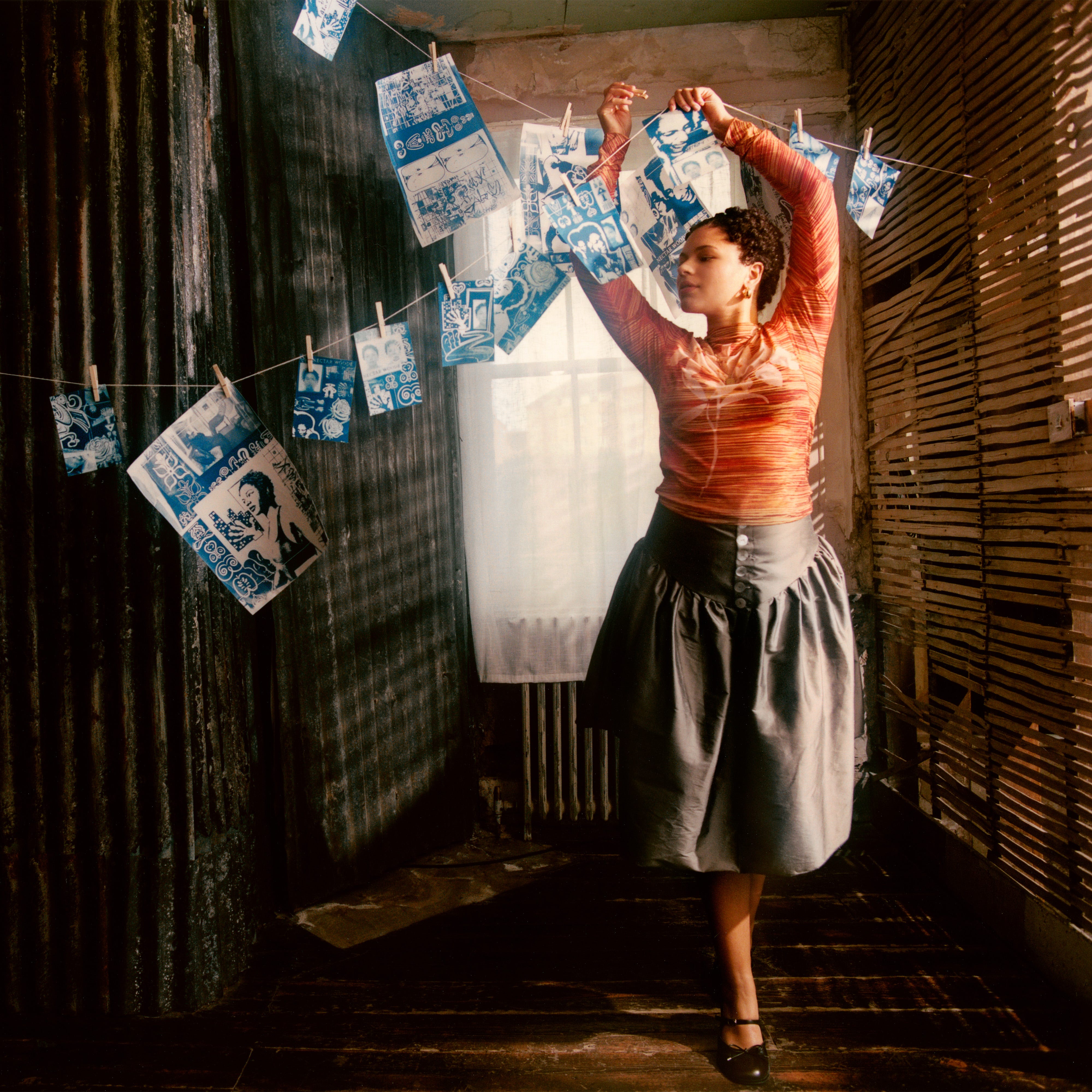
London, predictably, can’t help but produce young singers ready to blow out the room, the kind with belts and runners who can make the hook sound like a final closing argument. Instead of the pyrotechnics, the warm bass and live drums, Nectar Woode, a British-Ghanaian singer, works the other way. Singing at speaking volume, close to the music, the majority of these songs on Naturally are angled back in, toward the only people she can’t gain enough distance from: herself. The most insistent version, and the one who vocalizes herself most, is on the bubbling, percussionist-driven “Stick Fight.” She sings, “Playing with my own mind,” and, “Think twice/Then think another couple times,” folding the entire confrontation up into what becomes, with her, a fairly livable compromise, “Chipping away till I lose/I’d rather be painted a fool/In this stick fight,” carried off, on account of the rhythmic push and pull, so you don’t feel her actually sink to her knees. —Maya LeRoux
Rasheed Chappell, No Era for Margins
Passaic sits across the river from the part of New Jersey that’s written about in song and gets less traffic than Newark by a mile, and is close enough to Newark to use its exits and far enough that no one wants to claim it. It calls its worst Project City, and a rapper has been living there since 2009, when he dropped a single (eventually titled “Resurrection”) that got a little buzz but was ultimately ignored, and then again in 2011, when Kenny Dope blessed him with production on his first record, and all the buzz and attention kind of remained minimal. Rasheed Chappell has spent two years issuing goods and lineage-centered records to the few people who could hear them, and the rest of the world, most could not. On “Muscle Memory,” Chappell raps survival as something the body learned before the mind signed off on it. “Muscle memory, we hustle out of reflex/Hazards of the job is the way that we see death,” he asserts, and sets the violence next to the church, the way the block really keeps them, no seam showing: “No saviors, just sinners and Holy Ghost/With the blood of Jesus, we make a toast.” Yolanda Sargeant sings on “Mother’s Cry” by the camera looking out over a Passaic news of a man dead on Main Avenue near Garden Street, one woman, mother of a son who pulled the trigger, one woman, mother of a man who caught the bullet. It leaves the two mothers, side by side on one night, and both on their knees before the same blockade. The boasts slide home, the grief remained hidden. He has been framing the block on the wall all along, framing and lighting what normally remains on the street. —Phil
Naomi Sharon, No Sleep In Paradise
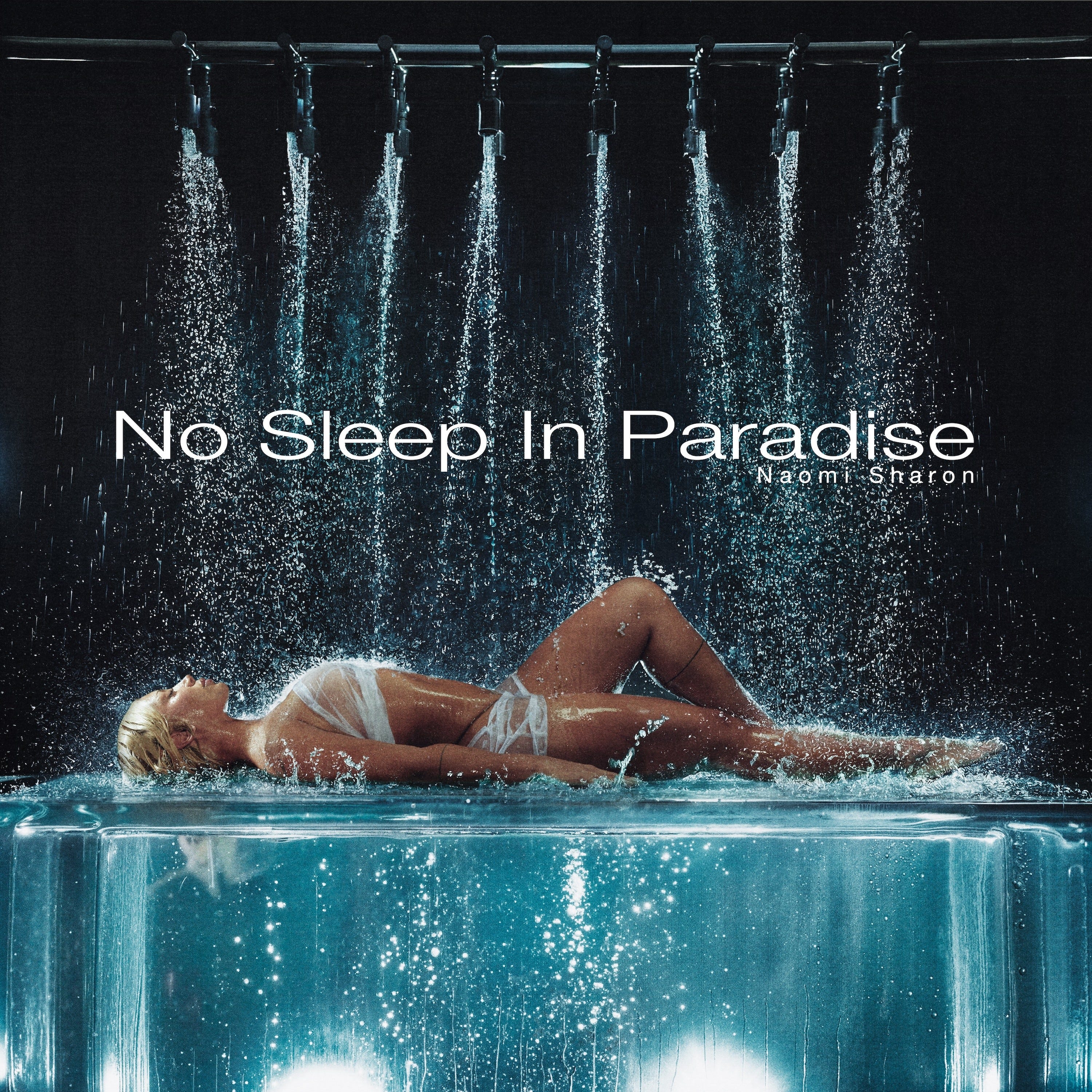
The musical theater background of any singer means learning to live inside somebody else’s words, before your own. Naomi Sharon spent years on Dutch stages, performing in casts of The Lion King and Dream Girls, as a deep-voiced alto perfectly engineered to fill an arena from the back row, and when OVO Sound picked her up as their first woman in 2023, that voice was the story. Her debut, Obsidian, ran on it. That has one purpose: to hold you captive with her voice. The second album, No Sleep In Paradise, uses a more understated, bass-driven R&B framework, drums out of the way, and the low-end taking the lead, and in this controlled room, she almost never needs the high notes to make her point. “Half a Lie” contains some of her coldest and most precise lyrics. To love this man means accepting what he is able to give; “Giving just enough to make it feel real.” So “I dim myself just to match your shade” and, unable to accept what is happening and resentful of a fabricated calm, feels she embodies love. “I taste your past when I kiss your lips/Like I’m a loving ghost you still miss”—she knows the path forward: “We’re living in a half lie/Too close to leave, too far to fight.” She knows precisely what her compromises mean, and can’t escape that fact either. —Ameenah Laquita
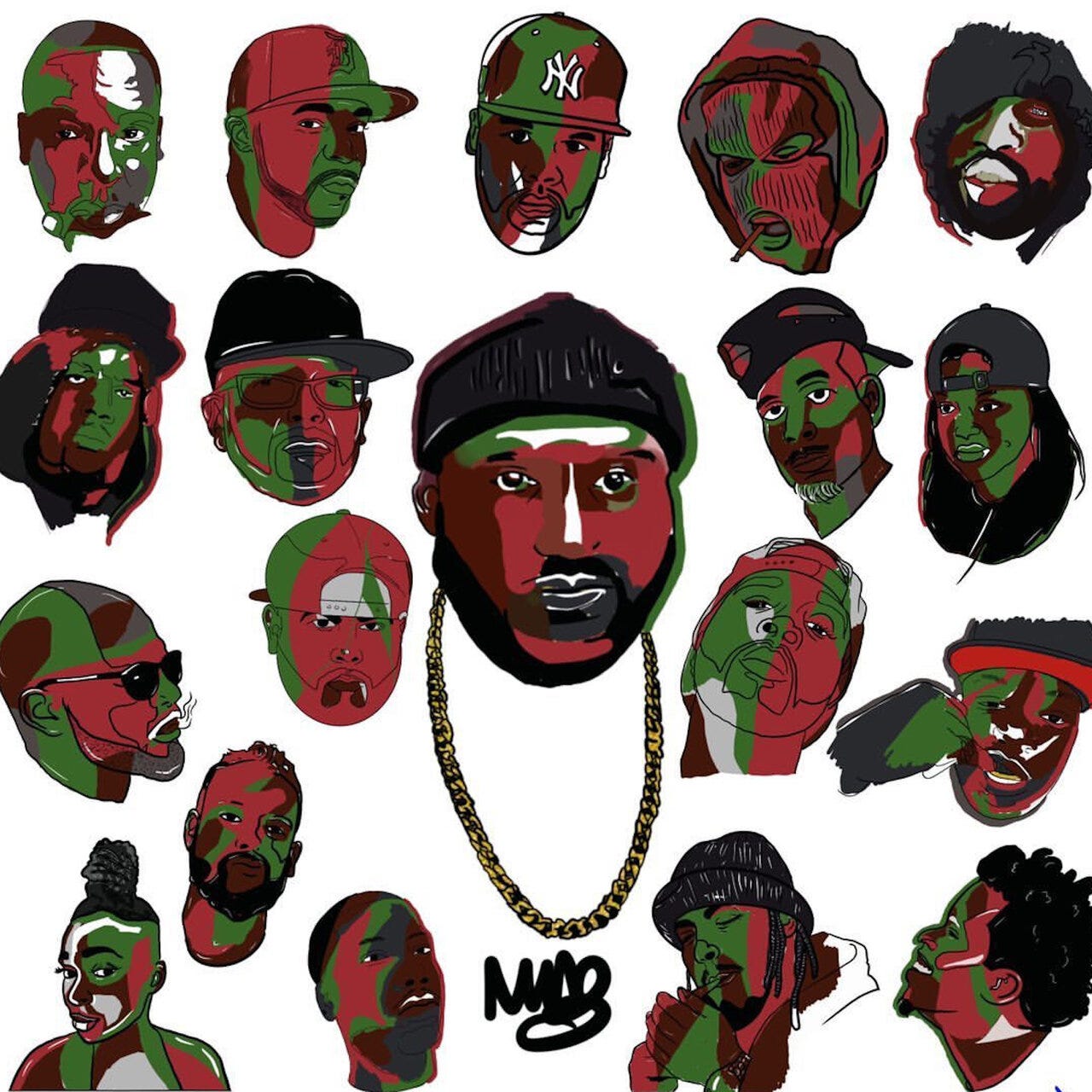
Maxo Kream, O.Y.N
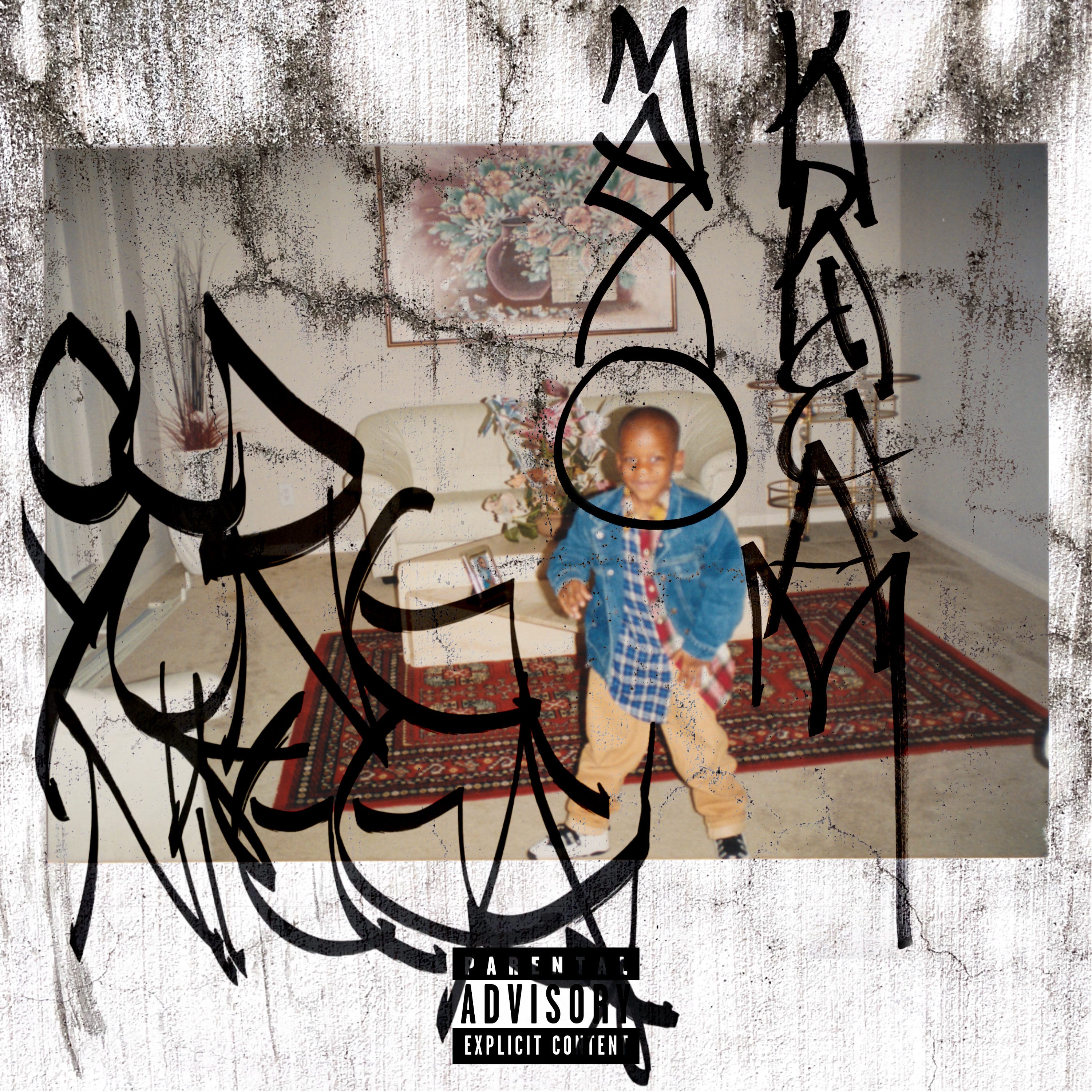
There is very little space for men in street rap to age within it. It’s about the young hustler, the kid who has everything to prove and limited time to do so, and it’s easy for the long-term guys to become elder-statesman speeches or cosplay twenty-two. Maxo Kream, whose childhood was spent in Alief in Southwest Houston, has, through his latest studio effort, found a third way. O.Y.N, or Old Yung Nigga to be exact, is a nickname that denotes a younger guy at the core—keeping one’s twenty-two-year-old urges intact. He teamed up with only one producer, JPEGMAFIA, and directed the record at both his younger peers on their way up and at friends who never made it. “Time Out” exemplifies this more fully; Maxo deals with the death of his father, travels to his place of ancestral origins in Naija and Ghana, and addresses the combination of adderall and Vyvanse in his day-to-day routine, name-dropping Amy Winehouse as well as he can. He sets a firm boundary on interpretations of his words: “Low vibrations in my thoughts, but never suicidal.” It is here where Maxo makes perhaps his clearest and most vulnerable statement with the line: “This street shit was inherited, can’t share it with no therapist.” —Murffey Zavier
Ibeyi, Offering
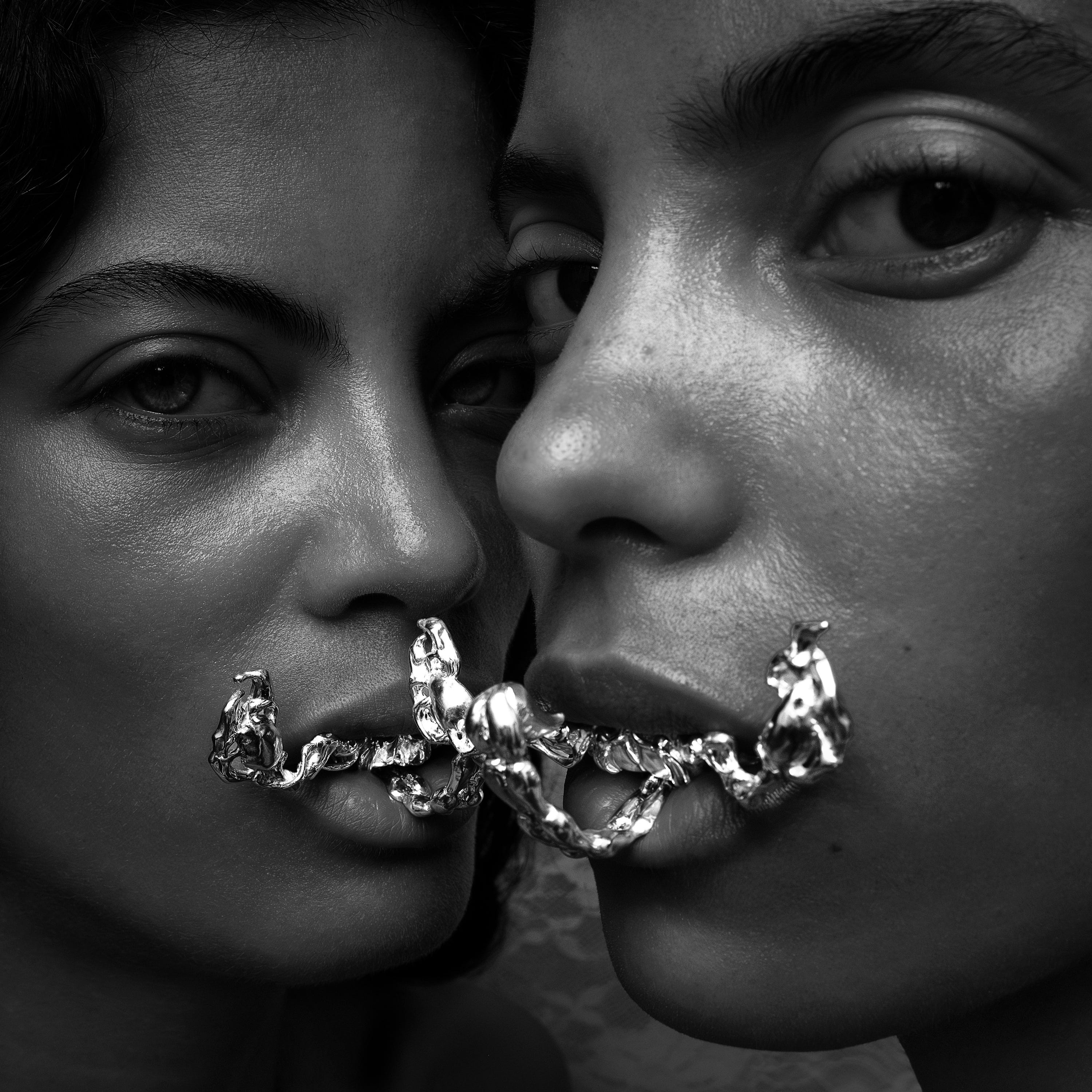
Four years came and went between Spell 31 and this release, and most of that time was spent jettisoning themselves from a major label and aiming their sights back at Cuba. It’s where the twin sisters, Naomi Díaz and Lisa-Kaindé Díaz—collectively Ibeyi—shot the album’s new material, in the city where their father found employment as a percussionist. On the new project, Ibeyi handed the control of the narrative and the beats to a team of producers they’ve never worked with. The two instrumental focal points that anchored everything they had ever created prior—Díaz’s drum kit and her sister’s piano—are gone. Their absence removes the last thing standing between the listener and two perfectly blended voices. On “Aset,” Ibeyi look to Egypt, and the sisters narrate an Egyptian myth that begins with “I am Osiris Rising/I kept stealing their knowledge/Now I know divination/As I throw all the shells in,” weaving a tale of rebirth and resurrection by means of shell divination, leading to a powerful resolution in Spanish: “Esto es amor eterno.” Here, the devotion to a deity and a lover converge—the rite allows for more tenderness between breakup narratives than either is accustomed to delivering. —Rosa Delgado
Shabaam Sahdeeq & Es-K, Outside the Lines
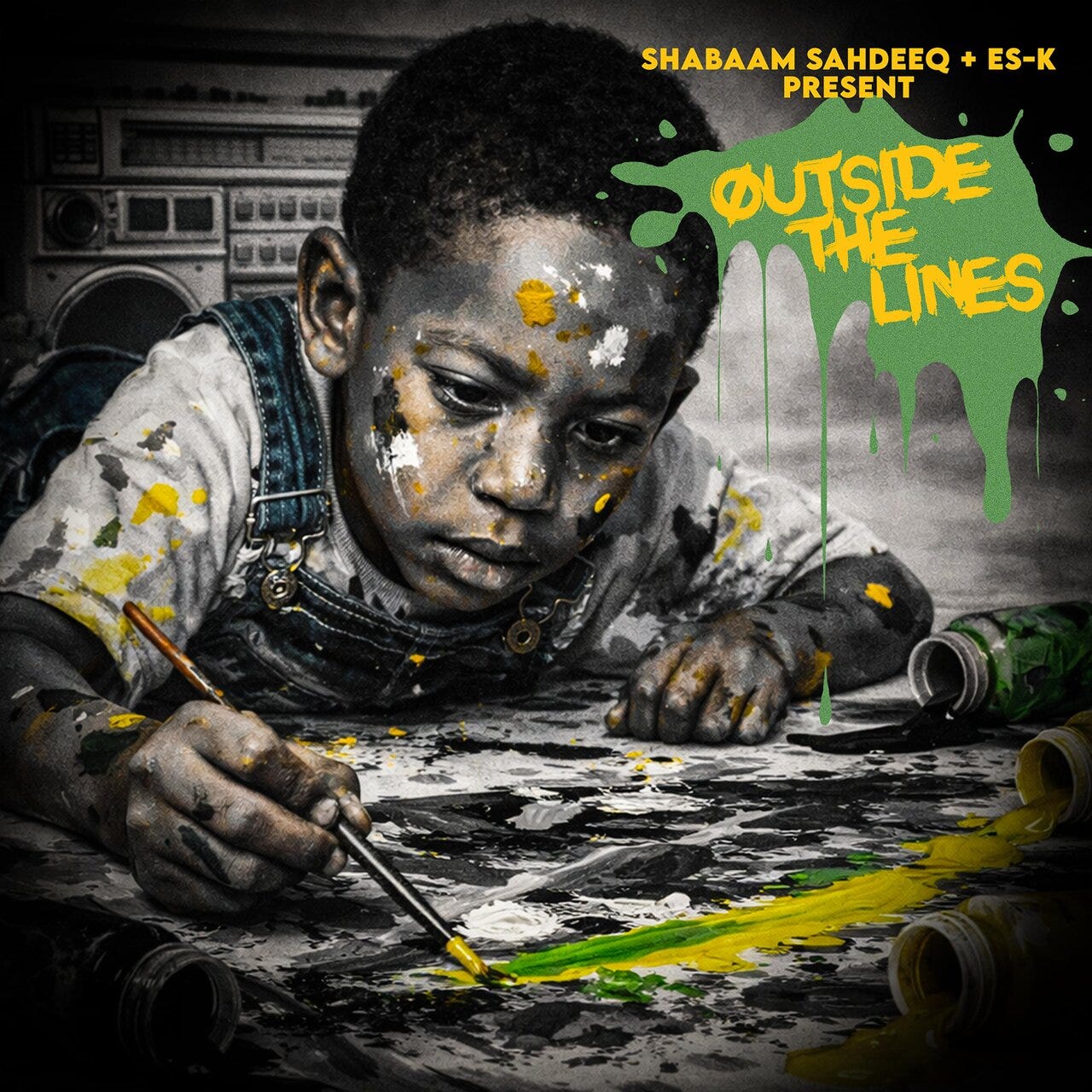
The Lyricist Lounge began in a Tribeca loft and Wetlands even before it became a televised program, and the rappers who blossomed in those environments acquired the ability to rap for an audience that could detect a frail couplet from the back tier. Shabaam Sahdeeq was one such performer, a child of Brooklyn, equipped with Rawkus singles and parts on the Soundbombing tapes; at fifty-two, he is still engaged in it, with Es-K now solely composing the beats. He delivers depictions of the street like a man recounts battles at a barbecue, seated in a lawn chair with a plate upon his knee. The braggadocio is no longer the corner or currency. Today, he survives; he sustains the catalog and mercies discussing his treadmill over other topics.
Nursing a cup of Cersei tea in his boxer briefs and under a durag, Shabaam turns “Tea Reflections” into a wellness log, fifty pushups and fifty squats after he gets on his feet, protein in the shake, the parasite cleanse in progress and a target for 103. With a blood pressure monitor on and the stress contained, it is funny (more so than other rappers’ threats), convincing—and more convincing than most—to hear a Brooklyn hardcore MC rhyme off their vitamin schedule. The cornering of “The Underdog” surely defeats the slight chest-beating in a brief spoken word piece. Shabaam drops himself off the top-tier throne altogether, claiming he is dozens of galaxies from the wackest, reminding us all of time after time he was overlooked, tilted and cast aside, ending with the bluest number he ever utters: that he will just keep on keeping on. The revealed doubt beats the bravado convincingly. —Quinn Baptiste
Glenn Lewis, Overture
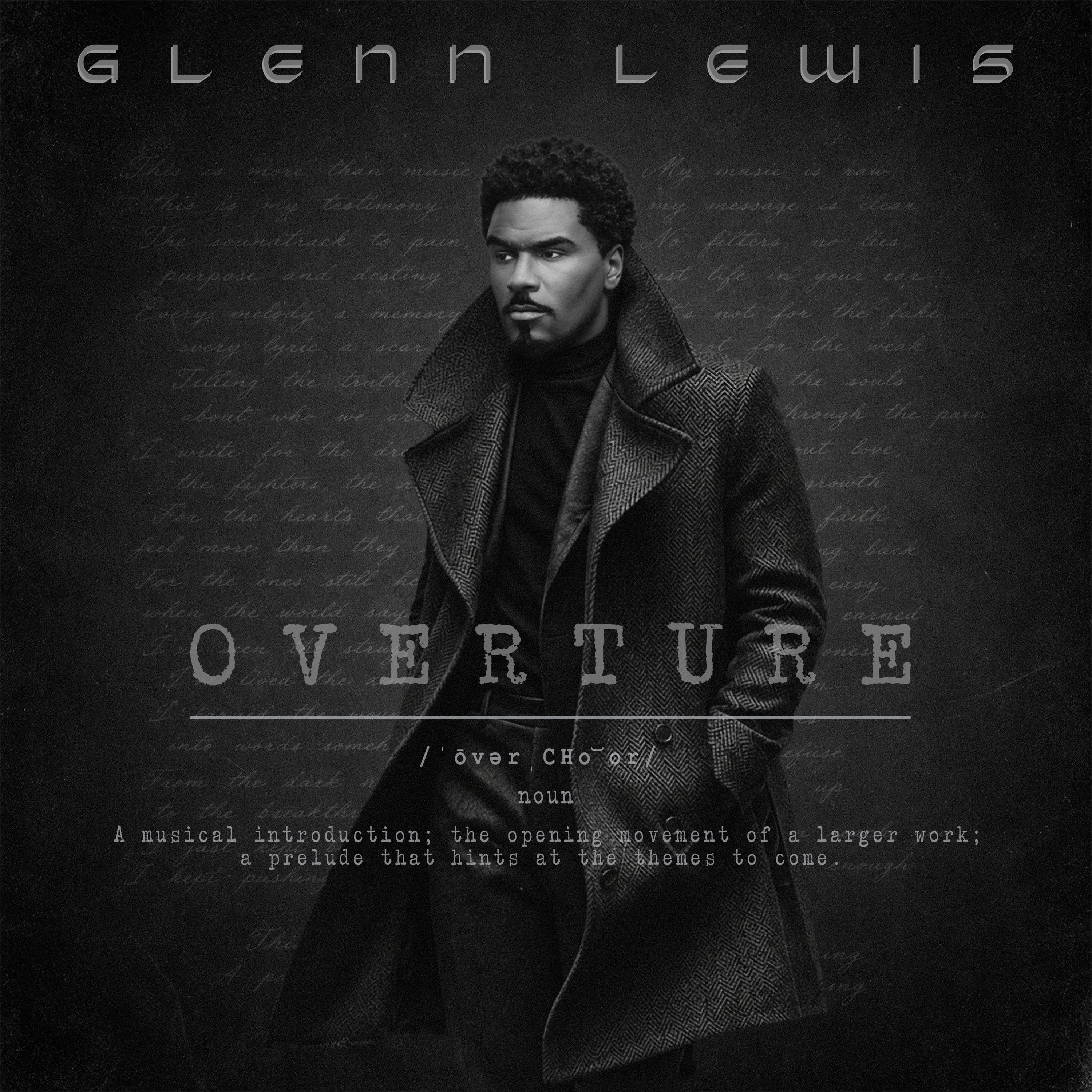
Welcome to the return of Glenn Lewis. The Toronto soul singer went silent years ago but re-emerges with Overture, in which he wrestles more with love than celebrates it. There’s one song on the LP that tells the tale of a con artist who wins hearts as effortlessly as passwords and PINs. Another chronicles the tale of a friend dumped and then ghosted, only to resurface like it was nothing. A third, however, borrows the sing-song of the hook, of a woman responding to a toast to new beginnings with a sly query into self-interest. Unlike so many love songs striving for surety, these offer space to question the costs and to ponder the demands of those previously broken hearts.
For much of the song “Ruthless,” which resembles a heist movie with its constant movement and acquisition, he is painting a picture of progress. When Ruth has collected all the trappings of her desire, she finds herself alone off the coast of Belize and wondering whether love is in the cards for her at all. His observation, quiet and somewhat tragic, concludes with: “To protect herself, she hid behind the pain and the hate/But all she ever wanted was someone to make her feel safe.” He has spent one song after another measuring the value of love and then doubting that value, but he’s landed somewhere he sounds certain about, with his most resonant phrase: No one is ever truly known by another. “Honesty from tears and facing our fears,” he intones, “That no one truly knows us before the last goodbye.” It’s the closet the skeptic comes to an avowal of faith, and the stretch holds. —Sydni Carter-Reed
Imani Imani, Papercut
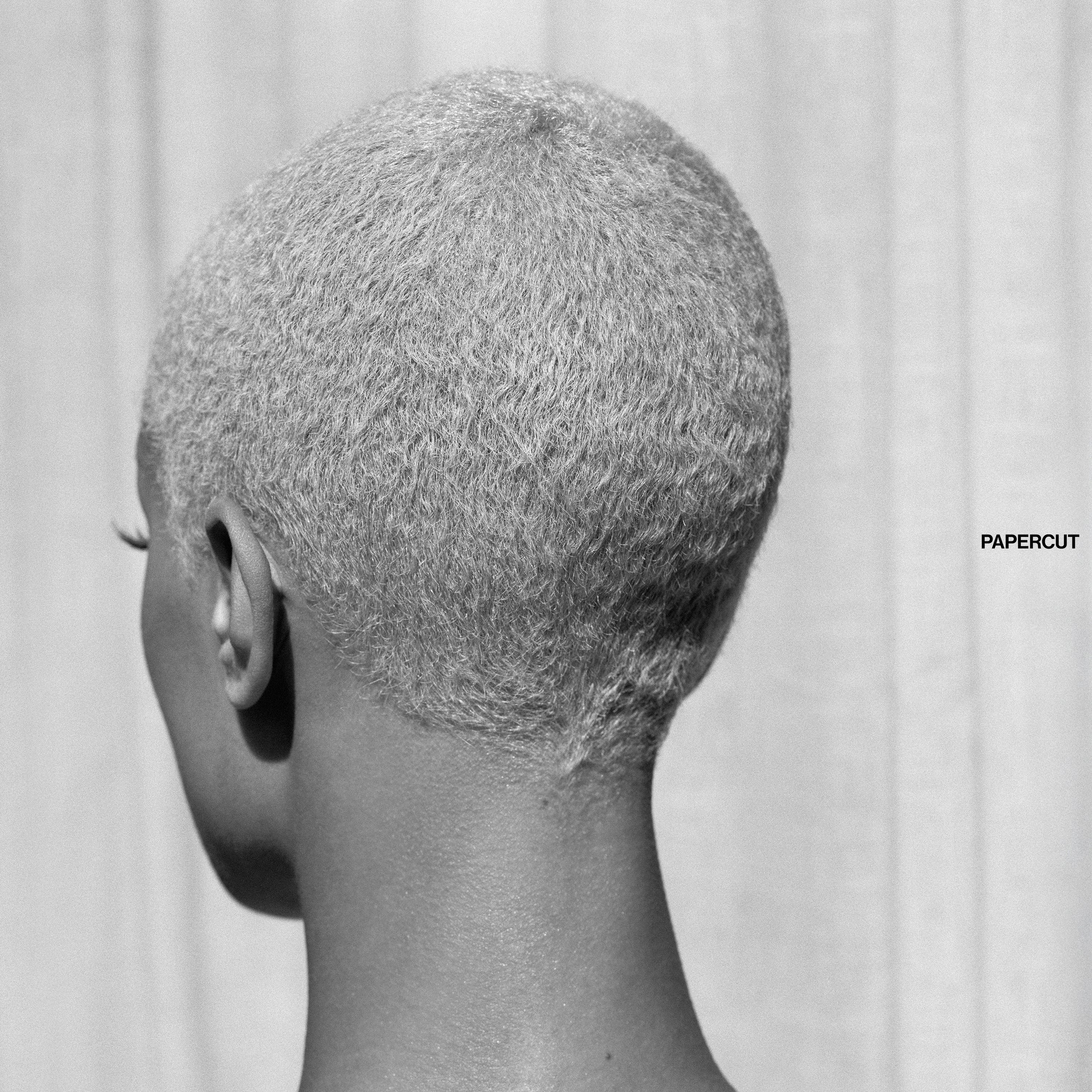
pgLang built its early years on rappers and partnerships, and rollouts slow enough to transform silence into an event. A singer seemed an unlikely first booking. And Imani Imani, as the first voice the company is putting its name behind, is someone who arrives on the scene unannounced, as she herself seems to prefer, for someone who is never shy about using her voice to clearly state exactly what she needs. Suggestion and seduction were already off the table. Here, on Papercut, want arrived fully formed as a stance and not a question, and it dominates all that follows.
“Put a bet on me/I bet on you,” she tells a man whom she has just met. She is fully confident that he’s the one on “Bet On Me” before she’s even heard him say his name. Selling this blindness off as a virtue, she expands: “I don’t even know your name/But I can feel all the things you say/I know what’s on your mind/I’ll be knocking, knocking.” There’s just a clock and a list of demands. “Come Together” similarly pushes the desire through angles and around corners. She wants “all that ass,” not half. And when the man hesitates, she renders the issue as a word problem: “So bent out of shape/Thought you wanted to try angles/Running ‘round in circles/Can you get one thing straight?... It’s math you can’t handle.” Even still, she continues to apply it: “Add it or subtract from it/Keep it coming, I just want it.” The total never appears. —Maya LaRoux
Maiya the Don, Precious Cargo

Maiya the Don made the transition from a beauty influencer to a rapper, which can look quick on paper but feels more like a struggle in real life. The fans who watch hauls and obsess over Telfar bags don’t translate to a rap verse, and just about everyone who tries the crossover sounds like a clueless tourist as soon as their foot hits the beat. The Brooklyn-based MC who used to rap as just Maiya Earley, steps into the scene as if waiting for the world to catch up. Precious Cargo, her new project, implies what’s held at all costs—the woman, the her; it’s the brand of someone used to being treated like a prop. Let Maiya take control of a studio budget, and she’ll grab a tiger just to name it Tigger. Her unapologetic attitude gleams with an honest style of joke-telling on “Miss Irresponsible.” She dresses her two dogs up in Gucci and Pucci for an expensive stroll with a Ferragamo leash, takes Elon up on a rocket launch, and even when she boasts of immense wealth, her tone remains deadpan: “I’m treating Neumann like it’s Whole Foods, never check the total,” “You bitches local, I’ve been Amalfi coastal.” —Tabia N. Mullings
Dreamer Isioma, Quantum Entanglement
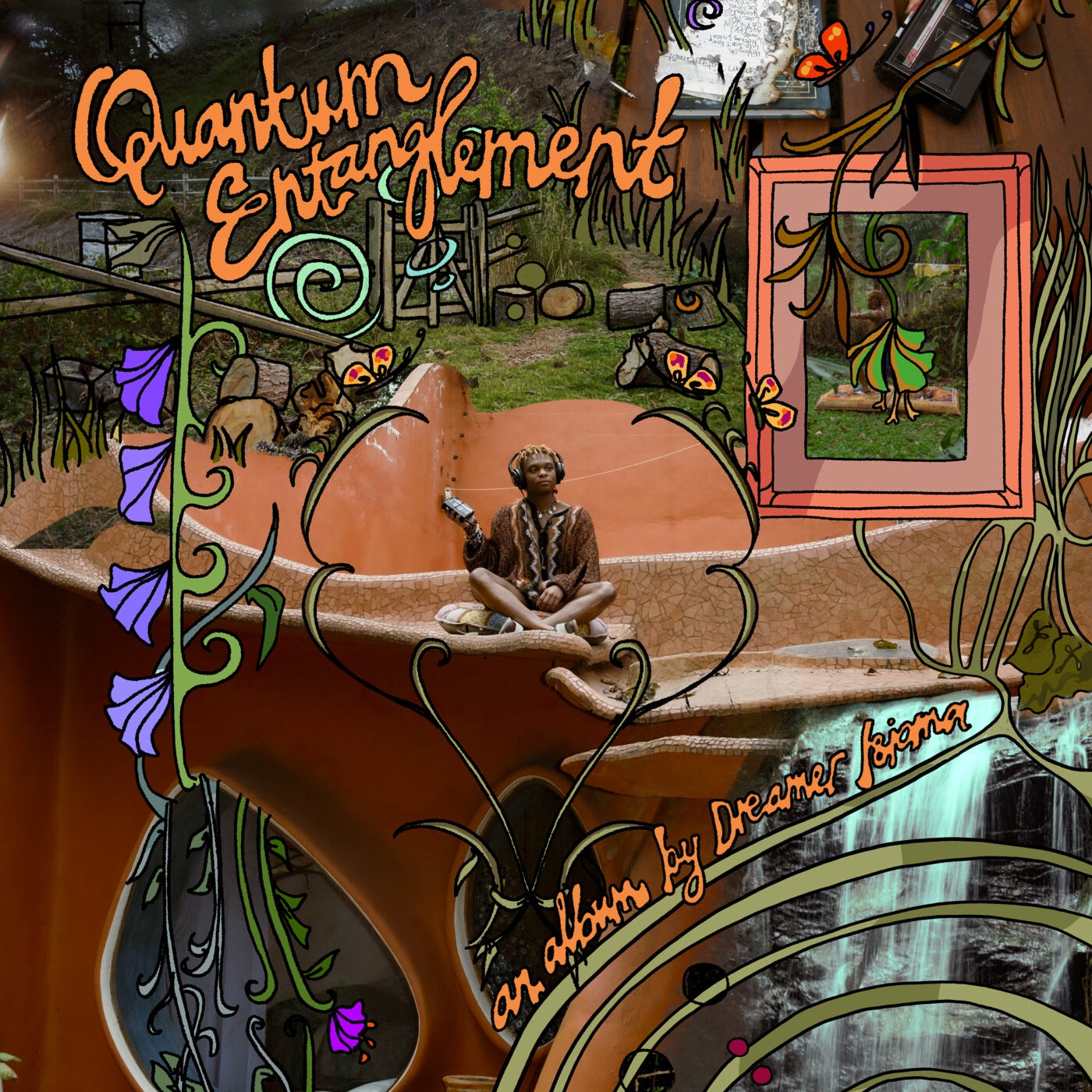
Quantum immortality is an argument both crueler and more reassuring. Because consciousness has no way of imagining its own disappearance, it seems it never ends, and it is assumed that somehow, some version of you continues on in another universe, no matter what happens to this body. A few years ago, in a slump, Dreamer Isioma, a Nigerian-American singer and producer raised between Lagos and Chicago, found the argument and says during a Bandcamp interview in 2022 that in some cases it had anchored them when survival was an option more willingly than a necessity. It is this same love for all things universe that provides the title to Quantum Entanglement and the justification to Isioma’s choice to survive.
In “Holding On,” we are initially asked not to be left alone with our worst thoughts before the music breaks apart and all that is left are the words, “At the top, I might just jump off the world/But I’m holding... On for you.” The entire jump from suicide note to club anthem is about three seconds. Isioma’s central idea of love existing across space between two points can finally be sung out in “Love Me”: “Between every star there is space and no matter how far we are, we’re entangled by love.” The chorus breaks down the want into the base element of survival: “Love me/Do you really love me?/How can you say you love me?/I don’t even love me” sums up the problem with three simple, four-line questions, begging for something outside yourself to provide you with a feeling that you cannot generate from within. —Darryl Keyes
Mary Sue, Rapihaler
The scene in Singapore is so small that the producers and engineers and the same MCs cycle through the same album credits. And rapping as Mary Sue for a little more than three years now, a significant number of those tasks—chopping a loop to make it into a drum pattern to make it into an English-and-Mandarin beat for him to rhyme over inside—has mostly been himself. Rapihaler came to him one period when the symptoms of his asthma had him off his feet, so the wheezing and a phantom cigarette turned up in his songwriting as inspiration, not out of some attempt to tell a sad story. The homemade production ties it together, though it’s the writing on Rapihaler that most stands out, jumping from a lost grandmother refusing to call him by his name, to his “Language” of, as her question goes, the “language of colonialists,” to the cities announced on screen. “Catapult,” a jumping, jumpy beat and a description of his fall but an eventual appreciation of “Thank God I can feel it now.” feardorian’s (Atlanta’s own sole producer on the LP) bounciest beat lifts “WALAO!” to an exciting climax for him and seems loose and fun on Dametrill’s verse when he name-drops some Singaporean places he has and has not traveled. He uses the thudding beat to lay down the heavy news on “Stardust” about bleeding in Sudan, starving in Yemen, children made to be martyrs, just begging you to look close, squint further. By “U Wish!” he tells off those who ever believed he would falter. “Am I giving up? You wish,” he chirps with clear joy of breathing and little else on what proves to be a triumphant farewell. —Mina Abdel
NappyHIGH, REDaze

Most producer albums are just compilations with a logo on the spine, a handle for lining up the guest list rather than an argument you can hear. REDaze is the opposite. NappyHIGH’s newest keeps every voice on it a guest and is everywhere else himself, flowing one cozy, unflustered stream of soul-rap and R&B underneath singers and rappers who’d never otherwise appear together on a tracklist. The drums thud rather than pound, the chords remain gentle, and the vibe sustains its head-bobbing fog whether there’s a rapper in the booth or not.
Unblemished love glows from Devin Morrison’s verse on “ANGEL(kp)” without a trace of sarcasm, just hazel eyes and a safe space above the warm West Coast cruising sound of NappyHIGH. On “IHadAGoodTime,” Fashawn is the carefree playa, making clear to the woman sitting on the sidelines that he’s not here to save anybody: “You get one night, you should be grateful.” Roy Rutto replies with something closer to appreciation than acquisitiveness, a Westside epiphany wherein the only grandstanding involved is just “God would never let me slide to Heaven if my mama never smiled.” Memnoc drives it home, “valley sunsets and ghetto birds” and a girl with Hot Cheetos riding shotgun, nearly crashing the vehicle and dumping her back in the streets without a fuss. —Harry Brown
Chlöe & Timbaland, Resurrection

For nearly a decade, Chloe Bailey was one half of Chlöe x Halle, an alliance with her sister Halle that felt designed from its outset for voices built to interlock, and launching her solo career never fully dissolved the impulse to partner. The title of her new mixtape, Resurrection, puts a partner’s name right on the cover, yet Timbaland only ever sounds off to the sides, counting her in, answering her hooks, adding signature tags. The singing on this short effort is all hers; so is the writing (with the help of Quiana Griffin and others), and that’s the part you should really pay attention to. Chlöe has elected herself the sole arbiter of what happened, the keeper of the gate (who goes in, who goes out), and the only one to determine the asking price for whatever it is she might be willing to surrender.
Chlöe commands on “Talking Dirty,” one of the early standouts, “Come inside, I’ve been thinking about this all night,” which comes across more as an order than an invitation. Quite a few men here get kiss-off treatment, and she gives none of them any grace. “Caught” is the best among them—a cheating song that catches the man dead in the act and then provides him no dignity on the way down. She has the proof: “I pulled your every card, I got receipts.” Even better, she has the petty detail that wounds more than proof itself: “Motel 6, not even DoubleTree.” “Mama’s Boy” offers up the clearest line on the set: “I stay calm, you get louder/I move on, you feel smaller.” —Brielle Saint-Amour
BabyChiefDoit, Rise Against My Broken Odds
A 16-year-old kid from Chicago’s South Side decided that he was a superhero, and kept finding different ways to say that he was. For BabyChiefDoit, he adopted the name of a Sylvester Stallone action hero, turned it into an acronym for everything he claimed to have overcome, and then refused to respond to any other name. He produced or co-produced the majority of his own beats, so the superhero he’s describing and the kid building the sound underneath are the same person. The cape never quite fits him. Every time he calls himself Lieutenant Rambo or Big Zoo or more than a man, some part of what it means to be a teenager starts spilling out around the edges.
The cockiness thins by the back half of “On the Run,” where the nah-nah-nah drops out in favor of random, rhetorical questions about whatever anyone listening knows about hurt, about being locked in a cell, about love some made a point of extinguishing, about that twenty-five thou put into a video, the statue of myself he’d want on the water fountain when he’s finally done, and more quietly, about that drowning he remembers. The questions are reduced to much smaller ones, more unbearable in “Dear Jonathan”—a letter to a nonpresent father asking about his favorite song, meal, game, the thought process of deciding on his name with his mother, a letter of forgiveness (”I’ll never resent you, think you had a golden heart and were battling demons yourself’), a query about the origin of his own rage, setting this absence next to the fact that he pulled the trigger on a gun and the fact that it rained too young, ending on the one unanswerable question the letter doesn’t allow itself to escape: “If you been watching over me, is you proud or is you ashamed?” —Randy
Devin Morrison, SAKURA

About a decade ago, Devin Morrison was splicing nostalgia-warped R&B in Tokyo, swapping ideas with Fitz Ambro$e and Budamunk and labeling it Dreamsoul before anybody had thought to ask him for an explanation. The name and the method stuck, four albums of surreal love songs taking grammar from anime and fighting games as easily as they do Stevie Wonder and the Japanese pop that defined Morrison’s early years. SAKURA is the album where the romance finally got the space to expand; the sweetness on the surface is funnier and darker than it first appears, as Morrison plays out a man who loves wanting nothing for fear of himself wanting anything and spins that fear into pure comedy.
The longest one on here begins in a cartoon and ends with a phone call no one ever wants to make. He kicks off “TULIPS & ROSES” wallowing deep in an idiotic, Super Mario level of infatuation with some sort of Princess Peach character in love with a Princess Daisy, and presents her a bouquet of what he claims to have personally hand-picked and de-thorned for fear of injuring her fingers. Then he walks in on her with someone else. The sweet factor drains from the song pretty quickly from there, until he’s grabbing a knife for the sake of “cutting ties,” while repeating, through and through, that it’s not his fault, that he didn’t do it, all the while referencing dead flowers. His solo diatribe at the end (”Find that number, call it up, and say/’Hey, baby, do you like tulips? What about roses?’”) is accompanied by “SUMIMASEN,” the wordless instrumental string piece with a title that means ‘excuse me’ or ‘sorry.’ It’s the apology that’s stuck in his throat after the knife has done all its work. —Jamila W.
PJ Morton, Saturday Night / Sunday Morning
Anyone raised in the Black church has learned the calendar very early. The night before is for the world—the party, the man you hope will take you home, the self that doesn’t enter the sanctuary. The morning after is for repentance. Bishop Paul S. Morton’s son, PJ Morton, learned that split before much else in New Orleans, and has operated in both worlds for years, playing keys with Maroon 5 on the pop scene and recording soul with his own band on his own label. He named this double-LP after his 2024 memoir, building it on that dichotomy, nine R&B songs for grown folks on one, nine gospel songs for the spirit on the other, the secular and the sacred put in different rooms he walks freely between.
He does best when he’s already won the argument, not when he’s trying to preserve it. This is where Morton shines, in that place where he can poke at a wound as opposed to begging for love. Rukhsana Merrise offers her voice to “Autopsy,” the bleakest song in the soul half, where Morton delivers cause of death like a coroner: “When you read the autopsy of us, you’ll clearly see the cause of death was love/We tried our best, but our best wasn’t enough.” The most thoroughly written gospel track here, “Close Enough,” draws on the story of the woman who pushes her way through the crowd in the gospels just to touch the edge of Christ’s cloak. Morton is willing to gamble the highest stakes on the smallest possible amount of belief: “Even if my faith is of a mustard seed, that is all I need.” —Imani Raven
Latanya Alberto, Seen
A blown-out bulb hangs over the room in “Save Me from Myself,” and the woman below it holds her hands out to someone she can’t bear to leave. Latanya Alberto is the one in need of being saved and she says it without cover: he stops the blood, catches her when she falls and, by the end, she promises to do the saving in return. A poet before she became a songwriter, she does scenes like this better than most of the rest of her debut. Give her a room, a body, a bulb hanging overhead, and the writing becomes instant. Put her trying to grab hold of a lesson, and it becomes limp.
The heaviest of the tracks here is “Watch You Leave,” where the whole struggle is the act of staying; she adheres strictly to a rule she will not break: “No one leaves unless we’re healed.” She attends to the other person, heals him, accepts what will come and reports it calmly; “Feel like I could die under your command sometimes,” she sings, and in the next instant, “Sometimes I can dodge your bullets/Turn them into stone with a soft touch/Turn anger around into tough love.” What happens in the house, stays in the house: the screams, she has decided, are proof of some kind of love. She briefly asks the question, “Is it God between us or am I on my own way out?,” lets it hang in the air, and returns to the one promise she will not retract. —Ulani Iona
Navy Blue, Sir Render
For most of the past few years, Navy Blue has done it all himself. He writes the raps, chops the samples, builds the drums, and puts out the records, one by one, until there are mountains of them. The new one caps a series he kicked off two years ago; the title is a pun: Sir Render versus surrender. He raps like other people footnote; every bar has its secondary and its tertiary meaning and references tucked into its rhymes until an individual line requires three read-throughs to unfold. Sage Elsesser is adept at it. He exercises this with the help of The Alchemist, Mario Luciano, Jason Wool, Shungu, and others. Writing so dense can become pointless; for long stretches of his music, it never does.
On “Circa,” Navy begins his set by noting that “I’m alive, was only five when I knew death,” while Ka replies from beyond the close of 2024 when the Brownsville rapper would be found dead. As any artist Navy has ever worked with, Ka packs every line, and the words never fail to conjure something concrete—a kid who “had a hunch in lunchbox, mom’s packed a prayer,” a boy who’d “watch Happy Days during my saddest year,” a fact about the way the world operates—“the establishment only want to establish fear.” Crying, he writes “only got you beat harder, smarter to master tear,” and with each sentence, he gives you something to picture, something to comprehend. That’s where the form keeps raising the bar, and at least on “Circa,” Navy is raising it. —Koda Lin
Ambrose Akinmusire & Mary Halvorson, Slo-Mo Neon Luminate Hoverings

This is the record they’d been working toward since they started playing in a Brooklyn apartment in ‘09, they twice flunked an attempt to record it, and three was the magic number, on a single day last January at Sear Sound the morning after a one-night stand at the Stone. The relaxed feel is evident immediately: Having spent years running her guitar through a wash of delay and digital-manipulation devices, Halvorson handed Akinmusire a five-minute-old Line 6 pedal before rehearsal, and he dances with its emanations through these nine pieces as if he’s duetting with someone he’s only just met yet would already give the shirt off his back to know better. Some of the sound that comes out of the pedal is actually his own voice treated and recontextualized into a new form, and it sent Halvorson into unaccustomed territory. “Prelude in the Ash” kicks off with Akinmusire alone on what amounts to a single-held note as he gropes for a key before Halvorson responds in her trademark, woozy chords. In the absence of rhythm section security and any preconceived notion, in this four-are-yours, four-are-his, one-is-ours collection (not for a moment do either settle into a traditional leader-and-accompanied role), the almost nine-minute-long title piece takes it deepest out, a daring, real-time conversation between two musicians with nowhere left to run and a sudden disinterest in doing so. —Nehemiah
Kelsey Lu, So Help Me God
Most break-up songs are predicated on the exit. The door is closed, the lesson learned, Kelsey Lu exits to a more liberated life. The cellist and composer who scored films and occupied a Blue Note residency in the long pause between albums of their own material keeps writing the reverse. Handed a clean break, they won’t take it. The choice repeated throughout the songs on So Help Me God, the one not to break away, but to stay inside the grief and making that choice sound something akin to devotion. “Reaper” enacts that impasse in all its dimensions. A nearly eight-and-a-half-minute-long song, Lu sings at a figure of Death like it is a negotiation and then refuses the job of intermediary: “You are the reaper left to decide/What you want, baby?/I’m not your guide.” The sin is passed back and forth, so Lu sings earlier on, “Can’t take a sin from a sinning man,” later on, “I took a sin from a sinning man.” The cure does not take. The singer says of taking pills, “Lifted, I feel nothing now,” and lights a match, “to watch it burn, but the pain still stayed.” Amidst this, the song falls apart, drums rise and fall, fade in and out, altered, a guitar floats in like distant noise (Kim Gordon), a saxophone hangs in the smear (Kamasi Washington). It ends with the song turning on Lu’s own voice, “You knew better/You’ll know better,” a half-memory, half-prophecy over the last, fragmented music. —Zaria Farah
Awon & The Other Guys, Solidified

Awon doesn’t do hype. He tells of a drug bust’s disintegration, his friends laid to rest, platters of oxtail and peach cobbler with the same steady, understated delivery that defined his come-up from Brooklyn to Newport News, Virginia. His authority doesn’t come from decibels but from how he crafts a phrase, from its cadence. He turns the camera on himself in “The Embrace.” Twelve years old and reading obituaries; fourteen years old and selling; a teen Nino Brown playing hide-and-seek through buildings where users fell asleep forever. All set to a hook which completely subverts the usual boasting: “I didn’t embrace the streets, the streets embraced me/It’s not crime, it’s the way the streets raised me.”
The most tender lines Awon writes are composed on his feet, in his kitchen. The three verses to “All My Love” are cooking and all the people who cooked them, opening with a grandmother humming gospels over candy yams and peach cobbler in a project oven, moving to a Crown Heights stove where his mom stirs cornmeal into cou-cou base, mackerel in the stew, flying fish, rice and peas with oxtail, tamarind balls eaten like candy on Park Place. This food is never just food. All the food served pulls back the dead or departed to sit in their seats. Grandmother is dead, and the space remains open, mom’s kitchen remains bare, his homies are in jail or in the ground, and his lost ones rise as the allspice hits and the flavors sharpen enough to sting. The third verse lands on the simplest form of the statement, food as love infused, Jesus feeding a host on five loaves and two fish, a plate honored at a table for folks long departed. —Quinn Baptiste
The War and Treaty, The Story of Michael and Tanya

With the duo’s fifth studio album, there’s Whoopi Goldberg. She strolls to the mic as an icon would, introduces a couple that the world couldn’t figure out at first, then outlines every contradiction stuffed inside fifteen years of marriage and tells the room they’re finally going to get to hear it all. Everything that follows takes her at her word. Michael and Tanya Trotter present every pleading, every prayer to be heard, and every moment’s argument, designed for the world rather than the pillows under their heads. Lights up and the house is full, and they work their marriage the way other singers work a testimony. Michael’s up first on “Shouldn’t Have,” listing what he didn’t ought to’ve been doing, his long disappearances, the late nights, the other woman he chose for dinner, and finally, “I crossed the line/I did it this time/How could I lose control.” Tanya takes the other position, and the chorus reconfigures to reflect a shared pronoun: “You crossed the line/You did it this time.” The conversation continues, the identical chorus acting in one minute as a confession, the next as an indictment, until both partners have voiced their side and nobody’s right. On “Holy Ghost Fire,” Michael moves from the role of rescuer to avenger, as he addresses a woman he “wanna send” to the fire with a specific warning to avoid the usual help. “You don’t need Grandmama’s prayer warriors,” he rasps into the microphone, “You need a killer who’s been there before.” —Renée Holloway
twogeebs & Action Figure 973, Surprise Motherfuckers
More rappers name themselves fewer times in their careers than Action Figure 973. From the sounds of these twelve tracks, all recorded under the same luchador alter ego and produced by a producer working under the same persona, he doesn’t shy away from twogeebs calling him out by name more than a couple times between lines and ad-libs. Working on the same corner as twogeebs in the DITCD.COM area, also known as Zilla Rocca’s inner circle, the latter is Zilla F. Baby to those in the mix and on the mic. He’ll drop a slasher story, then a corner move, all in the same monotone, all with a low, grimy drum pattern working to complement it. What’s delivered doesn’t give room for the humor to soften the violence—it’s delivered in a flat monotone, which keeps the slasher stories feeling fresh despite the familiar nature of many lines.
Hurt is the only one he hasn’t dabbled in until “How Could You.” Rapping accusations to his girl who went through his phone and possibly talked to the feds, he bleeds in the wrestling, “You think I’m out fucking hoes/I’m watching wrestling on TV,” and gives away what the whole thing boils down to, “I love pussy, but not more than money and rapping.” However, the verse that stays with you comes on “Aye That’s My Drink,” where he comes off the corner for a moment to acknowledge what the phone is doing to everyone. “It’s a fast food world, they microwavin’ it all,” he spits, and the screen turns the bright, cheap, unending light, “’For You’ page dopamine to the brain/This shit is insane, it’s like digital cocaine.” The dope he can’t quit selling, and the phone he can’t quit scrolling, are one and the same product by the final verse. He left the rest of his guys just as he found them, blindfolded with their eyes on the wall. —Kevin Matthewss
Swamp Dogg, Swamp Dogg Contemplates the Afterlife

With 83 years of age, Jerry Williams Jr. made his debut record for S-Curve in Brooklyn, along with a collective of the live band and the production team whose other customers are a third of his age. Swamp Dogg is a multifaceted person who has written about war, financial struggles, and all the women who wronged him in his life, typically, with a punchline attached. However, this time the topic is death. For instance, one song tells about a guy who comes into $242 million and spends it on turning down the ex who left him broke; on the other hand, another song features a three-year-old girl asking her mother why there is a flag on her father’s casket. Swamp Dogg writes the punchline like the funeral scene. The kid in “Daddy’s Little Girl,” who is three years old, has remained serious. SpongeBob is no longer able to make her smile, and Mickey Mouse, the one who was her entire universe, is now just a simple toy with no value to her. The little girl is now only able to see the moon at night by sitting on his lap and crying about him, asking her when he will come back. The second chapter indicates the coffin. He has returned from Afghanistan, but a fool shot her dad on the street. However, she is too little to hear and understand all of this. The cartoons and the coffin are parts of the same little life. Every Sunday, she sends a balloon to heaven with a message attached to it saying, “Love you, Daddy, from your little girl,” and on the rest of the days, she kisses his picture, talks about him to Jesus, and explains his personality every night before sleep. —Esther Blake
Joseph Solomon, TERRA COTTA

The flights are always bumped, the weekends always pushed back an hour or two, and there’s always a friend’s couch in a city that’s never really been his; that’s the life of the touring R&B singer when the road proves more resilient than whoever was waiting on the other side. Joseph Solomon sang the words to other people’s choruses into a webcam before he ever wrote one himself, and there’s still a looseness to his own originals from an artist who knows how a melody should resolve, even before he gets to the final phrases. TERRA COTTA is about one failing love affair split across the country with the same woman and the same departure repeated in each song, and the ever-present doubt in his mind that ultimately, it’s he who’s gonna be going.
What staying costs is fought over at the table of a restaurant, and that fight is the best piece of writing on “HALF ON THE BLAME.” It, the reservation, is already a bad sign on, and instead of swallowing the reservation whole, he draws a line down the middle of it. He’ll take his share and then some, but “you gotta make changes too,” and he’ll “won’t be taking the guilt for everything.” He calls playing the victim her best move and says she’s “allergic to responsibility,” and walks the entire fight down into a number, “Like forty-five, fifty-five.” A live band moves with him the entire way, guitar and bass and piano, and leaving the vocal plenty of room to push back off as the fight moves down and down and down, so it has a place to land. —Chinedu Faulkner
Thurz & 14KT, THEE IMMACULATE
An Escalade circles one block of Inglewood over and over while kids play on the sidewalk; the man watching them vows to open fire before they reach his children. “Father Protect Me pt.1” opens with a sung petition for protection over a verse Thurz, the man himself, is absent from; the MC is so deep in fear that both prayer and threat come from the same lips. Thurz, who raps about Inglewood, was born Yannick Koffi. He is not concerned with this speaker’s terror; he awaits the second half for answers. The deeper he can stick to the ground in his writing, the better he is.
Colorism pulls out the most straightforward writing from him, all of it contained in “Immaculate Skin.” The hook keeps a tight roll call: Marvin Gaye and Lauryn Hill and Curtis Mayfield and Stevie Wonder, who “had me feelin’ like Black was the thing to be,” then the verse deconstructs that from the inside. “I ain’t fair-skinned/So I’m a threat when I walk by or drive by,” Thurz raps before going through “Pope white, Mary white, Jesus whiter,” the Clark Doll experiments and body cams switched off for a man who “might disappear around here.” He goes all the way back to first grade, wishing he’d gotten a normal first name like the other kids when they laughed at his. A Funkadelic-esque beat switch hands over to Jimetta Rose, who grabs for daylight: “Black and brown, hold it down” then an entire verse to a kid named Jerome, with his last line delivering the sting of what his ex’s Creole grandmother told her face-to-face: “Don’t bring no nappy niggas around here.” —Tariq Belson
Inayah, Therapy Wasn’t Enough
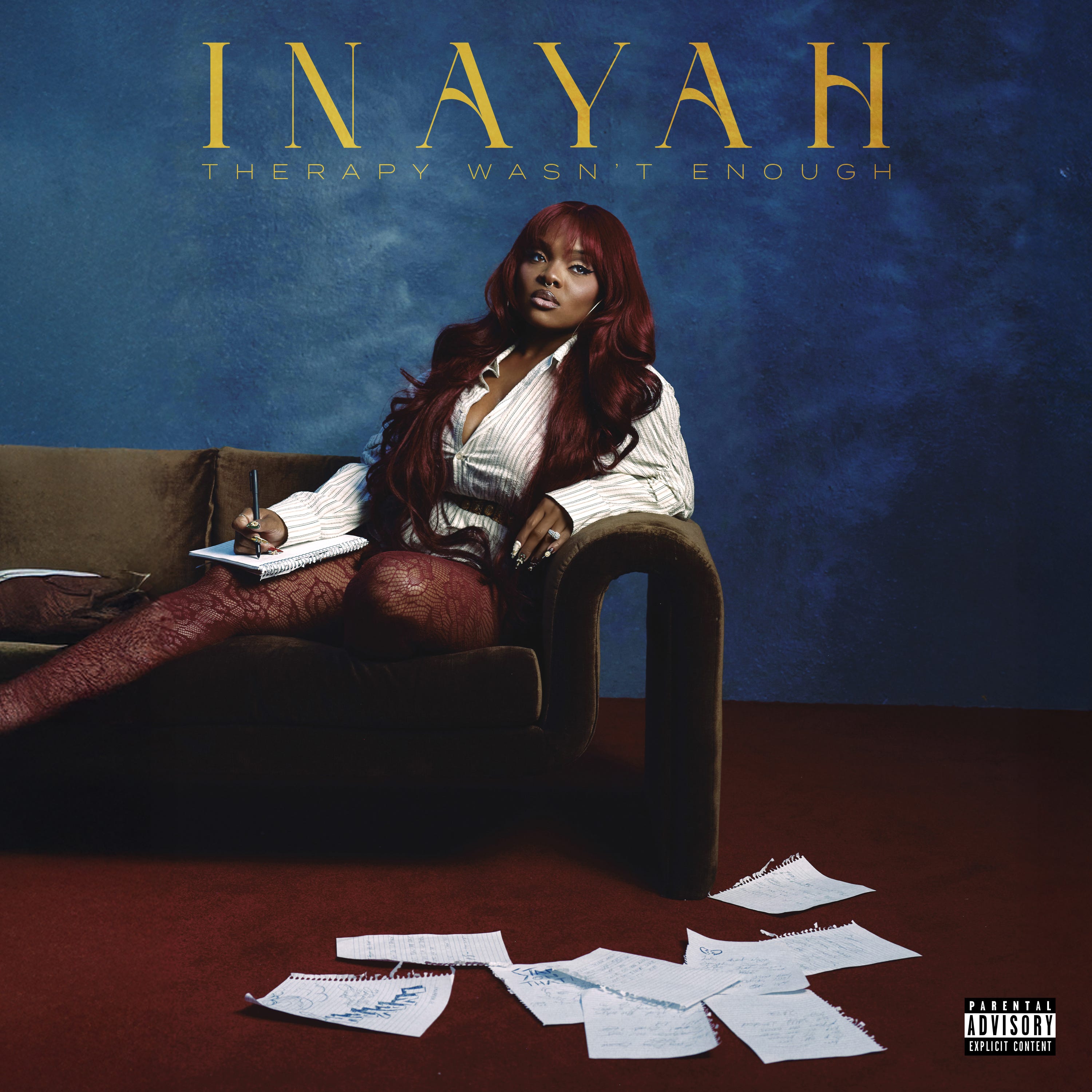
Inayah, the Houston singer who built a fanbase remaking other people’s hits over and over again online before her hit single “Fairy Tale,” knows that culture and in every single track, she is outraged that all her business is public for everyone to see. When these songs roll in, the split is already a public commodity. It took place in October. The ex took it to Instagram and put all the dirty laundry out for everybody to air out, and then people started to take sides, and from there on out, every move was photographed. She’s at her best when she bares her teeth.
On “Downside,” she winds the clock back to October. They broke up, he “hopped on the ‘Gram, acting out,” and she was on there telling him to “keep my name out yo’ mouth.” Then by November, he had caught a plane out to her, and she spent her birthday feeling nothing alone. And by December, he’s “posting pictures in the ocean with your hair down,” suddenly repentant, and she’s left torn between wanting him back and feeling the urge to wring his neck out. DJ Chose’s mid-tempo piano-trap soul beat makes for some smooth running; she makes the worst moments come out to the irritation. “Deleting pictures, now my fans really on to me/Leaving me to explain why yo’ ass out the country.” “WTF” condenses it into one rule of business: the fight should have stayed home. “If we’re gonna fight it/Should be in private/I’m trying not to lose my composure/In front of people that don’t even know us.” Over a slow snap beat with synth bass and strings, she lists every move he made outside in the public, trashing and flailing around acting the fool in front of everybody who couldn’t tell one from the next and then summarizes the disaster. —Jen Mauvais
Devon Gilfillian, Time Will Tell
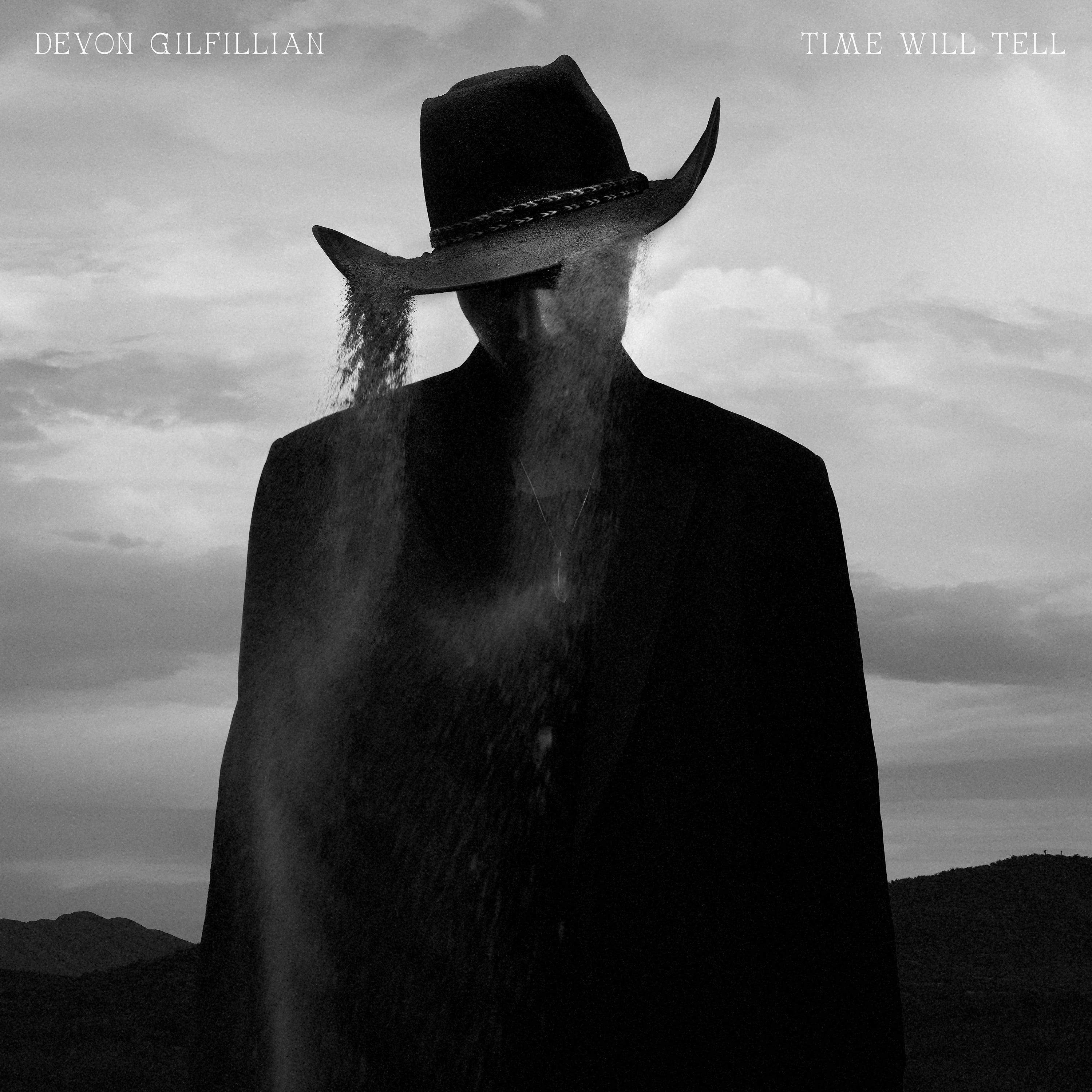
As for Devon Gilfillian, the former Philadelphia resident who decamped to Nashville to release his live-to-tape breakup album almost entirely in single takes, is essentially saying that a singer and the group in the same room trump anything a console will add later. He’s taking that bet and the word he keeps circling is time: he’s calling it the thing that corrodes a relationship, but it’s also all he has to fix it. So, with language available to anyone, he mourns a love falling apart and asks, endlessly, how much time will he get to collect the wreckage? Guitars are cranked and drums hit heavy on “Black Dog Rabbit Hole,” featuring a solo that shreds the middle while Gilfillian pitches a wispy falsetto to a bellow. It’s as loud as the band ever gets, and the noise isn’t so much ornamentation as it is a harder surface for the word’s surrender. The language sinks under with purpose, “Here I surrender, give in to the bad weather,” “I don’t wanna, I don’t wanna, but I’m gonna give in,” and the hook responds to the spiral with the pay-off, “’Cause baby it feels so good.” He sings the consequence as though he’s already accepted his underwater future: “If we come up too fast, baby, I’ma get the bends.” —Kendra Vale
Boldy James & Nicholas Craven, Trapper’s Alley 3: Hell or High Water
After three albums in as many years with the same producer, a lot of rappers settle into a comfortable groove, their bars smoothed over with the wear of familiar soul samples. But Nicholas Craven, Montreal beatsmith and Boldy James, is on a one-way trip to somewhere much colder. On Fair Exchange No Robbery, Penalty of Leadership, and many, many more albums in between, Boldy has treated Craven’s loops and beats less like a canvas and more like padded cells where the darkness he has encountered and is destined to confront can be safely put away without requiring a change of pace. With Trapper’s Alley 3: Hell or High Water, Boldy James continues the 2013 series with its most barren, icy season: one where the winter chill of Wayne County comes with a body count as quickly mounting as the sun descends, leaving behind cold earth and the knocking of blue lights at the door.
“I ain’t thinking ‘bout no pussy, I got murder on my mind,” Boldy declared earlier on “Summer’s Eve” not just in a fit of rage but a deep-seated pain: “Them cowards killed my brother, that was my realest plug/Found my nigga dead, now my head more fucked up than it was.” “Mama Maxine,” goes a level deeper, pushing the raw trauma back a generation, with 218Bojay doing more than enough justice to a hook that will likely carry the weight of the album’s most devastating moment: “Grandma was my angel, but my mama raised a demon child,” and Boldy, “My little brother got shot right down the hall from Jessica, eight houses down from your door,” as calm, cool and ineffectual as ever—a coroner reading a death report from behind a veil of unexpressive monotone. The jests start wearing thin, however, on “Grinding My Gears,” where, for the first time since the album began, the persona hesitates before delivering the punchlines. “Father always promised me I would have to face the music one day, but not today,” he says—a promise deferred which may well be the only true thing offered in the entire track. —Phil
Old Orleans & Trox, Uncle Roy & Friends 2
Old Orleans takes the host on Uncle Roy & Friends 2, which gives the impression of being at a dinner party that he is throwing for the whole 504. Trox provide the culinary expertise. While this is Old Orleans’ party, all of the plates are served from one kitchen—a looped sample, some harsh drums, a bass line holding down the low end, and whatever that particular diner craves is added on top of whatever he’s already ordered. Old Orleans’ persona of “Uncle Roy” is the consummate mixer, the know-it-all who recognizes the chemistry between certain bodies and seats accordingly, and in almost every instance, a guest is seated in the empty seat of the house. For the most part, not one seems eager to leave.
On “Curse of Apollo,” Old Orleans makes his way with a gun in case the tension’s on and a crucifix on his chest, and the pain emerges naked as he recalls a comrade who “Died ‘fore we had the opportunity to be legendary,” a guy who never made thirty. He refers to the entire run as a visual experiment and lets the bars flow past the line, conviction and despair and guard duty fused so firmly the prayer and the warning can’t be separated. “No Love Loss” is more frigid and subtle, Trox paring the beat to lifeless drums and vacant space so the voices sound unmanipulated. Monday Night admits he craves love as much as anyone while ducking from commitment, sick of the way it sounds when other emcees mention his name. Old Orleans replies from a deeper place, declaring himself proof that angels cry, questioning if dying when born would be better than losing her at twenty, before he hits the line the entire song hinges on, “The message is medicine.” It doesn’t sound like a pose. —Daliah Green
Cashus King & Big O, Water to Wine
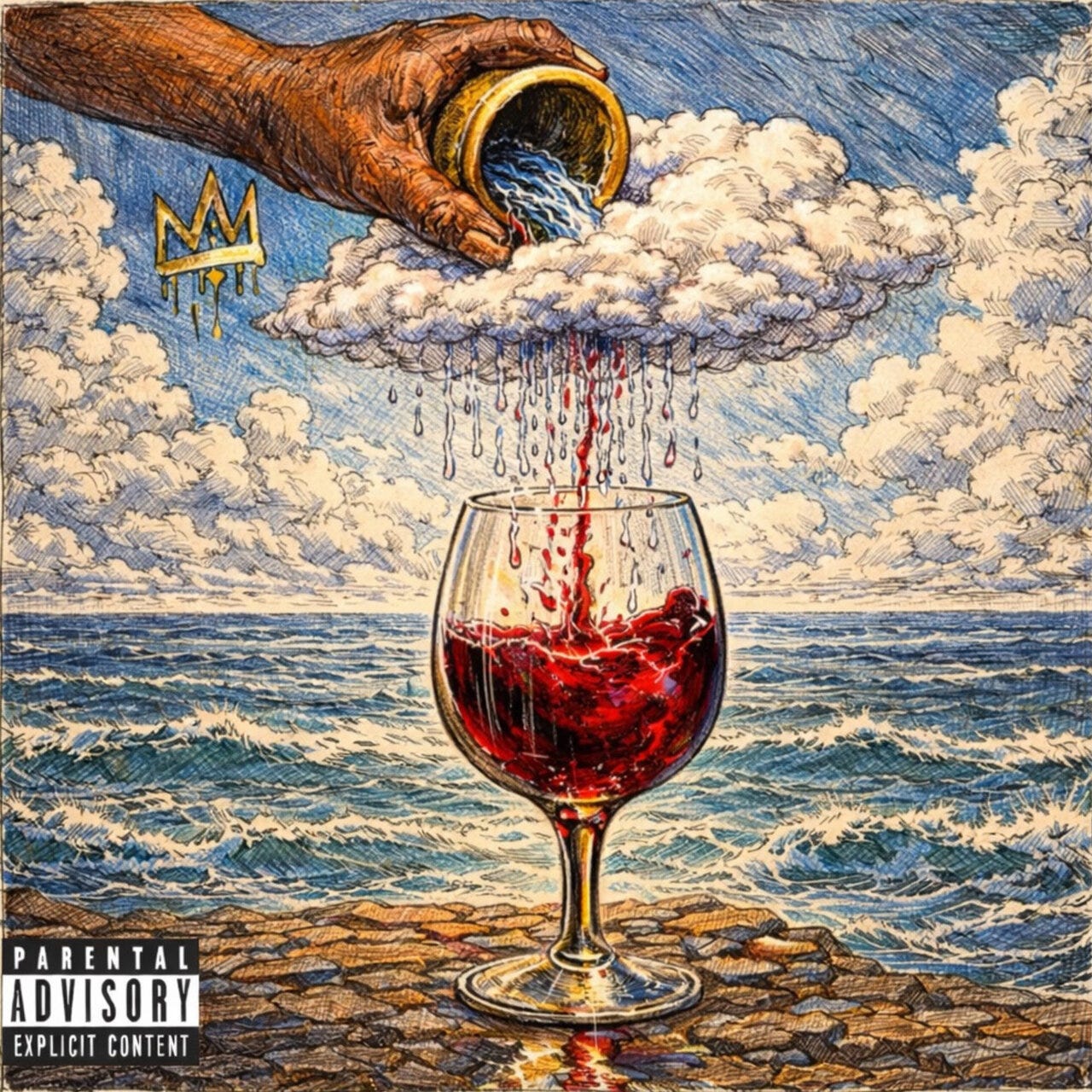
At the wedding in Cana, they used up the wine before the party was finished. A guest instructs the hungry servant to fill six stone jars with water, and what is poured back outshines the initial source. John presents the scene with a handful of verses, the first of the miracles, and the reason it is entered in the book is that it shows who the guest is. Cashus King, the Los Angeles rapper who appears to have recorded for most of a decade as Co$$, takes the parable at its word and tests it through a whole album generated entirely by the British producer Big O. The water continually shifts image on him, from street rain to soda to holy water, and the cycle of alchemic change remains the same before his eyes.
Nothing is lower than “Drownin’.” Cashus wrote for those who know what it is to be drowning. Water rushes into his lungs as he gasps for air, anchors of grief pull at his ankles, and every time he approaches the surface, another wave crashes him back down. The chorus can’t provide the elevation he keeps trying for: “I can climb on top of the mountain, I’m still drowning,” and the rise and the fall are one phrase. “Holy Water” takes all that damage into a rehab room. Cashus states the deal outright: God’s sober and the devil’s the drug, and the third verse enacts the admission. Then Cashus speaks. “My name is Cash, I’m an addict,” he intones, three months clean, and he thanks them for letting him find his purpose and be of service. The miracle, when it arrives, is placed directly beside the grave. —Lance “LX” Brooks
John Brown the Rapper & Da Beatminerz, Waxing In Mecca
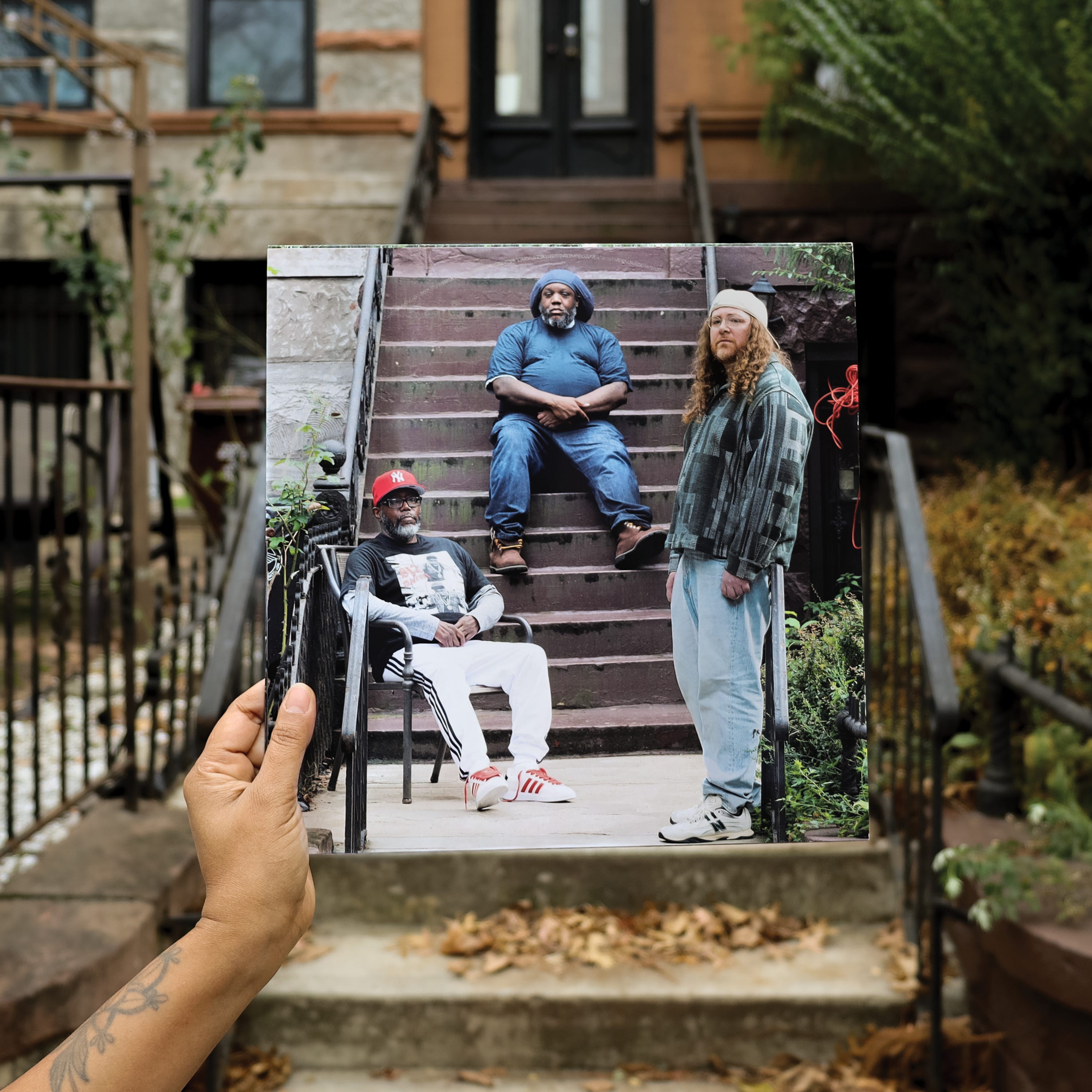
From 2022 to 2024, John Brown has been working through the rhyme schemes under Mickey Factz’s teaching in his lyricism program (Pendulum Ink). Waxing In Mecca defers judgment to anyone scoring it, while Da Beatminerz give him no room, only dark, blank beats nowhere to hide on. The conceits appear on the title track where Brown, alongside Smif-N-Wessun, lays the whole structure of rap over the tenets of Islam. The bulk of the structure lies with Tek and Steele, rapping “Breakers pop and lock in circles spinning round the Kaaba” while detailing a Brooklyn scene, “From park jams to Madison Square.” It’s a soaring yet empty idea, an extended metaphor designed to be taken as a scripture. The final lines give way to a sampled movie voice, a New Yorker who’s chided for considering her town the hub of the universe; when she suggests the place is holy, she’s reminded, “Smells like it.”
The density either works as a wall or a reward, depending on how many bars a person has already consumed. The weight lifts on “Curly Top.” He takes a whole verse to detail barber shop accoutrements: clippers, shears, the finished fade; “Up to your chin from a Caesar.” On “The Body Rock,” he takes an almost-serious nautical come-on, naming yachts and skiffs and teeth on a neckline below deck. “Weapons of Man” switches gears again, absolutely serious about Lockheed and martyrs, about how there is “No such thing as smart bombing,” and brings in that same haunted congregation from the title track again. That’s the scope for a writer who discovered writing on purpose and somewhat late and who has far too much to say to get it all within the boundaries of the record: a man in his basement using his low ceiling to hold every single word he knows. —Joelle Figueroa
Lakecia Benjamin, We Dream

Lakecia Benjamin built her reputation in part on the Coltranes—both John and Alice are celebrated on 2020’s Pursuance—and she could have kept working within that legacy for another ten years. Then she surveyed the ruins of the last two years, and concluded that the old story wouldn’t fly anymore. “I felt that story couldn’t continue in the same way given the state of the world,” she has said regarding her sixth album. We Dream is what that new story sounds like. On the album’s lone minute-long “First Light,” Benjamin offers her own poetry accompanied by Terence Blanchard’s trumpet, and you have to wait for the altoist’s own instrument to finally join in. “Ascension” finds Benjamin trading phrases between her speaking voice and her horn to the point where you wonder which one is in control.
Certain records were produced by Kassa Overall, whose hip-hop sensibilities color every moment - from spoken word verses and gospel inflections to post-bop ferocity all rolled into one. Guest artists are abundant: “Mi Gente” features Chief Xian aTunde Adjuah, the saxophonist exchanges a number of blistering ideas with Jeff “Tain” Watts and Chris Potter on “Dream Breaker.” High-profile virtuosos such as pianist Hiromi (who grooves on “Flamekeeper” and a sprawling “Hiromi Jam”) and R&B singer Bilal (who shares “Right Now” with Overall, on which Benjamin unleashes a twanging, wah-wah solo) are all present. Even the title cut, spoken to life by Tank Ball, somehow doesn’t feel like a parade of guest stars. Benjamin’s vision is consistently at the forefront of We Dream, and as a bandleader, she leverages everyone she loves and admires to dream out loud, on an album recorded in a year that’s tried every minute to persuade her not to. —Brandon O’Sullivan
Tierra Whack, WHACK’S MUSEUM

For years, Tierra Whack has written more densely than her clappers probably even realize. She builds bars the way that other rappers build whole verses, splitting one word into two things, turning a star’s name into the setup and punchline before the line is finished. Throughout these songs, she asks for it by name: credit, while she is still alive to claim it, from an industry and a fanbase she is convinced are aware of what she has accomplished. The doubling continues across homophones and spellings, and over a gritty Conductor Williams and Agent-X beat, the writing is her densest on “WIGGIDY WHACK,” which allows few lines to pass without splitting: “We are not the same, I’m super, you supper/The difference is the spelling.” She dissects her own moniker for pieces, “Dog, you wack without H, so that means you a knockoff,” and taunts, “They hold a grudge ‘cause I hold the torch.”
Black and white, filmed around Philadelphia, “WAX PAPER” is the sole song that sounds finished, and its writing is likewise hard and unvarnished. “I just want my credit, man, I promise I don’t need cash,” she protests, the grievance growing more raw and direct, “All the shit I’ve done for the culture and they forget to mention my name like it’s so hard to pronounce” before spelling it out: “It’s Whack!” Midway through her GOAT pronouncements on “WHACK JOB,” she stops short, “I just lost three relatives, and oh God I miss ‘em,” and the lowest point arrives on “CANDLE WAX”: “Feel too high, I had to drive myself/Yeah, I might kill me, but I’ll die myself/I’m too lazy to get the help I need.” The flowers she craves are interwoven with all their sorrowful weight, and on “FLOWERS,” her central request is, guess what, flowers, so she can be seen while she’s alive. —Blaise Freeman
Cécile McLorin Salvant, Metropole Orkest & Jules Buckley, With Every Breath I Take
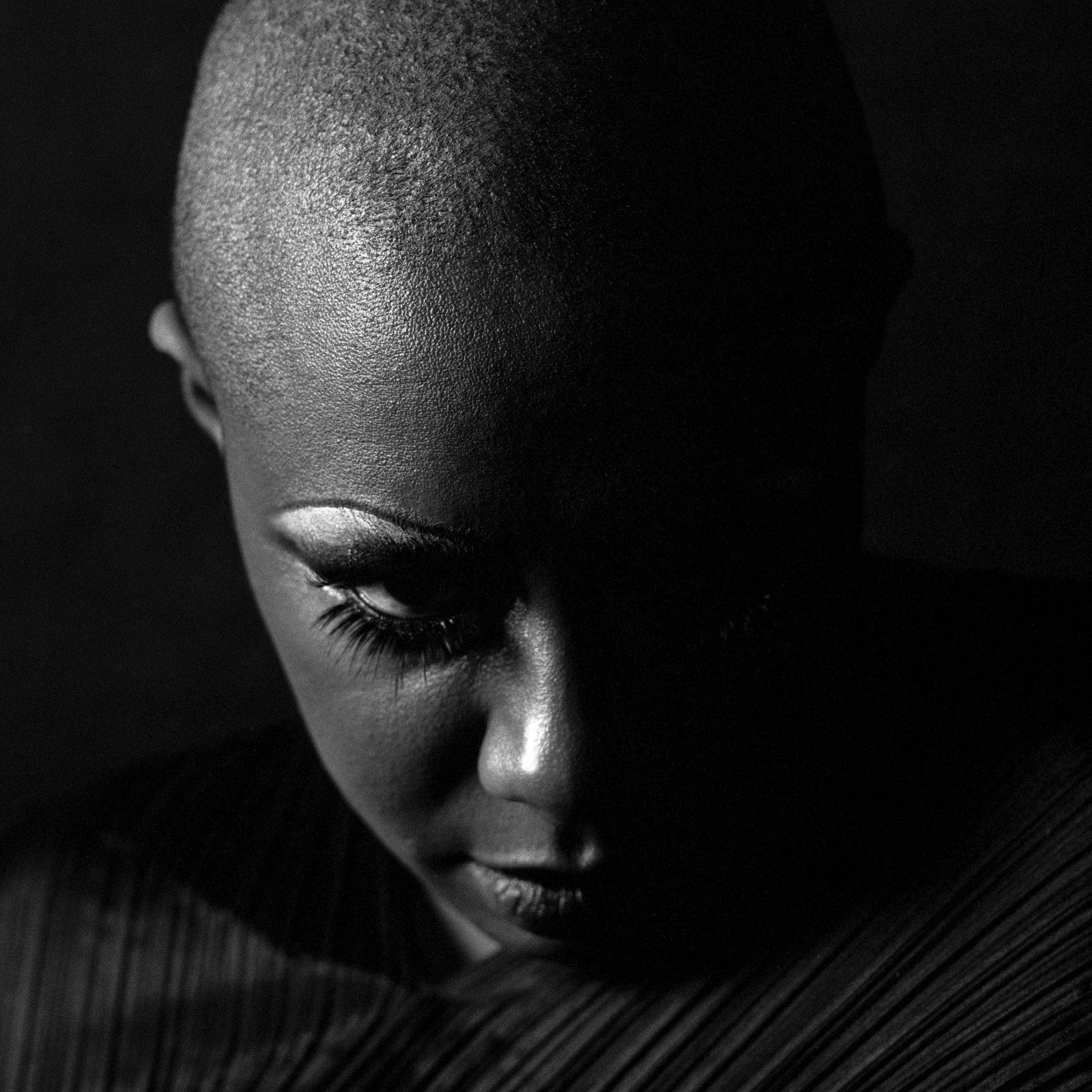
Last year’s Oh Snap was the small, weird, homemade thing, the one where you take all your weird ideas to a room by yourself and spit them out. This is that, turned inside out. It took Ccile McLorin Salvant nearly four years to make her way into a room with the Netherlands’ Metropole Orkest, the conductor Jules Buckley, and her own trio, and then she turned over the arrangements to Darcy James Argue, who makes his torched ballads and weepers huge and cinematic. The song choices tell you that prettiness wasn’t the goal, “I did not choose these songs because they are beautiful, but because they are crucial to me,” she says, and if there is anyone you would believe the minute you hear them. “Send in the Clowns” and “Being Alive” —a dude begging to be destroyed by someone—Strayhorn’s “Lush Life”—arguably the loneliest thing ever written—Kurt Weill and Brecht’s eight-minute “Barbara Song,” and Michel Legrand’s theme for The Umbrellas of Cherbourg.
It’s an orchestral standards record where not only is the voice, one of the most trained singers working, more schooled in jazz, blues, and vaudeville than a Conservatory master class, and capable of dropping into a nearly inaudible whisper only to throw everything into the rafters, the arrangements never crowd it, just hand it even more space to command. “Left Over” holds its own amongst these great works. It is the easy out to turn on an orchestral record if you have any interest in soft, simple ballads. She made the version that has a backbone and attitude and a bite in the delivery, that sings with full-throated, righteous anger and heartbreak for the people that the rest of us write off with the passing of a good night’s rest. —Brandon O’Sullivan
MXKA, Xclusiva

Corridos tumbados thrives on male bravado—the big names and packed rooms all belong to men who’ve earned bragging rights. MXKA works on the romantic, softer side of the genre, singing about love and the long process of moving past it. She does most of that in Spanish—she’s the daughter of a mother from Mexico City and a father from Louisiana, with English only entering the equation when her emotions demand it.
She keeps on surprising men and keeps collecting on it. The man in “La Vuelta” thought she would fall for him, but she didn’t, and she tells him exactly that: “Pensaste que yo iba a enamorarme, pero no” (You thought I was going to fall in love, but I didn’t). Then she drops the phrase that holds the whole stance together: “Las malas no caemos así fácil” (Bad girls don’t fall that easy) and judges his exit as a power move: “la vuelta, amor, se te volteó.” She’s not trying to rescue anything; she just shrugs him off with “La neta, me vale madre/Si te vas,” then explains that getting over him was as easy as a celebrity divorce: “Te olvidé fácil como Beli a Lupillo” and gives her coordinates: “Del Bay a LA,” the East Bay kid taking up territory traditionally belonging to men. “Tattoo” reverses the possession; she’s the indelible mark he can’t remove: “Pegada como tattoo/Asi te quedaste tu,” half a boast and half a warning: love easy come, easy go. “Xclusiva” swaps hurt for pure brag, an evening out in “Fendi, Balenciaga” with an ex waved off with “Pero yo las baddies ya no estamos puestas para el,” and JM4C replies to her bilingual flex with one of his own. It’s the most joy she allows herself at a man’s expense, one who is no longer in charge. —F. Qureshi
Satya, Yellow House
A music industry degree at Loyola is a road into the business. Then the world went on hold, Satya Hawley from Oakland came down to New Orleans, and never left after it. The city had somehow sunk into her the way four years of classes couldn’t. Through those confined weeks, she teased open journal entries from years ago and wrote back to the kid she’d been, a child in the Bay in a yellow house where the loving and the hurting were the same kind of air that filled the room. Produced by Colin Linden, cut in Nashville months later, the pages became her debut record, sung in a voice that remains low and conversational—closer to a private confession.
In “Yellow House,” the setting appears as a catalog of the things she can’t forget: “Yellow house, lemon tree, wooden floor she laid face down/Yellow house, dead birds, pill bottles missing from the cabin,” she sings low, over guitar and drums that loom close before they release into the final passage. She’s already come to a decision: “I’m not going home again, I won’t.” “Seven” tones down the music and turns that same straightforwardness onto her own kid self: “Honey, how could you have known?” she sings to the seven-year-old building walls after one man leaves and another follows. And by the chorus, she’s swearing herself to that child that she’s not the leaving kind, and she keeps the promise in that same steady and level tone. —Priya Okafor
Olivia Rodrigo, you seem pretty sad for a girl so in love

In a bar that closes at eleven, Olivia Rodrigo is praying the stranger across from her will never finish his beer. She’s stalked him online, convinced herself she has intuition, imagined the two of them pressed together in a bathroom line, and decided he looks like an angel frescoed on the walls of Versailles. Then comes the punchline, which is that this close together is the most alive she’s ever been, and will probably kill her too. Her crushes bring nausea, a pulse too fast and the suspicion that she invented the boy standing in front of her. In “the cure,” the illness gets a name, and the song lists its symptoms in bland, medical terms. Poison in the head, doubt in the heart. On “what’s wrong with me,” the duet with Robert Smith, Rodrigo sees a real doctor, “Went to the doctor and she said I was fine,” and gets no explanation for the weight in her chest, spinning head, inability to eat or sleep. So she blames herself: “Say I’m in love, so it’s hard to admit/I think you’re what’s wrong with me.” Smith offers his own brand of anxiety: “Head just keeps on pounding with/The simple thought/What if this isn’t what I want.” Two people staring down the same terror from opposing ends. —Darryl Keyes