

Lupe Fiasco Talks Lasers, Obama, and Protest (2011 Interview)
About three and a half years after The Cool, Lupe Fiasco is finally back in motion. Real talk from one of the foremost hip-hop commentators of his era, for listeners who are drawn to conscious rap.
Translator’s Note: Written by Keiko Tsukada for bmr (Black Music Review) in an April 2011 magazine issue number 392. Originally written in Japanese; translated into English for publication. All rights reserved.
On the day of Lupe’s interview, Egyptian president Mubarak announced his resignation. It was a coincidence, but it felt as if it symbolized something.
After a dark period in which he lost someone important and made it through various problems, the thinking wolf Lupe Fiasco finally released his third album, Lasers. Here he speaks about the feelings he put into the new work, the truth and deeper layers behind the talked-about single “Words I Never Said,” and where his mind is now.
We Are Lasers
When The Cool was released, Lupe shocked fans and made them uneasy by saying, “I’ll retire after the next third album, LUpE.N.D.” But brushing away that anxiety, the new album Lasers has finally seen the light of day after about three and a half years. Even though Lupe himself announced on Twitter that the album was complete, the record company still would not move toward releasing it, and it seems Lupe’s fans ended up playing a role in making the release happen.
“It took nearly four years because the record company kept trying to make me do specific songs. If I said, ‘I want to do this song,’ the label would say, ‘We don’t like that song,’ and then when I actually recorded the kind of song they wanted me to do, they’d say, ‘Actually we don’t like that song either. So let’s try this one.’ While that kept repeating, we got stuck in a negative spiral. I got tired of that situation and told them, ‘If you don’t even know what you want, I’m just gonna chill for a while.’ But even during that time, the fans were saying, ‘We want to hear Lupe’s album! We want to hear Lupe’s new music, no matter what kind of sound it is!’ They brought in a petition signed by more than 30,000 people demanding that the release date be set. Even then they couldn’t get a proper response from the label, so this time thousands of kids gathered and started protesting, and as that escalated, they finally announced the release date of March 8. To have fans that dedicated, I really felt that was dope.”
During the interview Lupe kept repeating the word “manifesto.” In that word, you realize, is the true meaning he wanted to put into Lasers.
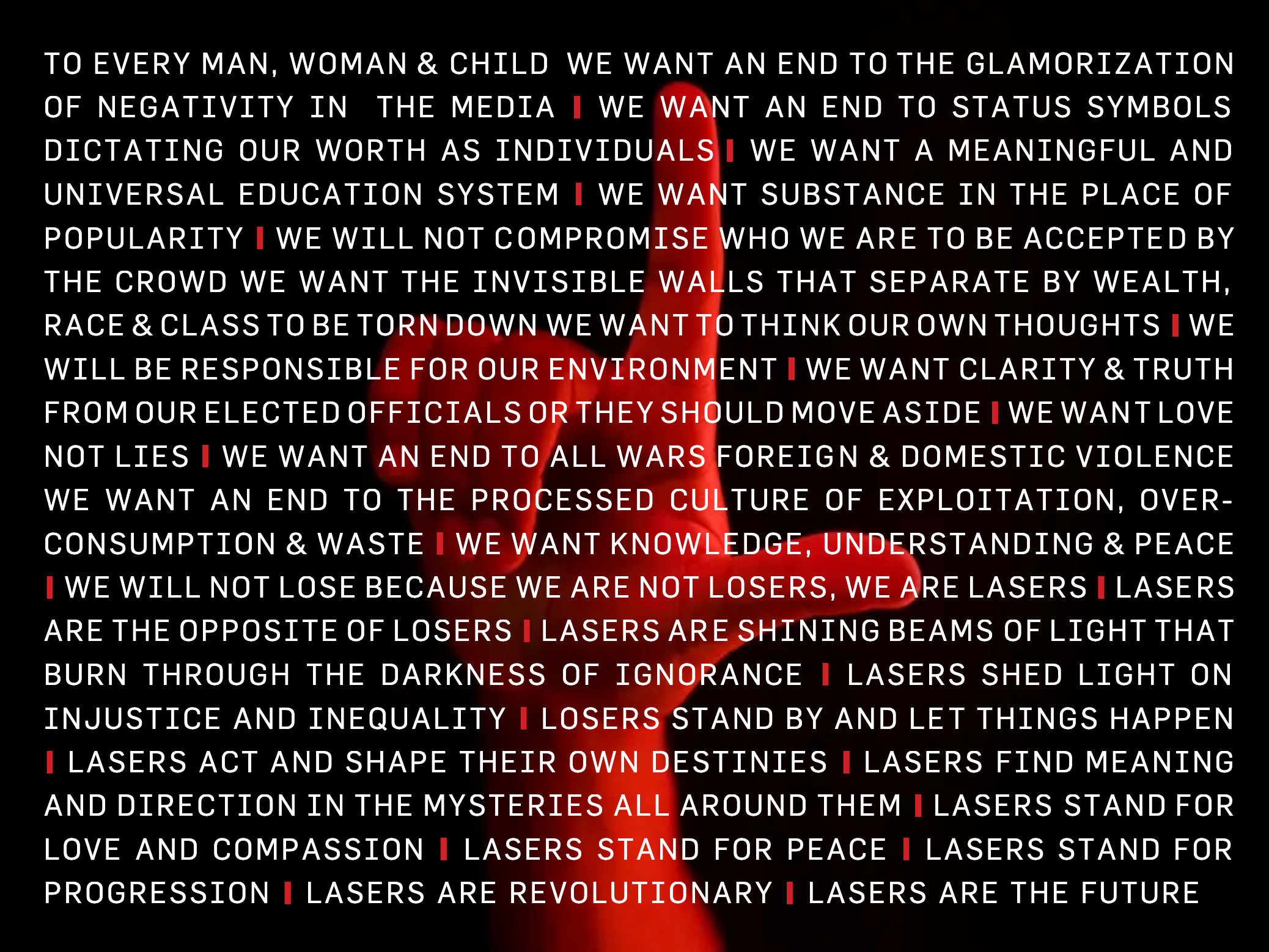
“Before making the music, before shaping the concept for the album, I tried writing out fourteen things I wanted to happen in the world. I want a meaningful education system. I want politicians to tell the truth. I want wars at home and abroad to end. It’s based on the Black Panther Party manifesto, but I made that first, and only after that did I start on the music. I made clear what I wanted to achieve before I went into the studio.”
The album artwork insists on the title Lasers by scribbling a red “A,” one that recalls the Sex Pistols’ “Anarchy in the U.K.,” over the “O” in “Losers,” adding an anti-social nuance. What feeling did he put into this title?
“I’ve also got a punk band called Japanese Cartoon, and at first we were talking about using the idea of a ‘manifesto’ for that band. It fit a punk band. But in the end, I decided to do the manifesto as Lupe Fiasco on Lasers. So this idea came out of the world of punk rock. And then there’s the meaning of changing something negative into something positive. We’re not losers, we’re lasers. Maybe we started out as losers, but we changed into lasers. Change happens when you reexamine yourself. You don’t have to change the whole world. Just changing your point of view a little can make it into something completely different. On this album, I wanted to convey the positive power that comes out of music.”
“Words I Never Said”
The second single from Lasers, “Words I Never Said,” is a masterpiece that sinks in little by little to a startling degree, and its presence stands out especially strongly on the album. The dramatic sound produced by Alex da Kid, and Skylar Grey’s chorus ringing out like a siren, bring out Lupe’s rhymes even more. What made him decide to pour out his thoughts on this song?
“I was worn out by the current state of things. By what’s happening in the world. ‘American Terrorist’ on Food & Liquor says similar things and has a similar structure, but that one was more metaphorical and more subtle. This song, though, hits straight on, with force, and that’s the point. Sometimes the most controversial thing is to speak the truth. And the truth is powerful enough on its own. This song isn’t aiming for some lyric competition or best-MC battle. The concept of words itself becomes communication. That’s why I needed to use simple words.”
One line in this song that has an especially strong impact is “If you don’t become an actor, you’ll never be a factor,” and I asked Lupe to explain the intention behind it in his own words.
“If you can’t turn your ideas into words, everything stops there. And if you don’t put those words into action, they mean nothing. They mean nothing unless there’s physical action backing them up. If you question a politician about something, they’ll probably just talk back. But if you actually go to their office and physically protest them face to face, then they’ll be forced to act, right?”
And for not only 2Pac fans but also listeners who like so-called conscious rap, the line that probably hurts the ear quite a bit is, “Just listening to Pac ain’t gone make it stop.”
“2Pac is one of my favorite rappers. He stood up to fight problems outside music, and that had a huge effect on his listeners. But no matter how much we as listeners were motivated by Pac, if we just listen to his songs and never take any action ourselves, then it means nothing. Same with if you just listen to Lupe Fiasco, Common, dead prez, Immortal Technique, and do nothing. It connects back to ‘If you don’t become an actor, you’ll never be a factor,’ but if you don’t act, it means nothing.”
In the 2008 presidential election, America’s first Black president was born, and history was dramatically rewritten. But Lupe directly criticizes Obama with the line, “Gaza Strip was gettin bombed but Obama didn’t say shit / That’s why I didn’t vote for him, next one either.”
“I don’t vote in presidential elections. I didn’t vote before Obama came along, and I probably won’t vote in the future either. In Obama’s case, the issue was that when the Gaza Strip was being bombed, he said nothing. About Egypt this time, he said change was necessary, but back then, fighter planes were literally bombing the people of Gaza, and he didn’t say a word, not even a word of sympathy, not even that this tragedy should be stopped immediately. For me that was an extremely important moment. I thought maybe something different could be expected from one of the three major presidential candidates. But America is still allied with a country that continues to carry out massacres. I can’t understand that. If it were army against army, maybe that would still be one thing, but residential areas where civilians live are being bombed and people are being killed. So when people ask me, ‘Why don’t you vote?’ I want to say, ‘That’s why.’ There are tons of other reasons too. It’s not that I’m against Obama himself. He’s a smart person, and I hope he acts with conscience. But at the same time, I don’t trust the system, and I can’t agree with it at all.”
Following that anti-Obama phrase, the song then turns the point toward Lupe himself: “I’m a part of the problem, my problem is I’m peaceful.” In my mind it links directly to the line from the intro of The Cool, spoken by the woman: “the problem is we think it’s cool too.” There, you can see the real Lupe, criticizing social conditions while also unable to fully become a bystander.
“People say that people who don’t vote are part of the problem. My answer to that is, I don’t vote, but I do pay taxes. You might vote once every four years, but I pay taxes every day. Probably more than the guy next door. Hip-hop artists make money, you know, and I’m not saying that to brag. If I buy a fire truck, for example, I’m going to pay thousands of dollars in taxes. That gets broken up and paid out in all kinds of directions. With just a small part of the taxes I pay in a year, the government can buy one bomb. If a bomb bought with my taxes bombs a school or a wedding, then I have the right to speak. More right than the people who vote, probably. Because I’m the one literally paying for that bomb. Whether you sing songs onstage, work at McDonald’s, or work in a clothing store, you pay taxes to the government, and part of those taxes goes to war. So I have the right to express my opinion, and the duty too. If I went to Egypt and picked up a tear gas canister that said ‘Made in USA,’ then some of those might have been paid for with my taxes.”
“All Black Everything”
What stands out on “All Black Everything” is the powerful message, the drums supporting it, and the unsettling combination of proper nouns that keeps flying into your ears one after another: the KKK, MLK, the Quran, Bush, Somalia, Eminem. Here too, Lupe’s political style is sharp.
“I’m talking about what kind of changes history might have seen up to today if Black people in America had not been brought in as slaves, but had instead been hired and paid wages. You can keep that ‘what if’ going forever. Because this is fantasy. If there had been no slavery, then there would have been no crack epidemic, and no ghettos either. I’m not saying drugs would never have existed at all, but it wouldn’t have become a problem so racially skewed to this extent. Then so many Black kids wouldn’t have gone to prison like this. And then there’d be no rapping about crack, because crack itself wouldn’t be there. If you keep tracing it back like that, you arrive at the assumption, ‘What if there had been no slavery?’ Because all the problems rooted in African American life come from slavery. There wouldn’t have been segregation or racism either. So there’s nothing fancy about it at all, I’m just talking about what would happen if only one tiny part of history had been different.”
If Lupe’s passionate fans were to get serious, maybe America really could gain a more decent future than it has now. Listening to the new album Lasers, learning the “Lasers Manifesto” that forms the basis of this music, and hearing this “dreamer with his eyes on reality” called Lupe Fiasco, that sort of vision slowly came into view for me. ◎