

Milestones: Acoustic Soul by India.Arie
On her 2001 debut, the Atlanta singer-songwriter built a guitar-driven R&B album around self-possession and quiet conviction, and mostly proved that sincerity could carry its own groove.
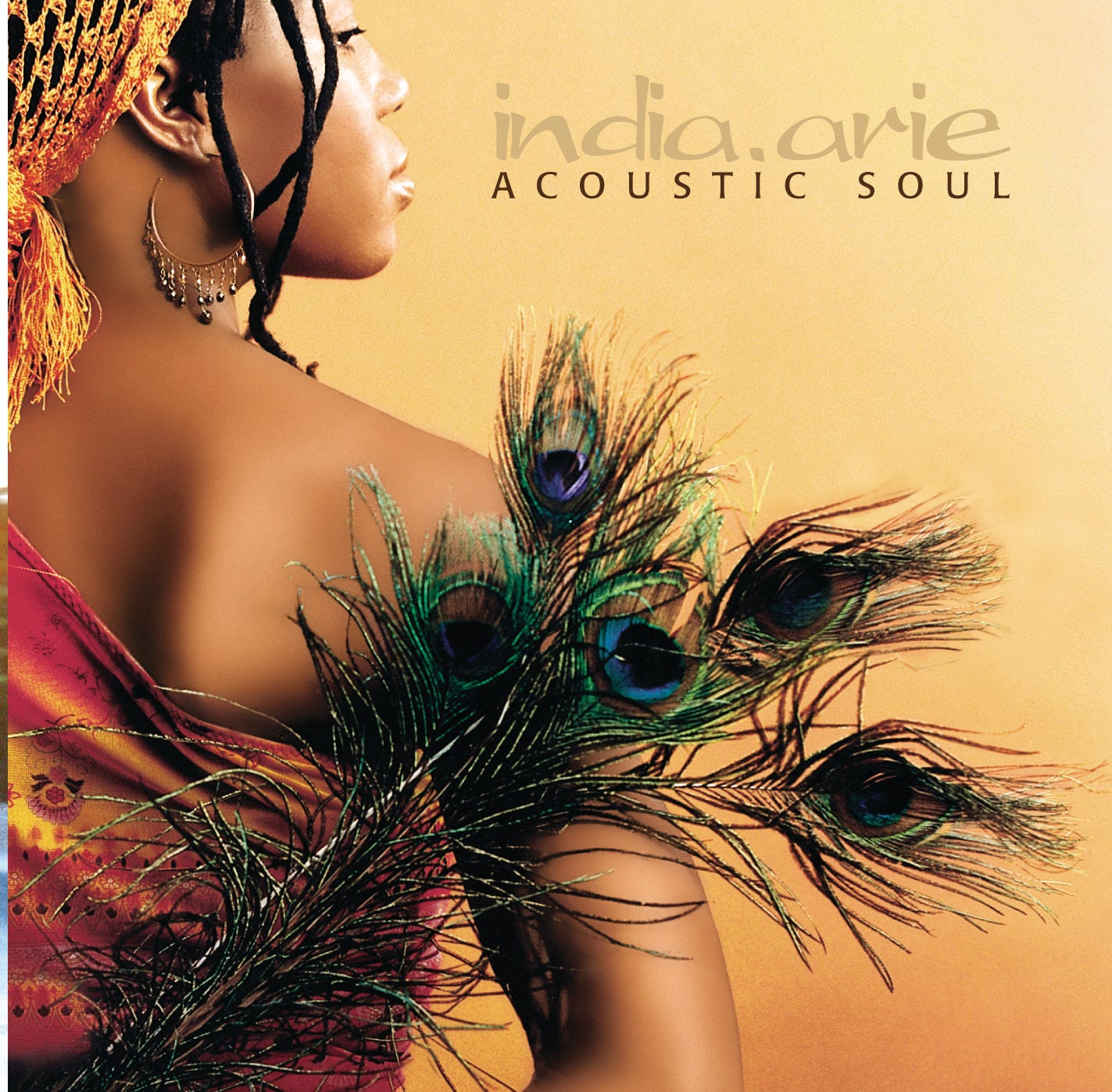
Neo-soul had already proved its commercial thesis. Erykah Badu’s Baduizm had gone double platinum, D’Angelo’s Voodoo won a Grammy, and Maxwell’s Now debuted at No. 1 despite three years of label delays. The market had made room for Black artists who wanted live bass, minor-key harmonies, and lyrics about something other than the club. But most of that wave still ran on familiar R&B machinery. Drum machines programmed to swing, Fender Rhodes cushioning every verse, horn sections deployed for gravitas. Almost nobody was building songs around an acoustic guitar. That instrument belonged to Joni Mitchell’s catalog, to Tracy Chapman’s protest folk, to the singer-songwriter tradition that Black artists could admire from a distance but rarely claimed as home turf. India.Arie Simpson, a 25-year-old from Denver by way of Atlanta, picked up a nylon-string guitar in college at the Savannah College of Art and Design and decided that divide was artificial. Acoustic Soul, her Motown debut, staked its entire identity on that bet.
Arie had spent the late ‘90s on the margins of the Atlanta music scene, co-founding an independent collective called Groovement (with its label arm Earthseed) and playing sets at open-mic nights and the Yin Yang Café. A slot on the second stage at Lilith Fair in 1998 caught the attention of a Universal/Motown scout, and by 1999, she’d been introduced to Kedar Massenburg, the Motown president who had signed Badu. Massenburg saw crossover potential and pushed for a more radio-friendly direction; Arie pushed back. “When I started tapping into my own sensitivity, I started to understand people better,” she said at the album’s release. “It was a direct result of writing songs.” The resulting record, co-produced by Arie alongside Mark Batson, Blue Miller, Carlos “Six July” Broady, and Bob Power and tracked largely at Electric Lady Studios in New York, took more than two years to finish. Arie later told Essence that she was depressed for eight months of that process and only made peace with the album on her 25th birthday, listening to it on a plane and deciding it was “good enough where I won’t be embarrassed when it comes out.”
That ambivalence didn’t survive the marketplace. Acoustic Soul debuted at No. 10 on the Billboard 200 and eventually went double platinum, driven almost entirely by “Video,” a single whose sales pitch was astonishingly direct. “Sometimes I shave my legs, and sometimes I don’t/Sometimes I comb my hair and sometimes I won’t,” Arie sings over a breezy mid-tempo groove built on an interpolation of Brick’s “Fun.” The chorus is a plainspoken inventory of self-acceptance, and the specificity is the engine. She lists her feet, thighs, lips, and eyes one by one, claims each of them, and then rejects the entire apparatus of pop-beauty gatekeeping with a single line. “My worth is not determined by the price of my clothes.” Her mother Joyce, a former singer who’d opened for Stevie Wonder and Al Green as a teenager, gave her the line that grounds the song’s middle section. “A lady ain’t what she wears, but what she knows.”
How close “Video” runs to a motivational poster is the real question. Arie pre-empts that objection herself—“Don’t be offended, this is all my opinion/Ain’t nothing that I’m saying law/This is a true confession of a life learned lesson I was sent here to share with y’all”—and the disclaimer works because she sounds like she means it as a genuine caveat rather than a rhetorical shield. She isn’t lecturing from a mountaintop. She’s telling you she figured something out and wants to pass it along, and it holds up across repeated listens because her phrasing stays loose and conversational, never tightening into sermon cadence. Where the song could calcify into slogan, her delivery keeps it porous.
With “Brown Skin,” it operates from a different angle entirely. If “Video” is a declaration of independence from external standards, “Brown Skin” is a love song that treats dark complexion as an erotic and cultural fact rather than a wound to be healed. “Where are your people from/Maybe Mississippi or an island/Apparently, your skin has been kissed by the sun,” Arie sings, tracing desire back through geography and ancestry before landing on candy metaphors (Hershey’s kisses, licorice) that could sound silly in lesser hands but land here because of the grin in her voice. The production, which borrows from Smokey Robinson’s “Quiet Storm,” gives the track a pillowy warmth that matches its mood, and Arie’s vocal sits low in her register, almost murmuring. The song doesn’t preach so much as flirt, and in doing so it accomplishes something that her more overtly self-affirming material sometimes can’t. It makes the celebration of Blackness feel like pleasure rather than homework.
Three spoken-word interludes scattered across Acoustic Soul find Arie reading roll calls of deceased musicians she counts as spiritual ancestors. The names range widely, and wildly, across genre and generation. Ma Rainey alongside Karen Carpenter, Charley Patton next to Minnie Riperton, Robert Johnson in the same breath as Stevie Ray Vaughan. The closing outro invokes Sam Cooke’s “A Change Is Gonna Come” as a kind of benediction. Arie was 25 and making her first album; claiming this lineage so explicitly was either an act of genuine faith or a bid for credibility that her songs hadn’t yet earned. The answer probably splits down the middle. She was studying at Savannah College of Art and Design when she discovered the guitar, and her parents’ record collection, which she’s said included John Coltrane and Johnny Hartman’s duets as a childhood obsession, gave her real reference points. They load the album with a weight it doesn’t always bear. Invoking Cooke while singing folk-pop about self-improvement isn’t exactly a fair exchange, and the interludes ask you to take Acoustic Soul as a cultural statement when it succeeds more convincingly as a personal one.
“Back to the Middle” is the most grounded song here, and the one that tests whether Arie’s autobiographical mode can carry real weight. Over a stripped-down arrangement driven by her own acoustic fingerpicking, she sings about recalibrating after losing her bearings, figuring out what was fear and what was instinct, trying to act on insight rather than anxiety. The lyric is precise enough to feel lived-in without being confessional in any exhibitionist sense. She keeps the stakes at human scale. Not transformation, just adjustment. “Strength, Courage & Wisdom” runs a similar register, building a mantra (“All the things I need are inside of me”) and repeating it with enough conviction that the song earns its euphoric chorus. “Ready for Love” is gentler, a promise of patience in a new relationship, and “Promises” tells three separate stories of people who failed to keep their word, including a father who left. These songs are individually sturdy, and they share a quality that makes Arie’s writing distinctive.
The production across Acoustic Soul varies more than its reputation suggests. Batson’s tracks (”Brown Skin,” “I See God in You,” “Simple”) tend to have the most rhythmic ambition, incorporating programmed drums and synthesized textures that give the guitar-based arrangements a contemporary pulse. “Simple” in particular has a futuristic, Timbaland-adjacent bounce that could have fit on an Aaliyah record; it’s the song most likely to surprise someone expecting coffeehouse folk. Blue Miller, a Nashville session guitarist who became Arie’s longtime collaborator before his death in 2019, brought a roots-rock sensibility to tracks like “Back to the Middle” and “Nature.” Bob Power, who’d mixed D’Angelo’s Brown Sugar and A Tribe Called Quest’s The Low End Theory, produced “Part of My Life” with string arrangements recorded in Philadelphia that give the song a sweeping orchestral feel. She settles into a phrase and lets the grain of her voice do the work, which keeps even the album’s quieter stretches from drifting into background music.
At the 2002 Grammys, Acoustic Soul carried seven nominations (Album of the Year, Record of the Year, Song of the Year, Best New Artist, and three R&B categories), more than any other artist that cycle. Arie won nothing, losing five of those seven to Alicia Keys. The shutout was LOUD. Rappers started using “getting India Arie’d” as shorthand for a Grammy snub. Arie told Oprah Winfrey years later that the loss made her wonder whether she was “meant to have all of that.” The industry outlined it as an upset, but the math was straightforward. Keys’ Songs in A Minor had sold four million copies to Arie’s one million-plus, and “Fallin’” was a No. 1 pop single while “Video” peaked at 47 on the Hot 100. The Grammy voters, as they always do, were following the numbers they always follow.
But the comparison itself is instructive, because it clarifies what Acoustic Soul does and doesn’t accomplish. Keys made a piano-driven R&B album that wanted to be canonical from its first note, pairing classical training with pop ambition and a voice built for arenas. Arie made a guitar-driven folk-soul album that wanted to be useful, to be the record a 19-year-old plays in her dorm room when she needs to hear someone say that her body is fine and her feelings are valid. That’s a narrower ambition, and the album fulfills it with real skill and intermittent beauty. “Video” and “Brown Skin” are strong enough to survive their era’s context. “Back to the Middle” is better than most of what passed for introspective songwriting in 2001 R&B. And Arie’s decision to lead with acoustic guitar on a Motown record, rejecting Massenburg’s push for radio-friendlier production, was a genuine creative bet that paid off commercially and aesthetically.
The songs that hold up best on Acoustic Soul are the ones where Arie lets herself be a songwriter. When she’s specific about what she sees in the mirror, or precise about the shade of someone’s skin and what it makes her want to do, she writes with a directness that most of her neo-soul peers couldn’t match. The album earned its audience honestly, and the people who needed it in 2001 weren’t wrong to love it. Whether it holds up as a piece of songcraft rather than a piece of cultural timing is a tighter question, and the honest answer is about half the time, yes. That’s sufficient to matter, and sufficient to explain why Acoustic Soul never got its canonical reappraisal. It didn’t need one. It already did its job.