

Out of nowhere, Endless was a surprise visual album that was released exclusively on Apple Music by Def Jam Records on August 19, 2016. Fans viewed the album as Frank Ocean recently surfaced, being built in a staircase where the entire album was coincidentally playing. The next day, the actual record was released on iTunes (under Boys Don’t Cry) but on Frank’s imprint. Universal Music Group, the parent company of Def Jam, has banned the company from entering into any further exclusive streaming deals.
Frank earned over $1 million in that week alone, according to Forbes (not including money he received through Def Jam). Frank’s royalty percentage share has changed from 14 percent on Def Jam to a whopping 70 percent since breaking off and going independent. He has special plans for his two records, released nearly on the same day: one, the sacrificial lamb, while his heart and soul were destined to communicate with the people who had already left.
The characters in Blonde are holed up in their thoughts. “I thought that I was dreaming when you said you loved me,” Ocean sings so effortlessly on “Ivy,” would have you believe: it’s hard to miss the effect that past tense has on a memory. The track’s poolside construct is studded with reminders of somebody else’s presence, and that whole back end resolves itself to nothing but the refrain, “I know you gotta leave, I know you gotta leave,” whispered into a void. “Self Control,” said Ocean in a conversation with the New York Times, is also not un-adjacent to a real relationship, a mutual one that just wasn’t gonna work, but “we weren’t really on the same wavelength.”
With “White Ferrari,” the affair in question has moved from the present tense and, finally, resolved into a memory: Ocean at 16 years old somewhere in Louisiana, with the expensive car. His claim that it’s “bad luck to talk on these rides” reeks of rule more than memory; fifty versions of this song might lead you to believe he’s still following it. Ocean’s fifteen-year-old brother heard it, then told him, and Ocean replied that it’s not the version “because it didn’t give me peace yet.”
In fact, there’s no rejection offered in the tracks where sexual intimacy isn’t specified, which can at least equally describe a same-sex or heterosexual inclination. Ocean’s two-minute “Good Guy” is exclusively the former but also light-hearted—after recounting having been set up on a date to a gay bar, dressing up, and having a drink, it ends with a virtually unembellished “Here’s to the gay bar you took me to” that might as well be the same conversational tone in which he’d order some food.
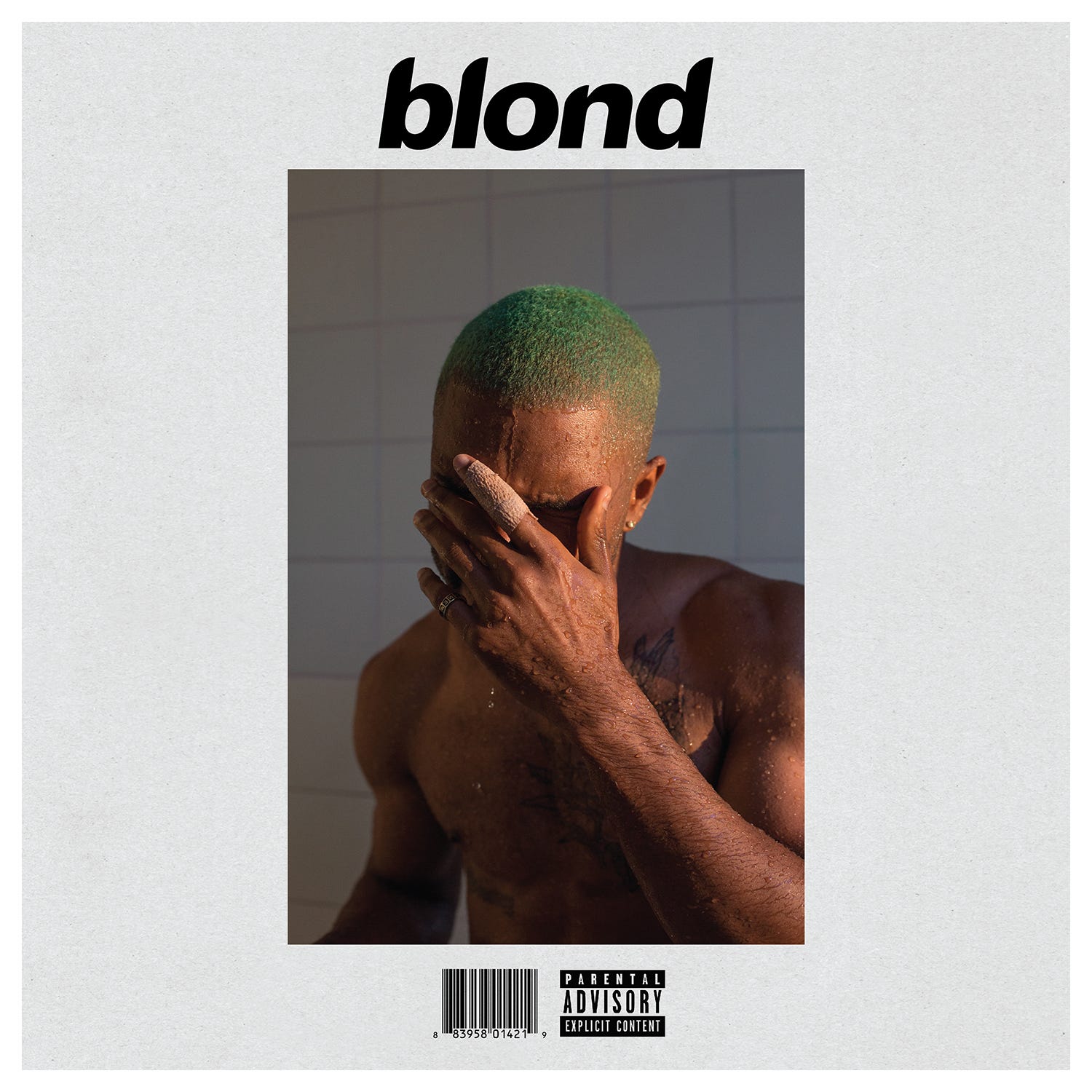
Four years before Blonde, he wrote a letter on Tumblr explaining that he’d fallen in love with a man at nineteen. Ocean carefully refrained from imbuing himself with the label “bisexual,” but rather used it to further elaborate on an interest in the fluidity of his experience—to instead position himself outside the traditional constraints of sexual attraction. He neither returns to nor further develops the topic on his record—“Nikes” mourns A$AP Yams, Pimp C, and Trayvon Martin instead, while also recounting meeting with someone and taking acid together; “Skyline To” is more concerned about the reeks of weed in California than the person lying beside you at night having already left you by morning. The very title of the record, with the feminine spelling on the cover and masculine written as Blond inside the album, denies any act of refusal.
André 3000 had recorded his creativity on “Solo (Reprise)” back in 2014. The recording took place in Austin, Texas, and the beat, a hip-hop one, he added to the track later—sending it to Ocean without the latter reacting for two long years. Then, when Blonde was released, the rapper went down the drive-in in California, Boys Don’t Cry magazine in the passenger’s seat, and CD in the car’s deck. The voice coming through the speakers was his, but he had never heard the beautiful piano tune accompanying it. “He didn’t tell us that it was coming out,” the musician later recalled, before revealing it had been James Blake who had played it and had forgotten to tell André all about it during their last studio session together.
Such stories are not rare with the musician, who struggled to get his talented collaborators to understand exactly which project they were on—Blake being one of them. Besides André, Blonde features Beyoncé (on “Pink + White” without credit), Kim Burrell (on “Godspeed” also without billing), and many more whose unexpected contributions are made known through short stories like the one SebastiAn (the French producer, not the crab) told when Ocean shared “Facebook Story,” his friend’s girlfriend breaking up with him for accepting her friend’s request.
The middle of the record cuts to two different songs. The beloved “Nights.” The first stretch comes on like a hustle: Ocean goes ‘round the city and round the clock, counting money in New Orleans before and after the flood. The beat switches, and something cold comes in where Ocean’s back in the dark: “Every night fucks every day up, every day patches the night up.” He’s out, but he’s still out here, struggling to get somewhere besides here. On “Seigfried,” asks himself if it’s time to settle down, if he should have two kids and a swimming pool and then wanders to eat mushrooms and hang glide from the moon. Near the end of the track, he quotes Elliott Smith’s “A Fond Farewell”: “This is not my life, it’s just a fond farewell to a friend.” Ocean takes those words the way you take a coat from someone who will not need it back.
He keeps the hard drives from recording inside the backpack because he figures, as he later told Jon Caramanica, “I’d rather the plane goes down in flames, and the drives go down with me, than somebody put out a weird posthumous release.” He was under the grip of almost a year of writer’s block when he ran into an old friend from New Orleans, who had also been struggling. “It made me feel as though I should talk about the way I grew up more,” Ocean says, and that urgency informs his writing.
He wrote channel ORANGE in two weeks. Not with Blonde. You hear the patience in it all. From the way he works in “Be Yourself,” a voicemail from a friend’s mother warning him about drugs, to how “Close to You” is just ninety seconds of a Stevie Wonder song rearranged to imply a wish. And “Pretty Sweet” begins as noise that could be a building falling before it’s revealed to be a church choir. If you listen to the back end of “Futura Free,” you’ll hear his brother and his friends answer questions in an interview: What’s your name? What’s your first memory? Do you have a hidden talent? Seventeen tracks of lovers who left and friends who died take on new meanings. It’s a version of himself that he still can’t return to. When the time came, that’s what he gave the kids. “I should be paying them, Momma,” he sings in the first half, still surprised that he gets paid for any of this.
Masterpiece (★★★★★)