

Milestones: Breaking Atoms by Main Source
Large Professor was eighteen and finishing the SP-1200 technique of an engineer who had been murdered. The debut he made turned into the school where half the golden age learned how to chop.
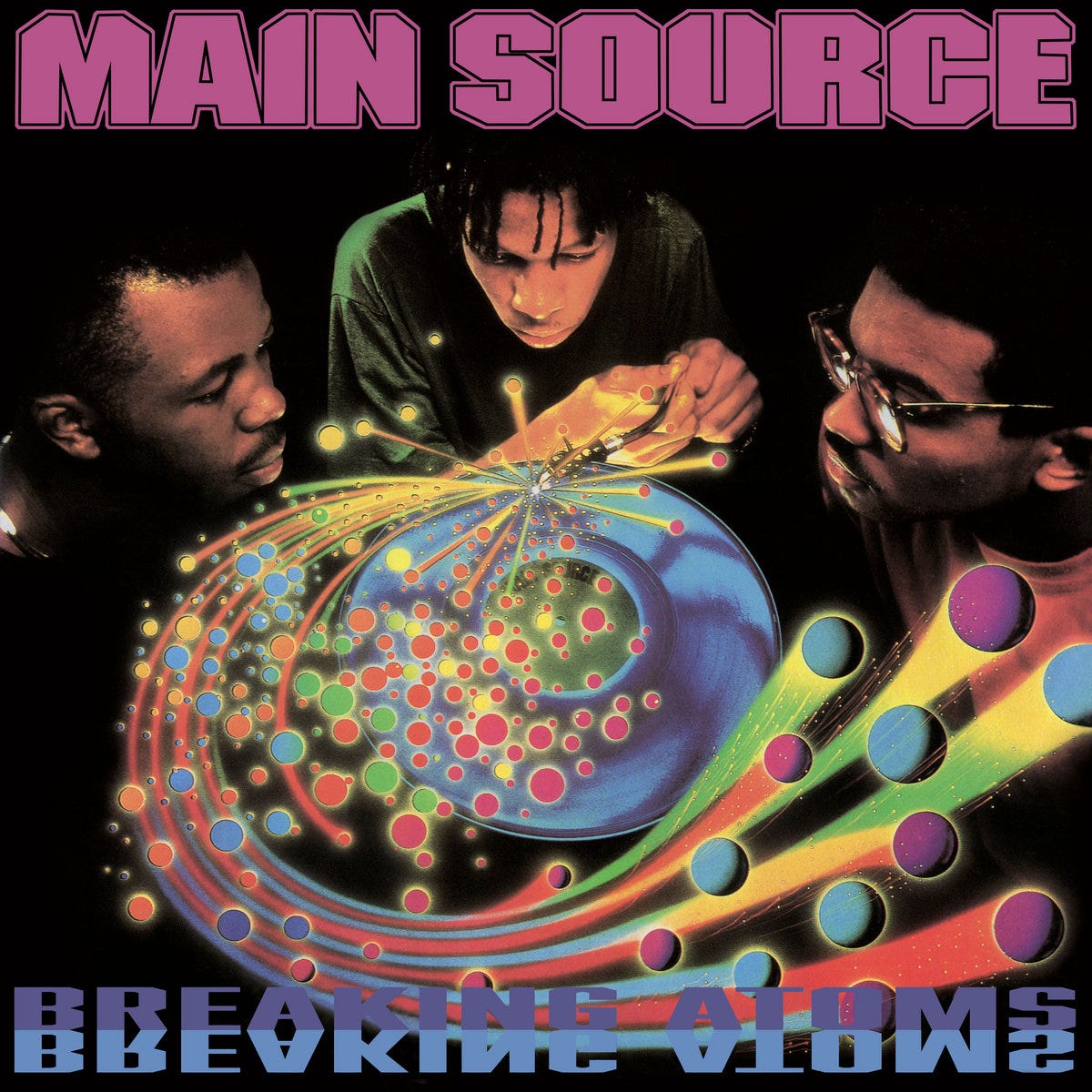
Paul C McKasty was murdered in his Queens Rosedale apartment in July 1989 on the same night that the SP-1200 sampler that he had been working on for the Ultramagnetic MCs’ second album was left resting on his desk in the open position. Paul, who had engineered Critical Beatdown and most of Eric B. & Rakim’s Follow the Leader, had been working out a way to chop drums and horns and stabs of horns up into grains that you could take and build into something new, and was taking the demos along with it to teach the method to a Queens teenager named William Paul Mitchell who was stopping by the studio after hours. The killer is still free. After Paul died, the kid kept coming by the studio, finished what he could of the Ultramagnetic record, and carried the technique into sessions with two DJs in Toronto. That album, released on Wild Pitch under the name Main Source, is a posthumous message from a producer no longer here to say it.
The McKenzie brothers, Kevin and Shawn (K-Cut and Sir Scratch on the sleeve), were in basements killing it in Toronto, and came to New York a couple of years before looking for work. By the time they met William Mitchell (he‘s know calls himself Large Professor) through a guy called Paul C. That’s how most of these links were being forged in the city. Officially in the group, every person was doing a part to a track, but Large was spitting, and the brothers were ‘killing’ the machine.
Large comes home late and catches his girl staring at the front door like she wants him to march right through it. She’s ready for him to leave for real. Large spends the next four minutes on a Donald Byrd loop, begging her to think about what she is about to do, asking “why you lookin’ at the front door?” What is underneath him on the tape is “think twice,” and Large is doing just that, trying to convince this woman to reconsider her decision in his own way. His final verse leaves him stuck in the same spot with her still staring past him at the front door. A pitcher in the Large Professor verse on “Just a Friendly Game of Baseball” throws a fastball; a Black man drops dead at the plate. The bat is a billy club, the umpire is going to miss certain calls unintentionally, and the stadium where the game is being played is called America. Large maintains this metaphor for every line, even though his delivery remains calm and conversational.
Later, on the record, he picks up “Peace Is Not the Word to Play,” and goes after the word peace itself. Rappers use it on their records; the industry people use it at the ends of meetings; the guys on the block use it as a greeting, and as a farewell, and by 1991 the word is completely played out, replaced by affections of goodwill that no one really owes anyone. So the same Brooklyn teen who just spent four minutes composing a piece of political metaphor that is the most sustained anyone in New York rap has produced all year, a few minutes later is telling you that the language of protest has been played out, and he would just as soon not talk that way anymore. He simply raps his way through the rest of the record.
Towards the back of the album is a posse cut called “Live at the Barbeque,” built on a loop of the Bob James “Nautilus” drums that would end up underneath everything Pete Rock, DJ Premier, and Q-Tip would touch for the next four years. Joe Fatal leads it off, then Akinyele “goes second,” then Large takes the third verse. Then Nasir Jones takes the last verse, uncredited on the cover and listed in the liner notes as a guest, still calling himself Nasty Nas, and opens it with “Street‘s disciple, my raps are trifle,” then rhymes a quatrain about kidnapping the president‘s wife without a kidnap ransom, then says the thing about going to hell at twelve years old for snuffing Jesus, and once he is done you can hear the rest of the track trying to catch its breath. Never mind that Nas wouldn’t put out his own debut album for almost three more years after this; it’s the opening line he would eventually build his brand and his legend and his book of sermons around, and sitting on a Main Source posse cut in July of 1991, waiting for somebody to recognize what it was. Large Professor would later play the same verse back over the first seven seconds of Illmatic, on a track called “The Genesis,” as the formal opening of Nas’s own career. Nas’s career begins with a sample of his own verse on somebody else’s album.
On the song “Watch Roger Do His Thing,” the listener follows a man from the block named Roger through a day of hustle and conflict-resolution at a harmless distance from a reporter. He doesn’t tell you what to think of Roger. On “Snake Eyes,” he watches a craps game and points out some of the moves the cheat players are using, and why they will get shot in the face at the table. The song “Just Hangin’ Out” moves block-by-block past kids on the corner and dudes in the bodega and old heads on the stoop, never getting above the block.
And the following year, after a royalty dispute with Wild Pitch, Large Professor left the group and went on to produce Nas’s “Halftime,” “One Love,” and “It Ain‘t Hard to Tell,” three years later all using the cutting method that Paul C had taught him to use on the machine Paul C had taught him to program. K-Cut and Sir Scratch kept the Main Source name on for one more single with a different rapper, then disappeared. The group, as it had been on the album, was over a year after Breaking Atoms appeared. But what remains of it is this first record and an SP-1200 in a room (the same room Paul C had shown the kid how to program one in) the month in which the record was mixed, pulling a Donald Byrd chord and a Bob James snare into so many grains they could fit in your pocket.
Masterpiece (★★★★★)