

Milestones: Cooleyhighharmony by Boyz II Men
Four Philadelphia teenagers sang their way onto Motown with nothing but harmonies and nerve—and gave early-‘90s R&B the vocal group album it had stopped asking for.
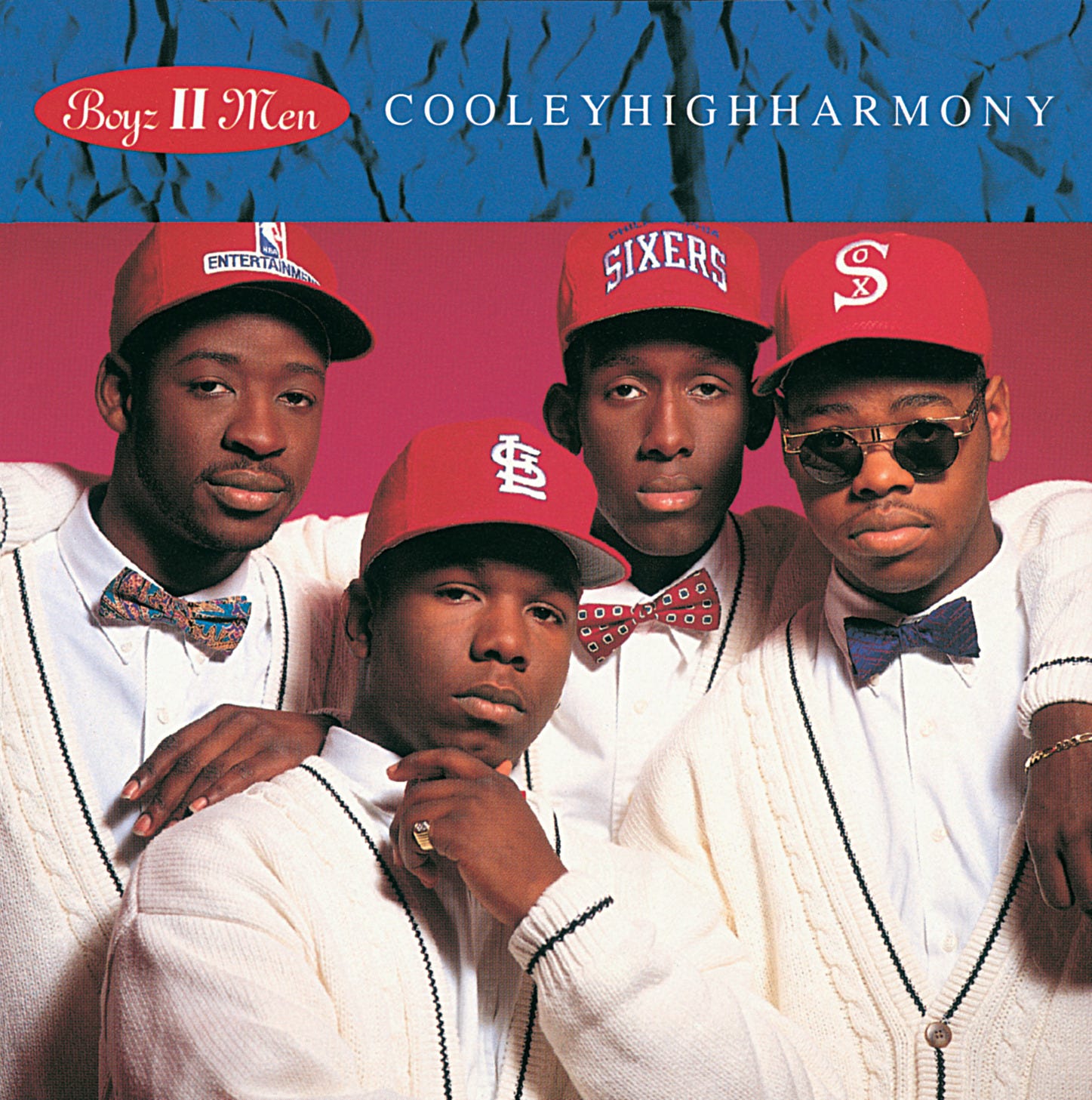
New Jack Swing had been running R&B for two years by this point. Teddy Riley programmed the drums, Bobby Brown set the attitude, and Bell Biv DeVoe proved you could break up a vocal group and come back louder with half the singing. The sound was percussion first, melody second, and if you wanted to hear men actually harmonize you were probably digging through your parents’ records. Male vocal groups—the format Motown had invented its empire around—were functionally extinct. Four kids from Philadelphia’s High School for the Creative and Performing Arts showed up that April with a debut they’d named after a 1975 movie about Black kids on Chicago’s Near North Side. Boyz II Men didn’t announce a revival. They just sang like one was already underway.
Dallas Austin, who produced eight of the ten tracks, was twenty years old and had never made a ballad. He’d been a high school dropout in Atlanta running the lightshow for a local act before becoming a keyboardist, then a producer; his first real credit was Joyce Irby’s “Mr. DJ” for Motown in 1989. He came to Philadelphia to cut two uptempo tracks and ended up doing the whole record. When the group asked if he could do slow jams, he went and bought Babyface records, listened to them, and figured out the structures on his own. Babyface didn’t produce a single note on Cooleyhighharmony, but his fingerprints are on every ballad. Austin copied his homework in real time. That kind of frankness says something about the album’s character. Nobody here was pretending to be seasoned.
And the songs don’t pretend either. “Please Don’t Go” opens with a spoken apology: “Hey baby, I’m sorry, I never meant to hurt you.” The speaker hasn’t given any reason for the apology yet. He just knows he should be saying it. He promises to be there when she calls, swears he thinks about her when temptation shows up, asks her not to leave. “Lonely Heart” starts even further along. The breakup has already happened. A girl tells Mike it’s over in a spoken skit, and the rest of the song is him trying to prove the relationship still has a pulse. “This Is My Heart” skips the conflict and goes straight to declaration:
“Loving and kissing and holding you tight
Letting you know everything is all right.”
These are teenage boys talking about love the way teenage boys do. Total commitment offered upfront, no hedging, no conditions, no evidence that they’ve been through enough to back up the promises they’re making. The sincerity is real precisely because it hasn’t been tested.
Nothing on the record is stranger or better than “It’s So Hard to Say Goodbye to Yesterday,” a cover of G.C. Cameron’s 1975 original from the Cooley High soundtrack. The group sings it a cappella. No drums, no keyboards, no bass, nothing except voices stacked on top of each other. Cameron’s version had a full arrangement with strings and piano. This one strips all of that away and makes you listen to Wanya Morris’s tenor and Michael McCary’s bass occupy the same space without anything between them. The song is a farewell, but the Cooley High context was friendship and death, not romance. When the group’s tour manager Khalil Roundtree was murdered in Chicago while they were on the road with MC Hammer, they started dedicating the song to him. A cover recorded by kids who probably just liked the melody ended up carrying real grief, and the absence of instruments made the weight of it sharper.
“Motownphilly” does something different entirely. Michael Bivins raps the group’s origin story over the top of the track, shouting out “ABC” and “BBD” for Another Bad Creation and Bell Biv DeVoe, the other two acts he managed. The song is a hometown anthem, Philadelphia pride, “back again doin’ a little east coast swing.” It’s also the group narrating themselves into existence inside the album, telling you their name, their city, their mentor, their lineage. They named themselves after a New Edition song. They titled the album after a Motown soundtrack. The biggest uptempo single is literally called “Motownphilly.” Everything about the record’s identity is stated outright, and the stating of it is the content.
The loosest track on the album is “Uhh Ahh,” which opens with the group harmonizing informally, joking about doing harmony over hip-hop beats, and then settling into a slow jam carried mostly by finger snaps, percussion, and layered vocals doing the melodic work that instruments would normally do. It found a second life when Beyoncé sampled it on “Countdown” twenty years later. The two songs produced by Troy Taylor and Charles Farrar as the Characters have a thicker, more synth-heavy feel than the Austin tracks. “Your Love” runs close to six minutes and stretches the vocal arrangements into long harmonized passages where the voices trade phrases without rushing to a resolution. “Little Things” puts its argument in the hook. Little things mean a lot. Neither song reinvents anything, but they round out the album by doing the small, specific work of being grateful instead of pleading.
What mattered more than any single song was the way the voices split the work. Nathan Morris’s baritone, Wanya Morris’s vibrato tenor, Shawn Stockman’s higher tenor, and McCary’s bass all sang lead at different points. There was no designated frontman. McCary did spoken-word intros; Wanya took the showiest melodic turns; Stockman provided the falsetto-range counterpoints; Nathan held the middle. Most R&B groups at the time ran on one or two lead voices with the rest singing background. This group rotated, and the rotation was the sound. Bivins called it “hip-hop doo-wop” and the phrase was clumsy but honest: New Jack Swing drums underneath, Temptations-era vocal stacking on top, and guys from a performing arts high school who clearly spent years singing together before anyone handed them a microphone.
Standout (★★★★½)