

Milestones: Corinne Bailey Rae (Self-Titled) by Corinne Bailey Rae
After twenty years, this record has become a standard. Corinne Bailey Rae’s debut, the LP that opened a lane for Black British womanhood that didn't require anguish, distance, or archetype.
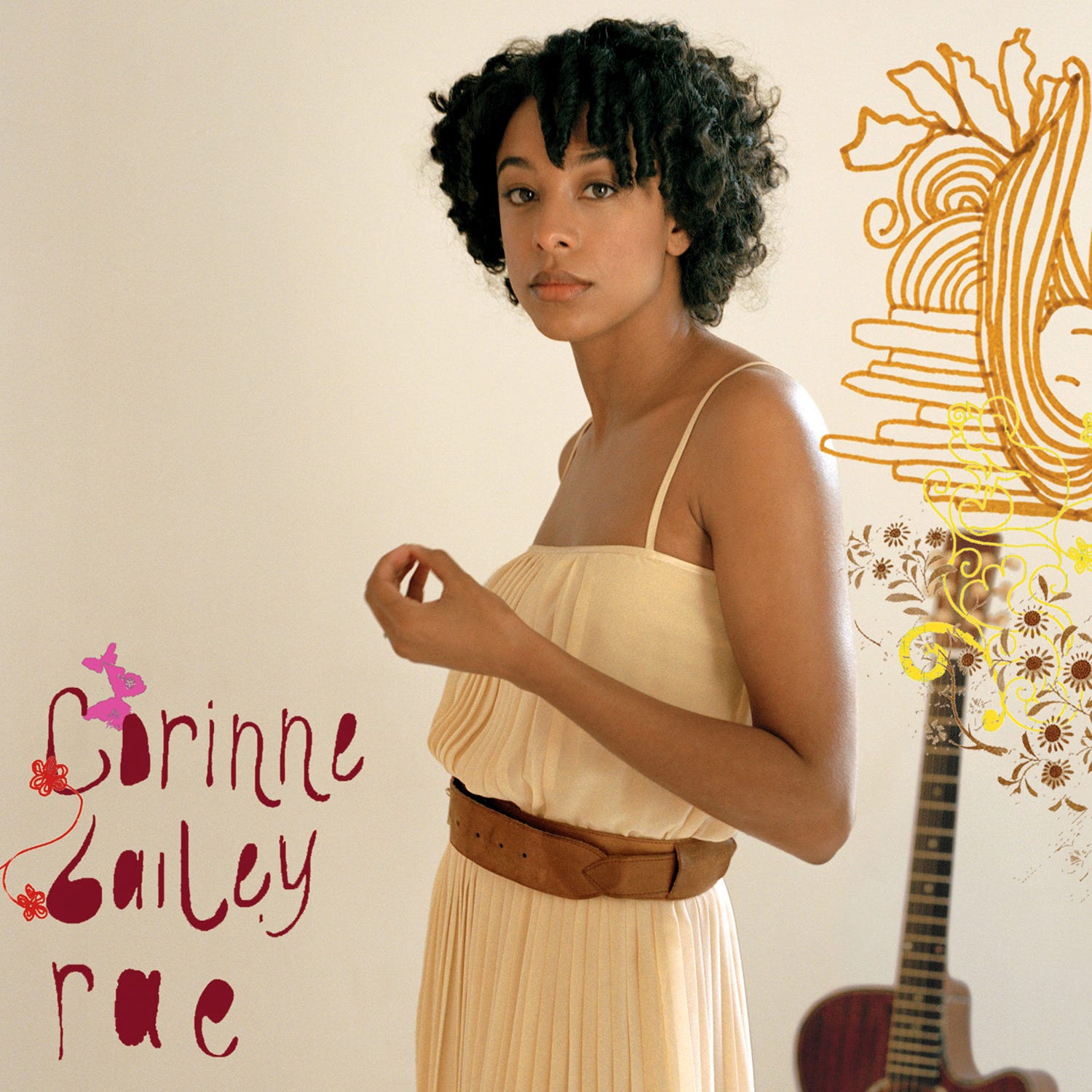
She graduated from the University of Leeds with an English Literature degree and then spent evenings taking people’s coats at a jazz club, watching musicians until they let her up to sing. Corinne Bailey Rae had also studied classical violin, recorded two worship albums with a Baptist church youth group under the name Revive, and fronted an all-female grunge band called Helen that nearly signed to Roadrunner Records before their bassist got pregnant and the whole thing collapsed. Before Helen, there was the Brethren church in Leeds, harmonies every Sunday. Before that, the youth leader Simon Hall lent her money for her first guitar. Together, they describe someone who had accumulated more than one way of listening, someone who understood structure from classical training, space from church harmony, and the appetite for noise from standing at the front of a stage at fifteen. The self-titled is built on that accumulation. It is a record made by a person who had paid close attention across rooms that had nothing in common except that she kept finding her way into them.
What those rooms gave her was a willingness to work with silence rather than fill it. The album was recorded across several London studios (Olympic, John Ellis’s Place, The Idle Studio) with producers including Steve Chrisanthou, Paul Herman, and Steve Bush, each handling different tracks rather than imposing a single production logic across the whole. Rae herself played acoustic guitar, electric guitar, Spanish guitar, piano, bass, and percussion on various tracks. That level of instrumental involvement is its own form of authority. She was not a vocalist handed a backing band’s decisions. The arrangements throughout stay spare in ways that serve the writing, keeping air around the phrases where the meaning is working.
The question the album keeps asking, never declaring it, is what it costs to tell the truth about love when the truth is uncomfortable and small. Not heartbreak at scale, not desire as force, but the actual daily texture of caring about someone, the friction that comes with it, the arithmetic of hope and doubt that you do not speak aloud because it sounds like ingratitude. “Like a Star,” the lead single she released the previous November, opens with a line that presents as devotion and bends immediately into discomfort. “It’s an honor to love you,” she sings, “Still I wonder why it is/I don’t argue like this.” That second thought is what the song is really about. Not the ache of early feeling but the real tension of caring deeply enough to fight, and the mild bewilderment of noticing the two things come from the same place. The Chrisanthou production at Olympic Studios keeps everything spare. Acoustic guitar, almost no reverb, her voice in close proximity. The arrangement leaves so much air around each phrase that you hear every small catch in her delivery, every place where she seems to be working out what she thinks while she sings it. Keeping the song that still was a decision, not a limitation.
Written with John Beck and Pam Sheyne, “Put Your Records On” is about a declaration of permission. Three little birds. You can let your hair down. The warm horns and patient guitar and light drum brush all keep faith with that impulse. Critics reached for Sade, and the comparison was not wrong; the song has Sade’s decisiveness, its sense of having made up its mind before the first bar. But Sade makes ease sound adult and slightly out of reach. Rae makes it sound like something a friend says on a warm afternoon, meaning it, not expecting anything back. The song sold close to a million downloads in the US by the end of 2006. That number tells you about the song’s initial reach. What it does not explain is why the song keeps turning up in actual moments of letting-go, at wedding receptions and late-afternoon drives home, years after the radio moment ended. What it says is specific enough to be reusable, which is different from being vague enough to mean anything.
The title “Choux Pastry Heart” is a writer’s gamble. Choux pastry is light and hollow and collapses under pressure; it is also faintly comic, and Rae plays the humor and the grief against each other without letting either win. The song moves through the old magpie-counting rhyme—one for sorrow, two for joy—and reaches a phrase that does not sound like a pop lyric: “I just wanna stay right here/Until never dawns.” That is something more honest, a person inside the loss reaching past the available rhetoric toward the actual shape of the feeling. “Till It Happens to You,” produced by Herman with bass guitar and a piano that sits low in the mix, does something harder. It holds on to optimism while naming exactly why optimism is difficult, why the person who has watched a marriage fail (her parents divorced when she was a teenager) can still marry at twenty-two and mean it. “I am drawn to those sad and beautiful moments of life,” Rae said in interviews at the time, “but I’m optimistic about love.” The song earns its confessional stance by keeping both things true at once, the hope and the knowledge of what hope costs.
In 2006, the British music press and American radio both needed a category for Rae, and the one they reached for most often was “soothing.” Norah Jones got name-dropped constantly. Erykah Badu. Minnie Riperton. Billie Holiday. Some of those comparisons were accurate in narrow technical terms (Rae does occasionally drop just behind the beat) but the grouping also refused to register what was actually particular about her. She was a mixed-race woman from Leeds whose church had not been gospel, who had studied English literature and knew a lyric as a textual object, who was twenty-seven and married and writing about love with the precision of someone who had spent real time inside it.
“People think it must have been a gospel church,” she said, “because of the whole, you know, Black assumption.” That parenthetical—dry, accurate, slightly tired—is the same voice you hear in her best lyrics. The category “soothing” was available to her partly because she did not perform exoticism or grief-spectacle. She presented herself as ordinary in a pointed, uncompromising way, as a person with a full biography rather than an archetype, and the British music industry in 2006 was not fully prepared to receive that without softening it into something easier to shelve. What got flattened in the critical reception was not her talent but her particularity, that combination of Brethren church and Veruca Salt records and English Literature seminars and Leeds jazz clubs that had made her the kind of writer she was. Audiences who heard the album as easy listening were not wrong about its warmth; they missed where that warmth was coming from, and why it sat in the throat the way it did. In the mid-2000s, the model for Black British female artistry in mainstream pop still required legible intensity. Amy Winehouse’s rage, Leona Lewis’s orchestral heft. Rae’s register was controlled, conversational, aimed at the person next to her rather than the back row. That looked like reticence. It was strategy.
“Trouble Sleeping” stays inside a single feeling, the wariness of someone who knows what opening up invites, the slight dread of wanting anyway, and does not push past it, which is the correct call. The wariness does not need resolving because the song understands it does not resolve in life; it just persists alongside everything else. “Breathless” has Rae’s voice doing more than the lyrics require, which suggests the melody came first and the words followed to fill it; the song coasts on her delivery without earning its feeling through the writing. “Call Me When You Get This” asks the sharpest question anywhere on the record, buried in its second verse: “What’s it really like to be loved?” It offers no answer because there is not one, the song’s small honesty residing precisely in that refusal. “Enchantment” catches something similar, the first rush of feeling before you have language for it, and keeps the production light enough that the lyric has room to be imprecise without becoming careless.
Where the album loses its grip, the writing turns scenic. “Seasons Change” reaches for landscape (leaves, time, the implied logic of weather as metaphor) in ways that are not false but are not exact. The distance between that and “until never dawns” is the distance between trusting a felt observation and reaching for a metaphor that was already lying around. “Butterfly” reassures without telling you precisely what needs reassuring, and there is nothing in the phrasing to catch on. In the second half, familiar-sounding softness sometimes substitutes for the precision that makes the best songs hold. The album has a genuine fault line, and it runs not between singles and deep cuts, not between fast and slow, but between the writing that commits to an exact detail and the writing that substitutes a general feeling for the thing that caused it.
What this means for how the debut reads at twenty years is worth saying directly. Rae was clearly capable of the precise thing. The question the record leaves open is whether she would learn to trust it consistently, and The Sea in 2010 answered that. A darker, stranger, more demanding record, made after her husband Jason’s death in 2008, which used her willingness to stay inside discomfort. The debut is where you can watch her discovering that her most unsettling instincts are also her most alive ones.
The version of Black British womanhood on this album—unhurried, grounded in Leeds rather than reaching for an imagined American south, neither performing anguish nor easing itself into ornament—had less precedent in pop than it should have. Rae was not inventing a tradition; she was being precise about her own life and expecting that to be sufficient. For the songs that hold, it is. The ones that falter are the ones where she stopped trusting it and reached for something more available instead. The distinction is worth naming at twenty years because it tells you what this debut actually was, under everything else. A record by a writer who, when she trusted herself, was right. Whether that is the same thing as saying she always trusted herself is the question the album quietly refuses to answer.
Great (★★★★☆)
Absolutely love this album and glad that people are still WRITING and preserving music and culture thank you