

Milestones: De La Soul Is Dead by De La Soul
The hippie costume never fit, so they burned it. Three guys from Amityville built a whole album out of the bonfire.
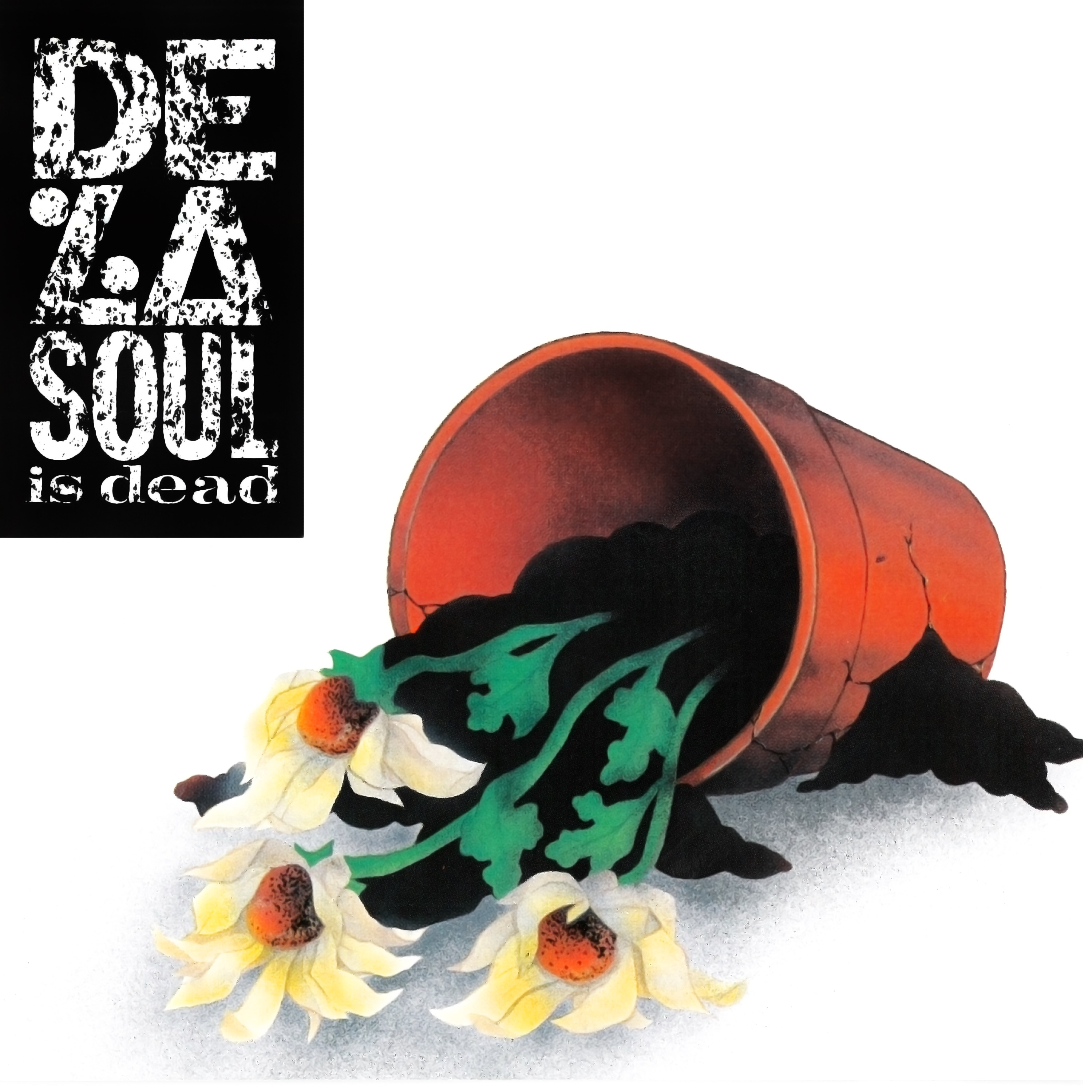
Arsenio Hall stood in front of his studio audience and introduced three guys as “the hippies of hip-hop.” They were about to perform “Me Myself and I,” a track whose whole point was we are not hippies. Cameras rolled. The audience clapped. And the gap between who these guys said they were and who the industry kept insisting they were got wider by the minute. Kelvin Mercer, David Jolicoeur, and Vincent Mason, better known as Posdnuos, Trugoy the Dove, and Maseo, had come out of Amityville Memorial High School on Long Island’s South Shore. They met their producer Prince Paul through a junior high music teacher who also drummed for the Isley Brothers, and together they made 3 Feet High and Rising, one of the most celebrated debut albums in hip-hop. The celebration came with a leash. Photo shoots wanted flowers. The press latched onto the D.A.I.S.Y. acronym. Journalists kept writing “flower children” into their copy like it was an established fact. They didn’t just reject that image on their second album. The cover is a painting of a smashed flower pot with three daisies wilting out of the wreckage, and the title says it plain: whatever you thought we were is dead now.
A kid named Jeff finds a De La Soul cassette in the garbage. Gets jumped by neighborhood bullies who steal the tape. Those bullies, led by a character called Hemorrhoid (voiced by Mista Lawnge of Black Sheep), spend the rest of the album listening and trashing every cut while the skits parody old children’s read-along tapes—complete with a chime that tells you when to turn the page. A fake radio station called WRMS plays nothing but “De La Slow” music. Prince Paul took the format of something gentle and kiddie and filled it with contempt, because the bullies aren’t just comic relief. They’re every dismissive listener, every A&R guy who wanted another “Me Myself and I,” every interviewer who asked about peace signs. The group built a fictional audience into the album just to let that audience fail them.
“Oodles of O’s” has Pos and Trugoy trading bars where every line ends on the same vowel sound, riding that constraint with loose pleasure over a jazzy descending bassline. Gone are the candy-colored synths of the debut. “Pease Porridge” stutters and bounces on a beat made from tap-dancing samples and the Harlem Globetrotters theme, and lyrically it’s a dare. We have a peace sign in our logo and we’ll still get in your face. “Bitties in the BK Lounge” is basically a comedy sketch about a disgruntled Burger King employee, “a BK mademoiselle, wrinkled uniform and bottom bell, and some jelly stuff on her sleeve.” Pos takes the first section from the customer’s perspective, flips it, becomes the employee himself. Tempos switch multiple times. Maseo gets more mic time than he had on anything prior. The humor is broader and goofier and meaner, and nobody’s asking you to like them.
Posdnuos’s older brother got hooked on crack, and Pos rapped about it on “My Brother’s a Basehead” without softening a thing. Started smoking weed in high school, moved to cocaine, picked up the pipe around ‘86. Stole Pos’s belongings, got kicked out of their father’s house, tried church and rehab, and the track just stops with the brother moving to New York City, presumably still using. Pos told Melody Maker he had strong feelings about it and didn’t care if people thought it was too personal. There’s no resolution because there wasn’t one to give. Prince Paul believed part of the motivation was trying to reach the brother—that Pos couldn’t say it to his face so he put it on wax. The brother eventually got clean, but the song doesn’t know that yet. On an album full of Burger King jokes and roller-skating jams it sits without apology or introduction.
Pos tells the story of “Millie Pulled a Pistol on Santa” in first person. A girl named Millie, her father Dillon, a respected social worker in the community who’s raping her at home. Trugoy takes the second verse and plays the friend who won’t believe her. Tells Millie to stop looking so upset, praises her father, calls Dillon cool. When Millie tries to say what’s happening he waves it off. She asks for a gun. He won’t give her one. Millie walks into Macy’s where Dillon is playing Santa Claus and shoots him dead in front of the children. A Funkadelic sample from “I’ll Stay” and Melvin Bliss’s “Synthetic Substitution” on drums sit warm and loose-limbed below all of it. The groove sounds like a Saturday afternoon. The lyrics are about a girl shooting her rapist father in a Macy’s. David Jolicoeur, the man behind Trugoy, died of congestive heart failure in early 2023, at fifty-four. Weeks later De La Soul’s music showed up on streaming for the first time. The voice that played the friend who failed Millie was gone before most people could hear the track on their phones.
After 3 Feet High blew up, people wouldn’t leave them alone. Aspiring rappers called constantly, showed up at their doors, cornered them on the street with demo tapes. Pos said they really couldn’t deal with being bothered at that point. One especially persistent fan, Miles Tackett (who later founded Breakestra), bugged them so hard he ended up in the subtitle of “Ring Ring Ring (Ha Ha Hey)”: “demo tapes by the miles.” That track rode a funk groove built on samples from the Whatnauts, the Honey Drippers, and Curiosity Killed the Cat all the way to the top ten in half a dozen European countries. The Arsenio thing still stung, too. On “Pass the Plugs,” Pos raps “Arsenio dissed us but the crowd kept clapping” and Prince Paul steps up to spit his own bars over a flip of the J.B.’s “Pass the Peas,” calling out Tommy Boy and the whole machinery of expectation by name.
Prince Paul programmed nearly a hundred samples across these tracks using the same Akai S-900, Emu SP-12, and Casio SK-5 he’d relied on for 3 Feet High. He told interviewers the equipment was limited, that the limitation was the whole beauty—you had to program a certain way because the machines couldn’t do what you wanted fast enough. Tommy Boy gave them more rope after the debut’s commercial success, let them call the shots at Calliope Studios. But this was late-era sample freedom and nobody knew it yet. The Turtles had already sued over the “Transmitting Live from Mars” flip, costing the label $1.7 million, and the Grand Upright Music v. Warner Bros. decision later that same year drew a legal line through everything. Paul said they got a little smarter about who they sampled but didn’t pull back on density. He used tap-dancing sounds on “Pease Porridge,” put Funkadelic under a child’s murder on “Millie,” flipped Genesis into a satirical metal blast on “Who Do U Worship?,” and scattered Tom Waits and ELO and Lafayette Afro Rock Band across the rest. You can’t make albums this way anymore, and the legal climate killed it within months of this one’s release.
Standout (★★★★½)