

Milestones: Dr. Octagonecologyst by Dr. Octagon
The weirdest rap album of 1996 was made in a basement that smelled like glue. Thirty years later, nobody’s sure who should get the most credit for it.
Foam insulation covered the walls of a basement in San Francisco’s Sunset District, glued there by a twentysomething producer who wanted to soundproof his parents’ house. It didn’t work. The room still leaked noise and stank of adhesive, and they called it the Glue Factory anyway. Dan Nakamura built beats down there on an ADAT rig surrounded by crates, and by the mid-’90s the place had become a clubhouse for Bay Area headcases and sample junkies. DJ Shadow cut Endtroducing..... nearby. Lyrics Born and Blackalicious drifted through. The Solesides crew treated it as a second apartment. Nakamura had quit DJing after watching two teenagers from Daly City, Qbert and Mix Master Mike, rip through a scratch battle at a party in Stockton. “I’ll never be this good,” he thought, and switched to making beats. His parents were third-generation Japanese Americans, interned during World War II. He grew up on violin before turntables, and that classical training stuck around in ways nobody predicted. When a pair of demo tapes from a Bronx rapper named Keith Thornton showed up at the Glue Factory sometime around 1994, mailed alongside copies to radio stations and a handful of DJs, Nakamura heard something in the two songs, “Dr. Octagon” and “Technical Difficulties,” that scratched a particular itch. Thornton’s voice was rapid and disjointed, funny in a way that didn’t ask permission. Nakamura wanted to make a full record out of it.
Thornton, by then, needed one. He’d cofounded the Ultramagnetic MCs in the Bronx in 1984, and their debut Critical Beatdown practically invented sampling as arrangement, chopped and reassembled and stacked in ways nobody had tried on wax before. Wu-Tang Clan later cited it. The Prodigy lifted a Thornton line for “Smack My Bitch Up.” But after Critical Beatdown, the story went sideways. A rumor took hold that Thornton had been committed to Bellevue Hospital’s psychiatric ward, and it wouldn’t die no matter how many times he denied it. He said the whole thing came from a joke he cracked during a brutal press day for the second Ultramagnetic album, Funk Your Head Up. Fifty interviews. No food, just water. He got punchy and told a reporter he’d been eating rat poison and ended up institutionalized, just to make Ced Gee laugh. “People still kinda like stuck in the myth of the Bigfoot Loch Ness Monster thing,” he told The Source Weekly. The two subsequent Ultramagnetic albums tanked. East Coast boom-bap was drying up commercially. And Keith Thornton was stuck carrying a reputation as a crazy person that he’d accidentally given himself. Dr. Octagon was the way out—a character so far removed from biographical reality that no one could confuse the rapper with the fiction, even though some people tried.
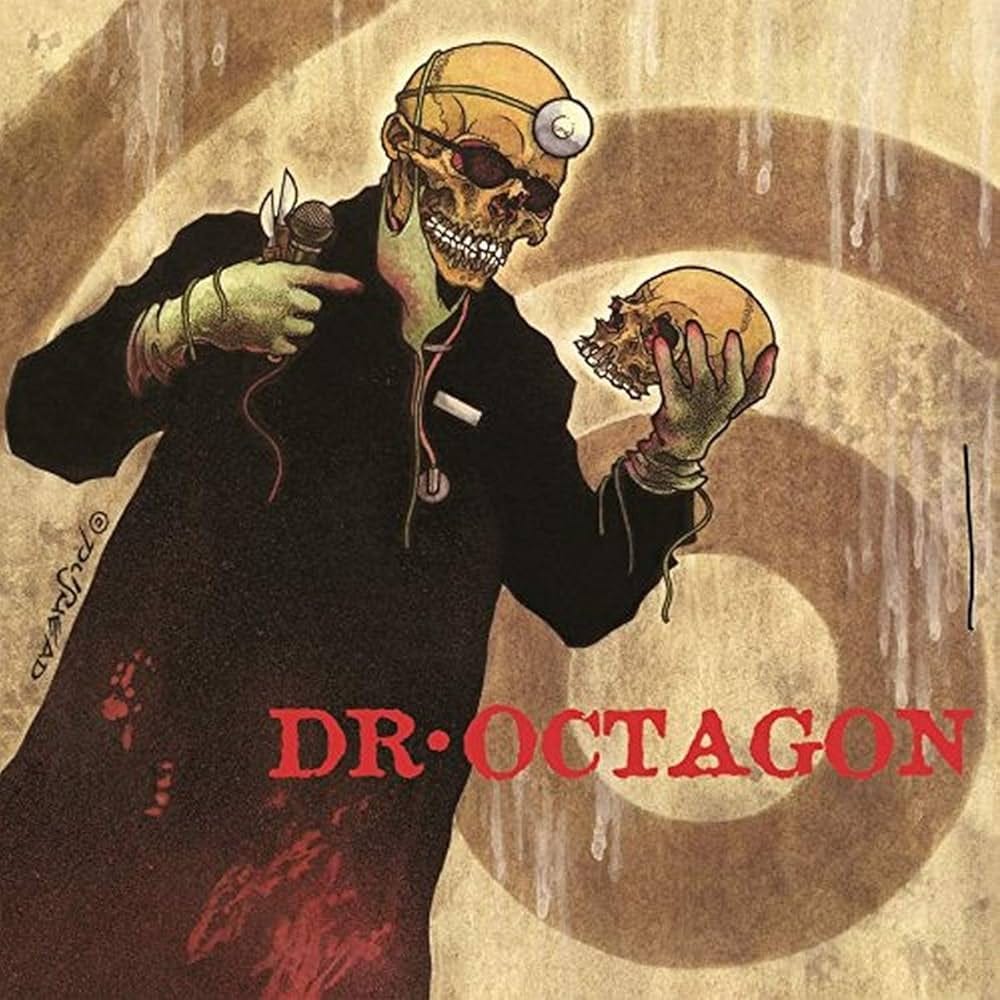
A homicidal extraterrestrial gynecologist and surgeon from Jupiter, yellow-eyed, green-skinned, with a pink-and-white Afro. He diagnoses chimpanzee acne. Relocates saliva glands. Loses patients on the operating table with disturbing regularity. He also has sex with his patients. Nothing in 1996 sounded remotely close to the record built around him. Not JAŸ-Z’s coke-rap elegance, not OutKast’s Southern funk, not the Fugees’ pop warmth. Nakamura wanted distance from all of it. “Hip-hop was always inventive,” he told an interviewer. “Then the ‘90s hit and everyone wants to be Dr. Dre.” At the Glue Factory, he stacked Moog synthesizer runs over LinnDrum patterns, wove violin samples through dusty breaks, dropped in dialogue ripped from pornographic films between verses. The drums thud with the dead-room weight of a lo-fi horror score. Where G-funk breathed sunlight and bass, this stuff was cold and green-lit, deliberately wrong-sounding. DJ Qbert, four-time DMC World Champion and one of the two kids who’d humbled Nakamura at that Stockton party, scratched on every track. Chopping vocal samples into jittery, fast-twitch interruptions that sounded as if damaged transmissions were being picked up on a broken frequency, beamed in from some radio station that doesn’t exist.
“Blue Flowers” nails the ratio between all three of them. Nakamura’s beat crawls on a violin loop and chalky drums, mid-tempo enough to let Keith’s words pile up without rushing. “Cybernetic microscopes and metal antidote,” he raps, “two telescopes that magnify the size of a roach.” Shakespeare, Mars, “the mascot of Evil” all get name-checked in the same breath. The chorus, “Blue flowers/It’s raining green, by the pond,” just sits there. A hallucination somebody forgot to explain. Then Qbert takes over for an extended scratch solo, needling a looped vocal sample (”let me show you something”) until it becomes a nervous breakdown happening inside a turntable. The song owes as much to trip-hop as to any American rap lineage, and Mo’ Wax releasing it in the UK made sense for exactly that reason. “Earth People” runs leaner: spare beat, heavy scratching, Keith announcing himself to humanity in a doctor’s coat. “First patient, pull out the skull, remove the cancer.” Body horror and space travel crammed into the same sentence without a breath between them.
And that’s the thing people tend to skip past when they praise Keith’s “abstract lyricism” and “surreal wordplay.” Track by track, a good portion of this record is graphic, and not in a way that the word “surreal” quite covers. “Girl Let Me Touch You” is a come-on delivered through the character’s mouth, crude, not particularly clever about it. “A Visit to the Gynecologyst” puts a female patient on a table while Dr. Octagon describes her condition in sexually charged terms and doesn’t look the other way when she asks him to. “I’m Destructive” mixes bodily damage with bragging. The sci-fi frame gives all of it a fictional address, and most of the critical conversation over thirty years has accepted the address without checking what’s inside the envelope. Keith isn’t hiding the content. It’s right there, sung in character, and the character’s whole joke is that he’s an incompetent pervert doctor from Jupiter. Whether the joke plays differently now than it did in ‘96 depends on how much you think a persona erases the words coming out of it, and the record never slows down long enough to let you decide.
Every skit on here holds the fiction together in ways that matter more than filler usually does. The opening “Intro” is an answering machine message for Dr. Octagon’s office, a receptionist asking callers to leave their symptoms, scheduling appointments, explaining procedures. Funny and stupid and it sets up the operating-room premise without a single rapped bar. “General Hospital” lasts 26 seconds: a hospital intercom pages Dr. Octagon, somebody yells “Oh fuck!” “Elective Surgery” has him diagnosing a patient with “Tomaine poisoning on your tongue” and bees around the rectum. These bits aren’t intermissions; they’re the connective cartilage of a concept that would fall apart without them. Take them out and you’ve got a collection of weird rap songs. Leave them in and you’ve got a fake hospital with an alien quack running the wards.
Keith’s free-association method goes furthest on “Halfsharkalligatorhalfman” and “Technical Difficulties.” The first describes a creature that is half shark, half alligator, half man. The math wrong on purpose, a monster-movie poster printed at a bootleg shop. The beat stutters and thumps underneath imagery yanked from B-horror VHS covers. “Technical Difficulties,” one of the original demos that kickstarted the collaboration with KutMasta Kurt, crams Chewbacca, circumcision, dinosaur funk, G-funk, Pepto-Bismol, Sam Cooke, Jimmy Castor, and Kurt Cobain into a single verse. No connective thread between any of it, and that’s the point. Keith’s method on these songs is to keep firing until the accumulation becomes its own kind of sense. Not meaning, exactly, but density. A pile of references so thick that picking through them feels like sorting someone else’s junk drawer. “No Awareness” takes the approach to its limit. Frenetic and rapid-fire, a barrage of disconnected images stacked on top of each other with no narrative at all.
Qbert owns “Bear Witness,” a track built almost entirely around his scratching. Fast and choppy, technically punishing cuts and transforms that turn the turntable into something closer to a lead instrument than a texture. Keith raps over and around the scratches, but the song belongs to Qbert. His presence across the rest of the tracklist is subtler but constant, those jittery chops and needle-drops coloring the spaces between Keith’s verses the way a horn section might on a soul record. An instrumental version, Instrumentalyst (Octagon Beats), came out the same year, and it holds up without any rapping at all, which probably says more about where this album’s identity actually lives than anyone involved would admit.
The last track breaks every rule the record spent an hour establishing. “1977” abandons the sci-fi, sheds the character, ditches the concept. Keith raps over a lo-fi breakbeat, mimicking late-’70s park-jam delivery, name-checking Grandmaster Flash, Kool Herc, the L Brothers, Grand Wizzard Theodore. He’s not Dr. Octagon anymore. He’s a rapper from the Bronx standing in the year the culture started, and the affection is plain and uncomplicated, totally out of place on a record about alien gynecology but it makes sense when you remember that none of this would exist without those park jams. An album that opens in the year 3000 closes in 1977.
Nobody agreed on who did what. Thornton said Nakamura and Kurt received more recognition than he did for the musical ideas behind the whole thing. KutMasta Kurt said he got the whole thing started and never got paid for it, and told interviewers he eventually had to sue Nakamura. Nakamura went on to produce Deltron 3030 and the first Gorillaz album and score Scott Pilgrim vs. the World and Booksmart and became, for about five years, one of the most in-demand producers alive. Qbert kept competing and winning. Thornton killed Dr. Octagon off on his 1999 album First Come, First Served. Dr. Dooom stabbed Octagon seventeen times, drowned him, electrocuted him with a razor. Then Thornton kept making music under dozens of names with diminishing commercial returns. The trio reunited in 2018 for Moosebumps: An Exploration Into Modern Day Horripilation. It sold to the already-converted. The question that’s followed the record for thirty years is whether it’s a great rap album or a great production album that has rapping on it. Keith’s bars are what make the record strange, but Nakamura’s beats are what made people buy it.
Two hundred thousand copies, no major promotion, ten units at a time vanishing from Tower Records shelves with no restock for a month. A triple-vinyl reissue in 2017. A limited-edition 2LP from Interscope’s Vinyl Collective in January 2025, three thousand numbered copies. The thing refuses to go away as nothing else sounds like it—not the underground rap it helped create a market for, not the Rawkus and Stones Throw records it made commercially possible, not even the 2018 reunion. Dr. Octagonecologyst didn’t change hip-hop the way Reasonable Doubt or ATLiens did; it opened a side door that a certain kind of casual rap fan walked through and never came back from. Keith Thornton is still making records nobody asked for, Dan Nakamura is still scoring movies, and the Glue Factory basement doesn’t exist anymore. The foam’s probably still up there on the walls, though. Stuff like that is hard to peel off.
Great (★★★★☆)