

Milestones: Efil4zaggin by N.W.A.
The first gangsta rap LP to hit number one on the Billboard 200 was made by a four-man crew. Dre quietly built the engine of West Coast rap’s next decade inside the noise of his old group’s collapse.
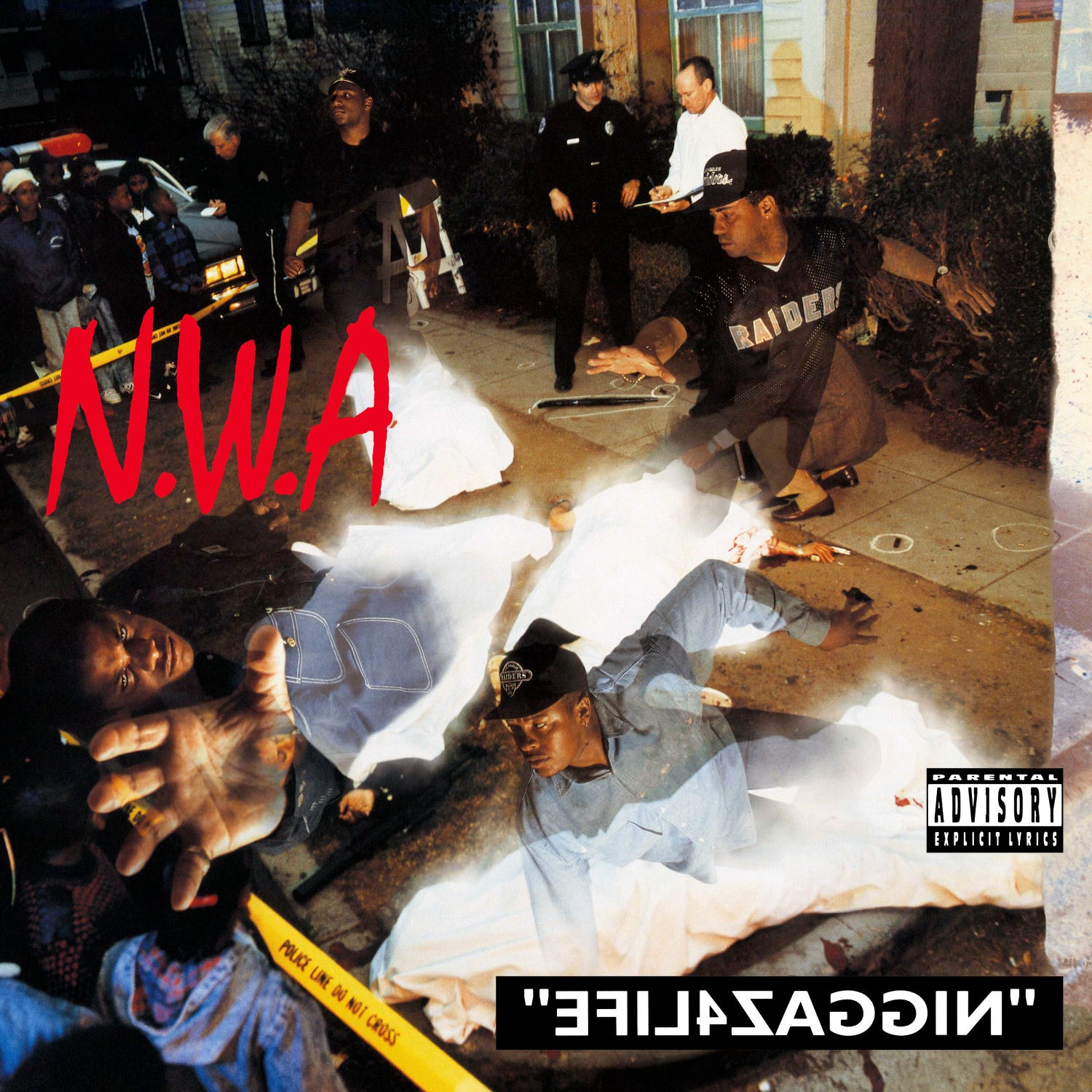
Trigger warning: This review contains mentions of domestic violence. We encourage you to reach out to The National Domestic Violence Hotline (1-800-799-SAFE (7233) or https://www.thehotline.org) if you experience or see domestic abuse.
On January 27, 1991, at a release party at the Po Na Na Souk on Hollywood Boulevard, Dr. Dre walked up to Denise Barnes, the host of Fox’s Pump It Up!, and put his hands on her. Barnes later described being lifted off the ground by her hair, slammed into a wall by a stairwell, kicked in the ribs, then chased into the women’s restroom and beaten in the back of the head while a bodyguard kept the crowd off with a gun. Her offense had been producing a Pump It Up! segment that spliced an Ice Cube interview against footage of the crew Cube had walked out on. Dre would tell Rolling Stone a few months later, deep into the press cycle for the album in question, that the whole thing was no big deal, since he had just thrown her through a door. MC Ren told the same magazine she had it coming, and Eazy-E backed him up on the record. The criminal charge against Dre had not yet been resolved by May when N.W.A.’s second studio album, packaged as Efil4zaggin on its cover, debuted at number two on the Billboard 200 and climbed to number one in week two. The four remaining members of the crew passed the spring giving interviews about a real assault while a song from from the head of an unnamed killer who has just murdered a sex worker climbed alongside them.
Track eleven puts Eazy in the head of a fictional killer in the immediate aftermath of a sex worker’s murder, and by the minute he opens his mouth to deliver the verse, the sophomore record has already cycled through the question of whether anything called N.W.A. could stand on its own after Cube walked out. “Real Niggaz Don’t Die” stations Ren and Dre on opposite sides on a song about longevity, enemies, the funerals of their doubters, and they sound winded inside the first ninety seconds. Cube had written most of what people remembered from Straight Outta Compton, and the absence of his pen across the opening of his old crew’s follow-up is the loudest fact on the wax. Ren is a sturdy writer with a flat voice who cannot carry an album alone, and he is not asked to here, because the actual pen belonged to a man whose own throat had been crushed in a 1989 car wreck on the 101 outside Studio City. D.O.C., post-accident, sounded like cracked tile when he opened his mouth, but he could write a verse, and he wrote almost all of Efil4zaggin the way he had written through Straight Outta Compton.
Nobody on hand to listen in 1991 could quite say it, since the misogyny was so loud it ate everything else, but Dre was figuring out the next decade of West Coast rap production while the men around him embarrassed themselves into a corner. Mike Sims’s four-string line on “Alwayz Into Somethin’,” played live instead of sampled, has a slow loose-hipped roll nothing on Straight Outta Compton ever touched, and it is the same loose-hipped roll Dre would loop under “Nuthin’ but a ‘G’ Thang” eighteen months later and ride to the top of the Hot 100. The drums sit deeper. The horns have air around them, and Dre’s tempo holds the kind of patience the first album had no use for. Anyone who heard The Chronic the next year and assumed Dre had built G-funk from scratch on a Death Row soundboard had not been paying attention to what he and Colin Wolfe were already doing in Torrance with a four-track in the spring of ‘91. Nobody else paid attention either, because the men with the microphones over those drums were saying things that made it impossible to listen for anything else.
You can hear the title track try, for one verse, to do the harder thing. Ren goes back to grade school and says the word was being put in his mouth by white kids who meant it before he was old enough to spell it. Dre half-mumbles something about his uncle. Eazy waves the whole question off and says nobody from outside the neighborhood gets to ask. None of those answers cohere into a thesis, which is how the song works, since it is the one place on the album where four men in the booth are arguing among themselves about something other than how much Cube had wronged them. Then a forty-second skit calls Cube a Benedict Arnold and the album stops asking questions for the rest of its run.
The diss the skit was setting up, “Real Niggaz,” spends nearly four minutes saying Cube took the money and ran. Ren spits the version of the diss with the most teeth in it. Eazy does his cartoon falsetto and a Dre line about a sucker eating him says itself out loud. The whole thing would have hit harder if Cube had not, the year before, dropped AmeriKKKa’s Most Wanted with the Bomb Squad and made an album so much heavier than this one that the diss is being delivered to Cube, who was no longer in the room and had been louder than the rest of them when he was. Cube knew exactly what he was leaving; the diss is just the sound of his old crew confirming his math out loud. And the math was already public.
By track ten the project opens its door on the material everyone was arguing about. “To Kill a Hooker” is a thirty-second skit. “One Less Bitch” plays out a murder fantasy from the killer’s first-person point of view. “Findum, Fuckum & Flee” compresses the same impulse into a slogan, “Automobile” stages it in the back of a car, “She Swallowed It” recites a graphic catalog of what its title promises, and “I’d Rather Fuck You” mocks the entire concept of writing a love song. The cuts arrive back to back with no gangster posturing between them to break the rhythm, and they were the reason the British Obscene Publications Squad walked into PolyGram’s Chadwell Heath distribution warehouse on June 4, 1991, and seized over twelve thousand copies of the wax. Our Price pulled the LP from every UK shop the same week, and the Crown Prosecution Service got their own copy in the mail. Nothing like that had ever happened to a rap LP on British soil before.
In interview after interview at the time, Dre and Eazy and Ren defended those cuts as a cartoon. None of it was real, they were performing characters, and the women were stand-ins for a joke about the kind of guy who said these things. Andrew Smith, reviewing for Melody Maker, agreed they had made themselves into cartoon characters and meant the line as an attack. The argument carries some weight on “I’d Rather Fuck You,” where Eazy is plainly working a Redd Foxx parody bit and the punchline lands right inside the joke. It carries no weight on “One Less Bitch,” where Eazy raps the murder from the killer’s first-person voice and dares you to find his indifference funny while the criminal charge against the producer of his beat had not yet been resolved. Whatever those cuts were meant to be in theory (back to the cartoon defense the group kept circling in interviews), in practice they played in dorm rooms and parked cars while Barnes was preparing a $22.7 million civil suit that would later settle out of court for terms nobody on either side has ever disclosed.
What rescues Efil4zaggin, what keeps anyone talking about it thirty-five years later, is what Dre and DJ Yella were doing under the High Powered Productions credit at Audio Achievements in Torrance. The horn line on “Appetite for Destruction” punches with the muscle of a brass section that knew exactly which room it was playing. The drum programming on “Approach to Danger” carries a slow patient menace Dre would later sharpen into the Death Row house style. Even the Warren G cameo buried in the comedy skit “1-900-2-COMPTON,” a fake collect call from county lockup, is a pre-echo of an entire West Coast career that had not started yet. Dre was building the chassis of his second career out of the wreckage of his first one ending, and nobody else in the booth had noticed yet.
On his second album, Eazy-E was the figurehead of a label that has been quietly handed someone else’s pen. The Compton kid who had founded Ruthless and put up the money for Straight Outta Compton sounded, on most of his sophomore outing, like he was reading lines off a sheet D.O.C. had handed him an hour earlier. His verses on “One Less Bitch” and “Findum, Fuckum & Flee” arrive in his voice but not his cadence. Too clean, too end-stopped, too obviously another writer’s flow worked into another guy’s mouth, and not exactly Eazy’s own beat under his throat either. He was the figurehead of a label being dismantled around him in real time. Within six months Dre and D.O.C. would walk out the door with Suge Knight to start Death Row, taking the production identity of the LP with them. Eazy would file suit against Ruthless and lose, then keep running the label until his death from AIDS in March 1995. Whatever his pen was doing through the record he ostensibly led, that pen was being held by a man already planning his exit.
MC Ren is the one who exits Efil4zaggin the same way he entered. Ren shows up on most of the cuts that have nothing to do with sex, and his verse on “Real Niggaz Don’t Die” is the most committed performance on the wax. And he was the same Ren who told the press that Barnes had it coming. Both facts sit next to each other on his ledger and neither one makes the other smaller.
Dre and Ren close the wax with a song about the Compton of the late seventies, the figures who shaped the corners of their childhood, the era before any of this had a name, the record goes quiet. Dre raps about his older brother Tyree, whose neighborhood reputation he had been chasing all his life in 1991, while Ren names corners and people, half of them now in the ground. The bass walks underneath both verses at the same patient tempo Dre had been working out all album, and then it stops, and “The Dayz of Wayback” is over, and within six months Dre was in a studio with Snoop Doggy Dogg cutting “Deep Cover,” and within eighteen months he had made an LP that took everything he learned in Torrance and used it to bury the men he had learned it next to.
Ice Cube, watching from his own number-one perch a year later with Death Certificate, reportedly said nothing in public about his old crew’s second outing. He did not have to. Anyone with both LPs on the same shelf could hear the writer had taken his weight out the door with him, and that the men he left behind had passed their second record insisting otherwise so loudly that they gave up, in their last ten minutes together, and went home to Compton in 1978. That last walk is the moment N.W.A. broke apart for good, and not on the day Dre signed his Death Row paperwork, but in “The Dayz of Wayback,” with Ren naming a corner none of the rest of them was going to be standing on much longer.
Solid (★★★½☆)