

Milestones: Endless by Frank Ocean
A contract-fulfillment album that turned out to be the most unguarded music its creator ever released.
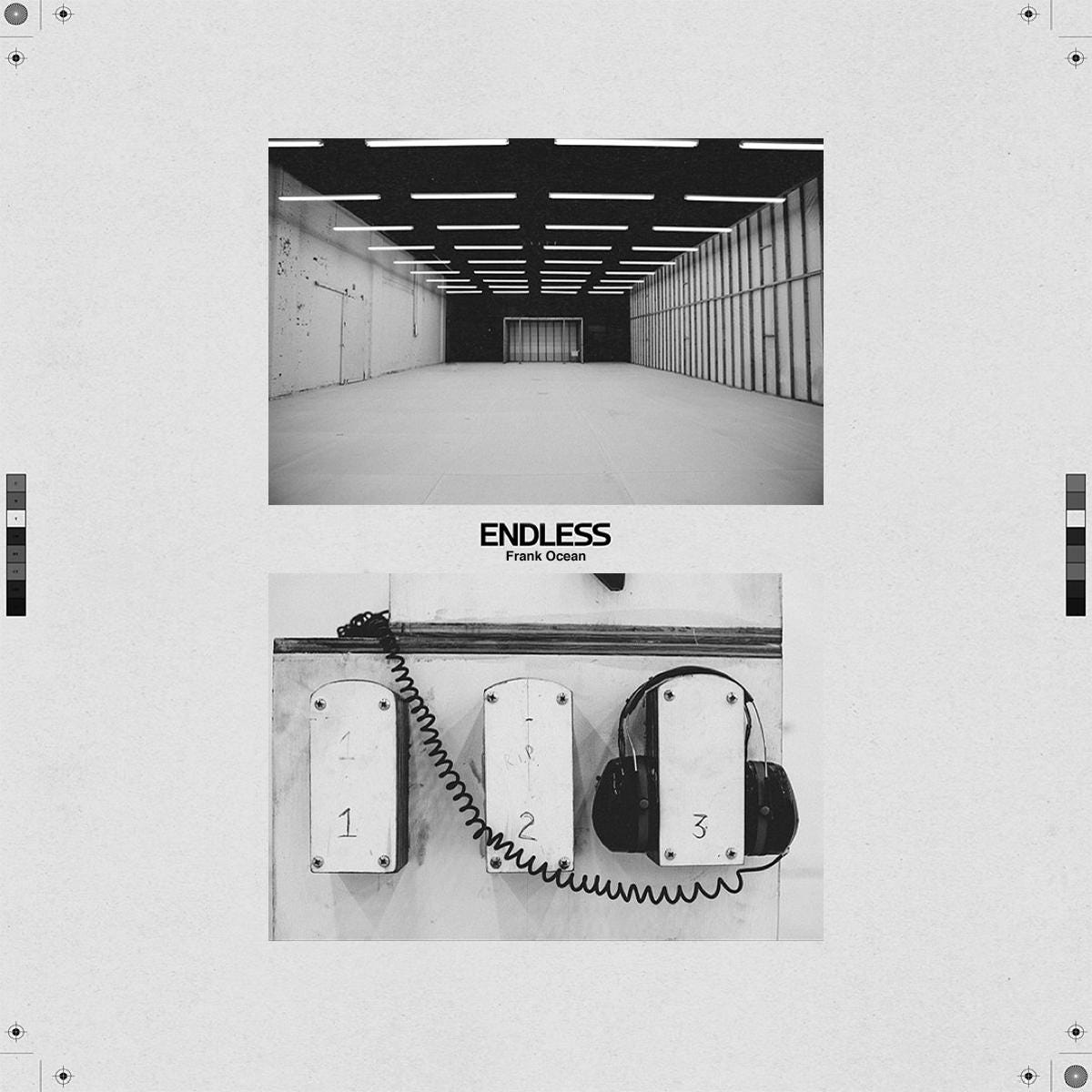
On August 1st, 2016, a live video appeared on the website boysdontcry.co. An empty warehouse. No announcement, no press, no explanation. Over the coming days, a figure appeared on screen, sometimes one, sometimes two, sometimes three, wearing a Jesus and Mary Chain t-shirt one day and a Playboy bunny sweater the next. Sawing wood and sanding planks and occasionally playing instrumental backing tracks that built and thickened in the background. The stream ran for 18 days. No one knew what it was—art, advertising, or a nervous breakdown.
It was Frank Ocean, who had not released an album for four years, had missed every self-imposed deadline since 2015, and had moved to London without saying why. On August 19, the stream concluded with Endless, a 45-minute visual album credited to Def Jam, a label he’d been trying to leave since 2010. In an interview with The New York Times’ Jon Caramanica, he described the work on Endless as “a seven-year chess game.” Having paid back the $2 million advance given by Def Jam from his own resources, he purchased back the rights to his previous music and presented Endless as his second album, fulfilling the terms of his deal. The next day, Blonde was released independently, with Ocean earning around 70% of the revenue generated and reportedly earning $20 million from exclusive deals with Apple. Universal Music Group’s chairman immediately responded by announcing a ban on all platform-exclusive releases by labels within his group. You don’t have to admire the cunning involved to appreciate what came out of it.
Within forty-eight hours of Endless’ release, it was almost forgotten. Blonde debuted at number 1 on the Billboard 200 album chart and quickly dominated all conversation about the artist. Pitchfork’s Ryan Dombal described the visuals as “painfully dull” while praising the music as “an interesting look into his creative process.” Spin described Endless as feeling “formless.” This general view of the album held true for about a year. I first returned to listen to it again when the 2017 re-release was issued on vinyl and CD/DVD cassette through Ocean’s Blonded store, and by then the album had changed. Copies of the limited-edition release can fetch high prices. Fans created guides to listen to all the tracks. And the songs initially thought to be warm-up tracks for Blonde reveal much more upon closer listening.
The strongest tracks from Endless are stronger than most on Blonde, but nobody knew this in 2016. They’re songs of love with all their significant details left out. Wither pictures a possible future with someone, with burnt-out trees and burnt fields, with two people dancing in a state of destruction. Alex G provides understated guitar work as Frank sings about wanting his children to see flowers bloom, and to “be able to see me, witness me wither.” The track name contains a wordplay between “Wither” and “with her” and doesn’t draw attention to its cleverness, which creates its emotional impact. He imagines himself growing old, asking to be seen before he’s gone. “Higgs” is over 6 minutes of disorientation in a new relationship: the title references the particle that was first proposed by theory in 1964 and discovered in 2012; “It’s all new to me/Having you around.” “What if we decide to live by choice?” And then starkly bare, “If acts of God break us apart/Least we did ours.” Big cheesy—but resolute. “Rushes,” the album’s longest track, deals with all meanings of the word: petrol money, blood pressure, and a rush of desire, and contains a snippet from Ms. Lauryn Hill’s “Just Like Water”—a constant refrain on every song, with Jazmine Sullivan and Alex G contributing to them all. Their consistent presence contributes to the best songs on Endless being the strongest material on the album as a collection, creating a sense of unity among its longer tracks beyond just individual highlights.
Less than a minute into “Comme des Garçons” and it’s already finished. A song that leans towards tropical rhythms, with a man who’s seeing someone on the side and surrounded by “perfect bitches” on his couch, “all this drillin’ has enraged the cops.” The song title plays on the fashion brand and the French term meaning “like boys,” touching on Ocean’s confusions about his desires and adulteries; he mentions them offhandedly, as if he were including some extra information in parentheses. “Alabama” creates a similar atmosphere but over 85 seconds, with layered vocals which evoke the sound of family members speaking over dinner, a dysfunctional household with a woman climbing out wearing cut-offs and a wife-beater, and extreme poverty, with Sampha providing a heartfelt coda (“What can I do to get to know you better?/What can I do to show you my love?”) although this sounds improper as a lyrical motif amid its dramatic storytelling of problems in a relationship. On “U-N-I-T-Y,” Ocean raps and delivers his strong bars. “My head fatiguing off the opus/Kept it underground to focus.” Outside of Federer and Djokovic, he puts “refugees in Margiela,” then play kids the Fugees, providing individual details that reveal more character information in a short amount of space than any of the longer music tracks managed to do.
Joe Thornalley, 23, from Kilburn, who performs under the name Vegyn, met Ocean at Plastic People, a basement rave venue in London’s East End that has since been closed down. (Plastic People helped to create an enormous amount of influential British music connections during the 2010s: James Blake has given out demos at the venue too.) Vegyn told the FADER about working on “Slide on Me.” “The song was one of his first projects working with Ocean, and he was worried sick. “I was just so fucking nervous. It was make or break, you know?” he recalls. He’d been creating boom bap beats for four years prior to working with Ocean, who flew him out to LA.
There is an air of the unfinished to some of Vegyn’s contributions, as on “Mitsubishi Sony,” “Rushes To,” and in “Higgs”; one gets the impression of an email draft you should not be privy to, words put down on the way to being sent. Alex G provides a counterpoint with his guitar work, a little messy and adrift but for the better. And where Ocean has left off, Jazmine Sullivan is there to put her voice to his on no fewer than five tracks. Jonny Greenwood of Radiohead has put together the string arrangements for “At Your Best (You Are Love)” with the London Contemporary Orchestra at Abbey Road; it is an oddity for a label the size of Endless. The album was put to tape in studios from Los Angeles to Berlin, London, and Miami, and the different sensibilities of artists who were likely in separate places with their objectives are evident in the coherence, or lack of it.
The visual album has Ocean at a table saw with some plywood as another version of him looks on and checks his phone; a third is at the broom. They do not so much as acknowledge one another. It is all high-contrast black and white from afar, with Ocean reduced to a silhouette in half the shots. Of the 45-minute film, Tom Sachs says to Pitchfork that it is but a continuous edit of a 140-hour uncut video he worked on with Ocean. In the course of it, Ocean puts up a spiral staircase and then is done with it. There is no door to the world, no other floor to go to. Which makes the title Endless something of a visual jest on hard work and infinity. Wolfgang Tillmans’ “Device Control” was part of the first live stream, a seven-minute affair with lyrics cued by the press releases (besides Apple) of Samsung and Sony. You will not find the satire on the CD/LP reissue, so most of the fan base will be without it. The staircase is still there, though.
Great (★★★★☆)