

Milestones: Exmilitary by Death Grips
Nobody asked for it, nobody paid for it, and nobody who heard it could stop talking about it. Sacramento’s free mixtape broke hip-hop’s brain.
Sacramento is the state capital of California, and nobody ever forgets that because Sacramento won’t let you. It’s a government town ringed by strip malls and tract housing, where gang shootings and legislative sessions happen on the same afternoon, a few miles apart. Zach Hill, a drummer known for the math-rock duo Hella, described it to NME like a medieval kingdom: the monarchy and the peasants, shoulder to shoulder. Andy Morin, who ran a small recording studio there, called it “very diverse but also very ‘California Conservative’”—the kind of place that regulates everything and fixes nothing. A woman had put her head on the train tracks a few days before Hill’s interview. He mentioned it the way someone might mention weather. In December 2010, Hill recruited his next-door neighbor Stefan Burnett, a visual artist and Hampton University dropout who’d been painting and working at a pizzeria since his old hip-hop group Fyre dissolved, and brought him to Morin’s studio. They recorded their first song the day they met. Four months later, Death Grips gave away Exmilitary on their website for free, and the internet started paying attention.
The tape opens with Charles Manson talking. Not singing, not ranting, just talking, in that slippery preacher cadence he used on the television cameras, about making money. Then a sample from Jane’s Addiction’s “Up the Beach” kicks in, and Burnett starts screaming (“I close my eyes and seize it/I clench my fists and beat it/I light my torch and burn it.”). He calls himself the beast he worships. He says to dismiss this life, worship death. In a 2012 Pitchfork video interview, Burnett said he takes more inspiration from his internal struggles than human achievements. On “Beware,” he sounds like he means both halves of that sentence equally, the internal struggles and the refusal to be impressed by anyone else alive.
Morin (who recorded and produced under the name Flatlander) and Hill pulled samples from five decades of outcaste music and piled them into one room. Link Wray’s 1958 instrumental “Rumble,” one of the first songs accused of promoting juvenile delinquency, runs under “Spread Eagle Cross the Block.” Black Flag’s “Rise Above” provides the backbone for “Klink.” Arthur Brown hollers, “I am the god of hellfire,” inside “Lord of the Game.” Bowie’s “The Supermen” bleeds through “Culture Shock.” Pink Floyd’s “Interstellar Overdrive” and “Astronomy Domine” get chopped into “I Want It I Need It.” A text-to-speech translator reads “5D.” A Half-Life 2 sound effect sits in “Thru the Walls.” None of this could’ve been cleared for a commercial release, and the band knew it. The mixtape format was the only container that could hold all this borrowed material without lawyers getting involved, and when they signed to Epic Records the following year, the approach mostly vanished. They later gave away all the instrumentals, stems, and acapellas as a separate free project called Black Google, which Morin described as a “portal to the deconstruction of Exmilitary.”
“Spread Eagle Cross the Block” is a song about appetite with no off switch. Burnett says he fucks the music, he makes it cum, he wants more, he’s getting more, it’s all his. The Wray sample is filthy and overdriven, and Burnett rides it like he’s daring it to throw him. “I Want It I Need It (Death Heated),” the longest track, stretches a house-party blackout into a genuinely disorienting six minutes of drugs, sex, losing the boundary between one body and another, one substance and the next. “Come come fuck apart in here,” he repeats. The wanting on these songs is compulsive and bottomless, closer to an immune response than a celebration. Burnett sounds like a man describing a condition where the difference between indulgence and self-destruction stopped mattering to him a long time ago.
Hill called the band’s philosophy “future primitivism” in a Pitchfork interview. That phrase fits “Takyon (Death Yon)” and “Guillotine” better than anything else on the tape. “Takyon” takes its name from a hypothetical faster-than-light particle, and Burnett raps like he’s trying to prove the concept: “Triple six, five, forked tongue/Subatomic penetration rapid fire through your skull.” He spits about drug rushes, blood, toxic waste, the words tumbling out so fast they lose their individual meaning and become percussion. “Guillotine” strips the approach even further, the word “guillotine” and the phrase “it goes” hammered over and over, heads rolling, syllables pounded flat until they turn into rhythm alone. Technology and regression fused at the molecular level, language shredded until it’s doing the work of a drum hit.
Two songs cut through the noise differently. On “Klink,” Burnett says he’s been to jail twice. He raps about police encounters, about the system chewing through people. The Black Flag sample under it is “Rise Above,” which started as a hardcore punk cry against conformity in 1981, and here supports a song about getting locked up in Sacramento thirty years later. On “Culture Shock,” over a Bowie sample (“So softly, a supergod dies”), Burnett riffs on people speaking in abbreviations because real conversation moves too slow, on being a drone to media, on free will getting taken without anyone noticing. “You need to vibrate higher.” It’s the plainest political statement on the record, and it has the weird clarity of a street preacher outside a courthouse—half-accurate, half-unhinged, and you walk away thinking about it three blocks later.
Something goes wrong at the end. There’s no transition from the track before “Blood Creepin’,” no shared mood, no connective tissue. Burnett howls wordlessly—“AHH WA OO WAH OOO WA”—over synthesizers that sound like they’re malfunctioning, and between those howls he describes being in a car, fleeing police, possibly dumping a body on the side of a highway. The lyrics are the hardest to parse on the whole record, and because of that, the most unsettling. You’re not sure if it’s fiction, confession, or psychosis, and the music won’t tell you. Exmilitary stops there.
Exmilitary had no label, no press cycle, no marketing budget. It spread from blog to blog while the band played to small Sacramento crowds. Burnett told Spin he was a very private person with no interest in sharing his life with the world, and then he put this thing on the internet for free. Within a year, Epic Records signed them. Within two years, they leaked No Love Deep Web against Epic’s wishes, got dropped, and continued releasing music without permission from anyone. The band originally had five members—Hill, Burnett, Morin, Mexican Girl, and Info Warrior—before reducing to the core trio. As of late 2025, Burnett and Hill announced they’re recording again; Morin’s involvement is unclear.
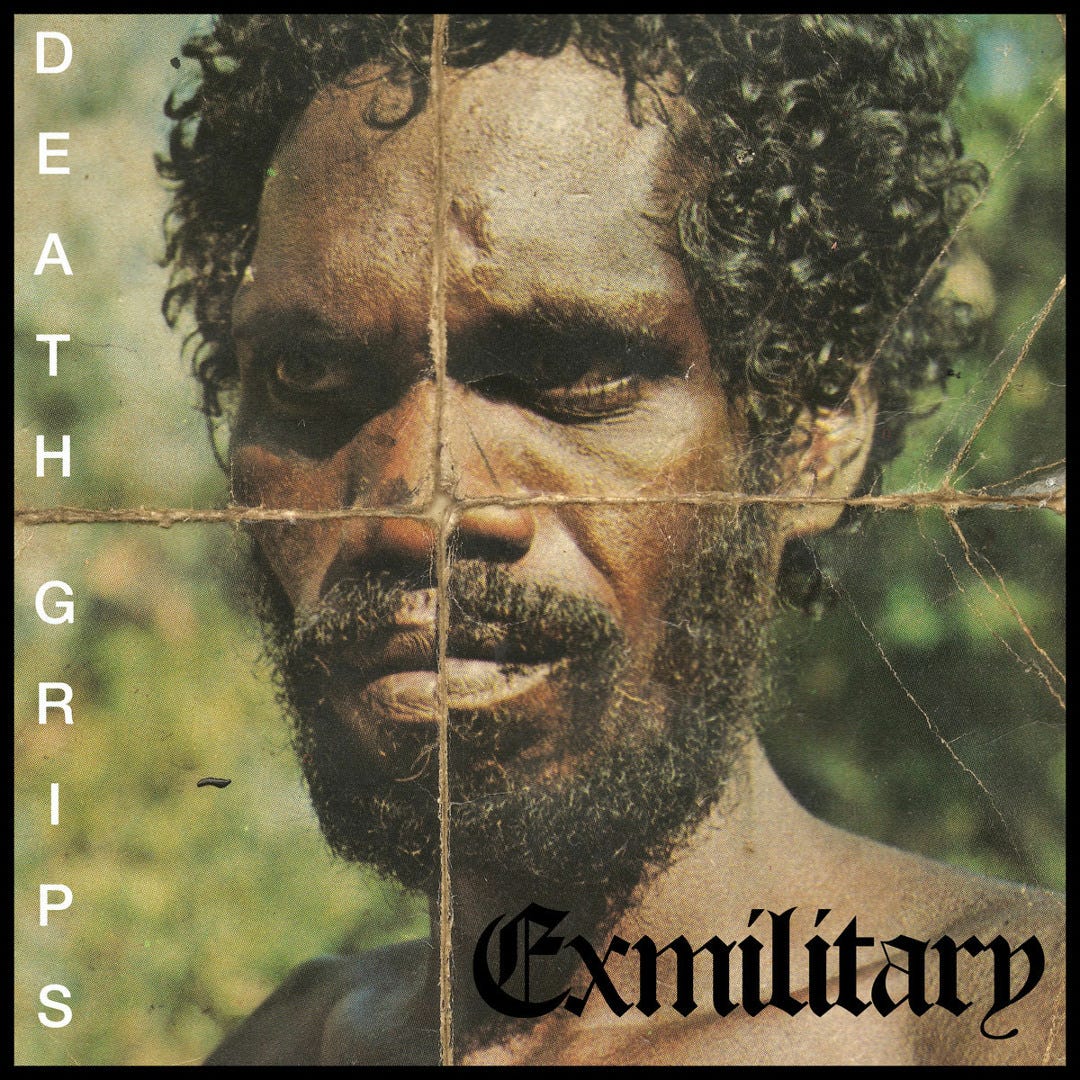
Morin pushed back on people calling them lo-fi in an NME interview. “We actually pack a lot of information into our songs,” he said. “When I hear lo-fi, I think of something that is a distorted copy of an original and for us, when you hear our songs it’s not distorted at all, it’s crystal clear. There’s just a lot going on in there.” He was right. Exmilitary is dense and precise, every sample placed with intent, every vocal stacked where it needs to be. The cover—a photograph of an Aboriginal man from Douglass Baglin and David Moore’s People of the Dreamtime—had been carried in a band member’s wallet for roughly ten years. They called it a “power object.” That kind of obsessive, private devotion to an image nobody else could explain runs through all of Exmilitary. Three guys in Sacramento, one of them a painter, one a drummer, one an engineer, recording songs the day they met and giving the finished thing to strangers on the internet, and the strangers wouldn’t stop passing it around.
Masterpiece (★★★★★)