

Milestones: Fishscale by Ghostface Killah
The Wu-Tang veteran’s fifth solo album trades kingpin fantasy for basement stress, a late-career monument to urgency and unresolved damage.
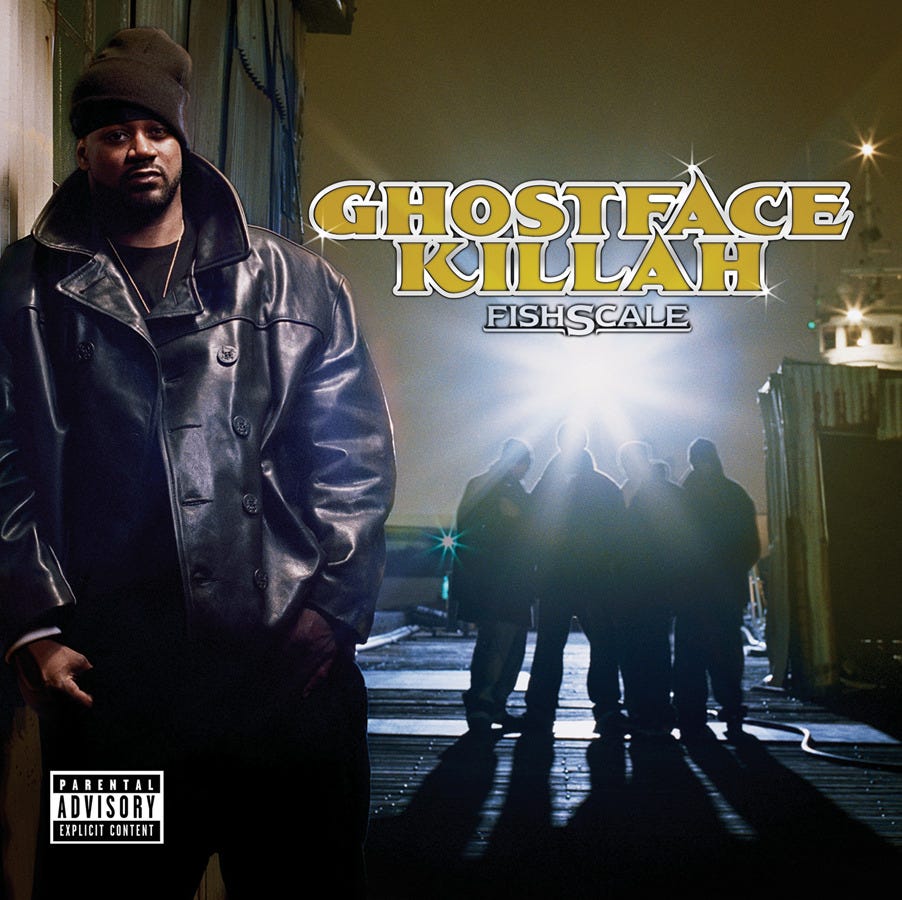
The solo Wu-Tang market had cooled considerably. Meth’s Tical 0 underperformed. Rae’s The Lex Diamond Story came and went. The group album Iron Flag sold on name recognition but left nobody hungry for more. Ghost had been the exception, dropping Supreme Clientele in 2000 to near-universal praise, following it with the Theodore Unit compilation and The Pretty Toney Album, both of which moved units without matching that peak. He was thirty-five, five solo albums deep, watching younger cats eat off flows he’d pioneered while the checks got smaller. Def Jam signed him hoping for a comeback. What they got was something stranger and harder to market: a record that sounds like a man with nothing to prove and everything to lose, rapping like the repo man is circling the block.
The production comes from everywhere. Lewis Parker opens with “Shakey Dog,” flipping Johnny Johnson & the Bandwagon’s “Love Is Blue” into a jittery loop that keeps threatening to resolve but never does, the drums hitting off-beat just enough to keep you anxious. Just Blaze delivers “The Champ” with boom-bap thunder and Smokin’ Joe Frazier samples. Pete Rock handles “Be Easy,” “R.A.G.U.,” and “Dogs of War,” flipping his signature filtered loops but dirtier than the Mecca and the Soul Brother era, more grit in the low end. J Dilla contributes “Beauty Jackson” and “Whip You With a Strap,” both pulled from the same Donuts sessions, built on that signature swing where the snare drags a half-step behind where you expect it. DOOM produces “9 Milli Bros,” “Jellyfish,” “Underwater,” and “Clipse of Doom,” pulling beats from his Special Herbs instrumental series. No single sonic identity holds the album together. Ghost’s voice does that work instead.
“Shakey Dog” runs under four minutes but packs more sensory detail than most rappers fit into entire albums. Ghost puts you in the passenger seat: “Ayo we had broke wilds spottin’ the grand wizard/My mind’s in a frenzy, son, the coke was gettin’ to me/Dude put me on the job, told me Ant live in the buildin’/He sellin’ crazy weight, his baby moms work for the Hilton.” The job sounds simple. Ghost and his crew roll up on a Dominican spot, masks on, everybody on the floor. But the details keep stacking wrong. The driver won’t stop sniffing. One of the crew is starving, stomach growling loud. The target has family photos on the wall, kids in school uniforms. By the time the shooting starts—“The big one, yo, he’s still alive/Reaching for his biscuit, plus the phone, yo son, give em five more”—Ghost catches a bullet and spends the last stretch bleeding out on linoleum, sirens getting closer, wondering if this is how it ends.
The drug material on Fishscale refuses the rise-and-fall structure that dominated coke rap since Scarface posters went up in dorm rooms. “Kilo” talks weight moved and money stacked, but Ghost keeps interrupting himself with costs: “My little cousin Clyde got himself three to nine/Exposed with the nine, caught him right on the turnpike line.” Kilos moving, family catching cases, the math never adding up to anything but more risk. “R.A.G.U.”—the title stands for Raw And Getting Undacut—drops you into a basement cook-up where the paranoia has physical symptoms: “Stomachaches, couldn’t stop shakin’/Fiends keep cakin’, jakes keep fakin’/Like they workin’ wit us, but they takin’.” No kingpin fantasy here. Just a grown man with intestinal distress trying to stretch a short count into next month’s rent.
Ghost yells about young men who won’t respect their mothers on “Whip You With a Strap,” threatening belt whippings and worse, sounding like a lecture until he slides into the kid’s perspective without warning: “I was bringin’ home the bacon at an early age/My moms ain’t pay attention so I turned the page.” The song doesn’t resolve into a clean position. Ghost is the disappointed OG and the kid who disappointed his own OG, the belt-wielder and the belt-catcher, and the beat—Pete Rock chopping a sample until it stutters like someone trying to get a word in—matches that confusion. “Big Girl” carries similar trouble. Ghost opens praising a thick woman at the club with genuine heat: “You fine, you got the whole package deal/Amazing grace, body laced, yo your face is real.” By verse two he’s suggesting she lose weight for her health, sounding like a concerned uncle at Thanksgiving dinner. The contradiction sits there unexamined because Ghost isn’t examining it. He’s just reporting both impulses as they arrive.
The album tilts sideways into stranger territory “Underwater” finds Ghost drifting through a half-dream populated by dead relatives: “Grandma’s in the kitchen, pots is clickin’/Fish is fryin’, she’s old, her hands like a lizard.” The imagery floats between warm and unsettling. His grandmother critiques his outfit. An old partner from the block walks past in burial clothes. Ghost sounds tired, genuinely tired, not performing exhaustion but living it.
The album’s biggest single paired Ghost with Ne-Yo on “Back Like That,” a breakup song that sounds odd on paper—R&B crossover crooning meets Staten Island stream-of-consciousness—but Ghost adjusts his flow to leave room for the melody, softening his delivery without losing the particulars: “I catch myself just starin’ at her picture on my Sidekick/Then it hits me, we ain’t got it no more, the vibe’s sick.” The Sidekick detail dates the song instantly, which somehow makes it feel more honest than a timeless abstraction would. Ghost loved this woman enough to carry her photo on a device that would be obsolete in three years. That’s the kind of specific detail that separates his writing from rappers who deal in generalities.
Tony Starks and Lex Diamonds ride together again on “Kilo” and “9 Milli Bros,” slipping back into the chemistry like no time passed since Cuban Linx. Although the latter track, is a Wu-Tang Cut cut with an archived ODB verse. Their verses on “Kilo” trade off without transition, finishing each other’s sentences about weight and risk: Rae talks distribution routes while Ghost handles the human cost, the two perspectives braiding together until you can’t separate business from damage. Trife da God, Ghost’s Theodore Unit lieutenant, shows up on “The Champ” with the kind of hungry verse that veterans either resent or respect. Ghost gives him room to work. The hook samples old fight footage, Smokin’ Joe Frazier getting introduced before a bout, and Ghost rides that energy into a verse that doesn’t coast on elder status: “I’m the jewel of the Nile, the style’s ancient/Twenty-four karat thoughts in the basement.”
What holds Fishscale together isn’t a concept or a unified sound. Ghost himself provides the continuity—his voice, his cadence, his refusal to let a bar pass without cramming in one more noun, one more brand name, one more physical sensation. “Barbecue ribs, fly pelicans, auto-mobiles/Exposed the rims, coach in the wind, hoes in the Benz.” Half the time you’re not sure what he’s talking about. The other half you’re seeing exactly what he saw, smelling what he smelled, watching the scene assemble itself from scraps of overheard conversation and peripheral vision. This is how memory actually stores trauma and pleasure: not in clean narratives but in sensory fragments that resurface without warning.
The record doesn’t offer lessons about the drug trade or fatherhood or relationships. Ghost drops you into rooms—the basement where the work bubbles, the club where the thick woman dances, the bodega where the robbery goes wrong, the kitchen where the grandmother fries fish—and lets you smell the stress and the cocoa butter and the fear. Whether any of it adds up to a statement depends on what you brought to the conversation. Twenty years from now, when the Sidekick reference needs a footnote and the sample sources are three generations removed, the specificity will still land. Ghost wrote down what he saw. He saw a lot. None of it looked simple from up close, and he didn’t pretend otherwise.
Standout (★★★★½)