

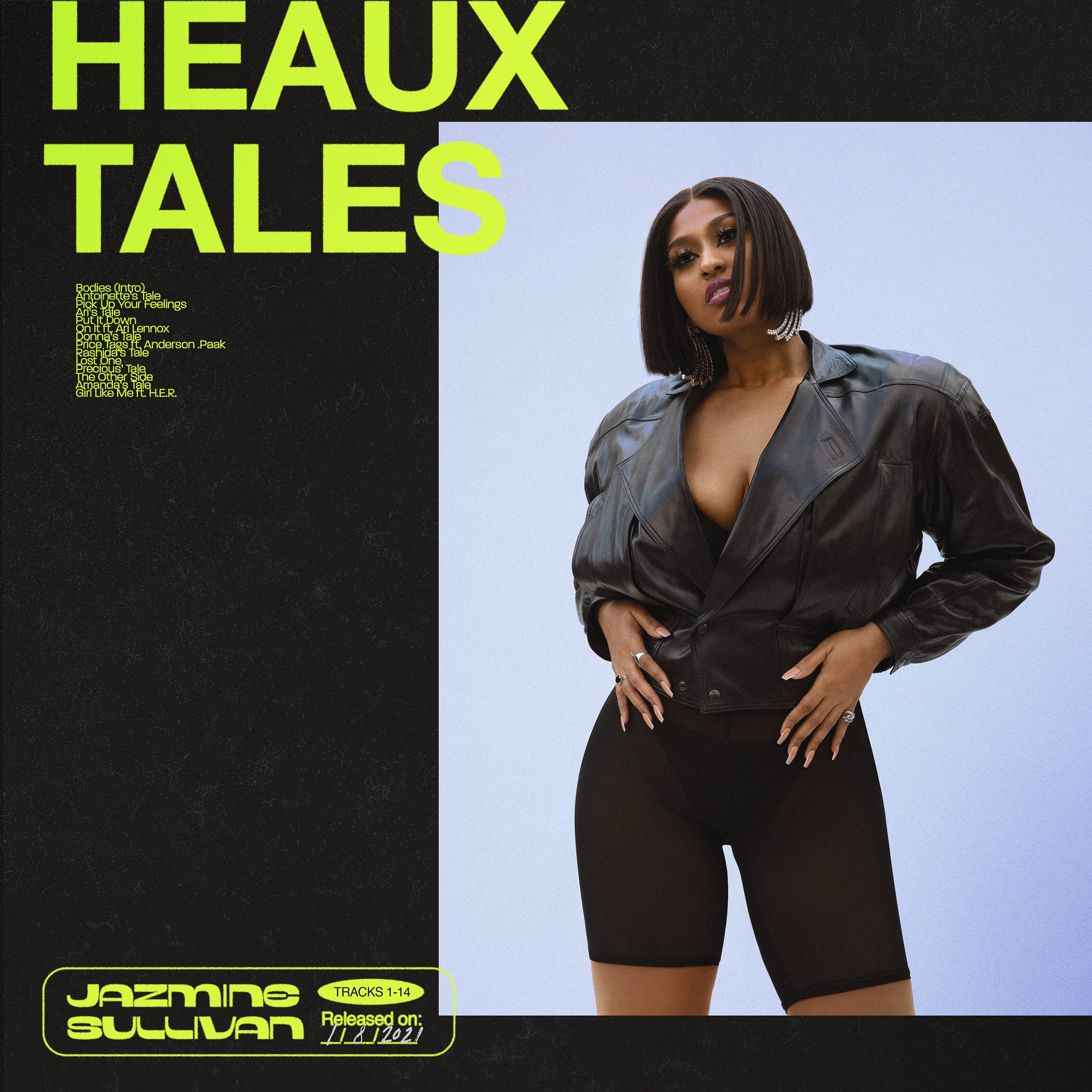
There was something Donna Anderson wanted to say. It was a small get-together at Pam Sullivan’s house in Philadelphia. The kind of night when wine makes people more open, and conversation turns to things women usually keep to themselves. Anderson, who is related to Jazmine Sullivan’s godmother, said everything. Her monologue about how intimacy is like a transaction, and how even married women, according to her, have their own ways of trading, was one of the most interesting parts of the album. Sullivan took a picture of the moment on her iPhone, not knowing that it would be the start of a project that would turn six years of silence into something that was needed, urgent, and brutally honest.
There were many recordings. Sullivan had been collecting these pieces since about 2019. At first, he thought of the project as a mixtape, but it grew into something more planned. At dinners and in private settings, she recorded voice memos and asked the women closest to her—best friends, family, and acquaintances—to tell their stories. The talks covered cheating, regret, desire, and the unique math that women use to figure out how much they are worth. Sullivan said they were “the meat” of the project. In interviews, she said she wanted to tell “the untold stories of women,” the ones that society says should stay private or, worse, make people feel ashamed. “We’re so very layered and multidimensional,” she told NPR in 2021. “They’re all not great stories but that’s what makes us who we are.”
Heaux Tales was the result. It was Sullivan’s first album in six years and the one that finally won her a Grammy after twelve nominations. The title takes back a term by making it sound French, turning an insult into something almost literary. Sullivan recorded about 98% of it in her Philadelphia home during the pandemic lockdown, even though she had been quarantining long before COVID-19 came along. She said, “I’m a homebody.” The material worked well in isolation. These were stories that were meant to sound like they were being overheard, like they were being told in a private confession instead of in front of an audience.
The architecture of Heaux Tales set it apart from Sullivan’s other work. Her first album, Fearless, came out in 2008 and showed that she was a singer with a wide range of emotions. Her second album, Love Me Back, came out in 2010 and built on that reputation. Her third album, Reality Show, came out in 2015 and showed her ability to write from points of view very different from her own life. But those albums were mostly just ways for Sullivan to show off her unique voice. Heaux Tales shared the story’s weight among a group of women, with each interlude giving way to someone else’s story. The six spoken-word parts serve as introductions to the songs that come next. They set up themes that Sullivan then explores through melody and lyrics. Antoinette’s Tale talks about how fragile the male ego is. Ari Lennox appears in Ari’s Tale, which tells the story of a woman who was so physically attracted to her partner that she was willing to risk her job. In “Donna’s Tale,” the line between acceptable and unacceptable desire is broken down. Every voice has a place in the cycle.
Sullivan had the interludes act as a kind of setup for the probing questions that the songs will ask, when putting the album together. Well-known album opener “Bodies” drops right in with no introduction, thrusting the listener into a bleary-eyed morning-after scenario, and it’s written from the perspective of a woman who’s disoriented and unable to figure out where she is or who she’s with, scolding herself in the second person. This is a very honest portrayal of a woman summing up her past choices and finding the total to be devastating. Coming hustling over off the heels of no lead-in, “Bodies” shows the controlled, almost clinical way that Sullivan had mastered on Reality Show, where she talked about learning to put the story first, not her own vocal range. Self-reproach in “Bodies” isn’t about being judged by others, but rather the internal monologue that lots of women can relate to. The crippling shame that we attach to female desire that goes beyond socially accepted limits.
The main theme of the album became how to deal with the grip of shame, and Sullivan explained that she wrote the album to address her own shame and resentment towards the decisions she made in her 20s that didn’t turn out well. However, she found out that just beating myself up over past mistakes wasn’t enough, and so she turned to the stories and experiences of other women to help her get through the process. She said in his 2022 Grammy acceptance speech, “What it ended up being was a safe space for Black women to tell their stories, for us to learn from each other, laugh with each other, and not be exploited at the same time.” Looking at Heaux Tales, you’ll notice its compact 32-minute runtime is really what makes it tick. Coming heading out of the gate with eight songs and six interludes, Sullivan avoids the bloated feel that’s all too common in streaming-friendly albums.
One of the fan-favorites, “Put It Down” follows Antoinette’s Tale and we get to see Sullivan playing the role of a woman who is completely satisfied with her love life, so much so that she doesn’t mind if her partner lives with his mother and borrows money from her. She knows exactly how it looks to her friends, and doesn’t care. When she lays down the truth, she does so without beating around the bush, drifting between being playful and bold. Coming from a male perspective, Anderson .Paak’s feature on “Price Tags” is basically the flip side of the coin. He’s the guy who bankrolls a woman’s goals until he finds out that the baby she’s talking about isn’t his. Neither song judges their characters, they’re just laying out the facts.
The production, handled by a team that includes Key Wane, Dev Hynes, DZL and Cardiak, boils down R&B to its simplest elements. Think sparsely decorated pianos, laid-back beats, and explosive string sections. There’s lots of space given over to Sullivan’s voice and to the interludes that make up the rest of the album, they don’t feel like interruptions anymore.
When Sullivan serenades “On It” with Ari Lennox, the song became one of her go-to tracks, admired by fans for its raw, unapologetic portrayal of mutual attraction—a departure from the typical R&B narrative that often places women as the recipient of male attention. The duet in which both artists articulate their desires with absolute clarity, then merge their vocal lines in shared intent is something, however, that does follow the pattern of Ari’s Tale, after Lennox bared her soul on Instagram Live, confessing to having been mesmerized by a former lover’s physical prowess, and nearly sabotaged her own music career in that pursuit. One of the singles, “Girl Like Me,” which has her teaming up with H.E.R. for the very first time on a record he’s released, cemented the bond between them, and was the first time he had ever recorded with another woman on her own song. The song digs into the difficulties of accepting oneself as being worthy of love. Something he’d been musing over ever since the days of Fearless.
Sullivan stepped away from the music scene after Love Me Back, after he’d weathered an abusive relationship that had made the stresses of his career unbearable. In 2015, she announced his return, saying “I had to go for a second” and Reality Show was born from that period of healing, however, still stayed within the confines of what was expected of her, songs written from fictional characters’ perspectives and the like. Heaux Tales put an end to that practice, by using real-life friends and family who, incidentally, are credited in the stories they share in the interludes, it made the tone more lighthearted and less isolating. It catapulted to the fourth spot on the Billboard 200 and finally won the Grammy that had been eluding her for fourteen years when she dropped her album.
Well-known for its success, the album was not driven by the critical or commercial reception but rather the countless stories and reactions of listeners, mostly from women, which are to this day cascading into Sullivan’s DMs. She is told, “I got a heaux tale for you, I got a whole book of heaux tales” in an interview with W magazine. The project gave its creators the power to be the first to speak up for others, who, for the same reason, started flooding in their own stories.
The EP’s breakout single, “Pick Up Your Feelings,” ingrained the essence of the project and was about a former partner who is unable to move forward and keeps coming back for attempts at reconciliation. Sullivan’s reply is not mean-spirited nor soothing, but rather, she stops dealing with his emotions and tells him to pick up his own, in effect redistributing a little bit of the emotional labor. A fitting outcome, “Pick Up Your Feelings” won Best R&B Performance at the Grammys, tied with Silk Sonic’s “Leave the Door Open.”
Sullivan considers the album’s reception to be like that of Ms. Lauryn Hill’s Miseducation, something she had grown up with. The structural and factual comparisons, in fact, contain a lot more significance. Both albums use speech interludes and take a completely honest look at the lives of Black women. Coming from a different background, however, Hill’s interludes feature anonymous high schoolers talking about love in the abstract, but Sullivan goes one step further by calling out the people who speak out and hooking their stories to real-life events. A year later, she released Heaux Tales, Mo’ Tales: The Deluxe, adding more songs and interludes, bringing new life into the project. “Jazzy’s Tale” gave Sullivan her own turn in the spotlight and set the tone as not being afraid of who she is and the things she has done, and giving herself a break.
“What I wanted to do was set the tone as far as just not being ashamed of what you’re going through, and giving yourself some grace.” — Jazmine Sullivan on Netflix’s Okay Now Listen Podcast
Grace means that it’s okay to be imperfect, to have made decisions that didn’t turn out as planned, to have been young and wild and still be deserving of love. The album doesn’t present this grace as something given by God, but as a kindness that women share with one another, in living rooms, over glasses of wine and through tears.
As it turned out, the timing of the album’s release was almost perfect. People were stuck at home, facing themselves, and yearning for genuine connections. Sullivan said she feels like people were at home and were really into what she was doing, and because everyone was locked down, they could give her album their undivided attention that they might not have otherwise. Heaux Tales rewards patience, tells you to sit with your discomfort, and knows that lots of tiny, honest moments will add up to something greater than any one song.
Coming from a very different experience, Sullivan’s mom, Pam, got diagnosed with inflammatory breast cancer during the time the album was being made (unfortunately, she passed on), and changed the way he sees life and time. When Laura Sullivan first took the stage in her homecoming show at the Philadelphia’s Met in March 18, 2022, she was a changed artist, someone who had spent years recovering from the industry pressures she once endured, only to now find joy from making music. Her reconnection with her songwriting spirit occurred through a new realization and relationship to her brand-new idea of life with the ladies in Heaux Tales.
The night of the show found her at the peak of her performance as she took to the stage for a crowd made up of roughly 70% Black women, all impeccably dressed, and singing every word of her songs. The night went back to the concept of the album, that of a women’s circle, a collection of women that see themselves and are not made to feel beautiful. Sullivan gave out major props to her hometown for basically raising her, and that love was reciprocated. Well-known as a trigger for people to tell their own stories, Heaux Tales gave Black women permission to be honest about themselves, to find solidarity in the understanding that they are all imperfect, and to cut out the need to please an audience that will never be satisfied.
One of the last legacies that Heaux Tales will be remembered for is the redefining of confession in R&B, where the genre traditionally focuses on first-person revelations, the artist laying out her own emotions. But Heaux Tales shows that when a story is told from the group perspective, it is more powerful. Laura’s voice is still at the heart of the story, but now shares space with others, and gives rise to a sense of less of a solo performance and a much more real and friendly chat that goes on after the show, when everyone starts sharing their stories. The statement made by Donna Anderson that every woman has lied in her own way, invites disagreement, laughter, memories and gets people talking, and the size of the framework is big enough to contain all of those thoughts, a foundation that won’t crumble under the weight of new stories still being told.
Great (★★★★☆)