

Milestones: I Want You by Marvin Gaye
Leon Ware built the body; Gaye dressed it in sweat and falsetto. I Want You is a slow-burning desire, a borrowed collection of songs that became the most physically honest record of his career.
Soul music was splitting in several directions at once. Disco was pulling dancers toward metronomic four-on-the-floor kicks; funk had gone slippery and strange in the hands of Parliament and the Ohio Players; singer-songwriters like Stevie Wonder were stretching the album format into symphonic autobiography. And the bedroom had gotten louder. Barry White’s orchestral come-ons had been filling arenas since 1973. The Isley Brothers had turned slow jams into humid, guitar-soaked marathons on records like The Heat Is On. Sexuality in Black popular music was no longer a matter of innuendo and church-trained restraint. Grown people were singing about grown things, and the audience was buying it by the millions. Into this climate, after three years away from the studio, Marvin Gaye put out a record that went further than most of his peers dared. I Want You doesn’t grandstand about how sexy it is. It just stays in the room, close, breathing on your neck.
The album almost didn’t belong to Gaye at all. Leon Ware, a Detroit-raised songwriter who’d already placed songs with Michael Jackson, Minnie Riperton, and the Miracles, had been assembling his own solo record for Motown, a collection of slow-grind songs he planned to call Musical Massage. When Berry Gordy heard the demos, he liked one song so much he wanted Gaye to cut it. Gaye listened and wanted the whole album. Ware told author David Ritz that Gaye said, “Leon, how about me and you working on my whole album?” Ware couldn’t believe it. “Nobody had ever really had a whole album on Marvin Gaye,” he recalled.
The two men holed up in Gaye’s newly opened personal studio on Sunset Boulevard, a spot some called the Studio 54 of the West Coast, where Ware played parts and Gaye would “Marvinize” them, stripping Ware’s vocals off the tracks and replacing them with stacked, multi-tracked versions of his own voice. They were recording the songs Ware had already finished, but filtering them through a new obsession. Gaye was deeply involved with Janis Hunter, a young woman he’d met during the Let’s Get It On sessions, and their relationship gave the borrowed material a desperate, specific charge. He sang many of these songs directly to her while she sat in the studio. “A lot of the lyrics he would sing directly to me, and I would get embarrassed,” Janis told Red Bull Music Academy in 2016. Gaye would reply: “Dear, please don’t be embarrassed. There is nothing to be ashamed of.”
That exchange tells you almost everything about what I Want You is actually saying. The title track opens with over a minute of instrumentation before Gaye enters, and when he does, he’s not commanding anyone but pleading. The song is about a man trying to convince a woman that he wants her to want him as much as he wants her. There’s an insecurity in that request that gets overlooked because the music moves so slowly and the strings swell so gracefully. “I want you,” he repeats, but the unspoken second half of the sentence is “to feel the same way.” Gaye recorded the vocal lying on the back of his sofa, according to Ware, who said he couldn’t see the singer at first and discovered him draped across the cushions, delivering the performance in a near-whisper. “Come Live With Me Angel,” the longest track, extends that plea into something more domestic. He’s not just asking for a night. He’s asking her to stay, to build something, to let him take care of her. The song stretches past six minutes without ever raising its voice, the Funk Brothers laying down a patient, swaying groove while strings and congas drift through the arrangement. Gaye’s overlapping harmonies hum underneath his lead vocal, a whole choir of himself arguing the same case from different angles.
Then the record gets blunt. “Feel All My Love Inside” drops the metaphors entirely. Gaye sings about physical lovemaking with a specificity that was startling for a major-label release in 1976. He describes the sounds his lover makes, the movements, the positions. He announces he wants her for his wife in the same breath that he narrates their bodies together. It’s tender and graphic simultaneously, and the fact that Janis was sitting in the studio while he recorded it gives the song a strange exhibitionist quality, like a love letter read aloud in front of witnesses. “Soon I’ll Be Loving You Again” pushes even further. The line about performing oral sex, slipped in among the gentle melody and feathered vocal runs, was the kind of detail that made critics uncomfortable.
The album’s one interruption from this sustained focus arrives with “I Wanna Be Where You Are,” a brief reworking of a Michael Jackson song that Ware and T-Boy Ross had originally written. Gaye sings it in barely more than a minute, and his voice carries a different kind of warmth. This version has been described as a message to his children, Nona, Frankie, and Marvin Jr., and the brevity is part of its sweetness. He ducks into the song like a father checking on sleeping kids before returning to the bedroom. It’s the only moment on the record where sex isn’t the subject, and its placement splits the album’s two halves.
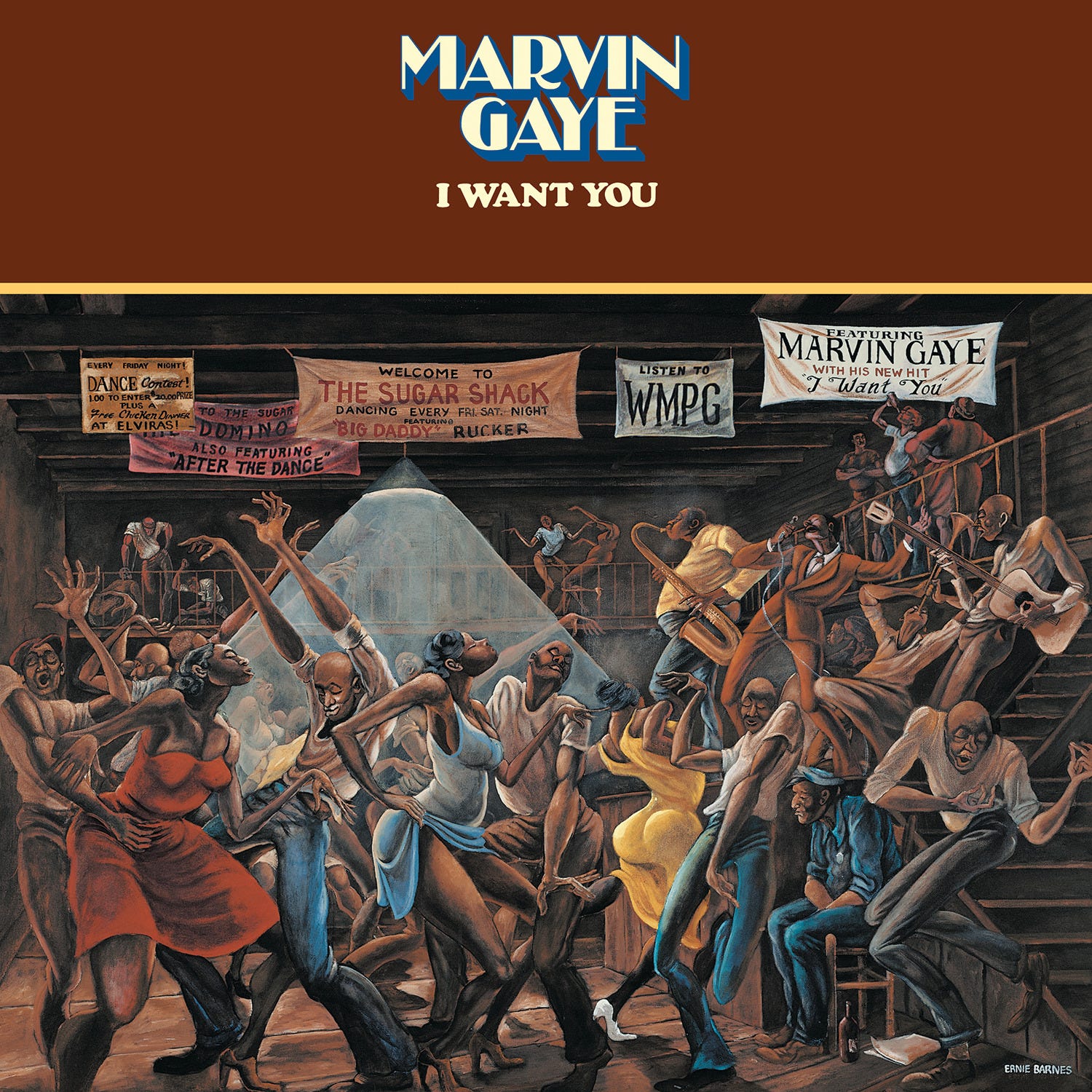
The cover art reinforces what the music is doing. Ernie Barnes’s painting The Sugar Shack, originally completed in 1971, shows a crowded dance hall full of Black bodies in motion, eyes closed, limbs extended, lost in rhythm. Barnes said the painting came from a childhood memory of watching a dance he wasn’t allowed to attend. “It was the first time my innocence met with the sins of dance,” he explained. Gaye owned the original and asked Barnes to modify a version for the album cover. The dancers on the cover don’t look at each other. Their eyes are shut. They’re turned inward, feeling the music through their bodies rather than watching it happen.
“After the Dance,” in its vocal version, closes the record with a proposition. Gaye and Ware wrote it about noticing a woman on Soul Train and trying to convince her to leave with him when the music stops. The song’s entire premise sits in that in-between moment, after the public performance of attraction and before whatever comes next. He doesn’t narrate what happens when they leave. He lets the question hang. That’s the last thing you hear on an album full of explicit confessions: a singer still asking, still unsure whether the answer will be yes. Graphic physical description and emotional uncertainty sit right next to each other through all forty minutes, the confidence of a grown man’s desire rubbing up against the nervousness of someone who can’t quite believe he’s allowed to have what he has. Leon Ware brought the songs. Janis sat in the room and gave Gaye a reason to mean them. And Gaye sang them in a voice that kept splitting into multiple versions of itself, as if one throat wasn’t enough to hold everything he was feeling.
Critics in 1976 didn’t know what to do with I Want You. Dennis Hunt of the Los Angeles Times called it disappointing. Vince Aletti of Rolling Stone wanted it to punch harder, to sound more like Let’s Get It On. But the record wasn’t trying to replicate that album’s sweaty, gospel-fired urgency. It was slower, more deliberate, more interested in the conversations that happen after midnight when nobody else is around. D’Angelo heard it and spent years chasing its mood on Voodoo. Maxwell built Urban Hang Suite in its shadow, and Ware himself co-produced tracks on that album. Mary J. Blige sampled the title track for “Be Happy.” The quiet storm radio format that dominated Black radio through the 1980s and 1990s took what Gaye and Ware had sketched out across these forty minutes and turned it into a programming formula. None of that legacy was visible in March 1976. What was visible was a man in a studio on Sunset Boulevard, lying on a couch, singing to a person across the room about what he wanted to do with her and to her and for her, while his co-writer laughed and the tape kept rolling.
Masterpiece (★★★★★)