

Milestones: In My Own Words by Ne-Yo
Before he made his mark as a solo artist, Ne-Yo arrived with credits already on the charts. His 2006 debut made invisible labor visible and built a career model around craft over flash.
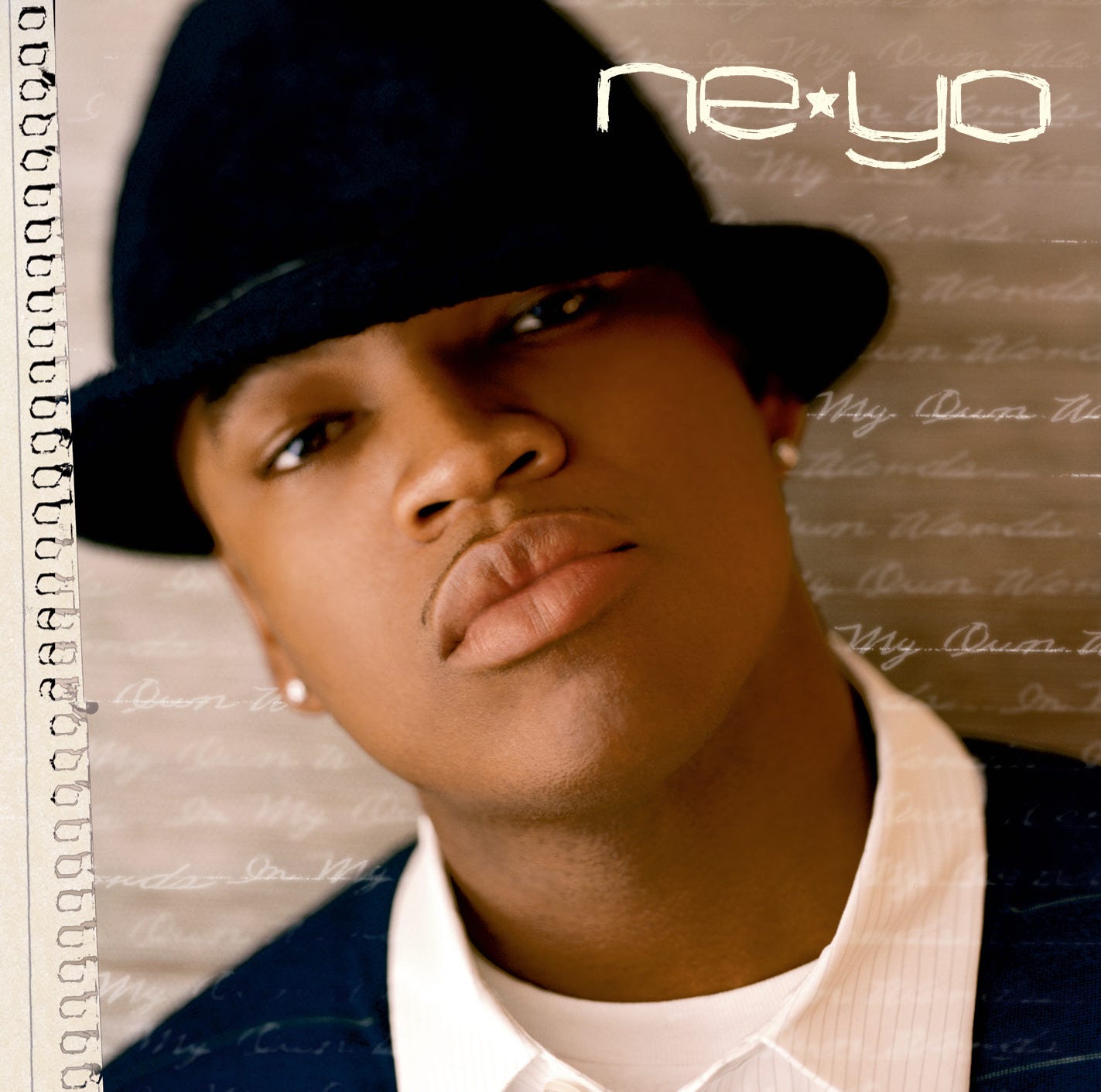
The title alone staked a claim. In My Own Words arrived from a singer most listeners had never seen but whose work they already knew by heart. Ne-Yo had ghosted through the upper reaches of the Billboard charts for two years before Def Jam put his face on an album cover, and the record made no effort to obscure the transaction. Here was someone who had shaped mainstream R&B from the shadows, written Mario’s nine-week number one “Let Me Love You,” seen his compositions recorded by other artists after Columbia shelved his first attempt at a solo career. The debut that finally materialized bore his songwriting credentials like armor.
The album’s visual language reinforced this framing with deliberate economy. Promotional materials featured lyric sheets, pencils, the tools of composition rather than the trappings of celebrity. Where other male R&B debuts of the mid-2000s leaned on physical display or lifestyle signifiers, In My Own Words presented its author in a fedora and vest, costumed less for a club appearance than for a Brill Building session. Def Jam had young men on its roster who could move, who could project sex appeal, who could sell charisma across a room. Ne-Yo offered something different, and the label gambled that the distinction would register. The marketing told a specific story about where value resided in a pop song, and the record itself had to make good on the premise.
What distinguished In My Own Words from its peers was an unusual organizational tightness for a debut carrying commercial expectations. The album ran ten songs without indulgence, each track arriving with purpose and departing without overstaying. Multiple producers contributed—Stargate, Shea Taylor, Curtis “Sauce” Wilson—yet the record maintained a coherent temperature, a consistency of emotional address that rarely wavered. This uniformity cut against prevailing wisdom. Major-label R&B releases of that period often sprawled across fifteen or eighteen tracks, hedging bets with genre detours and feature-heavy collaborations designed to capture different radio formats. Ne-Yo refused the hedge. The record included exactly two guest appearances, both from rappers rather than fellow vocalists, and their contributions occupied margins.
The restraint amounted to an argument. By limiting outside voices, In My Own Words insisted that a single perspective could sustain listener attention for an entire LP. The gamble paid off commercially—the album entered at number one on the Billboard 200—but its artistic logic mattered more than its chart position. Ne-Yo was betting that songwriting itself could function as sufficient theater, that craft and control could compensate for whatever his first record lacked in acrobatic vocal display or high-wattage collaborations. The bet proved durable. A model emerged here for how a writer-performer might build a recording career without depending on features or reinvention.
“So Sick” carried much of this weight. Released as the album’s second single in late 2005, the song reached number one the same week In My Own Words topped the album charts, a synchronized commercial breakthrough that confirmed Ne-Yo’s viability as a lead artist. Stargate’s production built from synthetic harps and a wobbly, almost seasick bass figure, the arrangement sparse enough to leave enormous space for the vocal. What Ne-Yo did with that space mattered. The song’s premise risked bathos—a man so wounded by heartbreak that even love songs on the radio become unbearable—but the performance sidestepped self-pity through understatement. Ne-Yo sang with deliberate measure, his tenor pulling back where another vocalist might have escalated. The bridge allowed some release, but even there the delivery stayed calibrated rather than cathartic.
Ne-Yo later told American Songwriter that the song originated from personal experience, written about a relationship he had damaged through inattention. He described the composition as arriving in three minutes flat, the speed indicating material that had been waiting for its form rather than something dashed off. The songwriting specificity helped. Where a lesser lyric might have leaned on abstraction, “So Sick” grounded its emotional claims in mundane particulars. The answering machine that still held her voice. The radio presets that kept delivering reminders. These details accumulated into something credible, a portrait of grief that felt observed rather than performed.
The song also refined techniques Ne-Yo had already deployed for other artists. “Let Me Love You” had confirmed his facility with romantic vulnerability pitched at a precise temperature—warm but not overwrought, pleading but not desperate. “So Sick” advanced the formula by turning the vulnerability inward. Rather than directing emotion at a beloved, the song directed it at the singer’s own fractured state. This inversion gave the track its particular sting. Ne-Yo sounded trapped not by circumstances but by his own inability to recover, and that self-awareness registered as both weakness and honesty.
Elsewhere on the set, the emotional narratives occasionally fractured. “Sexy Love” painted physical intimacy as transcendent communion, while “When You’re Mad” found erotic charge in conflict, the speaker aroused by a partner’s anger. “Mirror” lingered on sexual frankness with an explicitness the record otherwise avoided. These tonal shifts introduced contradictions that no unified persona could reconcile. A listener following the record as biography would find a protagonist whose relationship to desire kept changing shape, whose emotional posture varied from track to track without explanation.
The inconsistencies might have collapsed a more conventionally image-driven project. They did not collapse this one, precisely because In My Own Words never promised coherence at the level of character. The LP’s implicit contract prioritized song over singer. Each composition existed as its own discrete argument, required to satisfy its own internal logic rather than to advance a continuous narrative about the man delivering it. Ne-Yo performed as a writer serving individual songs, not as a star maintaining a consistent public identity. The approach had practical advantages. It allowed the set to satisfy multiple radio formats without seeming cynical, to pivot between emotional registers without whiplash.
His vocal instrument supported this flexibility. Ne-Yo possessed a light tenor with modest range and little interest in pyrotechnics. He rarely attempted the melismatic runs that characterized other male R&B vocalists of his generation, rarely pushed into falsetto for extended passages, rarely engineered climactic moments designed to showcase technical capability. His singing valued steadiness over surprise. Within that steadiness, small adjustments carried weight. A slight thinning of tone to suggest fragility. A rhythmic push against the beat to convey urgency. A controlled breathiness that made intimacy sound deliberate rather than accidental. These micro-variations allowed emotional contrast without requiring the grand gestures that flashier singers relied upon.
The discipline also served defensive purposes. Ne-Yo entered the market alongside Chris Brown and Trey Songz, younger artists whose debuts traded heavily on charisma and physical appeal. Competing on those terms would have been difficult. By positioning himself as a songwriter first, Ne-Yo sidestepped direct comparison. His value proposition rested elsewhere, on a claim that the songs themselves would outlast any particular fashion in male R&B presentation. The strategy demanded that the writing actually deliver, that the compositions justify the emphasis, and on In My Own Words they largely did.
Def Jam executives understood the strategy clearly enough to steer single choices around it. L.A. Reid initially pushed “Stay” as the album’s lead single despite doubts about its commercial ceiling, precisely because the song introduced Ne-Yo without overselling him. When “So Sick” exploded, Reid ordered Hype Williams to reshoot the video, unsatisfied with an initial cut that he felt undersold the track’s magnitude. The care suggested confidence in the material itself, a belief that the songwriting would reward investment.
What In My Own Words established was a lane, a viable career template for a writer-performer who lacked the obvious assets of his competitors. The album demonstrated that someone could enter the R&B marketplace without overwhelming vocal power, without a dancer’s physique, without the social-media-native charisma that would soon become prerequisite, and still command commercial attention through the accumulated evidence of craft. The model required specific conditions: a catalog of prior credits sufficient to cement credibility before the first record arrived, label support willing to market songwriting as a selling point rather than a background qualification, and an artist disciplined enough to accept that the songs mattered more than the singer.
Ne-Yo met those conditions. The record sold over a million copies domestically, earned a Grammy nomination, and positioned him for three consecutive number-one albums over the following three years. But the latter success matters less than what the album itself managed to prove in its moment. In My Own Words arrived during a period when male R&B still rewarded spectacle, still expected debuts to announce presence through flash and feature-stacking and vocal exhibition. Ne-Yo offered an alternative hypothesis. He walked into the frame already proven, already credentialed, and asked listeners to value the work over the worker.
On the closing track, “Time,” Stargate’s production built to the closest thing the record allowed to an anthem, a mid-tempo plea for patience in love that swelled toward its final minutes. Ne-Yo held the melody cleanly, resisting ornamentation even as the arrangement encouraged release. The song faded rather than resolved, the vocal sustaining its last note without pushing toward climax. The withholding felt earned. A career had just begun, and the man responsible was already comfortable leaving space unfilled.
Standout (★★★★½)