

Milestones: It Was Written by Nas
On his 1996 follow-up to Illmatic, Nas hands an entire song to a Desert Eagle, narrates a contract killing from the passenger seat, and opens the whole thing on a slave breaking his chains.
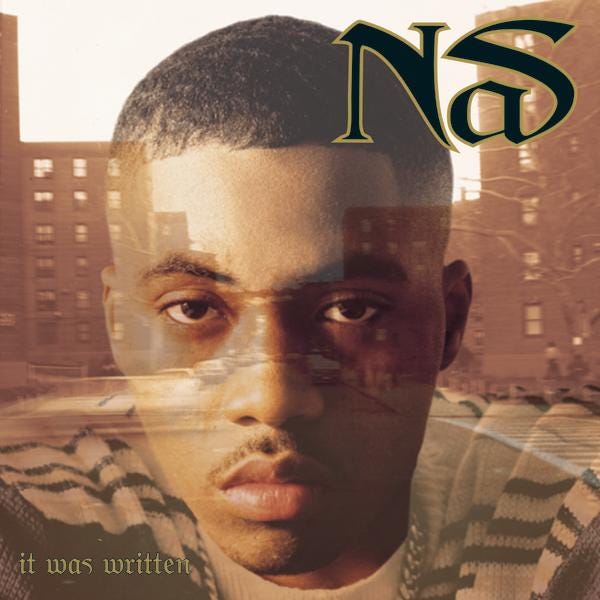
A young manager from Queens drove his beige Lexus through the Queensbridge Houses in 1995, cold-asking strangers where to find the kid who made Illmatic. Steve Stoute didn’t know the neighborhood, didn’t have an appointment, didn’t have a contract. Jungle, Nas’s brother, and his boys pulled guns on him. Stoute told Complex that Jungle eventually recognized his name and let him through, but the image sticks: a future music mogul waving his hands at gunpoint outside the same housing projects where Marley Marl built the Juice Crew a decade earlier.
The reason he was there was brusque. Illmatic had gone gold after almost two years, masterpiece numbers for critics but nobody’s idea of a commercial breakthrough. Stoute feared Nas would end up the way Kool G Rap did: revered by heads, invisible to everyone else. “G Rap could write his ass off,” he said on the Rap Radar Podcast. “He wasn’t a superstar. Nas was a superstar.” The plan was to prove it. Nas himself had wanted something different. He told Complex he’d gone to Marley Marl first, hoping to make “a street album” with the man who’d built Queensbridge’s musical identity. But Marley had moved an hour away, and there were days Nas couldn’t be bothered to make the trip. Songs sat half-finished. Some leaked onto radio. Discouraged, he scrapped the whole thing and started over with Stoute’s handpicked team.
Trackmasters, the production duo of Poke and Tone, had a reputation for crossover shine: Mary J. Blige’s “Be Happy,” Biggie’s “Juicy.” The underground recoiled. Q-Tip, who had produced “One Love” on Illmatic, told Stoute he was “killing [Nas’s] career.” Stretch Armstrong and Bobbito had reservations too. All of this happened before anyone heard a single bar. But the panic missed something. Trackmasters came up through Kool G Rap, Big Daddy Kane, LL Cool J. Poke remembered the early friction and compared it to “trying to put a square peg in a round hole.” Tone recalled it differently: “Nas didn’t really know that we come from the underground.”
So the Escobar persona arrived. Nasty Nas rebranded, at Stoute’s suggestion, into a mafioso alter ego timed perfectly for mid-‘90s New York. Raekwon had Only Built 4 Cuban Linx… the year before. AZ had Doe or Die. JAŸ-Z was about to drop Reasonable Doubt. Mob-boss fantasies were the dominant dialect, and Nas entered speaking it louder than anyone: Cuban link chains, Sergio Tacchini, a Mercedes wagon, a pager full of messages from people who might kill him. On “The Message,” he scopes enemies over a Sting sample while Kid Capri scratches underneath, and the famous line (“There’s one life, one love, so there can only be one king”) was aimed, he later confirmed in King magazine, at Biggie. “Watch Dem Niggas” is paranoia turned daily routine: checking your rearview, checking your pager, checking if the woman next to you is someone else’s plan. “Take It In Blood” has him watching Kathie Lee and Regis in a Lexus while his associates sniff coke and pop wheelies on Kawasaki motorcycles.
DJ Premier said he’d been on tour with Gang Starr and was heading straight to Japan, no time for more than one beat. Nas told him he wanted to rap as a gun. Premier’s instinct was counterintuitive: “Instead of making this hard, mean shit, let me make it sound sad.” The result, “I Gave You Power,” is the best thing on the album. Nas opens with a false start, almost breaking the premise before committing—“Look how muthafuckers use a nigga/Just use me for whatever the fuck they want/I don’t get to say shit”—and then the gun speaks. Hidden under car seats, sneaked into clubs, meeting a rusted TEC with a scraped-off serial number. It has taken children’s lives. In the final verse, the gun decides to jam in its owner’s hand, a tiny act of rebellion, and he never breaks character.
Stoute said he came back to the studio after leaving Nas and Premier alone, heard the finished song, and stole the only cassette tape to drive around listening to it. Nas called Premier: “Where the fuck is my tape?” Stoute drove back to Queens to return it. Tupac heard the song too. It inspired him to write “Me and My Girlfriend,” flipping the first-person idea from a weapon to a woman.
AZ references Corleone and Capone on “Affirmative Action,” which has the energy of a heist being planned in a restaurant where everybody’s armed. Cormega’s verse describes finding a rival decapitated. Foxy Brown talks about the crew’s money with the precision of an accountant keeping score. Nas closes out washing cash through laundromats and playing for stakes at gunpoint, the whole thing riding a string-heavy Trackmasters beat that somebody, somewhere, correctly described as straight out of Goodfellas. This was The Firm’s debut—all four of them, AZ and Cormega and Foxy Brown and Nas—and the chemistry is competitive and reckless. Everyone is trying to outwrite everyone else. Cormega’s presence makes it stranger in hindsight. Stoute would later push him out of the group, and the beef between Cormega and Nas festered for almost a decade. On this song, though, they’re passing the mic as if nothing could go wrong.
Some of it goes wrong elsewhere. “Black Girl Lost” has Nas giving advice to a young woman losing her way, having sex too young, getting exploited by older men, and JoJo Hailey of Jodeci singing underneath. In 1996, the paternalism probably read as concern. Now it reads as a man lecturing a woman about her own existence when she didn’t ask. The Dr. Dre collaboration, “Nas Is Coming,” was supposed to be a coastal bridge during the peak of the East-West feud. Dre had publicly called Nas his favorite rapper. But Stoute acknowledged that rushing to get Dre was the biggest mistake they made. The beat is clumsy and loud, and Nas raps over it trying to fill a room that’s already too crowded. It sounds bad coming from both coasts simultaneously. That’s about right for the album’s lowest moment.
While it may not get radio play, “Suspect” reams drug deals and paranoia over an L.E.S. beat that flips Chuck Mangione, every line adding a new face, a new threat, a new reason to glance over your shoulder. “Shootouts” goes further: a neighborhood plans to kill a trigger-happy cop who’s been terrorizing them, and Nas describes the gunplay with the compressed detail of a crime novelist who grew up in the crime. “Dangerous lives, mad leak and battered wives/a lifestyle where bad streets is patternized.”
Ms. Lauryn Hill was 21, two years away from The Miseducation, when she sang on “If I Ruled the World (Imagine That),” and her singing carries something the rest of the album doesn’t allow. Nas imagines opening every cell in Attica and sending the inmates to Africa. He imagines a world without police brutality, without poverty, without the daily math of staying alive in Queensbridge. It’s the only moment on the album where the fantasy isn’t about money or violence but about collective liberation, and it became the biggest song Nas ever had.
Nipsey Hussle, five days before he was killed, texted Stoute asking about how they made It Was Written. He said the song was “the only voice other than Pac that spoke to us as young kids from the street on that level.” He was 11 or 12 when he first heard it, growing up in Los Angeles, on some “West Coast only” shit. The album debuted at number one, stayed there for four weeks, beat Alanis Morissette on the charts, and went double platinum in less than three months. It remains Nas’s best-selling album. JAŸ-Z would later use it against him on “Takeover,” mocking the Escobar persona and claiming Nas had “one hot album every ten year average.” That line shadowed It Was Written for years, defining it as the start of a decline instead of what it actually was.
Lupe Fiasco has said he tried to recreate the album’s moods on Food & Liquor. Royce da 5’9” and ScHoolboy Q have both said they prefer it to Illmatic. And Stoute, on Drink Champs, remembered the backlash with pride and spite in equal measure: “Anybody who came up to me, ‘Y’all fucking Nas up,’ it was every artist who didn’t want that good-looking, rapping nigga to be a superstar. They wanted him to be the under guy who never made it. Fuck all of you guys, we getting all of the money.”
Standout (★★★★½)
 | A guest post by
|
Admittedly, while Illmatic is probably the better album, I too tend to think I prefer It Was Written to his classic debut.