

Milestones: Just As I Am by Bill Withers
A factory worker’s debut that sings about crooked preachers, absent fathers, and a man killing himself—and got played on The Tonight Show anyway.
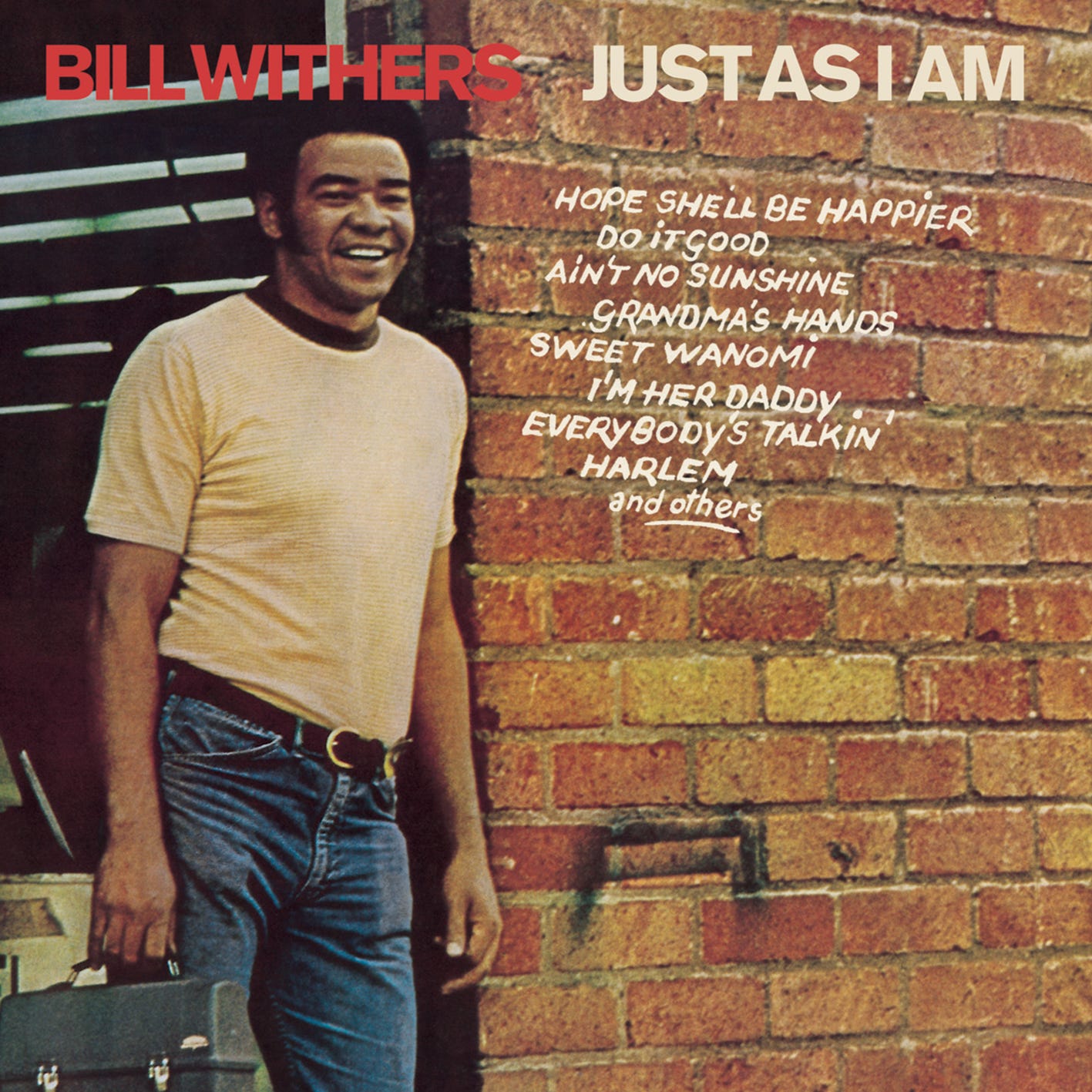
The album cover is a photograph of a guy leaning against a brick wall at his job, lunchbox in one hand, pack of cigarettes poking out of his jeans. Looks like he just clocked out, because he did. The factory was Weber Aircraft in Los Angeles, where Bill Withers installed lavatories in 747s for $3.50 an hour. When Sussex Records released Just As I Am, he was 32, a full decade past the age when most soul singers had already burned through a first contract, and the jacket note he wrote for it didn’t promise anything. He thanked his label and his producer “for allowing me to present myself to whoever is kind enough to listen.” That’s not modesty packaged for marketing. Withers had spent nine years in the Navy, worked assembly lines at Douglas Aircraft, IBM, and Ford, bought a guitar at a pawnshop after seeing Lou Rawls play a club, and paid for his own demo tapes out of pocket on a wage that barely covered rent. None of it was a pose. He genuinely didn’t know if anyone would care.
Clarence Avant at Sussex heard the demos and assigned Booker T. Jones to produce. Jones had just left Stax and was living out in Malibu. For the band, he pulled Donald “Duck” Dunn and Al Jackson Jr. from the MGs, added session drummer Jim Keltner, Flying Burrito Brothers bassist Chris Ethridge, Motown percussionist Bobbye Hall Porter, and Stephen Stills on guitar—Stills was filling the spot Steve Cropper would’ve normally had. Withers drove to the studio straight from the factory. Jones told Rolling Stone in 2015 that Withers showed up in old work boots and a beat-up car with a notebook full of songs, then pulled him aside and asked, “Booker, who is going to sing these songs?” The answer was him, and he hadn’t figured that out yet. Four sessions were planned; funding problems cut it to three, spread across six months. The musicians heard each song once and played it. Jones arranged everything (strings, keys, guitar) and kept the whole operation short and clean, out of Withers’ way.
Half the songs on Just As I Am clock in under three minutes, and none of them waste a second pretending to be bigger than they are. “I’m Her Daddy” is about a father who just found out he has a six-year-old daughter nobody told him about. He asks whether she’s pretty, whether she sleeps in a room of her own, whether she shows the babysitter his picture and says “That’s my daddy.” Then his voice catches: “You should’ve told me, Lucy.” Withers doesn’t milk it—just reports what a person learning this news would actually ask, in the order they’d ask it. “Hope She’ll Be Happier” does the same thing with a breakup except there’s no bitterness at all. He doesn’t blame her, doesn’t beg. Just concedes the lateness of the hour is making him seem sadder than he really is and hopes she does better with the other person. You believe him, too, which is the strange part. “Sweet Wanomi” and “Moanin’ and Groanin’” are both about wanting somebody, but one whispers about satin pillows and a woman covering her mouth when she yawns, and the other just comes out and says what the first one was polite enough to dance around.
Radio made the album’s biggest hit by accident. Sussex released “Harlem” as the A-side single; “Ain’t No Sunshine” was the B-side. DJs flipped it. Two minutes and four seconds long, the song barely has a second verse. Withers repeats “I know” 26 times where lyrics were supposed to go—he’d planned to write an actual passage and never got around to it. When he offered to fix it, the session players, people with decades of professional recording behind them, told the factory worker to leave it alone. So he did. Twenty-six repetitions of “I know,” and it says more than a finished verse would’ve. “Grandma’s Hands” runs just as short, and every second of it counts: her hands clapping in church, handing out candy, reaching for him when his mama couldn’t settle him down. Withers grew up in Beckley, West Virginia, raised by his mother’s family after his parents split when he was three. His grandmother was his whole world, and he doesn’t say that anywhere in the song. He just tells you what her hands did, and you get it.
Jones and Withers tucked two covers into the middle of the album. “Everybody’s Talkin’,” Fred Neil’s 1966 track made famous by Harry Nilsson in Midnight Cowboy, gets rebuilt under Jones’ arrangement as a chest-out soul strut about ignoring other people’s noise, and it barely resembles the original. “Let It Be” goes even further. Jones brings in the organ and a gospel-style tambourine and turns the whole thing into a Sunday service, Withers singing McCartney’s words like they came out of a Pentecostal hymnal. Both are cuts by white writers, and Withers and Jones just took them and made them theirs, no apology, no winking about it. After Just As I Am, Withers never covered anybody again. He told a New York Times interviewer in 1972 that too many Black artists got conned into recording standards by white songwriters who collected the publishing while the singers went hungry, and every song on Still Bill was his own.
You can hear how wide this album swings just by comparing the first track to the last. “Harlem” sketches seasonal life on a block. Summer nights too hot to sleep and too broke to eat, a radiator that won’t heat in winter because the landlord doesn’t bother, Saturday night parties and Sunday morning churchgoers crossing paths with heathens stumbling home. Then Withers turns to the crooked delegation shaking donations out of the congregation to send the preacher somewhere holy, and he warns them not to give that lying crook their money. “Better Off Dead” puts you inside an alcoholic’s last afternoon. He drank away his family’s savings, pawned their belongings, drove his wife to tears and eventually out the door. The priest came, and there was crying and praying and promises to quit, but none of it stuck. She’s gone with the kids. “I must die by my own hand,” he sings, “’cause I’m not man enough to live alone.” A gunshot ends the track. A debut on a small independent label, by someone nobody had heard of, and the last sound is a trigger pull.
Only one track on the album sounds like its singer is having fun. On “Do It Good,” Withers is grinning. If you wanna kiss a funky beagle, hitch a ride on an eagle, read a catalog from Spiegel—go on and do it, just do it good. Part spoken-word, part party starter. Fish was made for hooking, grits for cooking, eyes for looking. Halfway through, he drops the act and talks directly to whoever’s listening, referencing the album cover, introducing himself as a first-timer who’s never done this before. That nervousness is real. He wasn’t playing a character. He was just some person at a microphone, half giddy and half scared, talking to people he couldn’t see.
In October 1971, Withers received two letters on the same day. One was from Weber Aircraft, offering his mechanic’s job back at $3.50 an hour. The other was from Johnny Carson, inviting him to sing “Ain’t No Sunshine” on The Tonight Show. The single reached No. 3 on the Hot 100 and won the Grammy for Best R&B Song. Withers took firmer control after that—self-produced Still Bill, wrote “Lean on Me,” scored three million-sellers before a legal fight killed his Sussex deal and Columbia spent years trying to sand down his edges. He walked away from music entirely in 1985, at 47. Spent the last 35 years of his life out of the public eye in Los Angeles. When Stevie Wonder inducted him into the Rock and Roll Hall of Fame in 2015, Withers called it “an award of attrition” and said he didn’t think he’d done bad for a kid from Slab Fork, West Virginia. He died on March 30, 2020, at 81.
Masterpiece (★★★★★)