

Milestones: Keith Sweat by Keith Sweat
Four million copies of unchanged Keith Sweat, arriving when everyone counted him out. The begging worked better than the reinvention.
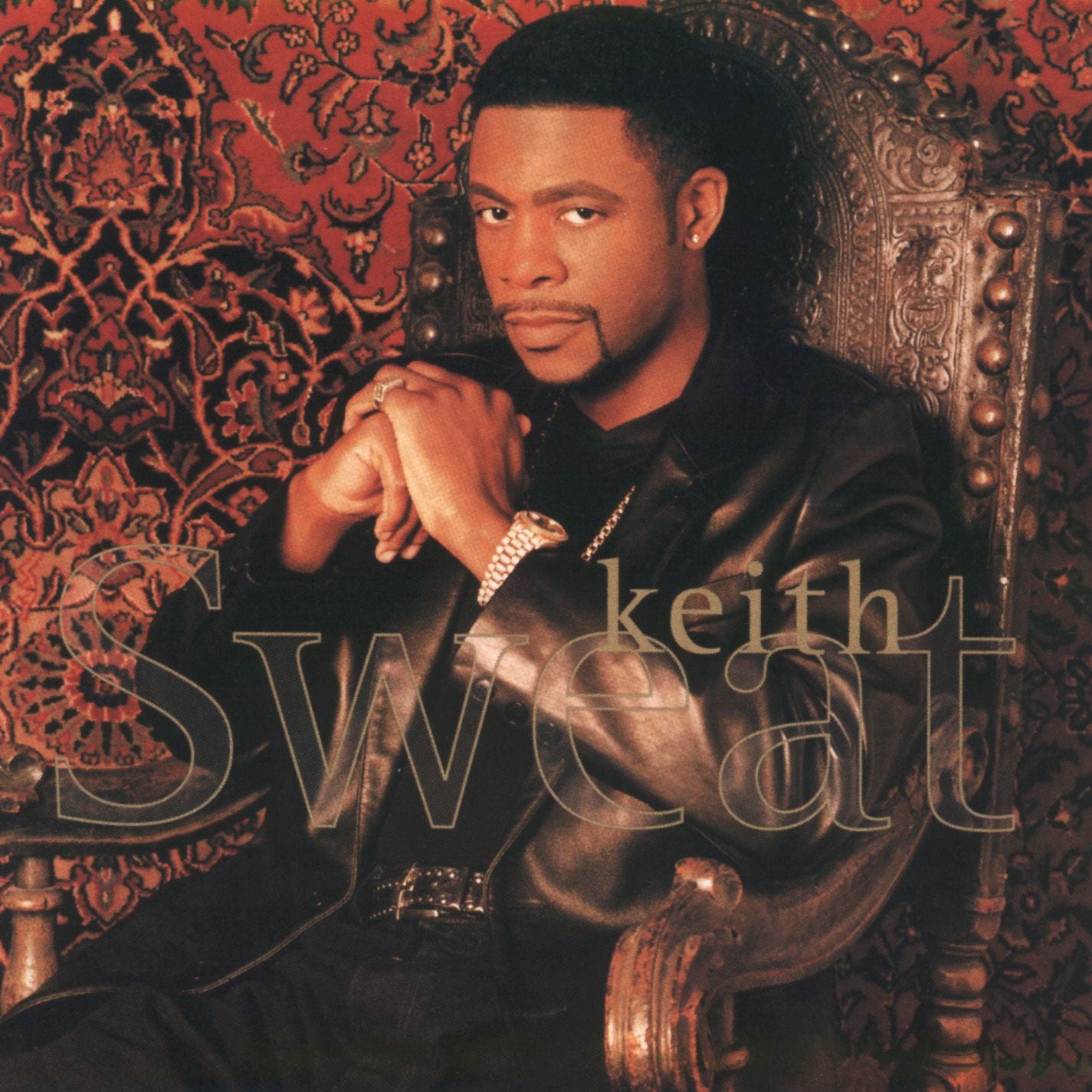
Keith Sweat spent countless nights stocking shelves at Macy’s, sorting mail at Paine Webber, and eventually made it as high as a floor broker on the NYSE, had four platinum-selling albums under his belt—all of which hit number one on the R&B charts. None of these had earned him a foothold in the pop world. Keith had spent most of his nine years in the game doing what had been predictably labeled here: singing through his nose, pleading with women to stay, doing this over fast and slow drum programs, and sticking with his sound post-“I Want Her” in 1987. Years later, his self-titled hit the top of the R&B charts, went quadruple platinum, and churned out two top-five pop singles. It was his best-selling album, topping 4 million in sales. His time of acquired irrelevancy became, in fact, his apogee.
Written and co-produced by Eric McCaine, a remix of “Twisted” by the Flavahood Sexual utilizes a Marvin Gaye “Sexual Healing” sample and was #1 on the Top 40/Rhythm-Crossover for 14 weeks. Longer than all but one chart hit recorded by TLC, “No Scrubs.” Singing the hook were Kut Klose, the Atlanta girl group, Sweat, signed by McCaine to his Keia Records a few years prior. The message is straight-up: the woman has you dazed; can’t focus; and, plenty, isn’t trying to fake one out: “You got me twisted over you.” The call-and-response has Sweat in the Tony M. vocal seat across from Kut Klose, and the stroke of genius is unfathomable. The album version of the track doesn’t incorporate the Soul screaming; the remix does, and the radio was ok to get it all. The track hit #2 on the Hot 100, behind the Fugees.
Gerald Levert, Aaron Hall, and Buddy Banks gather on the song “Funky Dope Loving” to sing about what the brothers are giving you with the song they are performing—it’s competition, fraternal. Levert has his mother, Marion (who sang with the O’Jays), and his father, Eddie Levert, so the O’Jays are in his DNA. Hall has been the lead vocalist in Guy, around which Teddy Riley built a New Jack Swing sound, prior to Sweat. These are not newer groups latching onto a sound to boost their careers. And Ronald Isley, what else to say about that man? At the point in your career that Isley ends “Come with Me” by singing directly ahead of you, he is your sponsor, not your mentor. They were appropriating a label: from the Isley Brothers through Guy through the O’Jays’ offspring to him, no one on the guest list shared a problem with the statement.
Jokes about his voice have been around for years, and you know what? Whoever said what they are all saying today really wasn’t wrong. That nasal whine, sucking for air and thin. Up in the upper—the one not quite at the top of his head but also not at the bottom of his mouth—the pitch between mother’s boy and someone who just rolled out of bed—this is what is remembered, this is what is joked about. But it communicates something his more sure-footed peers can’t: a failure to follow through. Arruh Nasty, in 1996, sang as if he already knew he would get a yes. Jodeci didn’t even bother to ask. Sweat sounds ready to be rejected, as if he might just get turned down, and that space between conviction and vulnerability is why it all feels convincing, not vacant. Each song is a plea. “Whatever You Want” completely gives in: everything she says, he will do. “In the Mood” states his yearning as fact, not theory, and not abstractly, but now. Even “Freak With Me,” the most obvious sex-kick in the pack, doesn’t sound like a demand. More like a suggestion he’s wishing she’ll accept. That whine expresses a particular type of desire, the kind that recognizes the possibility she might say no.
Athena Cage—also from Kut Klose sings the women’s perspective of “Nobody.” It charted at number three on the Hot 100; maybe the one time Sweat’s work is as close to perfection as he ever got in the pop market. Basically, Sweat’s positioning himself as ‘the’ one is downright cheeky, and Cage’s contribution is the receipt—the sharing of the wink—her presence here is the ‘ha ha, gotcha’ that makes this a duet rather than a monologue. Next up is “Chocolate Girl”—there was a lot of other mail over this song at the time, but this was the one that mattered in a way you could miss. Sweat’s talking about a dark-skinned woman, specifically her shade, explicitly stating his preferences in a public forum. In 1996, when R&B’s look definitely fell toward lighter skin, saying “chocolate girl” in a love song and using it as a positive? Not just a flirtation, but a choice most people simply refused to make.
Emotionally, it’s narrow. and its pretense to be anything else is specious. Want. Offer. Persuade. Take. No heartbreak. No anger. No politics. No “growth” arc through twelve tracks. Two interludes are meaningless. Some of the mid-album [“Yumi,” “Just a Touch”] filler (it sort of performs its function and then leaves) has little in the way of lingering aftereffects, but that’s not a shortcoming if the songs are not wide and the songs are wide and “lacks” isn’t their failing. The King of Smooth, who used to help line up at a Wall Street brokerage firm, who dreamed in his Harlem apartment when he was a kid that people were already paying money to see him do and woke up looking in those pockets for dollar signs, is the dude who sold four million copies of an album that does one thing.
Solid (★★★½☆)