

Milestones: Maggot Brain by Funkadelic
George Clinton built a psychedelic funk band so volatile it couldn’t survive its own best work.
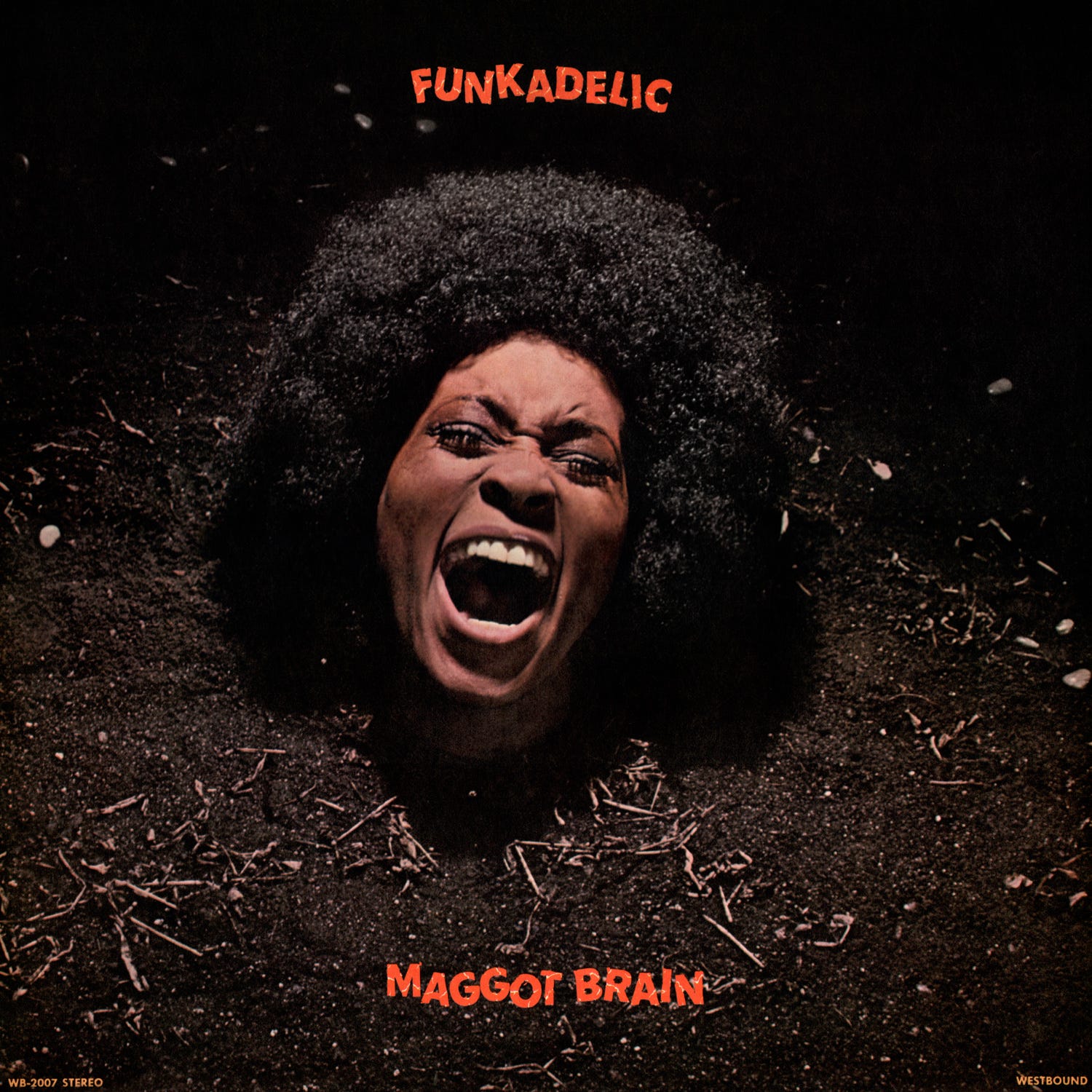
Joel Brodsky’s cover photograph is a Black woman, model Barbara Cheeseborough, screaming, her head shoved up through cracked earth, the rest of her body buried. The liner notes inside were written by the Process Church of the Final Judgement, a quasi-Satanic cult that gained extra notoriety through alleged (and probably false) ties to Charles Manson. Author Rickey Vincent wrote the combination gave the group behind this album the image of “a death-worshipping Black rock band.” Flip the sleeve, and you find seven song titles. No band photo, no legible credits. Just the screaming woman and the cult’s polemic on fear, and then whatever is on the vinyl.
Funkadelic was more manageable. George Clinton had been leading a doo-wop outfit dubbed the Parliaments since the late 1950s, featuring coordinated outfits, barbershop harmonies, and a contract with Revilot Records. When a legal dispute with Revilot rendered the Parliaments’ name inoperable, Clinton simply began recording under a different name with the same group of players he’d always had. Eddie Hazel on guitar, Tawl Ross on guitar, Billy Nelson on bass, Tiki Fulwood on drums, Bernie Worrell on keys. They signed to Westbound Records in 1968 and released two LPs in 1970 alone, the second of which was basically all of the Hendrix and all of the Sly and all of the MC5 and all of the Cream and all of the Vanilla Fudge run through the saw-toothed funk of a Detroit rhythm section. Maggot Brain, their third, was produced by Clinton.
Eddie Hazel was born in 1950 in the Bronx. His mother, Grace Cook, hustled the family to Plainfield in order to keep him from New York City’s bad influence. One Christmas, his brother gave him a guitar, and after he got his ears on a Hendrix record, according to Billy Nelson, “he found his calling.” Twenty or twenty-one years old when Maggot Brain was recorded, Hazel was one of the band’s old men. The older men in the group were Clinton and Bernie Worrell; the others were barely legal.
The title track begins with a voiceover by Clinton. For the third time, Mother Earth is pregnant; humanity has knocked her up; he has tasted the maggots in the mind of the universe; he was not offended; he knew he had to rise above or sink in his crap. The monologue ends, and the rest is filled with Hazel’s guitar. The Echoplex elongated everything into long, bending trails and added fuzz and wah effects. The performance transitions from well-executed control to something that intentionally sounds unhinged. Notes being held for so long they are about to break, fast runs that trip and recover, stretches where Hazel allows a single note to hang and die. Greg Tate dubbed it Funkadelic’s A Love Supreme, an extravagant description until you sit through all 10 minutes and realize you weren’t breathing after around four.
And then everything turns. Strumming and tuning acoustic guitar while singing gospel harmonies. The deep bass voice of Raymond Davis, who repeats “I want to know” while Pat Lewis, Dianne Lewis and Rose Williams of Hot Buttered Soul sing behind Hazel, whose electric has been traded for an acoustic. The song “Can You Get to That” equates love to a financial transaction. You get what you put out, you have to pay your debts, you cannot pay on credit and expect love to come back stamped “insufficient funds”: Clinton’s told of Martin Luther King Jr.’s “I Have a Dream” speech. Following a hammering guitar solo that is possibly the most punishing of 1971, Funkadelic, the band, sing together the way they used to, with the Parliaments’ backing band harmonising over an acoustic strum, gospel runs and all.
On the organ, Bernie Worrell tears through the song “Hit It and Quit It,” adding in some Keith Emerson-style prog flourishes that nobody in funk was playing back then. Worrell was allowed to take the lead on a song all about sex, complete with harmonized “da-da-da-do’s,” and he approached it as if the keyboard part were competing with the vocal. Billy Nelson takes the mic on “You and Your Folks, Me and My Folks.” The lyric turns into a tongue-twister. If I and my people love you and your people, and you and your people love me and my people. Yet the most straightforward political statement on the album lurks behind the tangled phrasing. The wealthy acquired a large share of this and that. The impoverished received discarded food infested with insects and rodents. Everyone desires peace. Children require peace. Peace will not be there. People do not trust one another because they are afraid, and hatred keeps growing. The same fear named in those Process Church liner notes shows up here as the specific reason nothing gets better.
Hazel composed a song titled “Super Stupid,” which essentially talks about himself and how he tried to collect cocaine one night and ended up getting sold heroin instead—that is, a nickel bag of skag passed off as coke. The song says it clearly. The Super Stupid received a one-and-one, his eyes started watering, his nose started running, he lost the fight, and the winner is fear. Hazel takes center stage with his strong vocals and aggressive guitar, delivering a driving speed-metal riff that would later be used by Audioslave in a performance. The organs in Worrell’s “Super Stupid” avoid turning it into a straight-up metal track. Still, it is Hazel who is pushing the whole thing towards desperation. Hazel’s playing about his own worst night and trying to outrun it.
LP finished in nine minutes. A voice complains about how he has to go to work and asks the other to keep the kid from crying. Disruption caused due to chants. The protesters chant “When do we want freedom? Now!” and then they start breaking things down. It is rephrased as “More pussy to the power,” then “More power to the pussy,” then “More peter to the eater.” Sirens. Newborns screaming. A clock which sounds like cuckoo. Noisy guitar riffs, fart sounds, animal sounds, and drum fills (that will not stop). Miles Davis listened to “Wars of Armageddon”, was so impressed by Fulwood that he stole the drummer from Clinton for a stretch. The final dialogue you hear in Maggot Brain is: “It’s a fat funky person.” Maggot Brain opens with a ten-minute funeral and ends with a nine-minute collapse of noise. The group can still find laughter over sex jokes and sing in harmony, even when the world feels like it is falling apart.
That band dissolved in the months after Maggot Brain was done. Fulwood’s drug use led to his firing. After having what was described as an acid-eating contest and then a raw speed, Tawl Ross had a bad trip and never performed again as part of the group. Nelson resigned due to a financial disagreement with Clinton. Worrell, Clinton, and Hazel were the only ones left. Collins and his brother Catfish, who joined from James Brown’s band, were brought in to fill holes, and the collective split up into two parallel units. Funkadelic on Westbound for heavy guitar stuff. Parliament’s Casablanca offers the funk sounds featuring horn and harmonized vocals too, more mainstream. The team which followed those seven songs at United Sound Systems ceased to exist within a year of them being made.
In 1974, Hazel was co-writing Standing on the Verge of Getting It On and playing lead on Parliament’s Up for the Down Stroke, which was pretty central to what Clinton was building. That year, he was arrested for drug possession and for assaulting a stewardess and a U.S. air marshal. There was one more album, Games, Dames, & Guitar Thangs, and pretty much that was it. He passed away in 1992 at age forty-two due to internal bleeding resulting from liver failure before most people who would go on to carry his playing forward were even old enough to pick up a guitar. According to OutKast’s André 3000, Maggot Brain blew his mind and encouraged him to learn. According to Dean Ween, the title-track solo from Hazel is the one he steals from the most. He paid tribute to them with “A Tear for Eddie” on Ween’s Chocolate and Cheese. “Before the Beginning” is another response recorded by John Frusciante on The Empyrean. Childish Gambino stated Awaken, My Love! that Funkadelic served as the direct influence for the work, whose cover alludes to the Cheeseborough photograph. The screaming lady from the dirt, years later, on another album of someone who red never met Eddie Hazel.
Masterpiece (★★★★★)