

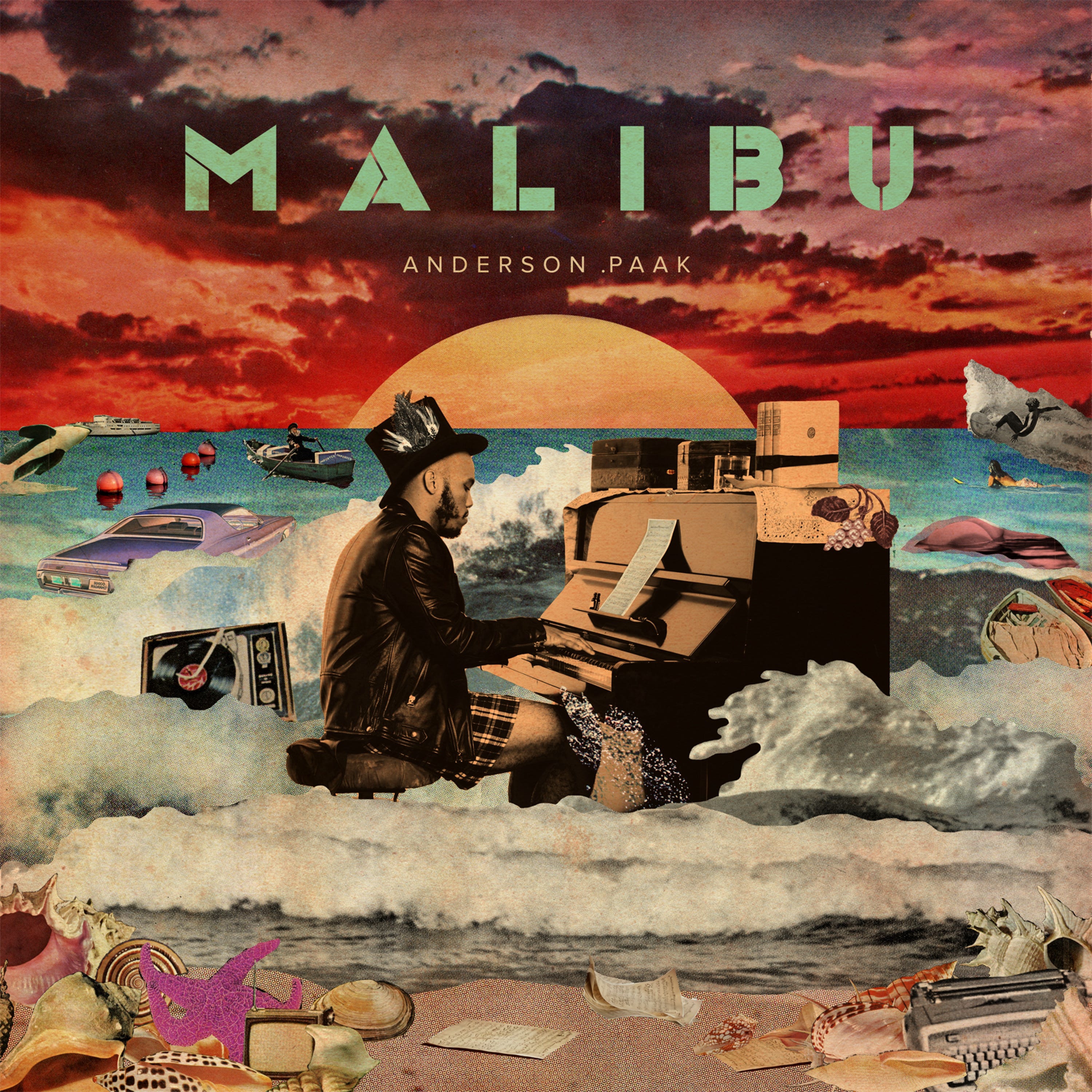
Milestones: Malibu by Anderson .Paak
On his breakthrough second album, Anderson .Paak doesn't just sing about survival—he makes you hear exactly what it costs after years of homelessness, family collapse, and relentless.
When a Georgia-born Baptist pastor’s son, who’s also a gospel singer, married Brenda Paak Bills in 1994, he brought the rich musical heritage of his upbringing to a household still reeling from the emotional aftermath of a domestic violence episode that had, fourteen years prior, sent his wife’s first husband, Ronald Anderson, away for a decade.
Brandon, who was seven at the time, still can’t shake the memory of his father on top of his mother, or the sight of blood in the street. In a move to heal the psychological wounds, Dennis picked up his drums, took a chance on Brandon, and brought him a practice pad that started him on a musical journey and went all the way up to a complete set, with him watching by his side as he discovered his hands and found his talent. He became the house drummer for the Evangelistic Missionary Baptist Church in Port Hueneme, California, by twelve. That church gave him, basically, the structure, language, and faith to set himself up for the rest of his life, but it didn’t amount to much else.
When the marriage ended, Brenda had to put herself back together, becoming a strawberry broker, and buying fifty-two acres of land with Dennis, cutting out the middlemen, living the high life in a mansion with fancy cars and rubbing shoulders with the elite Black people in Ventura County. Well-known El Niño storms wiped out two back-to-back strawberry harvests sending them bankrupt, and Brenda got caught up in professional gambling in Vegas, was really good at it, but got convicted of securities fraud, not reporting his earnings and siphoning off investor money to cover his own debts, and got sentenced to seven and a half years of a fourteen year prison term.
When Brandon found out about his mum’s arrest in class when he was seventeen, he completely fell apart. Coming home from school one day, he found out that his house had been foreclosed on and that his older sister Camille was basically bailing him out. Well-known as a kid who grew up on strawberry money and Sunday services, Brandon was now living in a world where neither of those things were guaranteed.
Malibu captures all of this perfectly. When listening to Anderson .Paak’s album, we’re immediately caught up in “The Bird,” a song that effectively blends the spirit of surf movies, floating above a throbbing bass and guitar background, and which sings about his family history and the emotional aftermath that it has left. Well-known for his rough background, Paak’s voice feels the emotional weight of this.
“When I look at my tree, I see leaves missing, generations of harsh living, and addiction.” — Anderson .Paak on “The Bird”
Coming from a renowned producer, Paak doesn’t allow his past to suck the life out of the music. Working with a dream team that includes 9th Wonder, Madlib, KAYTRANADA, Hi-Tek, DJ Khalil, Chris Dave, and his own band, the Free Nationals, his producers send the beat flying with pulsing, live basslines, piano fills, scorching brass, and staccato rhythms that perfectly lock into the rhythm.
Paak deftly dances on top of the mix, shifting between singing and rapping within the same sentence; his fluid phrasing makes it impossible to pin him down, and yet keeps him on track. It’s as if he knew he wanted the vocals to be the flexible element and the drums and bass steady, as he had told Gaffa magazine that year. With only his second album, Malibu was quite a departure from his 2014 debut, Venice, which was mainly produced by Lo Def in a super electronic and autotune-heavy style, and was still finding its sound. Paak had a strong need for something a lot more consistent in his voice this time around.
The fact that Paak titles his albums after the places he’s lived, Venice, Malibu, Oxnard, and Ventura, on his later ones, shows that he’s coming to terms with his art. The album is comprised of lots of songs that he had kept back since the beginning of his career, including “The Bird,” “Celebrate,” “Put Me Thru,” and “Parking Lot,” and includes the now well-known song “Suede,” which he made with Knxwledge as the duo NxWorries, and catapulted him to instant online fame. When Dr. Dre heard an unknown track he didn’t know was made by Anderson Paak, an A&R at Aftermath Entertainment went after him, booking a recording session where Paak would have to prove the voice on the record was really his.
Well-known for his fearlessness, Paak shut his eyes and killed the performance, and when he opened them, Dre gave him his stamp of approval, saying, “Oh, you’ve got the pain, you lit.” Paak features on six tracks of Dre’s 2015 album Compton, and absolutely knocked out the biggest crowd he’d ever performed for, but understood that a seal of approval isn’t necessarily about the music itself, but the circumstances surrounding it. Born out of the mentality that he doesn’t need anyone in the studio to sound like himself, Malibu was born.
Paak met 9th Wonder and Rapsody on the road through North Carolina and left with a beat and a feature that turned into “Without You,” and laid down ten tracks with KAYTRANADA, and split the profits right down the middle. Coming back fast to his hometown, Oxnard, was like sending a present to himself. Paak hadn’t met Madlib in person before, but when Dre asked him to mix one of their tracks, Madlib even sent over the stems, something he hardly does, and Paak considers that his best collaboration to date. The Free Nationals, his bandmates since the Venice days, dropped in with four tracks and stitched the different elements of the album together.
Paak’s rhythm section, bassist Kelsey Gonzalez, keyboardist Ron Avant, guitarist José Rios, and drummer Callum Connor, is a band that’s spent years covering tunes at weddings and watering holes, but has started getting recognition for their own music. They had a complete understanding of how he delivers his words, how much space he wants, and where he likes the beat to lift off. Well-known for his unpredictable approach to rhythm, nothing else on the album is as off-beat as the rhythm section on ScHoolboy Q’s “Am I Wrong” over Pomo’s infectious beat. As Anderson .Paak wrote “The Season / Carry Me,” he was baring his soul. Coming home from a long day’s work, he found himself sleeping on the floor with a brand-new baby, his wife lying beside him, and no money coming in.
Well-known as one of the artists who rode the wave of the game when Drake and J. Cole dropped their albums, right back when Kendrick Lamar didn’t yet dominate the scene, Paak was literally sleeping on the floor with a baby in tow, fighting to get his finances back on track, so his wife wouldn’t look at him disbelievingly. It was 2011 that things took a turn for the worse. Paak had a job at a marijuana farm in Santa Barbara, supporting his wife Jae Lin and their infant son Soul, and working on his first album. He got fired, didn’t have the money for the recording costs, and suddenly found himself without a place to call home. They ended up couch-surfing, staying with friends, and desperately trying to land any gig they could find. Shafiq Husayn from the group Sa-Ra sent him a lifeline, and that’s basically all that kept him going.
Paak landed a job that made him a jack-of-all-trades, assistant, videographer, editor, writer, and producer all in one, and this gave him access to a studio and got him back on his feet, and some of his most famous lines from that time still live in his memory and in Malibu. Coming from a place of conviction he said “There has to be a better ending to this” back then, and he still says it now, and this idea of moving forward is woven throughout the album, “Come Down” produced by Hi-Tek sends him into a period of self-assurance, and “Celebrate” sends out a 1960s-soul party vibe because he earned it.
Paak’s voice is rough because it’s been through a lot, rough emotions, and different influences have all left their mark. Brandon Paak Anderson made the conscious decision to opt for more poetic expressions, and it’s clear that’s what he’s done when his mom told him that cursing is a sign he doesn’t have a wide enough vocabulary. Coming hurrying into the music scene, his melodies and rhythms catch the listener’s attention much better than jarring, unpleasant words. Well-known for not reducing heavy themes like family, work, and grit to feel-good slogans, in Malibu, Paak tackles the idea of a partner who stuck around even when money was tight, and very gently says he wishes he could take that person anywhere, but isn’t financially able to do so. It’s an intimate, adoring letter to a loved one that isn’t straightforward, much like a Valentine’s Day card.
His sultrier song “Room in Here” kicks things up a gear with The Game and Sonyae Elise, but keeps things tasteful and has a greater eye for setting the mood than explicit details. Paak is famous for ending his albums on a high note, and Malibu is no exception, thanks to the help of his nieces. The Timan Family Choir, Talib Kweli, and the album are sent off with the affirmation that anything is achievable, and a throwback to a seasoned rapper who lays down some hardline principles of grit. He deliberately left it at the end so that people wouldn’t be afraid to pump up their music with love and positivity.
Dribbling between the songs, we get a soothing background noise from vintage surf movies, Surfers: The Movie, the Italian documentary Pot Smoking Surfers, and the 1978 classic Big Wednesday. This gives the album its laid-back, oceanic tone and helps to calm down the darker parts of the album. Coming in between the tracks, these samples function like palate cleansers and stitch the whole album together to give a cohesive message. It’s no coincidence, really, surfing is all about reading the wave and sticking to it when it changes direction, much like Paak’s whole career, where he seizes on any chance that comes his way and squeezes out all it has to offer.
As Malibu dropped, the critical reception was instant and resounding. Paak’s album secured a Grammy nomination for Best Urban Contemporary Album and firmly established him as a force to be reckoned with in the music scene. Coming off the heels of its release, he signed with Aftermath Entertainment and announced it on Twitter, basically like he was posting an update, and then spent the year touring, and even dropped a legendary Tiny Desk Concert with the Free Nationals back in August that is still one of the series’ most viewed videos. Well-known as a mastermind of Black artistry, Paak’s album captured the essence of church-trained, sample-savvy, live-band-friendly, and West Coast, but couldn’t be reduced to any single regional sound, and that’s exactly what was happening at the time, where those styles didn’t often come together on one album.
Paak went on to push the boundaries of his sound, with Oxnard being cleaner and funkier, overseen by Dr Dre, Ventura took a softer, more polished approach, and An Evening with Silk Sonic went into retro nostalgia-tinged territory with Bruno Mars. But Malibu still stands as the pivot, a record that formed all the trials he went through in his art, and displays a man who refused to stop, who persisted in producing music in the face of homelessness, heartbreak, and family imprisonment, and knows that the only way out of pain is through.
Paak’s dad taught him how to play the drums, the grooves he learned at church, the production techniques he soaked up over years of low-paying side jobs and uncredited sessions all merge here, and become so polished that they seem effortless. He has a heart-shaped tattoo on his chest that bears the likeness of five legends, Stevie Wonder, Aretha Franklin, James Brown, Prince, and Miles Davis, who he regards with great admiration, and on his upper limb, there’s a saying that says: “When I’m gone, don’t release any posthumous albums or songs with my name on them. They were rough drafts and never meant to be heard by the public.” This shows his comprehension of craftsmanship as something that is very deliberate, the distinction between making something and the end result, and the respect owed to an artist’s decisions on what they send out into the world.
Standout (★★★★½)