

Milestones: Maxwell’s Urban Hang Suite by Maxwell
A self-taught Brooklyn kid made a concept album about monogamy while R&B chased hip-hop, and the label buried it for a year.
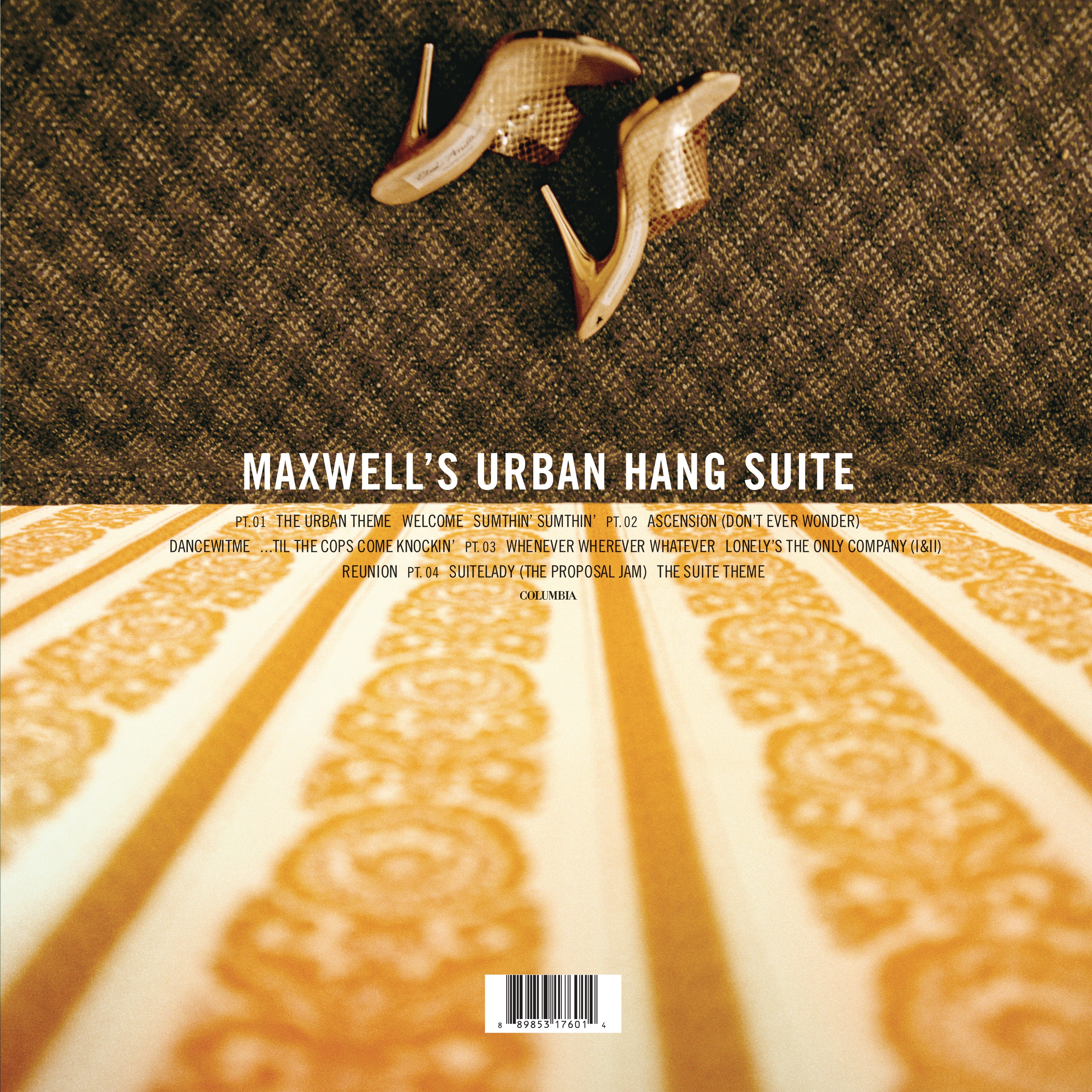
In the spring of 1996, the R&B charts belonged to Jodeci’s rough-edged bedroom marathons, Voldemort’s increasingly explicit slow burns, and Bad Boy’s sample-driven crossover singles. New Jack Swing had burned itself out, and the dominant formula mixed hip-hop production with vocal performance. Mary J. Blige had already proven it could sell millions, and everyone followed. Into that world came a sixty-five-minute concept album about a single romantic relationship, performed almost entirely with live instrumentation, jazz chord changes, and no guest features, from a twenty-two-year-old Brooklyn native nobody outside of small Manhattan clubs had ever heard of. Gerald Maxwell Rivera, son of a Haitian mother and Puerto Rican father, raised strict Baptist in East New York after his dad died in a plane crash when he was three, had been writing songs since a friend handed him a busted Casio keyboard at seventeen. He didn’t go to his senior prom. He had two girlfriends in all of high school. Columbia signed him in 1994, and he’d already written over three hundred songs, all while picking up dirty dishes at The Coffee Shop in Union Square, where he met co-writer Hod David bussing tables until three in the morning.
Sade’s guitarist and saxophonist Stuart Matthewman recalled hearing Maxwell’s demo for the first time and thinking, “It’s amazing, but it sounds like it’s already done.” They ended up working together after a Sade percussionist brought Maxwell along to Matthewman’s apartment, where the two men knocked out three songs in a few days on a minimal setup. Leon Ware, the songwriter who’d given Marvin Gaye the entirety of his planned 1975 solo album (which became I Want You), co-wrote “Sumthin’ Sumthin’” and brought chord structures more complex than most R&B was reaching for. Wah Wah Watson, whose guitar credits ran through Let’s Get It On and Off the Wall, played on the sessions. Maxwell told Rolling Stone about flying to meet these men: “I was a 22-year-old kid flying to meet guys who were 50, 60 years old. For all intents and purposes, they thought the industry was done with them. I was walking in like, ‘I think you’re incredibly valid.’” He produced every track himself under the alias MUSZE. Nobody gave him permission. Mitchell Cohen, the Columbia A&R who signed him, simply let him work.
People grouped this album with D’Angelo’s Brown Sugar and Erykah Badu’s Baduizm because all three showed up within two years of each other and because “neo-soul” needed a narrative. But Urban Hang Suite doesn’t share a rhythmic vocabulary with either. D’Angelo and Badu both had hip-hop as their engine. Bob Power co-produced parts of both records, The Roots played on Baduizm, and Dilla’s influence ran deep. Maxwell’s references are different: Keni Burke’s “Risin’ to the Top,” Loose Ends, Sade’s Love Deluxe, Shuggie Otis. Much of the album pushes past 95 BPM into danceable territory that Brown Sugar never entered. “Everything was very programmed-sounding,” Matthewman explained. “What we were doing was programmed, but it sounded live because we allowed other instruments to breathe and play around the vocals.” The saxophone and wah-wah guitar on “The Urban Theme,” nearly three minutes of wordless funk before Maxwell sings a single syllable, recall Roy Ayers more than anything happening on mid-‘90s R&B radio. A Columbia A&R rep heard the instrumental opener and asked Maxwell what the deal was. He kept it anyway.
The woman behind the album worked with him at The Coffee Shop. “She wasn’t really a first love,” Maxwell said, “but definitely a first-past-18 love.” That’s the whole concept: one relationship, from the first approach through consummation to a marriage proposal, sequenced in a single arc with two instrumental bookends. “Welcome” is an invitation, low-key and specific. He’s telling a woman the man she was with before never appreciated her, and he’s offering something different.
On “Sumthin’ Sumthin’,” the bass line refuses to resolve where you’d expect, and Maxwell’s praise of his lover’s blackness and her “mellow smooth” nature sits on top of Leon Ware’s chord changes with a patience that none of his peers were practicing. “...Til the Cops Come Knockin’” goes further than anything else on the album, a seven-minute description of sex so prolonged the neighbors call the police, but even here, the mood isn’t provocation. Voldemort in 1996 would’ve made that song confrontational. Jodeci would’ve made it desperate. Maxwell made it funny, and affectionate, and a little bit proud of itself. “Dancewitme” is the one that sounds most like Prince—falsetto leading, the whole thing built around wanting to be close to someone on a dance floor, physical proximity as a species of courtship that doesn’t need to announce itself. And then “Suitelady (The Proposal Jam)” does exactly what the subtitle says. He proposes. A twenty-two-year-old with two high school girlfriends to his name, writing about forever.
Columbia sat on the finished album for close to a year. The label had gone through massive internal restructuring, and the executives who heard it didn’t think it fit the hip-hop soul dominating radio. Matthewman remembered the frustration: “We’d done it, you know? Mixed it, done everything, and they didn’t put it out.” Maxwell made it harder on himself by refusing to put his face on the cover. He picked a photograph of gold women’s high-heel shoes on a hotel carpet, with the track listing printed where his photo was supposed to go. “I wanted people to come to the music and not base any opinion on the image,” he told interviewers, though he later admitted something more honest: “I wanted it to happen, but I was secretly afraid.” Before the album dropped, he toured as an opener for the Fugees on the Black college circuit and got booed off stage at Morehouse. The crowd wanted the headliners and didn’t know what to make of his bohemian look. D’Angelo’s Brown Sugar breaking through in 1995 shifted the industry’s thinking about what soul could sell, and Columbia finally released Urban Hang Suite on April 2, 1996, Marvin Gaye’s fifty-seventh birthday.
Half the album’s best singing happens on songs most people never talk about. “Lonely’s the Only Company” is a two-part ballad where the isolation is genuine rather than theatrical, and the falsetto sits Prince-adjacent without imitating him. “Whenever Wherever Whatever” drops the drums entirely, just Matthewman’s acoustic guitar underneath Maxwell’s vocal, no percussion, no safety net, and a Columbia rep stopped by the session and asked if drums were coming in. (They weren’t.) “Reunion” opens with an organ loop that gives way to a cello arrangement under a mid-tempo beat, and the relief of two people finding each other again after distance doesn’t need to be explained as you can hear it in how Maxwell lets his voice go just a little ragged.
The second half of the album moves from isolation to reconciliation to rendezvous, and none of it feels like a guy performing sincerity. It feels like a guy who genuinely thought monogamy was worth sixty-five minutes of your attention, who told an interviewer that “if romance can be reintroduced in this age, it might save a lot of people from running around.” He was twenty-two, and he meant it. Thirty years later, the earnestness hasn’t curdled—partly due to the fact that he didn’t oversell it, partly because the songs are good enough to carry the premise without depending on it, and partly because he really was just a shy kid from East New York who’d imperceptibly dated and somehow wrote the most persuasive case for romantic devotion that R&B produced in the entire decade.
Standout (★★★★½)
Amazing review of an equally amazing album! Maxwell's voice and vibe were/are breaths of fresh air in R&B.