

Milestones: Never Too Much by Luther Vandross
An ex-backup singer’s debut built entirely on romantic devotion, as though no other subject existed, and very much proves the bet right.
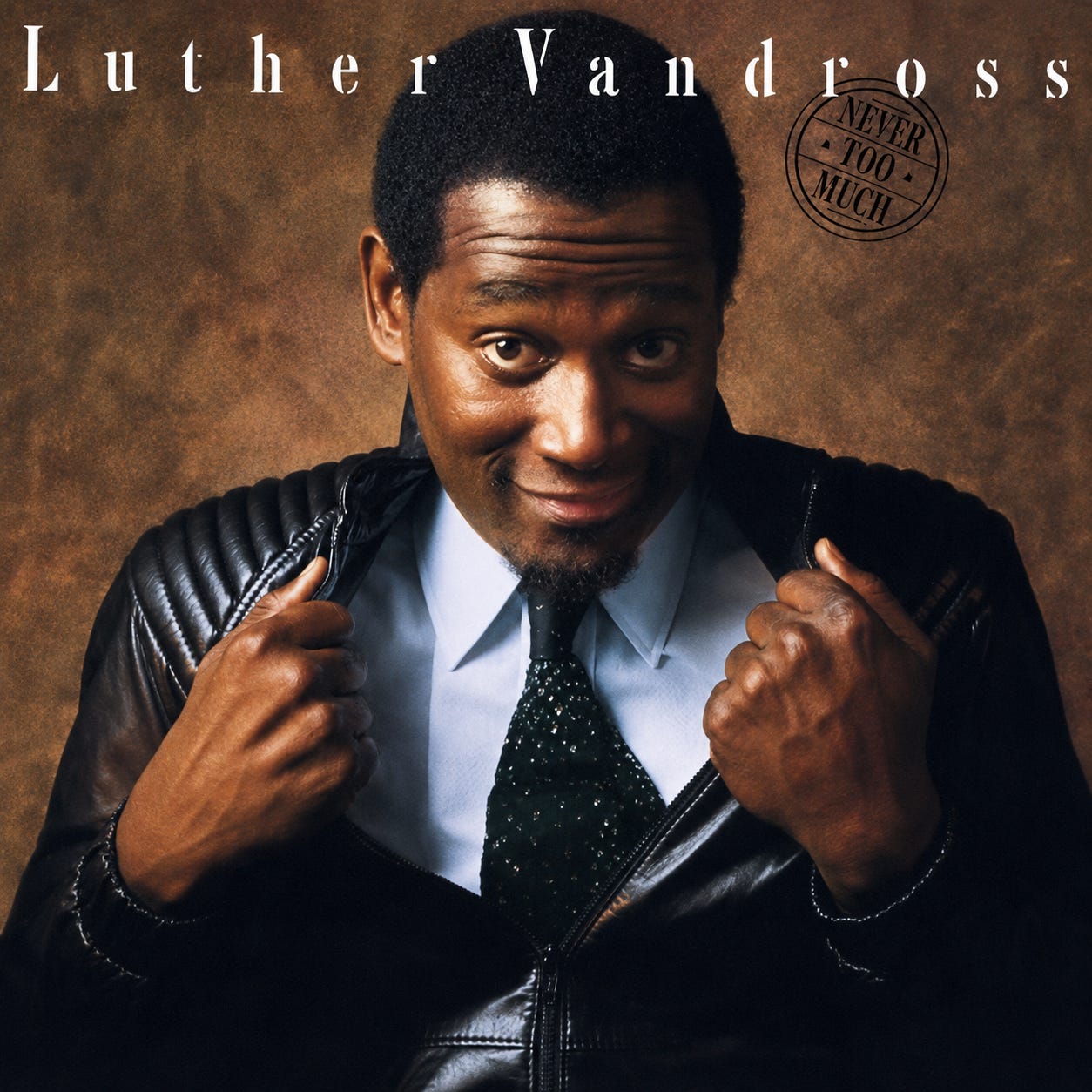
Between 1975 and 1980, for almost five years, you could hear Luther Vandross on various records. He crooned for David Bowie on Young Americans, worked with Roberta Flack and Donna Summer, and served up advertising jingles for Burger King and Juicy Fruit during sitcom reruns. Though a large man himself, born in Manhattan’s Alfred E. Smith Housing Projects on the Lower East Side, the son of an upholsterer and a registered nurse, Vandross’s voice was a hit with the public.
Though his name didn’t inspire any particular associations with the millions of records he sold or the loyal listeners of various radio stations. He appeared on everybody’s records without getting credited on any of them. More than 10 years into his music career, when he was 30 years old, he sang lead vocals on hundreds of very successful songs—none of which he owned a credit on.
In 1976 and 1977, he formed an R&B quintet called Luther and released 2 records on Cotillion Records—taking on the roles of lyricist, producer, arranger, and singer—but neither record achieved great success. 2 years ago, the albums were made available to stream. After the breakup of the group, he worked with the Italian band Change on their album The Glow of Love. “Searching” and “The Glow of Love” dominated the club scene with disc jockeys featuring him as “Change featuring Luther Vandross” due to this invisible presence behind great vocals. Roberta Flack even asked that he be fired during a recording session in an attempt to get him to move out of the “background” role that he played at that time. At the end of 1980, he started making demo tapes again.
CBS Records’ Vice President Larkin Arnold and CEO Jerome Gasper got wind of Vandross’s two-song demo tape and signed him with Epic Records in 1981. Luther Vandross was in his 30s when he started making records in 1981. At that time, 23-year-old Stephanie Mills, the youngest in DeBarge, was 25, and the Shalamar group of young women in their early 20s all started their music careers. Despite being an experienced and skilled musician, Luther Vandross began pursuing a solo career earlier than the youngest of these artists. Luther Vandross needed no educational courses to understand the workings of a recording studio, just adequate finances to work there sporadically with modern recording equipment.
Never Too Much was released in the summer of 1981. Two years before Disco Demolition Night at Chicago’s Comiskey Park, there was a segment of the audience that consisted of displaced and diverse groups of R&B fans able to enjoy many of its styles. Very similar to their Black-music peers at that time. Although rock and R&B were establishing themselves through the popular music charts and on the radio, hip-hop had not yet made its way into mainstream culture, and the disco and “post-disco” sounds that defined 1981 filled the airwaves. Cameo, the Gap Band, Mtume, and the Whispers enjoyed moderate success at this time. However, the flair and artistic skill displayed by popular vocalists from the 1970s, such as Stevie Wonder and Marvin Gaye, were no longer provided to the public with great fanfare. Then a 30-year-old singer, who had written and produced entire albums, filled a vacant space in the market.
At 22 years old, Marcus Miller was already gigging around New York City when Vandross included him in sessions at Media Sound Studios. Miller’s bass playing takes center stage on the title track; he’s beyond a rhythm section player providing forward motion to the rhythm section. On “Never Too Much,” his bass line is incredibly strong, standing out as the dominant element throughout the song - challenging the vocal and creating tension as the rest of the band supports the melodic motive. Nat Adderley Jr. plays keyboards, while Doc Powell and Cisco Houston Jr. share duties on guitar, Yogi Horton on drums, and Fonzi Thornton (from Chic) contributes vocals. Vandross and Miller hold fort at the center of this group, with Vandross confident in his arrangement skills and Miller old enough to not understand what he can get away with. This dynamic is particularly clear throughout the title track, building layers of texture without ever losing momentum.
All the original compositions written by Vandross focused on the theme of love, and in “Sugar and Spice” he references the old children’s rhyme with no irony whatsoever. The woman here is kind, warm, and good-natured; the singer is deeply grateful. In “Don’t You Know That?,” his infatuated with a woman who gives no sign of returning his affections—its tone is dominated by feeling frustrated, with a sense of being wronged hanging in the air. “She’s a Super Lady” is a straightforward love song, with no reservations expressed. Each of these songs has a different take on the same theme, which Vandross explores effortlessly: romance is not simply an emotion for him, but an attitude, a set of assumptions.
Luther is better at expressing certain emotional reactions than others—in “I’ve Been Working,” he wants credit for his efforts, and there’s nothing wrong with that. Except that it comes at the very end of a six and a half minute workout, when a man has already had more than enough. Vandross had spent ten years backing up other singers, and he probably never had that much attention fixed on his voice since. “You Stopped Loving Me” is the only torch song, and the very idea of it being one is anathema to him—he can scarcely believe it, in fact. After so much insistence that everything went wrong, it is challenging to accept that everything stopped so suddenly. Perhaps this is the real reason for the song’s strength: an almost shocked dismay at the turn of events, as if Vandross was surprised that he was surprised.
The seventh track is a Burt Bacharach and Hal David composition originally recorded by Dionne Warwick in 1964, as a three-minute single. “A House Is Not a Home” is first off in Vandross’s set, and the two artists could not be more different—Warwick’s version is practically stern, and Vandross’s own is close to delirious in its passion. He grew up on the Lower East Side, where Dionne Warwick’s music may have been one of the few sources of consolation, and his “A House Is Not a Home” is seven minutes long. What does that extra time add? It adds a sense of abandon, of freedom, of running wild vocal fireworks. All of this is great (and it may be one of the best three minutes of R&B vocalizing ever recorded), but it is the underlying sense of self-discovery that is most surprising. In a way, that is the most remarkable quality of this track list: it feels as if Vandross wasted years trying to sound as good as other singers have sounded—now that his own moment has arrived, he wastes no time showing how different he really is. This is no mere technical tour-de-force, however; the very heart of this performance beats in its own, unique rhythm. He simply sounds surprised to be able to sound so good (similar to another young man named Sinatra, perhaps?).
Vandross wrote and produced almost everything on Never Too Much and arranged and played all of these songs himself; the basic tracks were laid down at Media Sound with Michael H. Brauer, and all of it was mixed by him, too. He had been working for a decade and knew the way the studios worked, but there was still something deeply gratifying about having no one else but himself to answer to when it came to making this record. It peaked at the top of the R&B charts, number 19 on the Billboard 200, and was certified platinum twice over, plus earned him a Grammy nomination for Best New Performance and Best R&B Vocal Performance. He was thirty-one, and the world could finally recognize his voice for what it truly was.
Masterpiece (★★★★★)